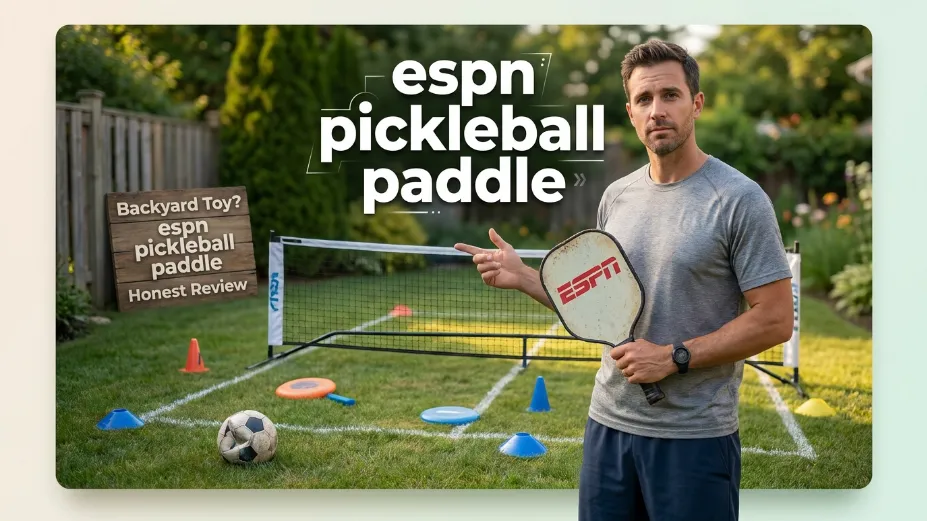
The global sports media giant doesn’t just broadcast the fastest-growing sport in America anymore—they want to hand you the gear to play it. Walking down the sporting goods aisle, it’s almost impossible to miss the sleek, budget-friendly espn pickleball paddle sets staring back at you. But in a market dominated by specialized paddle engineering, a massive logo doesn’t automatically guarantee a crisp third-shot drop. Before you tap your credit card at Walmart or order online, let’s look past the ESPN branding to see if this paddle actually delivers tournament-level control, or if it belongs strictly in the backyard with the barbecue.
ESPN pickleball paddle specs versus alternative gear 2026: model name, core material, surface material, weight range, skill level, and best used for — verified specifications
ESPN Pickleball Paddle vs Alternative Gear
Verified Specifications · 2026
For active recreational players prioritizing joint comfort and rapid skill progression, we recommend skipping rigid wooden or plastic equipment and investing in a specialized honeycomb option such as the Toby Pro Carbon Fiber or the budget-friendly Toby Lite Composite. These modern alternatives offer the lightweight maneuverability, shock absorption, and surface friction required for active court environments. While the highly durable espn paddle pickleball excels as a tough, low-cost tool for casual backyard barbecues, its excessive weight poses a structural handicap for players trying to transition into competitive local club play.
espn pickleball paddle review: Core Materials, Real Performance, and Market Realities
To understand the on-court behavior of the espn pickleball paddle, players must look beyond the prominent logo and analyze the structural reality of licensed sporting goods. ESPN is a sports broadcasting behemoth, not a specialized equipment manufacturer. The brand enters the court by licensing its trademarked assets to third-party logistics firms and distribution channels, such as Distribution Solutions LLC. These entities handle the mass importing and retail placement of affordable paddles in national chains like Walmart, Best Buy, Target, and Five Below.
In the United States marketplace, this licensing framework results in two primary product tiers designed for cost-conscious consumers. The first is the individual ESPN Wooden Performance Pickleball Paddle, featuring a core and facing composed entirely of Poplar wood. The second is the budget-friendly ESPN Core Set Paddle, which is constructed out of solid, molded plastic and sold as a multi-player recreational kit. While both options offer highly appealing price points for those entering the sport, they rely on rigid, outdated material profiles that are fundamentally distinct from the advanced composite engineering utilized by specialized pickleball brands.
If you are exploring the wider market for cost-effective gear, we recommend reading our dedicated guide to the best beginner pickleball paddles. This analysis highlights how modern starter kits have evolved to incorporate lightweight polymers, offering novice players a substantial performance cushion that simple wooden structures cannot replicate.
Head-to-Head: ESPN Wooden Paddle vs. ESPN Core Plastic Set vs. Toby Pro Carbon Fiber
Evaluating these products requires a direct comparison of their structural properties and target play environments. The Poplar wood core of the ESPN Wooden Performance paddle provides absolute physical durability; it will not crack, delaminate, or experience core crushing even after repeated ground impacts. However, this rigidity comes with a severe weight penalty. The wood build weighs a hefty 11.1 oz, making it an extremely heavy implement that limits hand speed during fast reaction sequences.
In contrast, the ESPN Core Set utilizes a molded plastic construction that reduces the total implement weight to approximately 9.0 oz. While this plastic design improves hand speed compared to wood, its ultra-thin profile (often just 0.5 mm thick) lacks structural depth. This results in an incredibly stiff response, an erratic sweet spot, and a distinct lack of ball control. When compared to a specialized composite option like the Toby Pro, the performance gaps of both ESPN models become immediately apparent. The Toby Pro leverages a 16 mm polypropylene honeycomb core coupled with a high-friction carbon face, delivering a balanced 8.1 oz profile that actively absorbs ball energy while offering consistent touch across the entire face.
If you want to understand how different wooden formulations perform across budget segments, feel free to dive into our detailed breakdown of the classic wooden pickleball paddle. This deep dive reveals how traditional hardwood designs compare to modern composite setups in weight, vibration transfer, and overall longevity.
The Biomechanics of Play: Weight, Wrist Speed, and Injury Risks
Many prominent retail listings mistakenly market the 11.1 oz ESPN wooden paddle as having a “lightweight feel” that ensures “optimal handling and maneuverability.” Biomechanically, this description is highly inaccurate. In the modern game, any paddle weighing over 8.5 oz is classified as extra-heavy. When you play with an 11.1 oz Poplar block, you must contend with a massive increase in the implement’s moment of inertia, which mathematically represents its resistance to rotational acceleration:
I = Σ (mi · ri²)
Because the heavy Poplar wood mass is distributed uniformly across a 16-inch frame, the moment of inertia (I) is exceptionally high compared to a perimeter-weighted polymer model. This structural reality directly translates into slow reaction times during fast volley exchanges at the kitchen line. For athletic players transitioning from tennis or squash, this high moment of inertia acts as a persistent speed brake, compromising defensive hand speed when trying to counter fast drives.
Furthermore, the physical rigidity of poplar wood and molded plastic creates a severe orthopedic hazard. When a polymer paddle makes contact with a ball, the flexible honeycomb cells collapse slightly, dispersing the kinetic energy throughout the core. Wooden and plastic structures cannot do this. Because these materials lack elastic deformation, the high-frequency vibration waves from ball impact propagate directly through the shaft, wrist, and forearm muscles. This intense, repetitive mechanical shock places a dangerous strain on the lateral epicondyle, dramatically increasing the risk of painful pickleball injuries such as lateral epicondylitis, commonly known as tennis elbow.
The Physics of Surface Friction: Why You Can’t Generate Topspin
Generating a dipping topspin drive or a biting cut shot in pickleball is a function of friction. The mechanical interaction between the ball and the paddle surface is governed by the basic friction force equation:
Here, Ff represents the frictional force, μ is the coefficient of friction determined by the surface texture (grit), and N is the normal force generated by the ball’s impact. The ESPN wooden and plastic models feature slick, painted surfaces with near-zero coefficients of friction (μ ≈ 0). When the ball strikes these smooth faces, it immediately slides off rather than adhering to the surface. This absolute lack of “dwell time” prevents the player from imparting any meaningful rotational velocity (spin) to the ball, limiting performance to flat, predictable trajectories.
Modern intermediate and advanced paddles utilize raw T700 carbon fiber or textured fiberglass faces specifically engineered to maximize the coefficient of friction. This grit allows players to easily spin the ball at rates exceeding 1,800 RPM. Without this spin, executing consistent dropping shots over the net becomes incredibly difficult, as flat ball paths are highly vulnerable to aggressive counter-attacks from opponents standing at the kitchen line. If you are determined to transition from simple flat hitting to a strategic, spin-focused game, we recommend studying the pickleball kitchen rules. Understanding these court dimensions and positioning constraints highlights why soft touch and heavy topspin are essential to surviving fast-paced hand battles near the net.
To see how advanced composite surfaces compare directly to flat wood, you can explore our comprehensive analysis of the carbon fiber pickleball paddle. This resource explains how modern thermoformed carbon fiber weaves utilize microscopic texture to grip the ball, allowing for precise control and explosive rotational power.
USA Pickleball Approval: Separating Marketing Stamps from Real Standards
A major point of confusion for buyers is the “USA Pickleball Approved” stamp. The individual ESPN Wooden Performance Pickleball Paddle is officially approved by the governing body, allowing players to legally use it in sanctioned tournaments. However, the budget-friendly ESPN Core Set and Neon Set plastic models do not hold official certification. Because of this, players who attempt to use these plastic models in sanctioned events will face immediate disqualification by tournament officials.
Furthermore, independent players frequently raise concerns about misleading retail descriptions. Some cheap import brands place fake approval stamps directly on their packaging or frames, exploiting the lack of on-site verification in casual recreational play. To protect your investment and ensure compliance, players should never rely solely on a printed stamp. Instead, we highly recommend verifying the exact model name by consulting the official database of tournament-legal gear. For a detailed guide on how these compliance rules work across different brands, review our curated USA Pickleball approved paddle list to protect your tournament eligibility.
Incentivized Reviews: The Truth Behind ESPN’s 4.6-Star Retail Rating
At first glance, the ESPN wooden paddle appears to be an undisputed fan favorite, boasting an impressive 4.6 out of 5-star rating across major retail sites. However, an in-depth analysis of these ratings reveals a significant market distortion. The vast majority of these glowing reviews are “Incentivized Reviews” generated through organized marketing campaigns like The Insiders. Reviewers openly disclose that they received the product for free or at a steep discount in exchange for sharing their honest opinions.
These promotional reviews typically focus on cosmetic appeal, brand recognition, and the comfortable feel of the cushioned handle, without evaluating true on-court performance. When you look at organic, independent communities like Reddit and Quora, the sentiment is completely different. Experienced players consistently describe smooth-faced wooden and plastic paddles as “pieces of junk” that actively handicap a beginner’s physical development. These organic reviews emphasize that while cheap gear may save you money upfront, it quickly limits your growth, forcing you to buy a proper composite upgrade within a few weeks of consistent play.
Frequently Asked Questions (FAQ)
Why is the 11.1 oz ESPN wooden paddle marketed as “lightweight,” and how does this extreme weight impact injury risk and wrist speed?
The term “lightweight” is used purely as a marketing claim by retail brands comparing wood to heavy, historical racket sports. Biomechanically, 11.1 oz is exceptionally heavy for pickleball, where modern composite frames average 7.3 to 8.4 oz. This excess weight increases the paddle’s moment of inertia, slowing your hand reactions during fast net exchanges and transferring high-frequency impact vibrations directly to your arm, which significantly increases the risk of developing tennis elbow.
What are the engineering differences between ESPN’s poplar wood core and modern composite polymer honeycomb cores?
Poplar wood is a solid, continuous natural fibrous material that does not deform elastically upon impact. Modern composite paddles utilize a polypropylene honeycomb core composed of hollow, hexagonal chambers. These polymer chambers compress slightly when the ball strikes the face, dampening harsh vibrations, extending the ball’s dwell time for superior control, and distributing energy evenly across a much larger sweet spot.
Is the ESPN core pickleball set officially USA Pickleball Approved for tournament use, and how can buyers verify true certification?
No. While the individual ESPN Wooden Performance paddle is officially certified, the multi-player ESPN Core Set (constructed of thin plastic) is not approved for tournament use. To protect yourself from non-compliant gear, always cross-reference the exact brand and model name with the official USA Pickleball Official Equipment Database before purchasing.
Why is a smooth paddle face like the ESPN wood paddle banned from high-level play, and why is surface “grit” essential?
USA Pickleball regulations require tournament paddles to have a minimum surface roughness (grit) to prevent completely flat, uncontrolled ball paths. Slick wooden and plastic faces lack friction, causing the ball to slide off immediately without spinning. Grit is essential because it generates the friction force required to apply topspin and backspin, which allows advanced players to drive the ball aggressively while keeping it within the court boundaries.
Does ESPN manufacture these paddles, and who is “Distribution Solutions LLC” in the production chain?
No, ESPN does not manufacture or design any sporting goods. These paddles are produced under a brand licensing agreement where a third party pays to use the ESPN logo. Distribution Solutions LLC is the specialized logistics and importing firm that sources these low-cost items from international manufacturers and manages their distribution to major retail outlets.
How do incentivized retail campaigns distort the online rating of the ESPN paddle compared to organic community feedback?
Incentivized campaigns provide consumers with discounted or free products in exchange for reviews. This often leads to highly positive, surface-level ratings (averaging 4.6 stars) from casual buyers who focus on price and appearance. In contrast, organic feedback from avid players on platforms like Reddit and Quora evaluates the gear based on tournament playability, calling attention to the severe performance limitations and high physical fatigue caused by heavy wooden cores.
How does the ESPN Wooden Paddle compare to the Toby Pro Carbon Fiber and Toby Lite Composite paddles?
The comparison highlights a massive generational gap in paddle technology. The ESPN wooden paddle is heavy (11.1 oz), rigid, and smooth, offering poor control and high vibration. The Toby Pro Carbon Fiber and Toby Lite Composite paddles weigh an optimal 8.1 oz, featuring shock-absorbing polymer honeycomb cores and gritty composite faces. These advanced materials provide superior vibration dampening, an expansive sweet spot, and excellent topspin potential.
At what point in a player’s development must they upgrade from an ESPN wooden paddle to avoid limiting their progression?
Players should upgrade within their first 2 to 4 weeks of consistent play, or as soon as they master basic dinking and ball positioning. Attempting to develop a competitive soft game, consistent third-shot drops, or spin-heavy drives with a heavy, smooth wooden paddle is extremely difficult and can lead to bad mechanical habits and chronic wrist or elbow fatigue.
Final Verdict: Should You Buy an ESPN Pickleball Paddle?
Ultimately, your decision to purchase an espn paddle pickleball should depend entirely on your budget and long-term athletic goals. If you are looking for a highly durable, low-cost option for casual family gatherings, backyard barbecues, or occasional beach games, the ESPN wooden paddle is a tough, long-lasting implement that will easily withstand rough handling and direct ground impacts. It serves as an affordable, accessible entry point for those wanting to try the sport recreationally without making a significant financial commitment.
However, if you plan to play regularly at a local club, join organized open play sessions, or develop a competitive skill set, we strongly advise skipping wooden and plastic equipment entirely. Spending an extra $20 to $40 on a specialized, lightweight polymer option like the Toby Lite Composite or Toby Pro Carbon Fiber is a crucial investment. Choosing a modern, honeycomb paddle will protect your elbow from chronic strain, dramatically accelerate your skill development, and ensure you have the control and spin necessary to truly enjoy the strategic depth of the modern game.