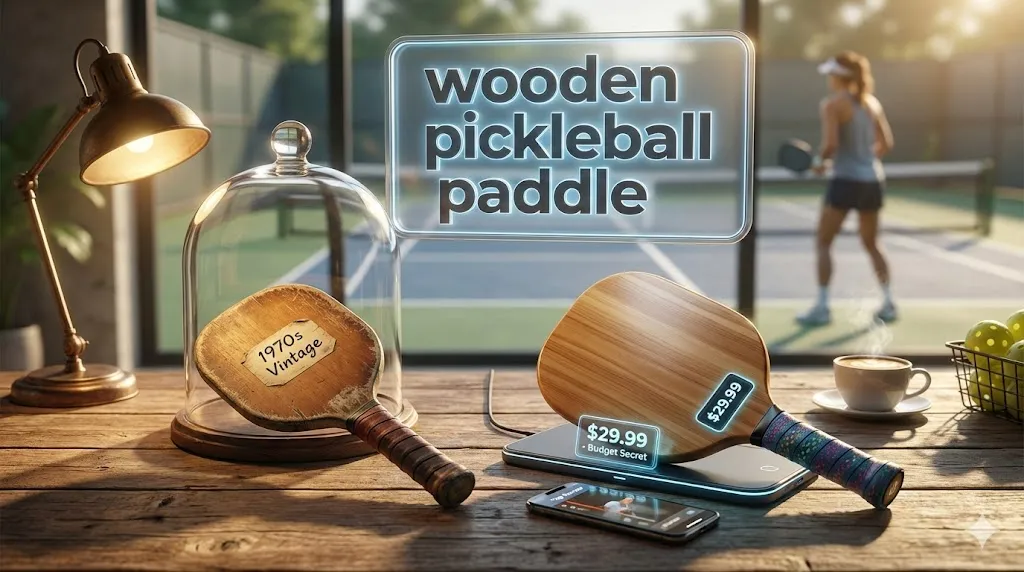
Pickleball has exploded into a high-tech sport dominated by aerospace-grade carbon fiber, polymer honeycombs, and spin-generating grit surfaces. But before the “pop” of modern composite gear filled the air, the game was built on a simpler foundation: the wooden pickleball paddle.
For many players, a wood paddle is a nostalgic relic. For others, it is the entry point into the fastest-growing sport in America. If you are standing in a sporting goods aisle holding a heavy, affordable piece of plywood, you might be asking yourself: Is this actually good enough to play with?
In this comprehensive guide, we will explore the pros, cons, and surprising utility of the wooden pickleball paddle in 2026. Whether you are a total beginner on a budget, a school administrator buying in bulk, or a DIY enthusiast looking to craft your own gear, this article covers everything you need to know about wood pickleball paddles.
The Basics: Are Wooden Paddles Good for Beginners?
The short answer is: Yes, but with caveats. Wooden pickleball paddles are the original equipment of the sport. When Joel Pritchard and his friends invented the game in 1965 (you can read more about who invented pickleball here), they improvised with plywood. Today, wood remains the most accessible option for new players, primarily due to one factor: Price.
The Price vs. Performance Trade-off
You can often buy a set of two or four wood pickleball paddles for the price of a single entry-level composite paddle. This makes them unbeatable for families who want to test the waters without investing hundreds of dollars. However, you “pay” for this savings in performance metrics, specifically weight and sweet spot size.
The Weight Issue: A Heavy Reality
The defining characteristic of a wood pickleball paddle is its weight. While modern composite paddles typically weigh between 7.0 and 8.2 ounces, wooden paddles usually range from 9.0 to 11.0 ounces (or even heavier).
- Pros of Heavy Weight: Mass equals power. If you can swing it fast, a heavy paddle drives the ball hard.
- Cons of Heavy Weight: Wrist fatigue and “tennis elbow” are real risks for beginners. Heavy paddles also slow down your hand speed at the net, making it harder to react to fast volleys.
If you have any history of wrist or elbow issues, we strongly recommend looking into light pickleball paddles instead. The extra $20-$30 for a graphite or composite paddle is cheaper than a visit to the physical therapist.
Performance Breakdown: How Wood Affects Your Game
Understanding how wooden pickleball paddles interact with pickleball balls is crucial for managing your expectations on the court.
1. Power vs. Control
Because wood is dense, it provides a solid wall for the ball to bounce off. This results in significant power on baseline drives. However, this density comes at the cost of “touch.” Modern paddles have honeycomb cores designed to absorb energy for soft dinks; wood simply reflects it. Controlling the pace of the ball with a wooden pickleball paddle requires softer hands and more practice.
2. Spin Capability
If you watch pro players, you will see the ball curving wildly due to heavy topspin or backspin. This is achieved through textured surfaces (grit). Most wood pickleball paddles are made from finished plywood, which is relatively smooth. While you can slice the ball slightly, generating competitive levels of spin is nearly impossible with standard wood gear.
3. The “Sweet Spot”
Wood paddles generally have a smaller sweet spot than their composite counterparts. Hits that are off-center tend to die or vibrate uncomfortably. If you are serious about improving your consistency, you might eventually want to check out our guide on how to pick a pickleball paddle that offers more forgiveness.
Top Wooden Pickleball Paddles for Beginners
If you have decided that a wood pickleball paddle fits your needs—perhaps for a backyard barbecue, a community center, or just casual fun—there are several reputable brands that manufacture high-quality 7-ply maple paddles. These aren’t just scraps of lumber; they are finished sports equipment.
Here are the top contenders in the market:
1. Amazin’ Aces (Best Bundle)
Amazin’ Aces is famous for their “bundle” approach. They often sell 4-paddle sets that come with balls and a carry bag.
- Material: 7-Ply Maple Wood.
- Weight: Approx. 9.5 – 10.5 oz.
- Verdict: Excellent value for families. The grips are surprisingly comfortable, often featuring a cushioned wrap similar to more expensive paddles.
2. Franklin Sports (Best Availability)
You will see the Franklin pickleball set in almost every big-box retailer. Franklin is a massive name in the sport, sponsoring top pros.
- Material: 7-Ply Wood.
- Weight: 9.5 – 10.0 oz.
- Verdict: A reliable standard. If you want a quick start, grabbing a Franklin pickleball set is a safe bet for durability and standard sizing.
3. Diller (by Pickleball Central) / Rally (Best Institutional Choice)
The “Diller” paddle is arguably the most famous wooden pickleball paddle in history. It is the green paddle you likely used in gym class.
- Material: 7-Ply Alternating Grain Hardwood.
- Weight: 10.0 – 11.0 oz.
- Verdict: Built like a tank. These are practically indestructible, making them the #1 choice for schools, YMCAs, and camps.
4. Niupipo (Best Value)
Niupipo has made a name for itself by producing budget-friendly gear that punches above its weight class.
- Material: Basswood or Poplar (often lighter than Maple).
- Weight: Approx. 9.0 – 9.8 oz.
- Verdict: Often slightly lighter than the Diller or Franklin options, making them a bit friendlier for children or smaller players.
The “Hidden” Benefit: Noise Reduction
Here is a niche benefit that few people discuss: pickleball paddles wood construction are often quieter than modern paddles.
Composite paddles, especially those with polymer cores and fiberglass faces, create a high-pitched “pop” or “crack” sound that can echo through neighborhoods (leading to noise complaints). Wood is denser and softer than carbon fiber, resulting in a duller, lower-pitched “thud.” If you are playing on a private court in a noise-sensitive HOA, a wooden paddle might actually be the diplomatic choice to keep the neighbors happy.
Niche & Technical Queries: DIY and Modifications
We often see questions from woodworkers and tinkerers asking if they can modify or build their own paddles. Here is the reality regarding pickleball rules and customization.
Can I make my own DIY wooden paddle?
Yes, for casual play. However, if you intend to play in a sanctioned tournament, the paddle must be on the USA Pickleball approved list. Most homemade paddles will not meet the strict surface roughness and deflection specifications.
Is it safe to drill holes in a wooden paddle to reduce weight?
Do not do this. We see forums suggesting drilling holes to improve aerodynamics or reduce the heavy 10oz weight. This is a bad idea for two reasons:
- Structural Integrity: Plywood is strong because of its continuous layers. Drilling holes creates weak points where cracks will form after repeated impacts with the ball.
- Illegality: Holes on the paddle face (other than the single gap near the handle) are illegal in official rules. It alters the aerodynamics and ball flight unpredictably.
Can I paint my wooden paddle?
You can paint it for fun, but be careful. Thick paints can make the surface slick (causing the ball to skid) or too rough. Official rules prohibit “anti-skid” textures or reflective surfaces that could blind an opponent.
Durability & Maintenance
One of the biggest selling points of wooden pickleball paddles is durability. They don’t have honeycomb cores that can crush or “dead spots” that develop over time. However, wood is an organic material.
- Moisture is the Enemy: Unlike plastic, wood absorbs water. Do not leave your wooden paddle out in the rain or in a damp car trunk. Over time, moisture can cause the plywood layers to delaminate or warp.
- Edge Wear: Most wood paddles do not come with a plastic edge guard. If you scrape the paddle on the court (which happens often when digging for low balls), the bottom edge will splinter. You can add edge tape to prolong its life.
Conclusion: The Final Verdict
So, is the wooden pickleball paddle an obsolete relic? Not at all. It serves a vital purpose in the pickleball ecosystem. It lowers the barrier to entry, allowing schools, camps, and families to enjoy the sport for a fraction of the cost.
If you are just looking to have fun in the driveway or hit the court once a month, a wood paddle is perfectly adequate. However, if you catch the “pickleball bug” and start playing weekly, you will likely want to upgrade quickly to prevent injury and improve your game.
When you are ready to graduate from wood, check out our list of top pickleball paddles to find a lighter, high-performance option that suits your style.
Frequently Asked Questions (FAQ)
1. Are wooden pickleball paddles USAPA approved?
Many commercially available wooden pickleball paddles (like the Diller or Franklin models) are approved for tournament play, but not all. Always check for the “USA Pickleball Approved” stamp on the face of the paddle if you intend to play in official events.
2. Why are wooden pickleball paddles so heavy?
They are made of solid plywood (usually 7 layers of maple or basswood). Unlike modern paddles which use a mostly air-filled honeycomb core, wood is solid material throughout, resulting in a weight of 9 to 11 ounces compared to the 7-8 ounces of composite paddles.
3. Can you get spin with a wood paddle?
It is very difficult. Wood pickleball paddles typically have a smooth, lacquered finish. Without the grit or texture found on carbon fiber or fiberglass surfaces, the ball tends to slide off the face rather than gripping it to create spin.
4. Do wooden paddles break easily?
Actually, they are incredibly durable regarding impact. They rarely snap. However, they are susceptible to environmental damage like warping from moisture or splintering at the edges if scraped against the court surface.