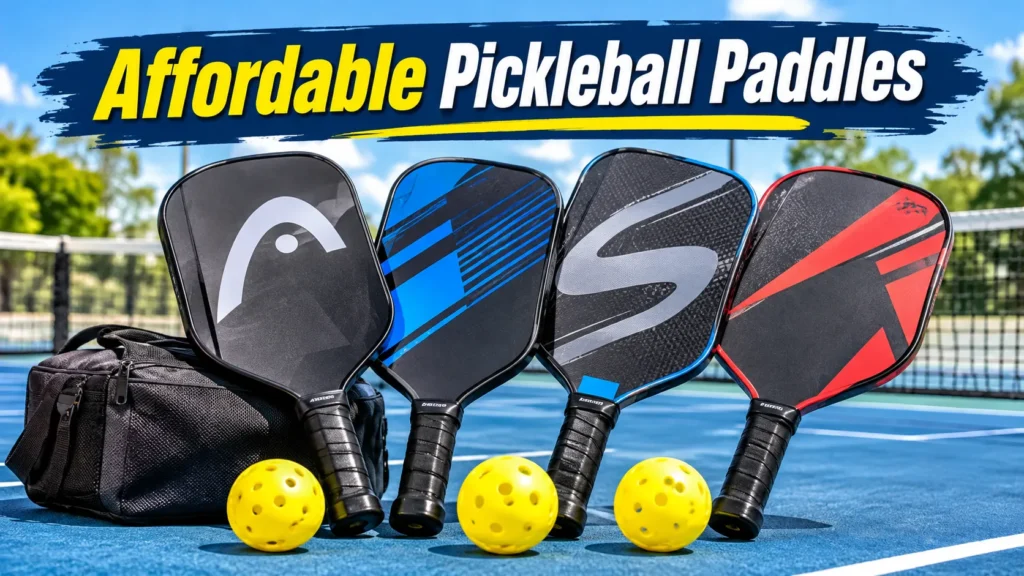
The $250 carbon fiber paddle market is a brilliant piece of sporting goods marketing, but paying that premium is no longer a mandatory toll for playing high-level pickleball. Over the last two years, raw thermoformed technology has completely democratized, allowing independent brands to engineer tour-quality gear at entry-level prices. If you know exactly which specs to analyze—specifically T700 carbon friction surfaces and unibody polymer cores—finding affordable pickleball paddles that genuinely rival the industry giants is a straightforward calculation.
Whether you are hunting for the best affordable pickleball paddle to dominate your local courts, or filtering through affordable pickleball paddles best rated by 5.0+ DUPR players, the data proves you don’t need to overspend. We have rigorously tested the sweet spots, swing weights, and grit longevity to rank the absolute best affordable pickleball paddles under 150 available right now.
Best Affordable Pickleball Paddles
Specs, Prices & Warranties · Updated 2026
For most U.S. players, the Vatic Pro PRISM Flash is the smartest buy right now: $99.99, a control-first raw T700 carbon face, and a 180-day warranty. If you play a fast, aggressive game, the Ronbus Quanta R1.16 delivers Gen 4 foam pop at a sale price under $80. If you want the longest safety net, the SLK Halo Control carries a full 1-year warranty, and if you are just starting out, the Friday Original is the cheapest legitimate way onto the court.
The explosion of direct-to-consumer brands has quietly rewritten the price map of American pickleball. The $100 to $150 bracket is now the true market price for raw carbon performance, before big-brand marketing and athlete endorsements inflate the tag. That shift creates opportunity, but also confusion: two paddles with nearly identical spec sheets can play completely differently, last half as long, or be barred from sanctioned events. Understanding the engineering beneath the graphics is what separates a smart purchase from an expensive mistake.
Best Affordable Pickleball Paddles: How to Choose Without Sacrificing Quality
Finding the best affordable pickleball paddles is less about hunting for the lowest price and more about knowing which specs actually move the needle on court. A value paddle earns its place when it delivers durable grit, a stable core, and a shape that fits your game. Here are the five factors that matter most:
- Surface Material: Raw Toray T700 carbon fiber is the industry benchmark for spin because its textured weave grips the ball without relying on a sprayed-on coating that wears off. Woven variants like Selkirk’s 18k UltraWeave trade a little bite for a tighter, more controlled response.
- Core Architecture: Traditional polypropylene honeycomb cores are light and lively. Gen 4 foam cores (EPP foam surrounded by an EVA perimeter) deliver more pop and resist structural breakdown far better under heavy hitting.
- Core Thickness: A 16mm core absorbs more pace and rewards touch. A 14mm or 13mm core feels crisper and generates more ball speed, but it is less forgiving on resets.
- Shape and Handle: Elongated shapes (around 16.5″ x 7.5″) add reach and leverage. Widebody shapes maximize the sweet spot. Handles of 5.5″ or longer suit two-handed backhands.
- Approval and Warranty: A paddle that is not on the USA Pickleball list cannot be used in sanctioned events, and a short warranty is a red flag at any price.
If you want a structured, step-by-step framework for matching these specs to your skill level, our complete guide on how to pick a pickleball paddle walks through every decision before you spend a dollar.
What Separates a $75 Paddle From a $150 Paddle
Below roughly $75, most paddles are cold-molded with fiberglass or basic graphite faces. That construction produces a narrow sweet spot, weak energy return, and limited spin because the surface simply lacks friction. In the $100 to $150 range, you move into raw T700 carbon, unibody construction, and foam-injected or fully foam cores. The result is a wider sweet spot, grit that lasts for months instead of weeks, and a frame that holds its shape under hard drives.
The real gap is not peak performance on day one; it is consistency on day ninety. A cheap paddle can feel surprisingly good out of the box, then lose its texture and develop dead spots long before a well-built value paddle shows any decline.
Thermoformed or Not? The Beginner Trap
Many buyers assume thermoforming is always an upgrade. It is not. Heat-molding the face and edges makes a paddle stiffer and adds pop, which is great for drives but makes soft drops and resets near the kitchen harder to control. Developing players often improve faster with a non-thermoformed or soft build that dampens incoming pace and builds touch.
Vatic Pro designed its PRISM series specifically for players who find thermoformed paddles too powerful but older sandwich-style paddles too soft. To see exactly how the heating process changes feel and power, read our breakdown of thermoformed pickleball paddles.
Core Crushing and Delamination: The Durability Question Big Reviews Skip
This is the topic most mainstream reviews avoid. Core crushing happens when the polypropylene honeycomb cells inside a paddle collapse under repeated hard impacts. The carbon face can then separate from the core, a failure known as delamination. The paddle starts behaving like a trampoline, producing abnormal ball speed that can push it outside USA Pickleball standards.
- Warning Signs: A sudden jump in pop, a hollow or rattling sound, or areas of the face that feel dead compared with the center.
- Not Just a Cheap-Paddle Problem: Several generations of expensive honeycomb paddles have faced the same challenge.
- The Gen 4 Answer: Full foam cores, such as the Ronbus Quanta’s EPP core with an EVA and TPE elastomer ring, eliminate honeycomb cells entirely, so there is nothing to crush.
For a deeper look at how foam construction changed the durability equation, explore our analysis of Gen 4 pickleball paddles.
Swing Weight and Twist Weight in Plain English
Static weight tells you very little. Swing weight measures how heavy a paddle feels in motion. Values under about 110 produce fast hands for kitchen battles but less plow-through against hard drives; many advanced players prefer the 110 to 117 range. Twist weight measures resistance to twisting on off-center hits. Numbers above roughly 7.0 signal a stable, forgiving face, while elongated shapes naturally score lower because their mass sits along a narrower frame.
5 Beginner Mistakes to Avoid
- Buying on Graphics Alone: Paint and branding tell you nothing about the core or face. Read the spec sheet first.
- Choosing the Stiffest, Most Powerful Paddle: Power without control loses more points than it wins at the 3.0 to 3.5 level.
- Skipping the Approval Check: A printed seal is not enough, because paddles can be delisted after production. Always confirm the exact model on the official USA Pickleball approved paddle list.
- Ignoring Warranty Fine Print: Coverage periods range from 180 days to a full year, and some cover U.S. purchases only.
- Trusting Gray-Market Paddles for Tournaments: Unbranded marketplace paddles can play well for rec sessions but often lack approval and show inconsistent build quality.
Curious whether the $40 to $60 marketplace options are worth the risk? Our honest review of the Juciao pickleball paddle covers the quality control and approval issues players report most often.
Affordable Pickleball Paddles Under 150: Is the Extra Spend Worth It?
For anyone who plays more than twice a week, affordable pickleball paddles under 150 are usually the better long-term value than sub-$75 options. Think in cost per session rather than sticker price. A $100 paddle that holds its grit and structure for a year of thrice-weekly play costs well under a dollar per session. A $50 paddle that goes flat in four months, then needs replacing, costs more over the same period and delivers worse performance along the way.
- Grit Longevity: Raw carbon textures outlast sprayed grit by a wide margin, preserving spin for months.
- Structural Security: Gen 4 foam and foam-injected walls dramatically reduce the risk of crushing.
- Warranty Protection: Paying a little more often buys a longer and more clearly defined warranty window.
- Room to Grow: A paddle in this bracket can carry a player from 3.0 to 4.0+ without an expensive mid-journey upgrade.
Timing matters too. Many of these brands list a regular price but run frequent sales, two-paddle bundles, and holiday promotions, so the same paddle can swing by $40 or more within a few weeks. For a wider field of models in this exact bracket, see our dedicated roundup of pickleball paddles under $150.
Affordable Pickleball Paddles Best Rated: Our Four Picks Ranked
When shoppers filter for affordable pickleball paddles best rated, they usually see star averages. Stars measure first impressions, not month-six performance. Our ranking weighs what actually predicts satisfaction: verified materials, core durability, approval status, and warranty strength.
1. Vatic Pro PRISM Flash: Best Overall Control Paddle
The PRISM Flash pairs a raw Toray T700 carbon face, finished with heat-compressed texturing, with a unibody frame and foam-injected walls. Instead of full thermoforming, it uses a gentler process that keeps the feel plush and muted. Two polyurethane inserts in the grip dampen vibration on contact, and the 4.125″ grip suits most hand sizes.
- Best For: Beginners and intermediates who want to sharpen dinks, drops, and resets.
- Trade-Off: Less raw power than thermoformed or Gen 4 foam paddles.
- Verified Spec: 16mm core, 7.9 to 8.2 oz average weight, also available in 14mm and a long-handle version.
Our hands-on testing notes are in the full Vatic Pro PRISM Flash review. If you are torn between the two thicknesses, our guide to 14mm vs 16mm pickleball paddles explains the trade-off.
2. Ronbus Quanta R1.16: Best Gen 4 Power Value
The Quanta R1.16 is the current R1.16 model on the official Ronbus site, and it replaces honeycomb with a Gen 4 core: an EPP foam center wrapped in an EVA and TPE elastomer ring. Ronbus states the design removes core crush concerns entirely. Its elongated 16.5″ x 7.5″ frame with a curved top and 5.5″ handle gives reach for drives and two-handed backhands, and it carries USA Pickleball approval.
- Best For: Aggressive players who want pop and are willing to tune their paddle.
- Trade-Off: A low twist weight of 6.03 makes off-center hits less forgiving until you add weight. A few owner reviews on the brand’s own site also report edge separation within months, so register your purchase and keep your receipt.
- Verified Spec: 7.8 oz, swing weight 110, raw T700 carbon face, 6-month warranty.
Explore the full brand lineup in our Ronbus pickleball paddle guide.
3. SLK Halo Control: Best for Defense and Warranty
Selkirk’s value line brings big-brand quality control to a lower price. The Halo Control uses an 18k UltraWeave raw carbon face over a 16mm Rev-Control polymer honeycomb core, built to soak up the pace of attacking shots. The low-profile EdgeSentry guard protects the frame without upsetting balance. The XL shape measures 16.4″ x 7.4″ with a 5.75″ handle, while the Max shape maximizes the sweet spot.
- Best For: Counter-punchers and defensive players who live at the kitchen line.
- Trade-Off: It uses a honeycomb core rather than Gen 4 foam, and the warranty covers U.S. purchases only.
- Verified Spec: 7.7 to 8.0 oz (XL), 4.25″ grip, 1-year limited warranty.
See how it fits within Selkirk’s wider value range in our SLK pickleball paddle breakdown.
4. Friday Original: Best Starter Value
The Friday Original brings a thermoformed carbon fiber face to the lowest real price on this list. It is USA Pickleball approved and backed by a 99-Day Happiness Guarantee in addition to its limited warranty. Frequent two-paddle bundles make it the easiest way to outfit two players at once.
- Best For: New players, couples, and anyone who needs a reliable second paddle.
- Trade-Off: Independent reviewers describe a smaller sweet spot than premium options, and it may not keep pace with competitive play at higher levels.
- Verified Spec: 16mm core (a 14mm version is also sold), $99 list, frequent sale pricing near $62.
Our full verdict is in the Friday pickleball paddle review.
Head-to-Head: Vatic Pro PRISM Flash vs. Ronbus Quanta R1.16
These two models represent the biggest fork in the road for value buyers. Both use raw T700 carbon and 16mm cores, and both sit near the $100 mark, but they approach performance from opposite directions: one is engineered for touch, the other for firepower.
The primary differences in on-court performance are detailed in the comparison below:
- Feel and Power: The PRISM Flash delivers a plush, muted response that keeps soft shots low and controlled. The Quanta’s foam core produces noticeably more pop, rewarding drives and speed-ups but demanding more discipline on resets.
- Maneuverability: At 7.8 oz and an official swing weight of 110, the Quanta is the quicker paddle in hand battles. Independent lab measurements place the PRISM Flash around 114, giving it more stability against hard balls.
- Shape and Reach: The Quanta’s elongated 16.5″ frame and 5.5″ handle extend reach and support two-handed backhands. The PRISM Flash’s hybrid 16.25″ x 7.7″ profile trades a little reach for a more centered sweet spot.
- Core Durability: The Quanta’s honeycomb-free Gen 4 core is built to resist crushing. The PRISM Flash relies on foam-injected walls and a unibody frame to protect its polymer core.
- Price and Warranty: The PRISM Flash lists at $99.99 with a 180-day warranty. The Quanta lists at $119.99 but frequently sells for $79.99, with a shorter 6-month warranty.
The verdict: choose the PRISM Flash if your game is built on the kitchen and you are still developing consistency; choose the Quanta if you already control the soft game and want more pace on put-aways. For a broader comparison against higher-priced competition, read our roundup of the best rated pickleball paddles alongside our list of best pickleball paddles for intermediate players.
How to Tune Your Best Affordable Pickleball Paddle With Tungsten Tape
Here is the angle almost no buying guide covers: the best affordable pickleball paddle is often one you customize. Experienced players treat a value paddle as a blank canvas, adding a few grams of tungsten tape to raise stability or power. Tape typically runs about 1 gram per inch, and one roll can tune several paddles.
- 3 and 9 O’Clock (Sides): Raises twist weight significantly, widening the effective sweet spot and steadying off-center hits. This is the most common fix for light paddles like the Quanta.
- 4 and 8 O’Clock (Lower Corners): Adds stability with minimal impact on hand speed, ideal for kitchen-line battles.
- 10, 12, and 2 O’Clock (Head): Increases swing weight and plow-through for heavier drives, at the cost of slower hands.
- Throat or Handle: Shifts the balance point toward your hand, making a head-heavy paddle feel quicker.
Start with 3 to 6 grams total, apply it evenly on both sides, and test for a full session before adding more. Our dedicated guide to tungsten tape for pickleball paddles covers placement templates in detail, and our report on how long budget pickleball paddles last explains how to spot when a paddle needs replacing rather than tuning.
Frequently Asked Questions (FAQ)
What is the best affordable pickleball paddle for beginners?
The Vatic Pro PRISM Flash is the strongest all-around choice for most beginners because its soft, control-oriented build makes drops and resets easier to learn. If budget is the top priority, the Friday Original offers a legitimate approved carbon fiber paddle at a lower real-world price.
Is a $100 paddle good enough for a 4.0+ player?
Yes. Raw T700 carbon faces and Gen 4 foam cores now appear at this price, and many 4.0+ players compete with them. What changes at higher levels is tuning: adding a few grams of tungsten tape often closes the remaining gap with premium paddles.
Are thermoformed paddles a good choice for new players?
Not always. Thermoforming increases stiffness and pop, which can make soft shots harder to control. New players usually develop touch faster with a softer build and can move to a thermoformed paddle once their kitchen game is consistent.
Are cheap marketplace paddles legal for tournaments?
Only if the exact model appears on the USA Pickleball approved list. Many low-cost marketplace paddles are not listed, which limits them to recreational play. Always search the official list by brand and model name before entering a sanctioned event.
Do sale prices change which paddle is the best value?
They can. The Ronbus Quanta R1.16 at $79.99 and the SLK Halo Control at $100 become exceptional values during promotions. Compare the sale price against the warranty length and core type rather than chasing the lowest number alone.
Does warranty length really matter on a value paddle?
Yes. Coverage on this list ranges from 180 days to one year, and core or edge failures tend to appear within the first months of heavy play. A longer, clearly defined warranty is cheap insurance, especially if you play several times a week.