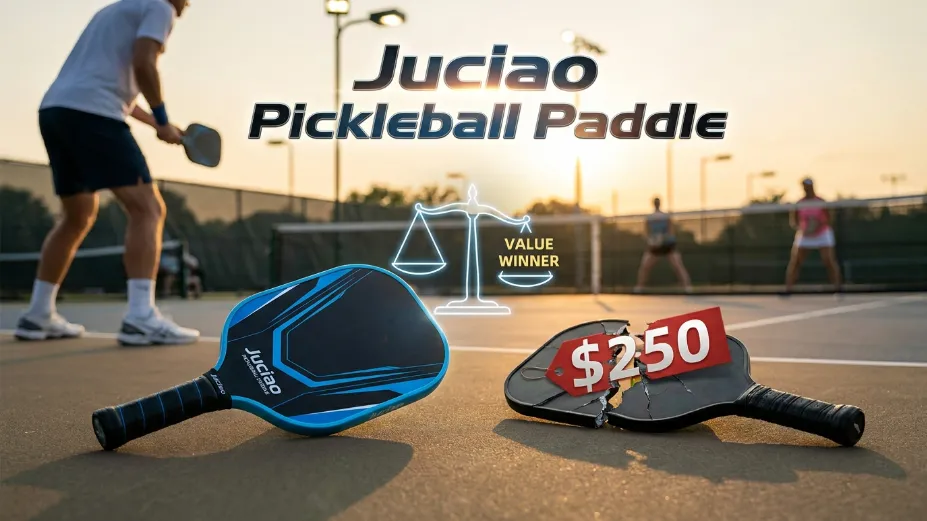
Dropping $250 on a big-name brand just to get elite spin and a gritty surface doesn’t make sense anymore. The underground hype surrounding the juciao pickleball paddle lineup claims you can master the kitchen line with tournament-level control for a fraction of the traditional cost. But before you open your wallet for what seems like too good of a budget anomaly, we need to look past the internet praise and break down how these paddles actually hold up under heavy baseline pressure.
Juciao Pickleball Paddles — Full Range
Surface · Core · Weight · Performance Focus · Price (USD)
For players in the United States searching for high-tier performance without the retail markup, the juciao pickleball paddle lineup offers clear options based on your stylistic needs. We highly recommend the Juciao Spin 1.0 as the absolute best budget-friendly control option for competitive local club play, while the Juciao Titan 1.0 stands out as the ultimate dynamic power paddle for aggressive players who want maximum baseline drive. Both models bypass traditional wholesale-to-retail markups, allowing recreational and tournament-level players to secure elite carbon composites for under $60.
Tournament Legality and the USAP / UPA-A Conundrum
Understanding the legal landscape of equipment certification is critical for any player looking to enter sanctioned leagues or tournaments in the United States. The governing body, USA Pickleball (USAP), maintains strict limits on the mechanical properties of a paddle face. Most notably, USAP technical standards mandate that the surface roughness must not exceed a maximum arithmetic average roughness ($R_a$) of 0.004 inches. This rule is designed to prevent players from generating extreme, unpredictable ball rotation that would alter the competitive balance of the sport.
When analyzing juciao pickleball paddles, players must look past generalized claims of legality and verify specific models. Currently, the Juciao Spin 1.0 and Juciao Titan 1.0 are fully approved and can be found registered under the “Composite Faces” category of the official USA Pickleball Approved Equipment database. The Spin 1.0 is specifically logged under the manufacturer identifier JUCIAO-TP700-RF, ensuring that you can confidently bring it to local brackets without fear of disqualification or technical penalties under official pickleball rules.
However, newer high-performance iterations such as the Juciao Savior Pro and the Juciao 18K Carbon do not carry official listing status. While these paddles comply with standard dimensional parameters (length, width, and cell structure), they have not undergone the expensive laboratory testing required to obtain the official USAP seal. For recreational players engaging in “open play” at neighborhood courts, this is a non-issue; however, for those participating in sanctioned events under USAP or UPA-A regulations, using an unlisted paddle will result in immediate disqualification.
Beyond tournament rules, there is a practical insurance concern that many domestic players overlook. Across community centers and municipal parks in the United States, facility operators often verify equipment safety markings. If a player causes or suffers an injury on-court while using uncertified, non-USAP equipment, the hosting club’s general liability insurance policy may reject medical coverage claims. Purchasing a certified model like the Spin 1.0 or Titan 1.0 ensures structural peace of mind and complete liability compliance.
The Material Science of Juciao: Breaking Down the Faces
To truly understand how Juciao matches the playability of elite brands, we must analyze the engineering behind their specialized face sheets. The brand uses advanced structural composites that directly impact ball dwell-time, friction coefficient, and durability.
T700 Raw Carbon Fiber & Thermoforming
The gold standard for modern spin-oriented play is a carbon fiber pickleball paddle. Juciao’s premium models utilize Toray T700 raw carbon fiber, which is processed using high-pressure thermoforming. In this manufacturing technique, the raw carbon plies are bonded directly to the internal polypropylene core inside a closed metal mold under 100 tons of hydraulic force and heated to 150°C (302°F). This hot-pressing method fuses all elements into a unified structure, completely eliminating the need for weak, secondary adhesive layers.
This process yields highly reliable thermoformed pickleball paddles that do not suffer from the classic delamination problems seen in old-generation, multi-piece construction. Rather than using cheap spray-on paint grit that shears off after fifty matches, Juciao’s raw carbon face features micro-texture created directly during the curing phase via peel-ply fabric layers. This leaves deep, microscopic grooves etched directly into the carbon grain, offering long-term spin retention that holds up over hundreds of hours of play.
Kevlar and Aramid Hybrids
Looking to capture the defensive audience, Juciao introduced hybrid faces woven with DuPont Kevlar and structural carbon. Kevlar has immense tensile strength and mechanical flexibility, making it highly effective at dispersing vibrational energy. In play, models like the Wu Kong Pro absorb incoming pace beautifully, allowing defensive players to block heavy drives directly back into the non-volley zone with exceptional stability.
However, Kevlar face sheets have a distinct structural drawback regarding texture longevity. Under intense rotational forces, the soft Kevlar yarns suffer from friction degradation faster than pure T700 carbon. Real-world durability testing shows that the gritty micro-texture in the sweet-spot of a Kevlar face starts wearing smooth within three months of consistent play, leading to a noticeable drop-off in maximum topspin capabilities.
The “Titanium White” Polyester Thread Illusion
The buzz surrounding the juciao titanium pickleball paddle is massive, but much of it is misunderstood by consumers. There is no physical titanium metal sheet or wire embedded within the face of these paddles. In reality, “titanium” refers to the color “titanium white” of the silver-colored polyester (PET) threads that are woven into the structural carbon matrix. This is a brilliant cosmetic and tactile innovation designed to alter the flex characteristics of the face sheet.
Because polyester threads are inherently more elastic than rigid carbon fibers, this composite weave behaves as a softer, more damp face sheet. When the ball impacts the surface, the PET fibers stretch slightly, increasing ball dwell-time (the fractional second the ball remains compressed against the face). This creates an incredibly plush, cushioned feel that makes third-shot drops and delicate dink battles feel effortless, while providing a stunning metallic aesthetic under the sun.
Head-to-Head Comparison: Juciao Spin 1.0 vs. Juciao Titan 1.0 vs. Juciao 18K
To help you navigate the lineup, we conducted a direct side-by-side comparison of Juciao’s most popular offerings. The results showcase distinct differences in performance, stiffness, and comfort.
Stiffness and Comfort Profiles
The first point of contrast in our juciao pickleball paddle review is overall frame rigidity. The Juciao 18K Carbon sits on the stiffest end of the spectrum. It uses a triaxial weave that deflects very little upon impact, resulting in a crisp, ultra-responsive feel. While this stiffness delivers explosive ball exit velocity, it transfers high-frequency vibrations directly up the shaft, which can aggravate elbow joints over time.
The Spin 1.0 represents the opposite end of the spectrum, offering a soft, plush feel that acts as an excellent shock absorber. The Titan 1.0 sits perfectly in the middle, utilizing its polyester-carbon weave to offer a “plush yet punchy” response that provides comfort without sacrificing baseline depth.
The Dynamic Playability and “Break-In” Period
A major point of discussion within the juciao pickleball paddle reddit community is the dramatic behavioral transition of the Juciao Titan 1.0 during its initial use. Out of the box, many players describe the Titan 1.0 as feeling “dead, unforgiving, and stiff as a block of wood,” offering subpar spin and an unusually harsh response. This initial stiffness often leads to premature frustration and negative reviews.
However, this paddle requires a strict “bedding-in” or break-in period of approximately 15 to 20 hours of hard play. During this phase, the high-density polymer bonds of the internal polypropylene core and the woven polyester face sheet undergo micro-flexing. This mechanical conditioning softens the internal structure, expanding the sweet-spot and activating what engineers call “dynamic playability.” Once broken in, the Titan 1.0 adapts to the speed of the game: it feels soft and plush during delicate dink exchanges but stiffens up to deliver massive power when driving baseline shots. Conversely, the Spin 1.0 requires zero break-in, playing soft and reliable from day one, though it lacks the high-end power ceiling of the Titan.
The Hidden Threat: Polypropylene Core Crushing
While Juciao paddles offer incredible value, they are not immune to the mechanical limits of modern polypropylene honeycomb cores. A phenomenon known as “core crushing” (or core collapse) occurs when the internal hexagonal cell walls of the core fail structurally under repeated, localized high-velocity impacts.
This problem is especially prevalent in thin-profile power paddles. When choosing between a 14mm vs 16mm pickleball paddle, players must realize that 14mm cores have thinner cell walls that carry highly concentrated shear stresses. Under intense baseline driving and overhead smashing, these thin walls can buckle and collapse inward, creating permanent “dead zones” on the face. We can express this mechanical vulnerability through the Core Fatigue Factor:
$$\text{Core Fatigue Factor} \propto \frac{\text{Impact Force} \times \text{Repetitions}}{\text{Core Wall Thickness}}$$
When the core collapses, the paddle face loses its rigid backing, leading to an erratic ball rebound, a hollow sound, and a complete loss of power. To ensure your paddle is operating at peak performance, perform these three simple diagnostic tests regularly:
- The Tap Test: Gently tap your knuckles or a plastic pen across the face of the paddle from the outer edges to the center. A healthy core will produce a high-frequency, consistent “thwack” sound. If you encounter a localized “dead spot” that sounds dull, hollow, or like damp cardboard, the internal core has collapsed under that zone.
- The Bounce Test: Hold your paddle perfectly flat and drop a standard outdoor pickleball from a height of exactly 1 meter. Observe the rebound height across different sections of the face. If the ball rebounds consistently in the center but dies completely or bounces 40% lower on a specific spot, you are dealing with localized core crushing.
- The Crunch Test: Place your thumbs directly over the sweet-spot and press down firmly. A structurally sound paddle will remain rigid and silent. If you feel the face flex inward or hear a faint “crinkling” or popping sound, the adhesive bonding the carbon face to the core has failed, indicating progressive core breakdown.
To maximize the lifespan of your core, avoid storing your paddle in hot car trunks or highly humid environments, as extreme heat weakens the structural adhesives, accelerating cell collapse under play.
Supply Chain Economics: Are Juciao Paddles 1:1 Brand Clones?
The massive surge in popularity of Juciao throughout Reddit and Quora has led many players to assume these paddles are literal “1:1 brand clones” or identical duplicates of premium options like the Vatic Pro Prism Flash or a high-end Joola pickleball paddle. To evaluate this claim, we must dissect the Direct-to-Consumer (DTC) supply chain.
Premium brands operate under massive operational overhead. A typical $250 paddle carries costs associated with multi-tier retail margins, distributor fees, expensive digital marketing campaigns, and lucrative sponsorship contracts for professional touring pros. The physical manufacturing cost of these premium paddles in Chinese factories rarely exceeds $30. By operating as a factory-direct brand, Juciao cuts out the marketing, player sponsorships, and retail markups. This lean business model allows them to offer a high-grade thermoformed paddle for $40, making it an undisputed choice for the best budget pickleball paddle for those exploring what is pickleball.
However, Juciao paddles are not 1:1 clones. Physical teardowns and dimensional checks reveal distinct differences from major brands:
- Non-Standard Grip Profiles: While standard premium paddles feature precise octagonal bevels, Juciao handles often use generic, rounded mold shapes with a slim 4.1-inch circumference and a non-standard 5.1-inch length.
- Head-Heavy Balance Points: Juciao paddles average a highly head-heavy balance point of 13.2 cm, whereas premium control-oriented paddles maintain a balanced profile closer to 12.0 cm.
- Lack of Professional R&D: Juciao relies on open-mold generic shapes from Chinese manufacturers. They do not have dedicated in-house research and development teams to custom-tune vibrational frequencies or weight distribution.
This reliance on generic manufacturing molds also explains why major YouTube gear reviewers (like Johnkew or Chris Olson) avoid publishing a juciao pickleball paddle review. Juciao does not offer an affiliate commission program or pay marketing kickbacks, meaning reviewers have no financial incentive to purchase, test, and feature their products on major platforms.
Pro-Level DIY Upgrades: Customizing Your Juciao Paddle
Because Juciao saves on manufacturing and assembly costs, players must perform a few quick, low-cost modifications to elevate these budget frames to a true professional standard.
Reconstructing the Handle Bevels
The most common complaint regarding Juciao paddles is the grip. Out of the box, the handle bevels are barely noticeable, making the grip feel almost completely round. This roundness makes it incredibly difficult to feel the paddle face orientation during fast-paced exchanges at the kitchen line, leading to accidental mishits.
To fix this, strip the cheap, thin stock grip off the handle down to the bare plastic/wooden core. Apply thin, rigid plastic or foam edge-strips along the eight flat bevel planes of the handle shaft. Once these octagonal planes are structurally defined, wrap the handle with a high-quality, moisture-wicking overgrip. This simple upgrade completely eliminates rotational slip and restores professional tactile feedback.
Custom Perimeter Weighting with Lead Tape
Because Juciao’s open-mold shapes can feature smaller sweet-spots, adding tungsten or lead tape is highly recommended. To maximize forgiveness and stability, apply 3-gram adhesive weight strips at the 3 o’clock and 9 o’clock positions on the edge guard. This increases the paddle’s twist weight, widening the sweet-spot horizontally and preventing the paddle from twisting in your hand when blocking hard-driven balls.
If you prefer extra power for deep baseline drives, place 2-gram strips at the 10 o’clock and 2 o’clock positions. This shifts the balance point toward the head, boosting head speed during high-velocity swings.
Final Verdict: Is a Juciao Paddle Right for You?
Ultimately, Juciao represents an incredibly smart choice for the budget-conscious player. By bypassing traditional marketing costs, they offer approximately 85% of the performance of a $250 premium paddle for just 20% of the price. If you are a recreational player or a local tournament competitor who doesn’t mind spending fifteen minutes on basic grip modifications, Juciao is an unbeatable deal. However, if you are a highly competitive 5.0+ player who requires an officially listed, USAP-approved weapon with long-term structural warranty backing, investing in a premium domestic brand remains the safer path.
Juciao Pickleball Paddle – FAQ
Q1: Are all Juciao pickleball paddles approved by the USAPA?
No. Only select models (such as the Juciao Spin 1.0 and Titan 1.0) are officially listed on the USA Pickleball Approved Equipment database under composite face designations like JUCIAO-TP700-RF. Advanced models like the Savior Pro and 18K Carbon are built to standard dimensional regulations but have not been officially registered or certified, making them illegal for sanctioned tournament brackets.
Q2: Does the Juciao Titan 1.0 actually have real titanium metal in the face?
No. The Juciao Titan 1.0 does not contain physical titanium metal. The “titanium” moniker refers to silver-colored polyester (PET) threads dyed “Titanium White” woven alongside structural carbon fiber. This hybrid blend increases surface elasticity, giving the paddle a plush feel and excellent dwell-time on impact.
Q3: How long can I expect a budget Juciao paddle to last before failing?
With regular play (3 to 4 times a week), a Juciao paddle will maintain its structural integrity for approximately 6 to 12 months. Players with aggressive baseline strokes may experience core crushing or grip loosening within 3 to 6 months, whereas soft, control-oriented players can comfortably extend the paddle’s lifespan past a full year.
Q4: Why does my Juciao Titan 1.0 feel stiff and dead during my first few games?
This is due to the woven polyester-carbon face sheet’s break-in (or bedding-in) period. Out of the box, the polymer structure is highly rigid and requires roughly 15 to 20 hours of consistent play to flex and soften. Once broken in, the paddle unlocks its dynamic playability, offering a much larger sweet-spot and a significantly softer touch.
Q5: Can I claim a warranty replacement if my Juciao paddle breaks?
Juciao Australia offers a limited warranty (6-month structural and 4-month core limited warranty) for the original purchaser with proof of purchase. However, if you buy directly from open-market retailers like AliExpress or Temu, securing a warranty replacement is highly inconsistent and often subject to long shipping transit times.