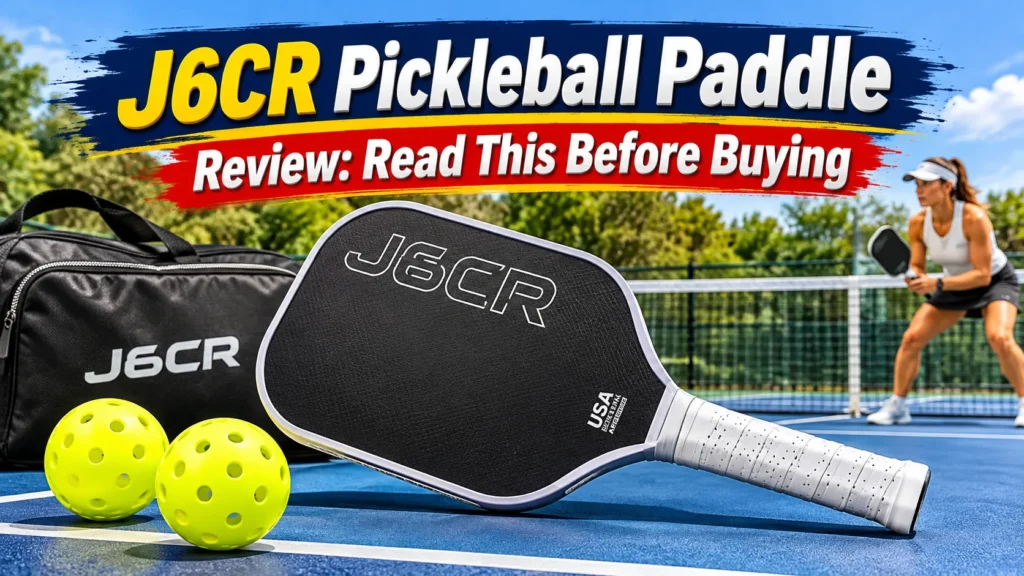
There’s a quiet revolution happening on the courts right now, and it’s being fueled by an elongated paddle that refuses to compromise between explosive pop and surgical precision. When split-second resets and baseline drives dictate the outcome of a match, the j6cr pickleball paddle delivers a calculated competitive advantage through its Gen 4.5 multi-density foam core and perimeter-balanced thermocompression.
We aren’t just talking about raw manufacturer specs; we are breaking down the exact mechanics behind the standard model and the highly sought-after honolulu j6cr pickleball paddle – pickleball nation blue edition. Whether you prefer the sleek court aesthetics of the honolulu j6cr pickleball paddle – pickleball nation white, or you simply want the unvarnished truth about the base honolulu j6cr pickleball paddle, this comprehensive j6cr pickleball paddle review cuts through the marketing noise to reveal exactly why this 16.48-inch weapon is dominating the 2026 tournament circuit.
Honolulu J6CR Paddles
Verified Specifications · 2026
J6CR Pickleball Paddle Review: Anatomical Breakdown and Core Performance
The real character of the j6cr pickleball paddle lives beneath the surface texture. Most reviews stop at “powerful and spinny,” but the paddle’s behavior is the product of a specific chain of engineering decisions: an elongated frame that shifts mass toward the head, a thick foam core that responds differently to soft and hard contact, and a face built to hold its grit long after ordinary carbon wears smooth. If you’re new to this category, our breakdown of elongated pickleball paddles explains the reach-versus-maneuverability trade-off in more depth.
- The Frame and Chopped-Top Shape: The J6 builds on Honolulu’s J2 long-handle architecture with an extended face and a chopped-top aero curve. Holding the 16.48″ × 7.52″ footprint while pushing mass toward the head raises swing weight to 111–116, which turns drives and serves into heavy, deep balls without requiring a bigger swing. The chopped top trims air resistance so the long face still moves quickly in hand battles.
- The Handle Nobody Measures Correctly: Honolulu lists a 6″ grip, but that figure includes the tapered neck above the rubber band and grip wrap. In practice, the fully flat section feels closer to 5.5″–5.75″. Two-handed backhand players still have room, because the taper is gradual enough for the off-hand index finger to rest on the throat.
- The Gen 4.5 Multi-Density Foam Core: Instead of a polymer honeycomb, the 16mm core blends expanded foams inside a perimeter-balanced thermocompression mold. On dinks and resets, the foam absorbs pace and lengthens dwell time. On full swings, the core compresses against the rigid face and rebounds through Honolulu’s Dynamic PowerFlex Technology, which is why the paddle feels calm at the kitchen and explosive from the baseline. Our guide to full foam core pickleball paddles covers how this design differs from honeycomb builds.
- Control Joint Technology: This patent-pending feature sits near the throat and isolates the handle from the striking surface. The practical result is cleaner, more predictable feedback when you’re absorbing hard drives, because harsh high-frequency vibration is filtered before it reaches your grip.
- The Crystal Blue Endurance Surface: Rather than spraying grit onto the face, Honolulu mechanically interlocks blue crystal media into a carbon fiber / fiberglass / carbon fiber (CFC) layup. Because the texture is embedded, it wears far more slowly than peel-ply carbon. Spin readings vary by testing method, from roughly 2,091 RPM in UPA-A testing (as listed by retailers) to about 2,400 RPM in independent cannon tests, with minimal drop-off after thousands of strikes.
This platform sits firmly in the newest wave of foam-core designs. If you want to understand how it evolved from earlier construction methods, our overview of Gen 4 pickleball paddles puts the J6CR’s architecture in context.
Pros and Cons: The Unfiltered Verdict
- Pros: Elite spin retention, heavy baseline drives from the high swing weight, soft touch on drops thanks to the 16mm foam, maximum reach, a $195 price that undercuts most rival durable-spin paddles, and an included premium waterproof cover ($25 value).
- Cons: A low 6.2–6.7 twist weight that punishes edge contact, a narrower lateral sweet spot, uneven-looking face finishes, Crystal Blue versions limited to UPA-A play, special cleaning requirements, and a strict return policy on used paddles.
The Honolulu J6CR Pickleball Paddle Lineup Decoded
Shopping for a honolulu j6cr pickleball paddle gets confusing fast, because retailers list several versions under nearly identical names. The differences come down to two things: what the face is made of and what the core is made of. Color, despite how much attention it gets, changes nothing about performance.
Honolulu J6CR Pickleball Paddle – Pickleball Nation Blue: The Flagship Edition
The honolulu j6cr pickleball paddle – pickleball nation blue listing refers to the Crystal Blue Endurance Surface version in its signature blue colorway. It’s the model most players picture when they talk about “Blue Grit,” and it carries the full Gen 4.5 core, Control Joint Technology, and UPA-A approval. Because the crystal texture is the same shade as the paddle, wear patterns and ball residue are harder to see. That keeps it looking fresher on court, but it also means you should clean it on a schedule rather than waiting until it looks dirty.
Honolulu J6CR Pickleball Paddle – Pickleball Nation White: Same Engine, Different Look
The honolulu j6cr pickleball paddle – pickleball nation white is the identical paddle in a lighter colorway: same dimensions, same swing and twist weight, same crystal-infused face, same certification. The only practical difference is visibility. On a lighter background, the natural variation in grit distribution can look more pronounced, and ball scuffs show up sooner. If cosmetic uniformity bothers you, the blue version tends to hide those quirks better. If you want a paddle that stands out under indoor lights, white is the sharper choice.
The Base Model and the M105: When the Flagship Isn’t the Right Fit
- Standard J6CR: Uses a conventional carbon fiber face instead of Crystal Blue. Spin will fade like any raw carbon paddle, but it carries USAP approval, which makes it the only J6CR option for USAP-sanctioned leagues and Golden Ticket events.
- J6CR M105: Keeps the elongated frame and Crystal Blue face but swaps in an MPP foam core. Players describe a deeper, quieter “thonk,” a slightly longer grab on the ball, and a little less top-end pop. It’s built for players who love the reach but find the flagship too lively at the net.
Head-to-Head: The J6CR Against Its Toughest Rivals
Inside Honolulu’s own catalog, the J6CR’s closest sibling is the J2CR Crystal Blue. Both share the same price, foam core, and face, but the J2CR is shorter and wider (16.2″ × 7.8″) with a 7.0 twist weight and a lower swing weight. That makes it more forgiving and quicker in firefights. The J6CR gives up that width for extra length, leverage, and slightly higher spin readings. In short, the J2CR protects your weaknesses, while the J6CR amplifies your strengths.
Against outside competition, the J6CR holds a clear value edge. The 11SIX24 Ultré Power 2 posts nearly identical spin and durability numbers with a more forgiving hybrid shape and a 6.86 twist weight, but it costs around $200 and feels stiffer and more hollow; see our 11SIX24 pickleball paddle review for details. The Six Zero Coral Pro offers a softer, denser feel through a diamond-dust grit layer at roughly $220, which we cover in our Six Zero Coral 16mm pickleball paddle breakdown. If spin is your top priority and you’re comparing across brands, our list of the best pickleball paddle for spin shows where the J6CR ranks.
Transparency: Hidden Flaws and Surface Quirks
An honest evaluation has to cover the rough edges. The most common complaint is cosmetic: buyers regularly report patchy-looking grit, shading differences, or lighter “bald” spots straight out of the box. Honolulu states that the surface is intentionally engineered as an organic-performance finish, that roughness is tested against a functional specification, and that cosmetic variation within its approved tolerance is not eligible for exchange or warranty.
Independent labs have also measured swing weight as high as 114–118 on some production units, so two paddles from different batches can feel slightly different. Finally, the low twist weight is real: edge contact near 3 or 9 o’clock loses pace and lets the face twist in your grip, so blocking hard drives demands clean, centered contact.
Care and Tuning: Getting More from Your J6CR
The rubber erasers many players use on raw carbon are a mistake on Crystal Blue. The sharp crystal texture shreds the rubber and leaves residue lodged in the grit, which actually lowers spin. Instead, use a slightly damp optical-grade microfiber cloth with one drop of mild dish soap, and save a little isopropyl alcohol for stubborn ball residue. Our guide to choosing a pickleball paddle cleaner covers safe products for textured faces.
Because the J6CR combines a head-heavy swing weight with a low twist weight, it responds well to weighting. Before you start, read our primer on lead tape for pickleball paddles, then try one of these proven setups:
- 4 and 8 O’Clock (Stability): Add 2–3 grams per side near the throat. Twist weight rises noticeably while swing weight barely moves, so you keep your hand speed at the kitchen.
- 3 and 9 O’Clock (Bigger Sweet Spot): Add 1–2 grams per side at the widest point of the face for up to about +0.5 twist weight, at the cost of slightly slower hands.
- Hybrid Build: Combine 2 grams at 4 and 8 o’clock with 1 gram at 3 and 9 o’clock for a steadier blocking platform and more plow-through on drives. Avoid clamp-on weights that could damage the edge guard, since that damage falls outside the warranty.
Practical Guide: Buying a J6CR Pickleball Paddle in the United States
Pricing is consistent across authorized U.S. retailers. On the Official Honolulu J6CR Crystal Blue Page, the paddle lists at $195.00 in both blue and white, with a premium waterproof cover included. Demand has outpaced supply: Honolulu sells the paddle in pre-order batches, and the official page shows the 12th batch sold out with the 13th batch scheduled to ship on November 13, 2026. Before you commit, confirm your event’s sanctioning body, because the Crystal Blue and M105 versions are UPA-A approved, not USAP. You can check current listings on our USA Pickleball approved paddle list.
Read the return terms carefully. Honolulu offers a 30-day window, but a full refund requires an unused paddle with original packaging and tags. A paddle with any playwear is subject to a 20% restocking fee based on MSRP, about $39 on a $195 paddle, plus return shipping. Heavy wear or a removed grip means the return is rejected. Beyond 30 days, a 1-year limited warranty covers structural defects such as core delamination or core crushing during normal play, but it excludes cosmetic wear, damage from third-party weights, non-performance rattles, and exposure to temperatures below 40°F or above 120°F.
In other words, never leave the paddle in a hot car. If you’re comparing the J6CR against the rest of the brand’s catalog, our roundup of Honolulu pickleball paddles is a useful starting point.
Frequently Asked Questions (FAQ)
What’s the difference between the standard J6CR and the J6CR Crystal Blue?
Both use the same 16.48″ × 7.52″ elongated frame and 16mm multi-density foam core. The standard model has a conventional carbon fiber face that loses grit over time and is USAP approved. The Crystal Blue version embeds crystal media into a carbon-fiberglass-carbon face for long-lasting spin, but it is UPA-A approved only.
Are bare or light spots on the Crystal Blue face a defect?
Usually not. Honolulu describes the surface as an organic-performance finish and tests roughness against a functional specification rather than visual uniformity. Cosmetic variation within its approved tolerance is not eligible for exchange or warranty. Only clear structural problems, such as delamination or a crushed core, fall under warranty coverage.
Is there any performance difference between the blue and white versions?
No. The blue and white colorways share identical dimensions, weights, core, face material, and certification. The only difference is appearance: the white version shows ball scuffs and natural grit variation more readily, while the blue version hides them better between cleanings.
Can I use a paddle eraser on Blue Grit?
No. The crystal texture tears up rubber erasers and leaves residue trapped in the grit, which reduces spin. Use a damp optical microfiber cloth with a drop of mild dish soap, and use isopropyl alcohol for stubborn buildup.
Is the J6CR a good choice for intermediate players?
It can work for strong intermediates with consistent mechanics, but its low twist weight punishes off-center contact. Players still building their technique will usually be happier with the wider J2CR. If you’re already playing at a high level and want more offensive firepower, browse our picks for the best pickleball paddles for advanced players to see how the J6CR compares.
When will the next J6CR batch ship?
According to Honolulu’s official product page, the 12th Crystal Blue batch has sold out and the 13th batch is scheduled to ship on November 13, 2026. Pre-order timing changes often, so check the official page before ordering.