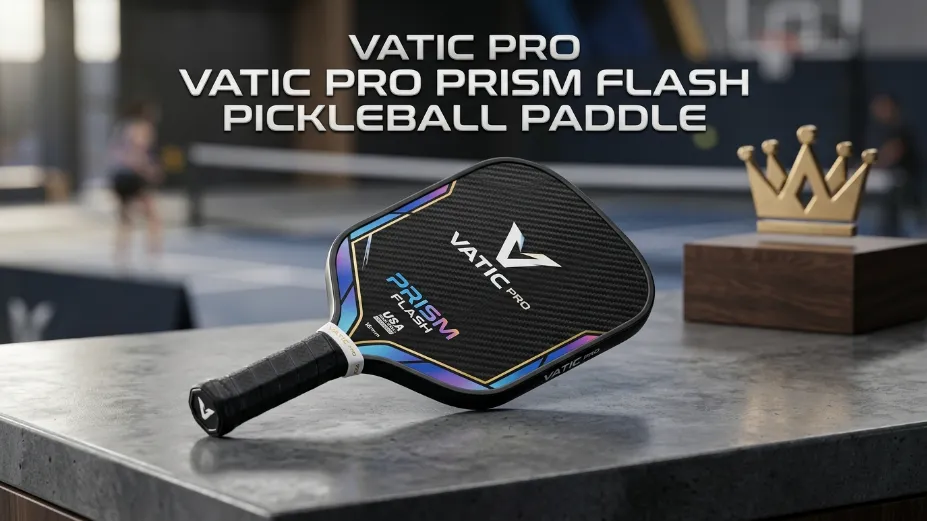
The $100 price point in pickleball is a dangerous psychological trap, usually forcing players to choose between a paddle that shatters in two months or one that feels like hitting a ball with a literal brick. Then came the vatic pro prism flash pickleball paddle, completely disrupting the market by bringing raw thermoformed carbon fiber performance down to a budget-friendly tier. If you are trying to figure out whether this hybrid-shape control paddle is the ultimate value play of the year or just another overhyped internet trend, let’s skip the marketing fluff and look at how it actually performs at the kitchen line.
Vatic Pro Prism Flash pickleball paddle full specifications and player benefits: face material, core construction, shape, weight, length, width, grip, edge tech, and USAPA approval
Vatic Pro Prism Flash
Full Specifications & Player Benefits
For US intermediate players seeking premium control and exceptional spin without breaking the bank, the vatic pro prism flash pickleball paddle is the absolute gold standard under the $100 price point. By combining raw Toray T700 carbon fiber with a foam-injected unibody construction, it offers the plush, forgiving feel of $200+ control models while delivering incredible maneuverability at the net. If you want to systematically eliminate unforced errors, master third-shot drops, and dominate hand battles on court, this paddle is our strongest budget recommendation.
The rapid expansion of the competitive pickleball scene across the United States has fundamentally altered player expectations regarding technical gear. Generic starter sets or cheap fiberglass models no longer suffice on highly competitive courts where spin rate and soft resets dictate the pace of the game. With specialized footprints arriving on the market, understanding the engineering beneath your hand becomes paramount to maintaining technical execution and avoiding chronic hand or elbow injury.
vatic pro prism flash pickleball paddle review
The engineering core of the vatic pro prism flash pickleball paddle review centers upon its non-traditional, hybrid unibody construction. While legacy control paddles relied primarily on multi-piece sandwich designs that suffered from fragile neck joints, this silhouette bridges modern molding technology with the rigorous constraints of high-speed court exchanges.
- The Core Matrix: Utilizing an optimized C7 polymer honeycomb core, the primary dampening engine offers exceptional shock absorption. When taking the pace off of aggressive baseline drives, the core absorbs kinetic energy, allowing you to drop the ball softly into the kitchen.
- The Unibody Boundary: Unlike cheap, multi-piece paddles that flex at the handle, Vatic Pro wraps the entire perimeter in a single, continuous sheet of carbon fiber pressed under heat. This raw unibody design ensures long-term structural durability and prevents the handle from snapping during intensive play.
- Foam-Injected Edge Tech: The edges of the paddle are packed with high-density foam before being sealed with an anti-abrasion TPU edge guard. This foam layer significantly increases the twistweight, ensuring that off-center hits do not result in twisting or lost energy.
The surface layer balances raw friction with structural integrity. Utilizing premium Japanese Toray T700 raw carbon fiber, the face is treated with heat-compressed texturing to ensure maximum ball bite. This texturing enables players to generate heavy topspin and underspin, making it highly competitive with the industry’s premium offerings. If you are preparing to upgrade from a basic starter setup to a high-performance Vatic Pro pickleball paddle, you will immediately notice how much easier it is to control the depth of your shots.
Check Top Pickleball Paddles Guide
16mm vs. 14mm: Deciding on Your vatic pro prism flash sh carbon fiber pickleball paddle
Navigating the product family requires a clear understanding of the mechanical differences between the 16mm control standard and the 14mm speed variant. Selecting your specific version of the vatic pro prism flash sh carbon fiber pickleball paddle dictates both your physical playstyle and your hand velocity at the kitchen line.
The Cushioning Variance
The 16mm core is built for the pure control player. By utilizing a thicker honeycomb bed, the ball is able to compress deeper into the paddle face upon impact. This increases the “dwell time”—the fractions of a second the ball remains on the face—giving you unmatched touch and placement. Conversely, the 14mm core is significantly stiffer. With less core depth to absorb the ball, energy is transferred back to the ball much quicker, offering a noticeably snappier response (commonly referred to as “pop”).
Weight and Aerodynamic Discrepancies
Because the 14mm model is thinner, it naturally carries less physical mass, typically weighing between 7.7 and 7.9 ounces. The thinner profile also cuts through the air with less aerodynamic resistance, allowing speed-focused players to react incredibly fast during hand battles. The 16mm model sits at a heavier 7.9 to 8.2 ounces. While the heavier 16mm model provides more stability and plow-through on drives, it does require slightly more wrist strength during quick exchanges at the net. If you are browsing through other options in this tier, our analytical look at the best pickleball paddles under $100 confirms that the Prism series remains unmatched in overall playability.
The Critical Fit Guide: Standard Handle vs. Long Handle
A major missing angle across commercial e-commerce spaces is how handle length directly dictates the balance and sweet spot of the paddle face. Because USAP regulations enforce strict total dimensional limits (Length + Width must not exceed 24 inches), altering handle length requires a direct engineering compromise on the face itself.
The standard handle (SH) version features a 5.3-inch grip paired with a wider, 7.7-inch face. This shorter handle allows for a larger, highly forgiving sweet spot that extends further down toward the throat. It is the perfect setup for single-handed players who want maximum forgiveness on off-center dinks. To accommodate a longer 5.75-inch handle (LH) for two-handed backhands, Vatic Pro had to slim the face down to 7.625 inches.
This slight dimensional change shifts the sweet spot higher up the paddle face. While the longer handle provides incredible leverage for driving topspin from the baseline, it reduces the overall sweet spot area. Players who do not actively use a two-handed backhand should stick with the standard 5.3-inch handle to maximize on-court forgiveness. Regardless of your choice, ensuring comfortable grip ergonomics is essential, as detailed in our guide to top pickleball paddles.
Exposing the Information Gaps: Real-World Durability Under the Microscope
While mainstream marketing highlights the premium materials of the Vatic Pro line, a deep analysis across US playing groups reveals distinct wear patterns and physical characteristics that competitors often ignore.
- The water damage illusion: A common complaint on community forums is the appearance of dark, irregular markings on the face that look like water damage. In reality, raw carbon fiber is highly porous and absorbs sweat and body oils (e.g., when tucking the paddle under your arm during breaks). This is purely cosmetic and can be resolved by wiping the face with a damp microfiber cloth.
- The “dead face” transition shock: Players transitioning from cheap, poppy wooden or fiberglass paddles often feel like the Prism Flash is “dead” out of the box. This plush, muted feeling is entirely intentional. Rather than relying on the trampoline effect of cheap paddles, the Prism Flash forces you to engage your hips and torso to generate power, dramatically improving your control mechanics over time.
- Raw grit degradation vs. core dwell-time: Some players note that the surface grit feels smoother after 3 to 6 months of intense play. While all raw carbon fiber faces lose texture over time, the spin potential of the Prism series remains highly stable because its soft core maximizes dwell-time, allowing the ball to compress against the carbon fibers even as the surface texture breaks down.
These real-world feedback loops prove that the Prism Flash is designed for structural longevity. Unlike thermoformed paddles that are prone to core-crushing and delamination within 6 months, the non-thermoformed C7 core of the Prism Flash remains structurally intact year after year.
Performance on US Courts: Dinks, Resets, and Hands Battles
Evaluating the Toray T700 face requires analyzing how the paddle behaves in highly specific competitive scenarios. The raw carbon fiber surface behaves fundamentally differently depending on the mechanics of your swing.
On third-shot drops and resets, the paddle is practically a cheat code. The soft polymer core acts like a shock absorber, deadening the energy of aggressive baseline drives so you can place the ball safely into the kitchen. In hand battles at the net, the low swingweight of $114.2\text{ kg}\cdot\text{cm}^2$ allows you to manipulate the paddle angle in milliseconds, converting defensive blocks into offensive putaways.
However, generating raw power from the baseline is the biggest challenge of this paddle. Because it is a pure control paddle, players cannot rely on the paddle’s natural rebound to drive the ball deep. It requires a complete, accelerated swing with proper body rotation to hit deep drives or hard serves. If you prefer a paddle that does the heavy lifting for you on power, exploring our guide to the carbon fiber pickleball paddle category will help you find a stiffer, more explosive option.
Head-to-Head: Vatic Pro Prism Flash 16mm vs. Six Zero Double Black Diamond
For players trying to choose between the vatic pro prism flash pickleball paddle reviews and the legendary Six Zero Double Black Diamond (DBD), the choice comes down to a fundamental split in design and pricing philosophy.
The primary performance differences are outlined below:
- Power and Rebound: The Six Zero DBD utilizes a fully thermoformed core, giving it a stiffer, much poppier feel off the face. Drives and overheads fly off the DBD with significantly more velocity. The Prism Flash focuses on a plush, dampening touch, making resets much more manageable for players who tend to pop the ball up.
- Sweet Spot and Forgiveness: While the Prism Flash is incredibly forgiving, the thermoformed edges of the Six Zero Double Black Diamond provide an even wider sweet spot near the outer perimeter. However, this extra stiffness makes the DBD harder to control for players who struggle with their soft game.
- Value and Price Point: Retailing at $180, the Six Zero DBD is almost double the price of the $99.99 Prism Flash. For budget-conscious players or those wanting to refine their placement before moving to a high-power model, the Prism Flash offers a significantly higher return on investment.
For players analyzing high-end control tools across the industry’s legacy brands, benchmarking this paddle against the classic Joola Ben Johns Hyperion highlights how Vatic Pro managed to deliver near-identical performance metrics at less than half the retail price.
Buying Advice in the US: Sourcing and Authenticity
Tracking down the Prism Flash in the United States requires navigating both direct-to-consumer channels and secondary marketplaces. The standard baseline retail price is set firmly at $99.99, but utilizing verified ambassador codes can regularly bring the price down to a highly competitive $89.99.
While the paddle is available on Amazon, US players are highly encouraged to purchase direct from the official Vatic Pro store. Purchasing directly from the manufacturer guarantees that you receive the latest production run with updated unibody reinforcements and ensures that your 180-day warranty against core defects is fully valid. It also eliminates the risk of receiving counterfeit look-alikes from unverified third-party sellers.
Verdict: Is the pickleball paddle vatic pro prism flash Worth Your Money?
The final evaluation of the pickleball paddle vatic pro prism flash depends entirely on your competitive playstyle, physical injury history, and approach to your soft game.
- Who Should Buy: Intermediate players looking to build a consistent third-shot drop, control-focused competitors who play aggressive doubles, and anyone suffering from tennis elbow who needs a plush, shock-absorbing paddle face.
- Who Should Avoid: Single-minded bangers who want explosive pop from the baseline, and players who dislike a soft, muted feel and prefer a stiff, loud, high-feedback paddle face.
Frequently Asked Questions (FAQ)
How does the overall swingweight of the Prism Flash impact hands battles compared to elongated paddles?
With a moderately low swingweight of $114.2\text{ kg}\cdot\text{cm}^2$, the Prism Flash is designed to maximize hand speed at the kitchen line. The rotational inertia formula $I = \sum m_i r_i^2$ dictates that by keeping the head slightly shorter, less torque is required to accelerate the paddle, giving you a massive speed advantage during fast-paced exchanges.
Will playing with a damp microfiber cloth to clean my raw carbon fiber face damage the core?
No. While you must never submerge your paddle in water, wiping down the raw Toray T700 carbon fiber surface with a slightly damp microfiber cloth is highly recommended. It dislodges ball dust and sweat oils from the pores of the carbon fiber, and when followed by a carbon fiber eraser, fully restores your spin potential.
Can I use lead tape to increase the power of the Prism Flash, and where should I place it?
Yes, because the Prism Flash has a light stock swingweight, it is the perfect canvas for customization. Adding 3 grams of lead tape at the 10 and 2 o’clock positions will dramatically increase your plow-through and swingweight for baseline drives, while placing weight at the 3 and 9 o’clock positions will maximize the twistweight ($6.46\text{ kg}\cdot\text{cm}^2$) and sweet spot stability.