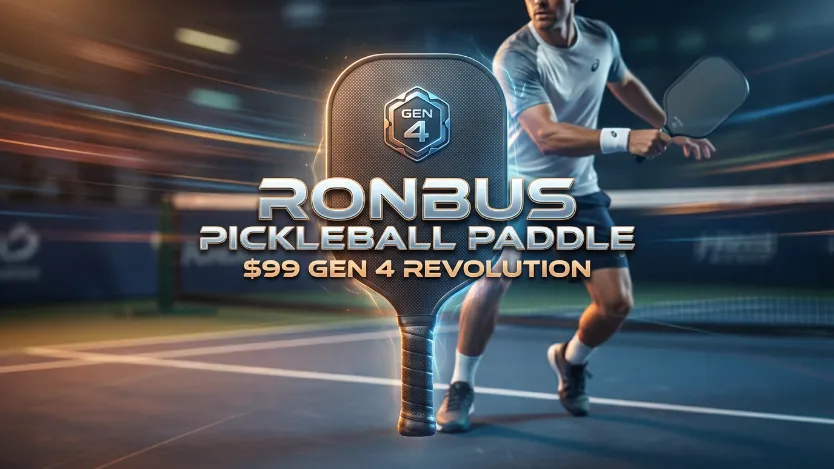
For years, the pickleball world was trapped in a honeycomb cage. Most high-performance paddles relied on polypropylene cores that, while effective, were prone to “core crush” and inconsistent energy return over time. But a shift is happening. The introduction of 4th Generation foam core technology has disrupted the status quo, and at the heart of this movement is the ronbus pickleball paddle. While legacy brands are charging upwards of $250 for these innovations, Ronbus has taken a different path—delivering elite, “tunable” chassis for under $100. This isn’t just another equipment release; it is an invitation to engineer your own performance.
Whether you are looking at the ronbus quanta pickleball paddle for its customization potential or considering the ronbus ripple v2 pickleball paddle for its muted power, understanding the mechanics behind these tools is essential. In this deep dive, we will uncover the information gaps—such as the secret 20-hour break-in period and the specific “Quantastik” weighting setups—that official marketing materials often leave out.
The Customization Chassis: Understanding the Ronbus Quanta
The ronbus quanta pickleball paddle is perhaps the most misunderstood paddle in the current US market. Out of the box, many players find it surprisingly light, weighing in between 7.6 and 7.8 ounces. To a beginner, this might feel “cheap” or “flimsy.” However, for advanced players, this lightweight build is a deliberate design choice. It is a “chassis” designed to be built upon.
Unlike traditional thermoformed pickleball paddles that use a polymer honeycomb core, the Quanta features a solid EPP (Expanded Polypropylene) foam core. This material is surrounded by an EVA foam ring at the perimeter to enhance “pop” and TPE elastomer inserts in the bottom corners to dampen vibrations. This foam core pickleball technology provides a linear power response: what you put into the swing is exactly what you get out, without the “trampoline” unpredictability of Gen 3 builds.
The “Quantastik” Project: Mimicking the $330 Giants
In US pickleball forums, a phenomenon known as the “Quantastik” setup has gone viral. Players realized that by adding roughly 15 grams of tungsten tape or lead tape to the 3 and 9 o’clock positions of a ronbus quanta pickleball paddle, they could essentially mimic the performance of the $333 Selkirk Labs Project Boomstik.
- Stability: The stock twist weight of the Quanta is around 5.6 to 6.2. By adding 7.5g to each side, you can skyrocket that twist weight to over 8.0, making the paddle incredibly stable on off-center hits.
- Sweet Spot Expansion: The added mass at the edges physically expands the effective sweet spot, turning a “stiff” feeling paddle into a forgiving block machine.
- Plow-through: For former tennis players, this added weight provides the “heft” needed to drive through the ball during deep baseline exchanges.
If you aren’t willing to “tinker” with weights, the Quanta may feel underwhelming. But if you are looking for the best pickleball paddles under $100 that can be tuned to outperform professional-tier gear, the Quanta is currently in a league of its own.
The Ripple V2: Regulation, Muted Power, and the Break-In Secret
The transition from the original ronbus ripple pickleball paddle (the “Beta”) to the ronbus ripple v2 pickleball paddle was born out of necessity. The original Beta was considered “too hot” for tournament play, leading to USA Pickleball (USAP) certification challenges. Ronbus responded by engineering the V2, which utilizes vertical carbon fiber ribs to stiffen the core and stay within the legal PBCoR.43 limits.
You can verify the latest status of these models on the USA Pickleball Approved Paddle List to ensure your gear is tournament-ready.
The Missing Angle: The 20-Hour Rule
One of the biggest complaints from US players regarding the Ripple V2 is that it feels “dead” or “stiff” compared to the legendary Betas during the first few sessions. Here is the angle the big reviewers often miss: The Ripple V2 requires a significant break-in period.
While most T700 Carbon Fiber surface paddles play consistently from day one, the unique resins and carbon ribs in the Ripple V2 need roughly 10 to 20 hours of play to “loosen up.” After this period, the sweet spot expands noticeably, and the “muted” sound develops into a deep, satisfying “thunk” that absorbs the vibration from heavy bangers. If you judge this paddle within the first hour, you are only seeing 70% of its true potential.
Deciphering the R-Series Shapes (R1 to R5)
Ronbus offers five distinct head shapes, which can be confusing for the average consumer. Each shape affects Swing Weight (SW) and Twist Weight (TW) differently, especially when you are planning to add weight.
- R1 (Elongated Aero Curve): Measures 16.5″ x 7.5″. The curved top reduces air resistance, making it faster at the kitchen than traditional elongated paddles. It is the best choice for players who want reach without the “clunky” feel.
- R2 (Standard Widebody): Measures 16″ x 8″. This is a “block machine.” It has the highest stock twist weight (around 6.34) and the largest sweet spot. It is the ideal shape for doubles players who prioritize resets and hand speed.
- R3 (Elongated Square Top): The powerhouse. The squared-off top puts more mass at the tip of the paddle, creating maximum leverage. It is a favorite for singles players and those who drive the ball with heavy topspin.
- R4 (Hybrid): Measures 16.25″ x 7.75″. The “Goldilocks” shape. It offers 90% of the reach of an R1 with 90% of the forgiveness of an R2. If you are coming from a Selkirk Luxx review and want more power, the R4 is the perfect transition.
- R5 (Tapered Widebody): A specialized widebody with a tapered neck. This design provides more usable handle space, making it the top recommendation for players with large hands or those who use a two-handed backhand.
Durability Realities: What to Expect After 3 Months
While the foam cores of the ronbus pickleball paddles are virtually indestructible—meaning they won’t lose their “pop” like honeycomb cores—the surface is subject to the same laws of physics as any other best paddle for spin.
The Grit Crisis
Players in the US have reported that the “grit” or texture on the Toray T700 carbon fiber face begins to smooth out after about 60 to 80 hours of intensive play. You may notice your RPMs drop from a top-tier 2100 to a mid-tier 1800. To combat this, advanced players recommend:
- Using a Carbon Fiber Eraser after every session to remove plastic residue from balls.
- Avoiding cleaning with harsh chemicals that can degrade the resin bond.
The “Crackle” Sound
Another “missing angle” in many reviews is the soft crackling sound sometimes heard when pressing the edge of a Quanta or Ripple. This is often not a manufacturing defect but rather the EVA foam ring compressing against the carbon fiber face. While it can be alarming, it typically does not affect performance unless you see physical delamination (the face peeling away from the core).
Consumer Protection: The Warranty and Return Trap
Ronbus offers a 180-day (6-month) warranty against manufacturing defects, which is standard for the industry. However, US buyers should be aware of specific policy details that can lead to unexpected costs:
- Restocking Fees: Ronbus charges a 20% restocking fee for “lightly used” paddles. In the world of pickleball, “used” is defined as hitting even a single ball or removing the plastic wrap from the handle.
- The Customization Clause: If you request a custom grip—such as a left-handed wrap—the paddle is immediately disqualified from a full refund because it cannot be resold as “new.”
- Shipping Costs: Unlike some larger conglomerates, Ronbus typically requires the customer to pay for return shipping on warranty claims unless the defect is undeniably clear from photographs.
Final Verdict: Is a Ronbus Paddle Right for You?
The ronbus pickleball paddle lineup is not for everyone. If you want a paddle that is “perfect” out of the box and you have no interest in applying lead tape or experimenting with balance points, you might be better off with a pre-weighted premium option.
However, if you are a “paddle nerd” or a value-conscious competitor who wants Gen 4 foam core performance for half the price of the competition, Ronbus is the gold standard. The ronbus quanta pickleball paddle is the ultimate tinkerer’s tool, while the ronbus ripple v2 pickleball paddle offers a unique, muted feel that excels in defensive resets and counter-punches. In an era where paddle prices are inflating faster than ever, Ronbus remains the primary driver of the “performance for the people” movement in the United States.
Frequently Asked Questions (FAQ)
1. Is the Ronbus Quanta better than the Ripple V2?
It depends on your preference for “feel.” The Quanta has a crisp, more “hollow” feedback similar to traditional thermoformed paddles but requires added weight to reach its potential. The Ripple V2 is denser, quieter, and offers a “muted” feel that many find superior for the soft game, though it is heavier stock.
2. Why does my Ronbus Ripple V2 feel so stiff?
You are likely in the break-in period. These paddles use vertical carbon ribs and specialized resins that need 15-20 hours of play to soften and expand the sweet spot. Don’t give up on the paddle in the first week!
3. What is the “Quantastik” setup?
This is a popular customization where you add 15g of tungsten tape (7.5g each) to the 3 and 9 o’clock positions of a Quanta paddle. This increases the twist weight and power to match paddles costing $300+.
4. Does Ronbus cover surface wear under warranty?
No. Normal wear and tear, including the smoothing of the carbon fiber grit or ball marks, is not covered. The 6-month warranty covers structural failures like core collapse or handle breakage.
5. Which shape is best for former tennis players?
The R1 and R3 shapes are elongated (16.5″), which provides the leverage and reach most tennis players are accustomed to. The R3, specifically, has a square top that offers more “plow-through” for heavy drives.