In every other court sport on the planet, letting the ball bounce twice guarantees a dead ball and a lost point. Pickleball flips this logic completely on its head. If you want to survive the first three shots of a match and avoid giving up easy points, you have to master this exact paradox. New players constantly lose their serve because they fundamentally misunderstand what is the double bounce rule in pickleball, confusing a strict mechanical requirement with a court fault.
Officially known in the USA Pickleball rulebook as the “Two-Bounce Rule,” this brilliant design flaw-turned-feature is exactly what prevents the serving team from rushing the net and overpowering their opponents. Let’s break down the exact sequence of this rule, how it dictates your third-shot strategy, and why understanding it is your quickest ticket out of beginner-level play.
Pickleball Double Bounce Rule Phases
Verified Official USAP Guidelines · 2026
in pickleball what is the double bounce rule
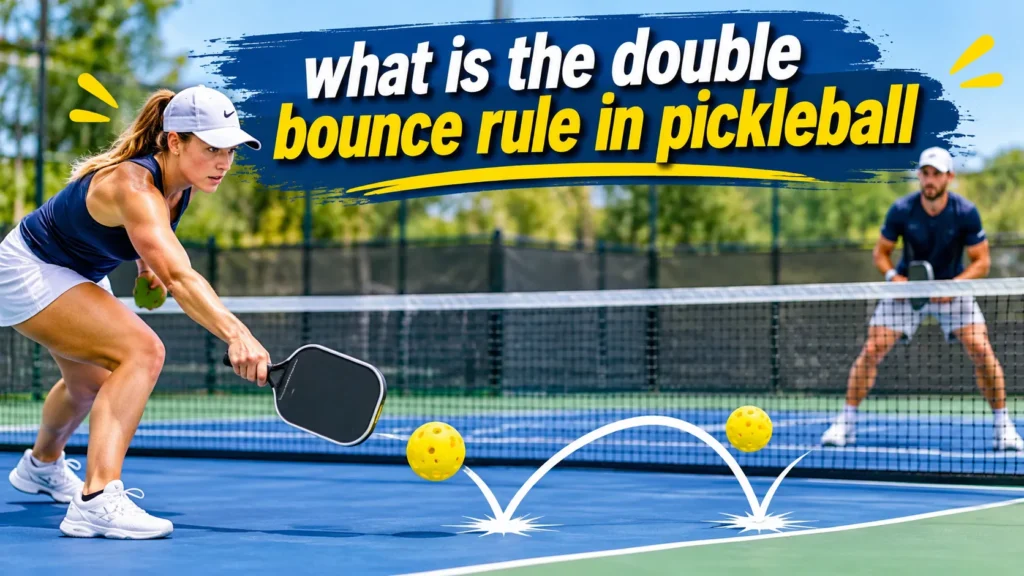
The engineering core of this topic centers upon its non-traditional rally startup setup. While legacy racket sports rely primarily on serve-and-volley dominance, this rule bridges patience with the rigorous tactical positioning of modern court sports. The 2026 USAP Rulebook defines it formally under Rule 10.A, mandating a specific sequence for the first two shots of any point.
- The First Bounce Matrix: Utilizing the serve as the catalyst, the ball must clear the Non-Volley Zone and land inside the receiver’s diagonal service box. This initial ground contact counts as the first mandatory bounce. If the receiver catches an out-of-bounds serve in the air before it lands, it is a fault against the receiver, not the server.
- The Second Bounce Boundary: Because the returning team can immediately move forward after hitting their shot, the serving team requires a structural countermeasure. The serving team must stay anchored behind the baseline, allowing the return shot to bounce once on their side. Hitting this ball out of the air is an instant fault.
- Open Court Mechanics: Once these two bounces have been fulfilled, the rally enters open play. This allows players to execute sudden volleys or let the ball bounce, opening up the entire court for dinking, drives, and lobs.
The tactical layer balances ultra-aggressive positioning with the protective requirement to wait for the bounce. This forced patience prevents immediate premature points caused by overwhelming overhead smashes off the return. For players analyzing options across the entire tactical matrix, evaluating the dedicated strategies outlined in our comprehensive look at how to play pickleball for beginners provides clear contextual background before stepping onto the court.
Double Bounce vs. Two-Bounce Rule: Deciding on the Call
Navigating the rulebook requires a clear understanding of the mechanical differences between the flagship “Two-Bounce Rule” (Rule 10.A) and its similarly named counterpart, the “Double Bounce” (Rule 10.B). Selecting the correct terminology dictates how conflicts are resolved during un-officiated match play across local parks and facilities.
The Self-Officiating Variance
The traditional Two-Bounce Rule focuses extensively on the start of the point, expiring after the third shot is struck. Conversely, a “Double Bounce” is an actual fault that occurs when a ball bounces twice on the same side of the net during any part of the rally. According to the 2026 guidelines (Rule 13.D.1.d), calling this fault is strictly the responsibility of the players on the side where the ball bounced. Furthermore, the updated rules strictly prohibit players from asking spectators to verify if a ball bounced twice, mandating that the crowd remain entirely uninvolved in line calls.
The Missing Angles: Rare Physics and Wheelchair Rules
There are rare anomalies that deeply impact this rule, introducing an undeniable strategic penalty. For instance, the extreme backspin anomaly (Rule 11.I.A) occurs if a ball bounces legally on your side but spins backward over the net before you can touch it; in this rare case, you lose the point unless you legally reach over the net to strike it. Additionally, wheelchair and adaptive players are granted a “Two-Bounce Allowance” (Rule 25.A.9). This allows the ball to bounce twice before they must return it, and significantly, the second bounce is permitted to land completely out of bounds, altering the entire geometry of hybrid matches.
If you are a high-level competitor seeking to match advanced court dynamics with elite-tier control, exploring the definitive structural mechanics detailed in our guide to 3rd shot pickleball will ensure your entire game plan functions in perfect technical alignment.
Head-to-Head: Traditional Volley Serve vs. The Drop Serve
For players trying to choose between mastering the traditional Volley Serve and the newer Drop Serve, the choice comes down to a fundamental split in design philosophy regarding how you initiate what is the double-bounce rule in pickleball. Both models command top-tier placement across US courts but approach the mandatory first bounce from completely opposing angles.
The primary differences in on-court performance and how they trigger the initial bounce are detailed in the comparison matrix below:
- Compliance and Rule Scrutiny: The Volley Serve wins decisively on raw power but faces strict 2026 regulations; contact must now “clearly” be below the waist, and the paddle head must “clearly” remain below the wrist. The Drop Serve features a remarkably simple structural layout—you drop the ball from any natural height, let it bounce, and hit it without any wrist or waist height restrictions.
- Spin Generation and Control: The traditional serve dominates the spin category by allowing players to generate heavy topspin off the paddle face, making the first required bounce violently kick toward the receiver. The Drop Serve provides excellent fluid consistency but yields slightly less pace, making it easier for the receiver to safely satisfy the bounce rule.
- Learning Curve and Value: The heavy mechanics on the traditional volley serve easily require months of continuous match play to master without faulting. The lighter, un-restricted motion of the drop serve generally shows significant reliability within just a few sessions of intense use, making it the superior choice for minimizing service errors.
For a complete, comprehensive overview of the broad variety of choices currently occupying the competitive landscape across American clubs, take a moment to read our detailed breakdown of official pickleball rules alongside our independent evaluation of advanced pickleball kitchen rules to select your ideal strategic fit.
Frequently Asked Questions (FAQ)
Are continuous double hits considered a fault if they happen while waiting for the bounce?
No. Under the updated 2026 rules (Rule 10.D), if you accidentally hit the ball twice—or even three times—in a single, continuous, single-direction stroke, the play remains legal and the rally continues. The fault is only called if you deliberately stop your swing and start a second distinct motion.
Can I safely step into the non-volley zone right after I let the ball bounce?
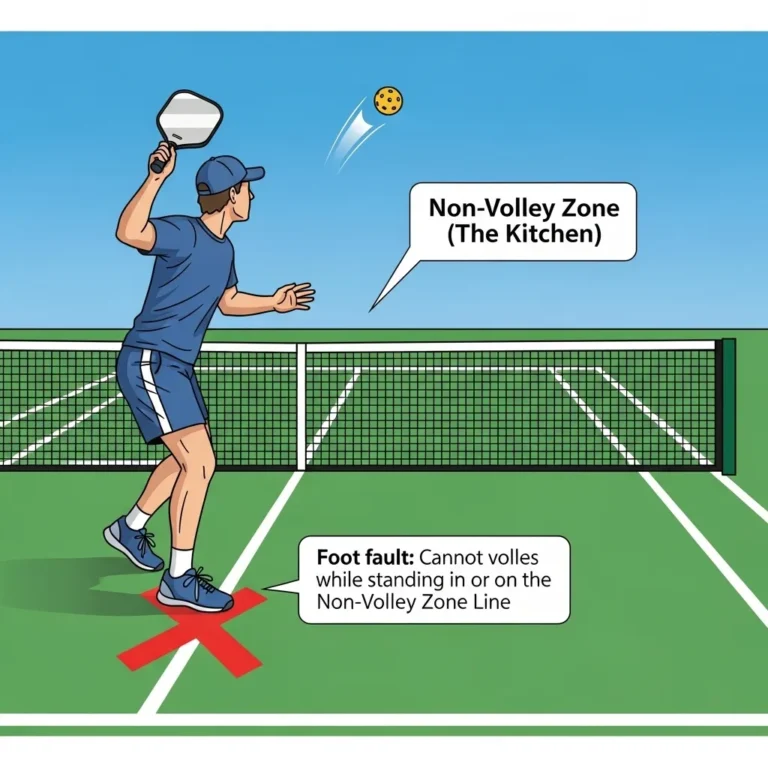
Yes, with a critical caveat. You are allowed to stand in the Kitchen at any time to hit a ball that has already bounced. However, if you hit a volley from outside the Kitchen, but your forward momentum carries you onto the line, it is a fault—even if the ball is already dead on the opponent’s side of the court.
What happens if the ball legally bounces in the court, but then immediately hits the net post?
The 2026 rule updates clarified this specific permanent object anomaly. According to Rule 10.C.5, if your shot legally clears the net and bounces inbounds, but then spins or deflects into a permanent object like the net post or fence before your opponent can hit it, you win the rally.