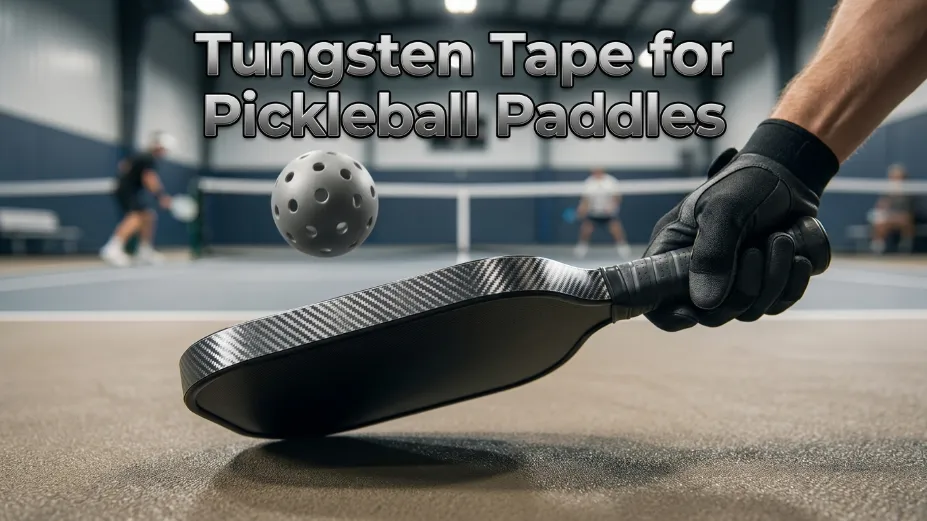
Most pickleball paddles come off the factory line missing one crucial element: your specific swing mechanics. If your off-center hits are dying at the net, or you feel the paddle twisting during heavy drives, the fix isn’t buying a new $250 paddle—it’s altering its mass distribution. Adding tungsten tape for pickleball paddles is the cleanest, most efficient way to expand your sweet spot and inject raw power into your shots without touching hazardous lead alternatives.
Best Pickleball Lead Tape — Comparison
Weight · Adhesive · Primary Use · Price (USD)
For players in the United States looking to optimize their gear setup, we highly recommend 11SIX24 Premium Weighted Tape for its exceptional value and temperature-resistant adhesive, while those who want maximum customizability in weight should choose Pickleball Effect Tuning Tape. If you are modifying a high-end, thin edgeless paddle and want convenient, tool-free court tuning, Selkirk Weighted Tungsten Tape is the superior, highly precise option.
Materials Science: Why Tungsten Beats Lead (Toxicity & Density)
Historically, racquet customizers relied almost exclusively on lead tape to alter swing mechanics. However, lead is a highly toxic heavy metal. When you handle exposed lead tape, microscopic residue transfers to your fingers, raising ingestion risks. This is especially concerning for players who wipe sweat off their faces mid-match or enjoy snacks on the sidelines without washing their hands. Switching to non-toxic tungsten eliminates these hazards entirely, making it safe to handle without gloves or post-installation sanitization.
Beyond safety, tungsten offers physical properties that make it an exceptional material for equipment tuning. In its pure elemental form, tungsten has a density of approximately 19.3 g/cm3, whereas lead has a density of about 11.3 g/cm3. This represents an approximate 70% increase in density, meaning a smaller physical volume of tungsten can match the weight of a much larger, bulkier piece of lead. In a sport like pickleball, where lightning-fast net exchanges require maximum maneuverability, maintaining a slim, aerodynamic profile is a significant competitive advantage.
The Malleability Paradox: Why is Some Commercial Tungsten Tape Thicker Than Lead?
A common point of confusion among gear enthusiasts is the thickness of commercial tungsten tape. If tungsten is chemically denser than lead, why does a strip of 1-gram-per-inch tungsten tape often feel thicker or more rigid than an equivalent lead strip? This is known as the Malleability Paradox. The answer lies in the mechanical properties of the metals. Pure tungsten is incredibly stiff and brittle, meaning it cannot be rolled into ultra-thin, flexible sheets without cracking or breaking. To make it malleable enough to conform to the curved edge guard of a carbon fiber pickleball paddle, manufacturers must use powder metallurgy.
Microscopic tungsten powder is suspended within a flexible polymer matrix filler or silicone binder. While this polymer matrix provides the necessary flexibility, the inclusion of non-metallic materials lowers the overall bulk density of the finished composite tape. To compensate for this lower composite density and still hit a target weight of 1 gram per inch, the tape must be extruded with a thicker profile. In contrast, pure lead is naturally soft and malleable, allowing it to be hammered into paper-thin, solid metallic foils that require no polymer fillers. Understanding this material variance helps players appreciate the subtle engineering differences between these two weight-tuning options.
The Physics of Paddle Customization: Swingweight vs. Twistweight
To understand how adding a tungsten tape for pickleball paddle modifications alters your game, you must look at rotational dynamics. Every swing of a pickleball paddle is governed by its moment of inertia, which is mathematically represented as:
$$I=\sum m_i r_i^2$$
Where $I$ is the moment of inertia, $m_i$ represents the added mass, and $r_i$ represents the distance of that mass from the axis of rotation (your wrist and forearm). This physical relationship determines how the paddle interacts with the ball across two critical axes: swingweight (resistance to forward swing acceleration) and twistweight (resistance to twisting on off-center hits).
- Swingweight: Represents how heavy the paddle feels when in motion. Placing weight further from your hand (high $r_i$) increases swingweight dramatically, translating to heavier plow-through and deeper baseline drives, but slowing down reaction speed at the kitchen line.
- Twistweight: Represents the paddle’s torsional stability. When you hit a ball off-center, the paddle attempts to rotate around its vertical centerline. Adding weight to the lateral edges increases twistweight, resisting this rotation and widening the effective sweet spot of the paddle face.
The “Clock System” Setup for Precise Customization
Players use a tungsten weighted tape for pickleball paddles layout modeled after a clock face to target specific performance characteristics :
- 12 O’Clock (Top of the Head): This placement maximizes the distance from your hand, raising the swingweight and balance point to their absolute limits. It is highly recommended for singles players who want maximum driving power and deep, rolling groundstrokes, though it will make your hands feel slower during rapid volleys.
- 10 and 2 O’Clock (Upper Corners): A hybrid zone that provides a moderate boost to swingweight while expanding the sweet spot vertically. This is ideal for all-court players who want to inject more power into their overhead slams and serves without completely destroying their defensive maneuverability.
- 3 and 9 O’Clock (Sides): This is the premier placement for increasing twistweight. By placing the mass at the maximum horizontal distance from the paddle’s centerline, you drastically minimize twisting on off-center blocks. It expands the sweet spot horizontally, making your defensive resets feel incredibly stable and forgiving.
- 4 and 8 O’Clock (Throat/Bottom Corners): This zone places the weight close to the paddle’s natural balance point. It adds stability and solidness to the face while keeping swingweight low, preserving your quick hands at the net. If you are learning what is pickleball paddle tuning for the first time, this is the safest starting point.
- Handle / Butt Cap: Adding weight under the grip shifts the balance point downward, making the head feel lighter. This is used to counterbalance a head-heavy paddle or simply to increase the static weight for a more substantial hand feel without slowing down your swing speed.
Physiological Prevention: Combatting “Pickleball Elbow” Through Vibration Dampening
Adding weight is not just about power and stability; it is a critical tool for injury prevention. Lateral epicondylitis, commonly known as “tennis elbow” or “pickleball elbow,” is a frequent overuse injury caused by repetitive micro-trauma to the forearm tendons. When a ball strikes a paddle face outside of the sweet spot, the paddle twists violently. To keep the paddle from turning in your hand, you must grip the handle with excessive force—a habit known as over-gripping. Over time, this constant tendon strain leads to chronic inflammation and pain.
Adding tungsten tape to the 3 and 9 o’clock positions directly prevents this by raising the paddle’s twistweight. With higher torsional stability, the paddle resists twisting on its own, allowing you to maintain a relaxed, comfortable grip even when you miss-hit a ball. Additionally, the polymer-tungsten composite matrix acts as a highly efficient viscoelastic damper. When the ball impacts the paddle face, kinetic vibration waves travel through the frame. The flexible polymer binder absorbs these high-frequency shockwaves, dissipating them as negligible heat before they reach your wrist and elbow. This acoustic impedance shift is instantly recognizable: the loud, annoying “ping” of a stock paddle is replaced by a satisfying, deep-thudding feedback that protects your joints over long playing sessions.
Finding the Best Tungsten Tape for Pickleball Paddles
When selecting the carbon fiber pickleball paddle tuning accessories that match your playstyle, you must evaluate brand-specific variations. Brands like Pickleball Effect and Selkirk offer highly refined products tailored specifically for the sport’s unique dimensions. For example, the best tungsten tape for pickleball paddles utilizes high-grade 3M acrylic adhesive, which is formulated to withstand the heat and humidity of outdoor summer courts without sliding or peeling off mid-game. Selecting pre-cut 3-gram strips or flexible rolls of 0.5-gram-per-inch tape gives you complete control over your paddle’s physical evolution.
Is Importing Tungsten Weighted Tape for Pickleball Paddles China Wholesale Worth It?
For clubs, coaches, or players who customize multiple paddles weekly, buying unbranded rolls of tungsten weighted tape for pickleball paddles china wholesale is highly appealing. These direct-from-factory options are incredibly cheap compared to retail brand names. However, wholesale imports present a few quality-control trade-offs that you must navigate carefully:
- Inconsistent Density: Lower-tier wholesale manufacturers often fail to distribute the tungsten powder evenly within the polymer matrix. This results in inconsistent weight-per-inch measurements across the same roll. If you use wholesale tape, you must use a digital scale to verify the weight of each strip before applying it to maintain side-to-side symmetry.
- Adhesive Degradation: Cheap wholesale tapes often use low-grade industrial adhesives that dry out, slide under high heat, or leave a messy, sticky residue when peeled off. To fix this, you should secure wholesale tungsten strips under a layer of high-quality electrical tape.
- Aesthetic Imperfections: Unlike the sleek matte-black finishes of premium retail brands, wholesale tapes may have irregular metallic gray surfaces that look rough and unfinished on a premium paddle.
How to Customize Edged vs. Edgeless Paddles
The structural build of your paddle dictates how you should apply tape. Traditional paddles feature a thick plastic edge guard, whereas modern aerodynamic designs are completely edgeless. Customizing these two styles requires different physical approaches:
- Edged Paddles: These models feature a protective plastic rim with a flat channel that is typically 1/2-inch wide. Standard 1/2-inch tungsten tape fits perfectly inside this channel, protecting the weighted tape from ground scrapes during low dinks and keeping your paddle looking clean.
- Edgeless Paddles: Models like the Selkirk Luxx Control Air Invikta are highly aerodynamically efficient but extremely thin, often measuring only 13mm to 14mm. Standard 1/2-inch tape is too wide and will bleed onto the textured grit of the hitting surface. For edgeless pickleball paddles, you must use specialized 1/4-inch tungsten tape and seal the edges with electrical tape to prevent peeling.
The Precision Installation Protocol
To ensure your customized weight setup lasts through intense gameplay, follow this professional installation guide :
- Decontaminate the Surface: Clean the paddle’s rim twice with a cloth soaked in >90% Isopropyl Alcohol. This removes dirt, sweat, and oils that ruin adhesive bonds. Let it dry completely for 60 seconds.
- Buff the Surface (Optional): For smooth, glossy edge guards, gently buff the application area with 400-grit sandpaper to create micro-textures that improve mechanical adhesion. Clean again with alcohol after buffing.
- Manage the Temperature: Ensure the room temperature is at least 68°F. Cold temperatures prevent pressure-sensitive adhesives from achieving maximum tack.
- Apply and Compress: Place the measured strips symmetrically on either side of the paddle. Press down firmly from the center outward, then use a flat plastic tool (like a credit card) to rub the tape with heavy, uniform pressure for 12 seconds to eliminate air bubbles.
- Respect the Dwell Period: Do not play with the paddle immediately. Allow a full 18-hour dwell period for the acrylic adhesive to chemically cure and lock onto the frame.
USA Pickleball Rule Compliance and Warranty Protection
Before you take your newly weighted paddle to a tournament, you must ensure your modifications comply with the official rules. According to USA Pickleball Rule 2.E.5, aftermarket alterations are legal as long as they follow strict placement boundaries to preserve fair play. You can read the complete guidelines in the USA Pickleball Official Equipment Standards manual. Specifically, Rule 2.E.5.b states that weighted tape and decals must not extend more than 1.0 inch above the top of the grip, nor more than 0.5 inches inside the outer edge or edge guard. Violating these rules during sanctioned tournaments can lead to immediate match forfeiture.
Furthermore, many players worry that adding tape will void their manufacturer’s warranty. Fortunately, leading brands like CRBN and Selkirk explicitly state that adding non-destructive modifications, like weighted tape or overgrips, is completely fine. However, making permanent structural changes—such as drilling into the paddle core, altering the face texture, or removing the butt cap—will immediately void your warranty. When removing old tungsten tape, peel it off slowly and avoid using sharp metal tools that could scratch or gouge the underlying carbon fiber surface.
Advanced Customization: The Temporary Testing Hack
Because premium tungsten tape is relatively expensive, peeling and discarding strips during the trial-and-error phase can quickly drain your wallet. To prevent this waste, use the Temporary Testing Hack. Cut your tungsten strips to the desired lengths, but do not peel off the adhesive backing. Instead, place the backed strips onto your paddle’s rim at the targeted locations (such as 3 and 9 o’clock) and secure them tightly using a layer of cheap electrical tape.
This allows you to test the setup on the court for several matches, adjust the placements, or swap configurations without wasting a single strip of your premium tungsten. Once you dial in the perfect balance that matches your swing mechanics, simply remove the electrical tape, peel the backing off the tungsten, and apply it permanently.
Frequently Asked Questions (FAQ)
1. Does tungsten tape damage the carbon fiber surface of my paddle when removed?
No, high-quality tungsten tape uses non-damaging acrylic adhesives that peel off cleanly. If any sticky residue is left behind, simply rub it off with your thumb or use a small amount of isopropyl alcohol on a cloth. Avoid scraping the surface with sharp metal blades or knives, as this can sever the carbon fiber weave and ruin your paddle face.
2. Can I apply tungsten tape to edgeless paddles?
Yes, but you must use 1/4-inch wide tape instead of the standard 1/2-inch option. Wide tape will overlap onto the hitting face, which ruins the paddle’s clean look and can negatively affect spin dynamics. Because edgeless paddles have no plastic guard to shield the tape from ground impacts, you should always cover the tungsten with a layer of protective edge tape or vinyl tape.
3. Is tungsten tape fully legal for official USAP tournaments?
Yes, adding weighted tape to customized paddles is fully permissible under USA Pickleball rules. However, you must adhere strictly to Rule 2.E.5.b, which prohibits tape from extending more than 0.5 inches inside the outer edge of the paddle face or more than 1.0 inch above the handle. Always ensure the tape is applied neatly along the outer rim to avoid penalties.
4. Why does my arm feel sore after adding tungsten tape to increase power?
If you add too much weight to the top of the paddle (12 o’clock), you drastically increase its swingweight. A higher swingweight requires much more forearm and wrist acceleration to swing, which can cause rapid muscular fatigue or tendon strain. If you experience soreness, move the tungsten tape down to the throat (4 and 8 o’clock) to lower the balance point while keeping the paddle stable.