You’ve likely heard the whisper on the court—or rather, the lack of it. There is a quiet revolution happening in the sport, and it revolves around foam pickleball paddles. But along with the hush comes a lot of noise about legality, performance, and confusing technology.
Are they banned? Do they cure tennis elbow? And what on earth is the difference between a “foam core” and “foam injected walls”?
If you are looking for the best foam pickleball paddle to reduce noise in your neighborhood, or you simply want to understand why pros are suddenly hitting harder than ever, this guide is for you. We will break down the critical differences between foam core pickleball paddles (often illegal) and perimeter foam technology (fully legal), so you can make the right choice for your game.
What Exactly is a “Foam” Pickleball Paddle?
To understand the controversy, you first need to understand the construction. For years, the industry standard has been the “Polymer Honeycomb Core”—a grid of plastic hexagons that is rigid and poppy. When players talk about foam pickleball paddles today, they are usually referring to one of two completely different technologies:
1. Solid EVA Foam Core (The “Quiet” Paddle)
This is what most people think of when they hear “foam.” Instead of a honeycomb grid, the entire core of the paddle is a solid slab of EVA foam (Ethylene-Vinyl Acetate). This is the same material used in the midsoles of high-performance running shoes.
Key Characteristics:
- Solid Construction: No air gaps or cells.
- Soft Feel: The ball sinks into the face, creating a “trampoline effect.”
- Silence: It produces a low-frequency thud rather than a high-pitched pop.
2. Foam Injected Walls (The “Pro” Paddle)
This is the technology used in modern high-performance paddles like the Joola pickleball paddle series or the Six Zero pickleball line. In these paddles, the core is still a traditional polymer honeycomb, but the manufacturer injects a specialized foam around the perimeter (the edge) of the paddle.
Key Characteristics:
- Perimeter Weighting: Increases the sweet spot and stability.
- Legal: Almost always USAPA approved.
- Hybrid Feel: Retains the crisp pop of honeycomb but with added solidity.
The Legality Question: Are Foam Paddles USAPA Approved?
This is the number one question we see on forums: “Can I use a foam core pickleball paddle in a tournament?”
The answer depends entirely on where the foam is located.
Why Solid EVA Foam Paddles are Often Banned
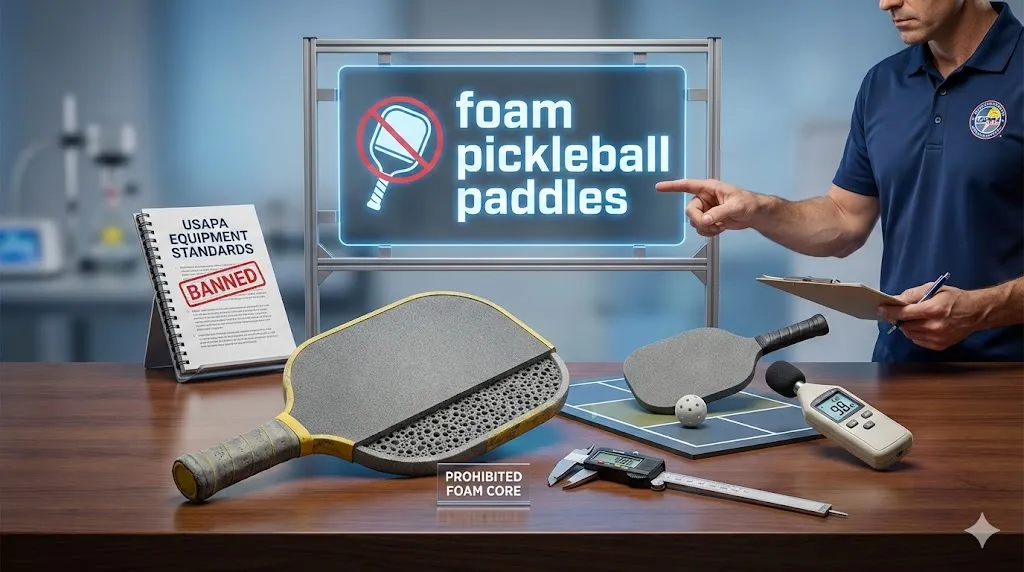
Most foam core pickleball paddles (where the entire core is EVA foam) are not USAPA approved for tournament play. The reason lies in the physics of the material. EVA foam is highly elastic. When the ball hits the paddle, the foam compresses and then rebounds with significant energy.
According to the official USAPA Equipment Standards, paddles are tested for “deflection.” If a paddle acts too much like a trampoline (launching the ball too fast), it is deemed illegal. Many solid EVA paddles exceed these exit speed limits. However, they remain incredibly popular for recreational play, especially in communities with strict noise ordinances.
Which Foam Paddles ARE Legal?
If you are looking for tournament-legal performance, you want a paddle with Foam Injected Walls. Brands have mastered the art of using foam strictly for stability rather than propulsion.
For example, the CRBN pickleball paddle utilizes foam injection around the edges to expand the sweet spot without violating deflection rules. These paddles give you the benefits of foam (stability and solid feel) without the risk of being disqualified.
Performance Breakdown: How Do They Play?
Whether you choose a solid EVA model or a perimeter-weighted paddle, introducing foam into the equation changes the physics of your game. Here is what you can expect.
1. Power & Pop (The Trampoline Effect)
Foam core pickleball paddles are effortless power generators. Because the foam compresses, it stores energy and releases it into the ball. You don’t need a massive swing to generate speed. This makes them excellent for players who lack arm strength or want to drive the ball deep with a compact stroke.
2. The “Silent” Factor: Noise Reduction
If you play in a neighborhood where neighbors complain about the “pop-pop-pop” of pickleball, a solid EVA foam paddle is the solution. The density of the foam absorbs the sound waves, creating a muted “thud” that is significantly quieter than honeycomb cores. Manufacturers like Diadem pickleball paddle (specifically the Vice model) have marketed this technology specifically for its acoustic benefits.
3. Vibration & Comfort
One of the hidden benefits of foam is shock absorption. Traditional honeycomb cores are rigid; when you mishit a ball, that shock travels down the handle into your arm. Foam dampens this vibration significantly. For players suffering from common pickleball injuries like tennis elbow, switching to a softer foam-based paddle can provide immediate relief.
4. Spin Potential
Solid foam paddles often have a longer “dwell time”—the ball stays on the face of the paddle for a fraction of a second longer than on rigid plastic. This allows players to brush up on the ball more effectively, generating immense topspin. However, some players find the face feels “mushy” at the net, making delicate dinks harder to control compared to the crisp feedback of a carbon fiber pickleball paddle.
Pros & Cons of Foam Core Paddles
Before you invest in the best foam pickleball paddle, weigh these factors carefully.
Pros
- Massive Power: effortless depth on drives and serves.
- Neighbor-Friendly: The quietest paddles on the market.
- Durability: Solid foam does not suffer from “core crushing” or soft spots like honeycomb cells do.
- Joint Relief: Excellent vibration dampening for sensitive elbows.
- No Dead Spots: The consistent density means the entire face is the sweet spot.
Cons
- Legality Issues: Most solid EVA models are banned from sanctioned tournaments.
- Weight: High-density foam can be heavier than air-filled honeycomb, potentially slowing your hand speed.
- Lack of Feedback: The soft feel can make it difficult to “feel” the ball for precision dinking.
- Price: Advanced manufacturing often comes with a higher price tag.
Buying Advice: Which Type is Right for You?
Choosing the right paddle comes down to your goals. Are you playing for fun in a noise-restricted area, or are you training for Gold in a local tournament?
For the Recreational & “Quiet Court” Player
If you play strictly for fun, or if your HOA requires “quiet” equipment, a solid EVA foam pickleball paddle is a fantastic choice. You will enjoy the power and the smooth feel. Look for models like the Diadem Vice or the Ronbus EVA. These are strictly “illegal” for tournament play but perfect for open play where pickleball rules regarding deflection aren’t enforced.
For the Tournament Competitor
Do not buy a solid EVA paddle if you plan to compete. Instead, look for “Gen 3” or “Thermoformed” paddles that list “Foam Injected Walls” as a feature. This gives you the stability and expanded sweet spot of foam while keeping your gear 100% legal. The Joola Ben Johns Perseus is a prime example of this technology done right.
If you are unsure where to start, check our guide on how to pick a pickleball paddle to match your playstyle with the right core material.
Frequently Asked Questions About Foam Paddles
1. What is the difference between EVA foam and Polypropylene core?
Polypropylene is a hard plastic arranged in a honeycomb shape (mostly air), offering a crisp pop and rigid feel. EVA foam is a solid, dense material (like a shoe sole) that offers a soft, muted feel, significant shock absorption, and a “trampoline-like” power boost.
2. Why are solid foam pickleball paddles usually banned?
They often fail the USAPA “deflection test.” Because the foam is so elastic, it propels the ball faster than the allowed limits, which is considered a safety hazard and an unfair advantage in competitive play.
3. Do foam paddles wear out or get soft over time?
Actually, solid EVA foam is incredibly durable. Unlike honeycomb cores which can delaminate or develop “dead spots” where the plastic cells break, a solid block of foam maintains its consistency for years.
4. Are foam pickleball paddles better for tennis elbow?
Yes, generally. The density of the foam absorbs impact vibration much better than rigid plastic cores. If you suffer from arm pain, a foam paddle (or a foam-perimeter paddle) can reduce the strain on your tendons.
5. Can I use a foam core paddle for open play at my local club?
In almost all cases, yes. Unless your local club specifically follows strict USAPA tournament rules for recreational open play, nobody will object to you using a foam paddle. In fact, your opponents might appreciate how quiet it is.
Conclusion
The term “foam” in pickleball is no longer a dirty word—it is the future of paddle engineering. Whether you opt for the forbidden power of a solid foam core pickleball paddle for your weekend games, or the precision-engineered stability of a foam-walled tournament paddle, this technology is here to stay.
For beginners, we recommend starting with a standard polymer core to learn control before graduating to the unique feel of foam. You can see our top picks for best beginner pickleball paddles here.
Ultimately, the best paddle is the one that feels right in your hand and keeps you on the court longer. If that means a silent, soft, powerful foam paddle, then embrace the technology and enjoy the game.
You May Also Like