diadem pickleball paddle
If you’ve spent any time on the courts lately, you’ve probably noticed a shift. Amidst the sea of generic paddles, there’s a brand that’s been turning heads—not just because of their flashy designs, but because of the distinct pop and precision they bring to the game. I’m talking, of course, about the diadem pickleball paddle.
Choosing a paddle used to be simple, but now? It feels a bit like buying a car. You have horsepower (power), handling (control), and aerodynamics (speed). It can be overwhelming. Whether you are a weekend warrior just looking to have a laugh with friends or a tournament grinder obsessing over spin rates, finding the right gear is personal. It’s an extension of your arm, after all.
In this deep dive, we’re going to chat about diadem pickleball paddles like we’re sitting on the bench between games. We’ll look at the pickleball paddles diadem offers, from the controversial “Vice” to the steady “Warrior,” and explore exactly what makes this brand tick. We will also touch upon the diadem warrior edge pickleball paddle and look at every new development diadem pickleball paddle engineers have cooked up.
Grab a water bottle, sit back, and let’s break this down.
General Overview & Brand Reputation
When you are investing your hard-earned money into sports gear, the first question is usually about trust. You want to know if the company behind the product actually knows what they are doing.
Is Diadem a good pickleball brand? (Focus on their transition from tennis to pickleball and reputation for quality)
Let’s be honest: a lot of pickleball brands popped up overnight in someone’s garage. And while there’s a certain charm to that, there is something reassuring about a company that has deep roots in racquet sports. Diadem didn’t just stumble into pickleball; they migrated from the high-stakes world of tennis.
Originally based in Florida, Diadem made a name for itself designing high-performance tennis strings and racquets. Why does this matter for you? Because tennis tech translates surprisingly well to pickleball. They understand dwell time, aerodynamics, and material physics. When they decided to enter the pickleball space, they didn’t just slap a logo on a generic factory paddle. They brought their engineering team with them.
The consensus among players is that Diadem represents “affordable luxury” and innovation. They are often credited with pushing the envelope—sometimes a little too far, which we will get to later—regarding core thickness and face materials. If you are looking for a brand that prioritizes engineering over marketing fluff, Diadem is absolutely a top-tier contender.
Top Pickleball Gifts 2025:From Stocking Stuffers to Pro Gear
Looking for unique pickleball gifts? We break down practical gear, funny apparel, and budget-friendly ideas to help you surprise the player in your life.
What is the difference between Diadem’s top paddle lines? (Overview of the Warrior, Icon, Edge, and Vice series)
Navigating the Diadem lineup can feel a bit like learning a new language, but once you get the vocabulary, it makes perfect sense. Think of their lineup as a spectrum ranging from “soft touch” to “pure chaos.”
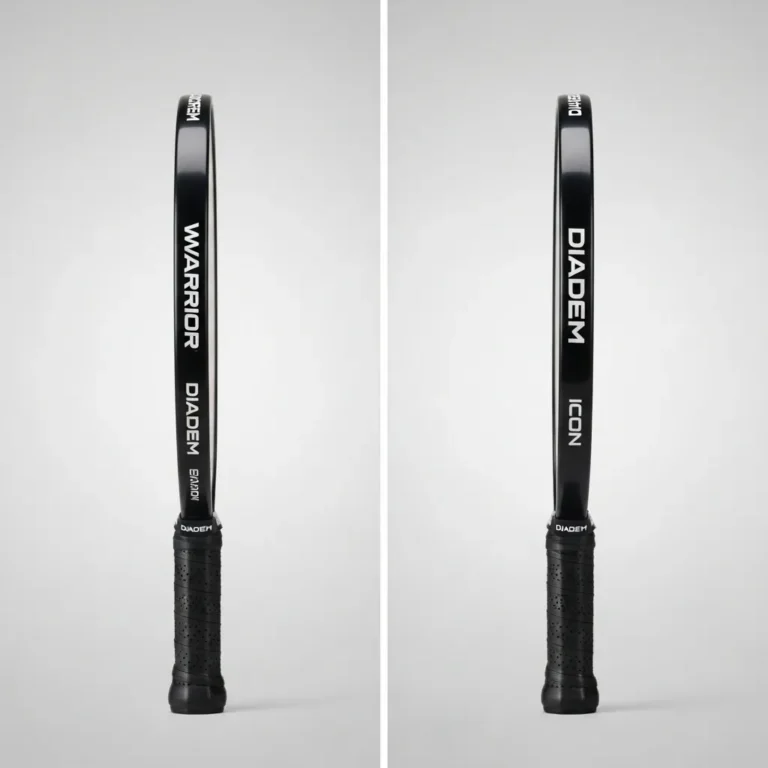
- The Warrior Series: This is the flagship. When you hear people talking about the “thick core” revolution, they are usually referencing the Warrior. It’s designed for the player who wants stability. It’s the shield. It absorbs energy and gives it back with controlled precision.
- The Icon Series: If the Warrior is a shield, the Icon is a sword. It’s generally thinner, stiffer, and designed for players who want the ball to fly off the face. It’s for the “bangers” and the speed-up specialists.
- The Edge Series: This is the middle ground, often considered the “Goldilocks” paddle. Specifically, the diadem warrior edge pickleball paddle bridges the gap, offering the spin capabilities of the Warrior but in a more maneuverable, slightly thinner profile (usually 16mm). It’s incredibly popular because it fits so many playstyles.
- The Vice: The rebel. We will dedicate a whole section to this bad boy later, but in short: it’s the paddle that breaks the rules.
Are Diadem paddles suitable for beginners or advanced players? (Distinguishing between the Hero line for starters vs. the Warrior/Edge for pros)
One of the things I really appreciate about Diadem is that they don’t exclude anyone.
If you are just starting out—maybe you’ve played three times and are tired of borrowing the wooden loaner paddle at the rec center—you don’t need to drop $200. Diadem has the Hero line. It’s accessible, durable, and has a massive sweet spot. It’s forgiving. It allows you to learn the mechanics of the game without the paddle punishing you for hitting slightly off-center.
On the flip side, if you are a 4.0+ player looking to refine your third-shot drop or win hand battles at the kitchen line, the Warrior and Edge lines are engineered for you. These paddles reward proper technique. They provide the spin necessary to keep drives in court and the touch required for resets. So, yes, whether you are a “Hero” in training or a “Warrior” on the court, they have a stick for you.
Model Comparisons & Buying Advice
Okay, let’s get into the nitty-gritty. This is usually the part where people get stuck. You’re standing in the pro shop or staring at your online cart, hovering between two models. Let’s clear up the confusion.
Diadem Warrior vs. Diadem Icon: Which one should I choose? (Comparing the thick, control-oriented Warrior vs. the thinner, power-oriented Icon)
This is the classic “Control vs. Power” debate.
Imagine playing with the Diadem Warrior. It’s famous for its 19mm thickness (which is huge in the pickleball world). When the ball hits the Warrior, it feels like it sinks into a pillow for a split second before launching. This is called “dwell time.” It gives you incredible control. If your game is about resets, dinks, and frustrating your opponent with perfect placement, you want the Warrior. It feels plush, solid, and incredibly stable.
Now, imagine the Diadem Icon. It is usually 12mm to 13.7mm thick. It’s sleek and stiff. When the ball hits the Icon, it rebounds instantly. There is less absorption and more deflection. If you have a short, compact swing and want the ball to scream over the net, or if you struggle to generate your own power from the baseline, the Icon is your best friend.
The verdict: Choose the Warrior if you are a tactile player who likes to “feel” the ball. Choose the Icon if you want immediate pop and hand speed.
What makes the Diadem Edge 18k different from other carbon paddles? (Focus on the carbon fiber face and spin potential)
You’ll hear a lot of buzz about “Raw Carbon Fiber” in the industry. It’s the gold standard for spin. But Diadem decided to take a new development diadem pickleball paddle route with the Edge 18k.
Most carbon paddles use a uni-directional weave. The Edge 18k uses a multi-directional carbon fiber weave (specifically, 18,000 filaments per tow, hence the name). Without getting too bogged down in the science, think of it this way: standard carbon fiber is like a smooth road; the 18k weave is like a road with micro-grooves running in every direction.
What does this mean for you? It means the paddle can “grab” the ball from any angle. Whether you are slicing a return, rolling a dink, or hitting a topspin drive, that tri-axial weave bites into the plastic of the ball, imparting massive RPMs (rotations per minute). If you are a spin junkie, the Edge 18k feels almost like cheating.
Which Diadem paddle has the most power?
If pure, unadulterated velocity is what you crave, the Icon v2 (specifically the Power Pro version) generally takes the crown here. Because it uses a thinner core and a stiffer face material, it transfers energy very efficiently. It doesn’t “eat” the energy of the ball; it reflects it.
However, a special honorable mention goes to the Diadem Warrior Edge pickleball paddle when you swing it fast. Because it is lighter than the original Warrior, you can swing it harder, which generates pace. But for “pop” off the face with little effort, the Icon is the heavyweight champ of power.
Which Diadem paddle offers the best control and soft game?
Hands down, this title belongs to the original Diadem Warrior (the 19mm beast).
There is simply no substitute for core thickness when it comes to the soft game. Think about blocking a hard drive. With a thin paddle, the paddle might twist in your hand, or the ball might pop up too high. With the 19mm Warrior, the paddle acts like a wall. It absorbs the shock, stabilizes the hit, and allows you to drop the ball gently into the kitchen. It is the ultimate tool for the “chess player” style of pickleballer.
The “Forbidden” Paddle (The Vice)
Every good story needs an outlaw, and for Diadem, that outlaw is the Vice. This paddle caused quite a stir when it was released, and it’s a fascinating piece of engineering, even if you can’t use it everywhere.
Why is the Diadem Vice “illegal” for tournament play? (Explaining the holes in the core and EVA foam construction)
The Diadem Vice is not USAPA approved. You cannot use it in a sanctioned tournament. But why?
The governing body of pickleball has strict rules about surface roughness and core materials to prevent the ball from moving at dangerous speeds or behaving unpredictably. The Vice breaks two main rules:
- EVA Foam Core: Instead of the honeycomb polymer core found in 99% of paddles, the Vice uses EVA foam—the same stuff found in high-end running shoes. It is incredibly springy and quiet.
- The Holes: If you look at the core, it has actual holes drilled through the foam (though covered by the face). This creates a trampoline effect that is frankly terrifying if you’re standing at the net.
The combination of the foam and the structure launches the ball at speeds that exceed the current safety limitations set by the USAPA. It creates too much power and creates spin that is difficult to read.
Can I use the Diadem Vice for recreational play?
Absolutely! And you should, if you get the chance.
If you are playing in a local rec league (check with your organizer first), playing in the park with friends, or just drilling to improve your reflexes, the Vice is a blast. It is incredibly easy on the arm because the foam absorbs almost all vibration. It’s also silent. If you have neighbors complaining about the “pop-pop” noise of your court, the Vice is essentially a “stealth mode” paddle.
Just be a good sport: if you show up to open play with a Vice, tell the other players. Don’t be the person blasting drives at grandma with a non-compliant super-paddle without a warning!
How does the Vice compare to approved paddles in terms of spin and pop?
It is in a league of its own.
Regarding “pop,” the ball rockets off the face. You barely have to swing. It levels the playing field for players who might not have a lot of physical strength.
Regarding spin, the surface friction combined with how the ball sinks into that soft foam allows for angles that defy physics. You can hit slices that skid and jump sideways. It’s fun, it’s wild, and it highlights exactly why regulations exist—because the technology is capable of surpassing the human ability to react.
Technology & Performance Specs
Diadem is for the geeks (and I say that with love). They pack a lot of tech into these rectangles. Let’s decode the specs so you know what you are actually paying for.
What is the benefit of the Diadem Warrior’s 19mm core thickness? (Explaining stability and vibration dampening)
We touched on this, but it’s worth a deeper look. Most standard paddles are 13mm or 16mm. A 19mm core is like driving a tank versus driving a sedan.
The primary benefit is stability. When you hit the ball near the edge of a thin paddle, the paddle wants to twist in your hand. This is called torque. The 19mm core creates a massive “moment of inertia.” In plain English: the paddle resists twisting. This expands the sweet spot practically to the edge guard.
The secondary benefit is vibration dampening. This is crucial for anyone worried about tennis elbow. The thicker core dissipates the shock wave before it travels up the handle and into your tendon. It’s a smoother, buttery feel.
Does the “grit” on Diadem paddles wear off quickly? (addressing concerns about the durability of the textured surface)
This is a common concern with all raw carbon and spray-grit paddles.
Diadem uses a few different methods. Their “raw carbon” paddles (like the Edge 18k) rely on the actual fabric of the carbon for friction. This is very durable and lasts a long time, though it can get clogged with ball dust (more on that in the maintenance section).
Their painted or sprayed-grit surfaces (found on some Icon models or lower-tier paddles) are essentially layers of texture applied to the face. While Diadem’s application is high quality, physics dictates that grit eventually smooths out over time with repeated impact. However, Diadem is known for using a “vertical spray” technique that bonds the grit well. For the average player, you will get a long life out of it. If you play every day for four hours, expect the spin to drop off slightly after 6-8 months, which is industry standard.
What is the difference between the “Power Pro” and standard versions?
You might see an “Icon v2” and an “Icon v2 Power Pro.”
The “Pro” nomenclature usually involves a few tweaks. Often, it implies a denser core or a specific weight distribution designed for higher-level play. The Power Pro versions often have a slightly different edge construction or handle length to facilitate two-handed backhands, which are common in the pro game. Essentially, the “Standard” is balanced for all-around ease of use, while the “Power Pro” is tuned for aggressive, offensive play, sacrificing a little bit of forgiveness for raw output.
Are Diadem paddles thermoformed? (Clarifying construction methods for models like the Icon V2)
Thermoforming is the buzzword of the last two years. It means the paddle is molded under heat as one single piece (unibody), rather than having a handle glued to a face.
Yes, Diadem has embraced this with their newer lines, representing a new development diadem pickleball paddle strategy. The Icon v2, for instance, utilizes elements of this construction. Thermoforming creates a stiffer, more durable paddle with a larger sweet spot because the edge is reinforced with carbon fiber foam. It prevents the dreaded “dead spots” near the edges. If you see “foam injected walls” in the description, that’s a sign of high-end thermoformed (or semi-thermoformed) construction.
Durability, Warranty & Maintenance
You’ve bought the paddle. Now, how do you keep it playing like new? And what happens if it breaks?
How durable are the edge guards on Diadem paddles? (Addressing the replaceable edge guard feature on some models)
This is one of the coolest features Diadem introduced. On the Icon v2, they introduced a replaceable edge guard system.
Let’s face it: we scrape our paddles. We dive for balls; we accidentally smack the court surface. The edge guard is the first thing to go. Usually, once the guard cracks, the paddle is on death row. But with Diadem’s innovative design, you can actually purchase replacement edge guards and swap them out. This significantly extends the life of the paddle.
For the models without the replaceable guard (like the Warrior), the adhesive and materials used are robust. They aren’t invincible, but they hold up well to standard court abuse.
What is Diadem’s warranty policy for paddles? (Covering defects vs. normal wear and tear)
Diadem stands behind their gear. Generally, they offer a 6-month warranty against manufacturing defects.
It’s important to understand the difference between a “defect” and “wear.”
- Defect: The handle snaps in half during a normal serve; the face delaminates (bubbles up) after one week; the edge guard falls off without impact. Diadem will replace this.
- Wear and Tear: The white graphics fading; the grit smoothing out after a year; a crack in the edge guard because you threw your paddle after losing a point (we’ve all been tempted). This is on you.
Register your paddle on their website immediately after purchase. It streamlines the process if you ever need to make a claim.
How do I clean my Diadem paddle to maintain spin? (Best practices for carbon fiber vs. painted grit surfaces)
If you own a diadem pickleball paddle with a raw carbon face (like the Edge 18k), you need a rubber eraser.
As you play, tiny bits of yellow plastic from the ball get shaved off and lodged in the microscopic grooves of the carbon fiber. This clogs the weave and reduces spin.
- Get a “carbon eraser” (or a generic rubber abrasive cleaner used for skateboard grip tape).
- Rub it up and down the face of the paddle. You will see the yellow dust vanish and the black carbon shine again.
- Do this once a week.
For painted/grit surfaces (like the Hero or standard Icon), do not use the eraser aggressively, as you might rub the grit off. Instead, use a damp microfiber cloth (water only, no harsh chemicals like Windex) to gently wipe away sweat and dirt. Dry it immediately.
Final Thoughts
At the end of the day, the pickleball paddles diadem produces are more than just equipment; they are a testament to how rapidly this sport is evolving. From the innovative 19mm core of the Warrior to the rebellious nature of the Vice, Diadem is a brand that refuses to be boring.
Whether you decide to pick up a diadem warrior edge pickleball paddle for that perfect blend of spin and control, or you go for the raw power of the Icon, you are buying into a philosophy of high-performance engineering.
So, head to your local shop, demo one if you can, and see if it brings that magic pop to your game. See you on the courts!