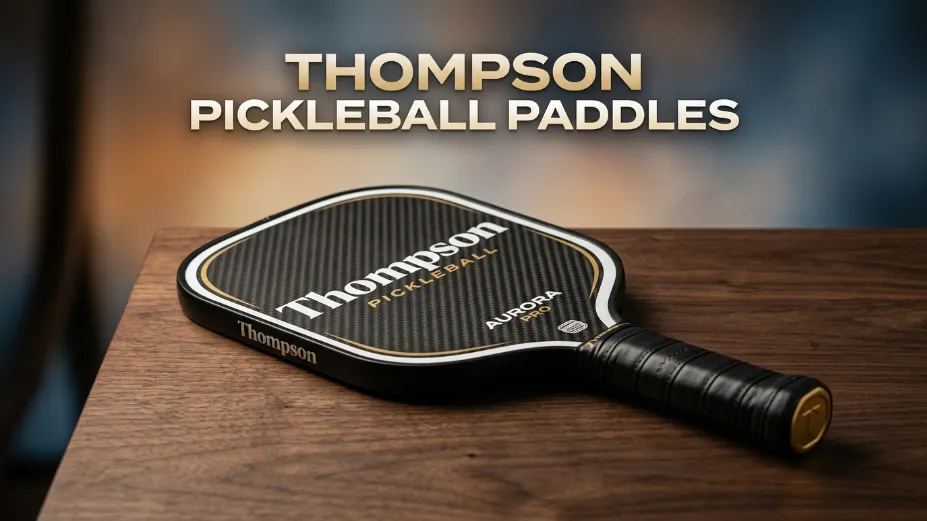
Finding a paddle that perfectly balances raw power with pinpoint resets is the ultimate challenge on the court today. While mass-advertised carbon fiber options flood the local clubs, serious players are quietly shifting their attention to a more refined engineering approach. If you have spotted that sleek, distinctive weave during rec play and wondered if the hype matches the on-court performance, you are looking for clarity. This comprehensive analysis of thompson pickleball paddles breaks down the deflection metrics, sweet spot consistency, and exact spin rates of their flagship models to see if this brand genuinely deserves a permanent spot in your gear bag.
Thompson Model 515 vs standard thermoformed competitor pickleball paddle comparison: core material and thickness, surface texture technology, average weight, control-to-power ratio, and price
Thompson Model 515 vs Competitor
Core · Surface · Weight · Power Ratio · Price (USD)
For US club players navigating intensive court schedules, the best option depends strictly on your history with joint stress and your typical playstyle. If you prioritize explosive hand speed at the kitchen line and drive-heavy baseline dominance, the Model 515 Uni is the superior choice. However, players seeking maximum physical shell longevity, a plush dinking feel, and unmatched defensive stability will find the Model 515 Twill to be the ultimate upgrade on the court.
The rapid expansion of the club scene across the United States has fundamentally altered player expectations regarding specialized gear. Generic tennis racquets or cheap entry-level paddles no longer suffice on highly competitive local courts. With specialized premium layouts arriving on the market, understanding the exact engineering beneath your paddle face becomes paramount to maintaining technical execution and avoiding injury.
Thompson Pickleball Paddle Review: Engineering the Model 515 Uni
The engineering core of the thompson pickleball paddle review centers upon its non-traditional edge construction. While legacy composite paddles rely primarily on mass-produced thermoformed foam edges, this silhouette bridges aerospace material science with the rigorous lateral constraints of modern kitchen exchanges.
- The TrueFeel™ Sidewall Matrix: Utilizing a patent-pending poured thermoset urethane edge rather than expandable foam, the primary perimeter boundary offers exceptional mechanical dampening. When defending hard drives, this dense urethane barrier absorbs massive impact energy, distributing it evenly before it can vibrate down the handle and strain your forearm muscles.
- The Unidirectional T1100 Layup: By aligning high-modulus Toray T1100 carbon fibers along a single vertical axis, Thompson creates a surface with explosive energy return. This specific composite configuration allows the Uni to achieve a 95th percentile pop score, making it a highly lethal tool for hand battles without suffering from the dreaded “trampoline effect” common in standard thermoformed faces.
- Aerodynamics and Weight Distribution: The edgeless construction minimizes drag, lowering the swingweight to an incredibly agile 107. This allows players to maneuver the carbon fiber pickleball paddle rapidly, responding to hyper-fast net volleys with instantaneous speed.
The upper surface balances raw structural integrity with an American-made peel-ply grit. This textured shield ensures consistent grit retention over hundreds of hours of play. For competitive athletes who demand a specialized weapon for hands battles and drives, analyzing the physical construction differences outlined in our analytical look at the best pickleball paddles for advanced players provides the necessary technical alignment before making a purchase.
On-Court Performance of the Thompson Pickleball Twill Paddle
Navigating this premium family requires a clear understanding of the mechanical differences between the unidirectional Uni layout and its cross-woven counterpart. Selecting your specific version of the thompson pickleball twill paddle dictates both your physical fatigue recovery cycles and your kinetic velocity on the court.
The Cushioning Variance and Dwell Time
The Twill architecture focuses extensively on energy dampening and touch. By crossing the high-grade carbon fibers in a classic multi-directional twill weave, ball impact is absorbed evenly across the face. This structural change dramatically extends “dwell time”—the fractions of a millisecond the ball remains compressed against the paddle. This pocketing effect gives control-focused players a plush, velvet-like feedback, allowing them to drop and dink with extreme precision. Conversely, the Uni employs a stiffer vertical fiber orientation designed for immediate, crisp ball deflection.
Weight and Balance Discrepancies
Because the Twill weave utilizes a denser fiber layering system, the static weight of the paddle sits at 8.4 ounces, compared to the Uni’s 8.15 ounces. However, due to the low balance point engineered into the patent-pending urethane sidewall, the Twill possesses a highly balanced swingweight of 112. This weight distribution generates a unique “weight perception paradox”—the paddle feels up to 0.5 ounces lighter during play, giving you the high-mass stability needed to block heavy drives while preserving your fast-twitch hand speed at the net. This makes it an exceptional choice for players seeking the best pickleball paddle for spin and control.
If you are a competitive player looking to match advanced footwear dynamics with your elite-tier control tools, exploring the physical court traction detailed in our guide to the skechers viper court pro pickleball shoes will ensure your entire physical setup is optimized for tournament play.
The Critical Fit Guide: Navigating the Thompson Cushioned Oval Handle
A major missing angle across commercial, mainstream e-commerce review spaces is the highly specific, non-traditional geometry of the Thompson handle. When choosing a thompson pickleball paddle, the shape of the grip requires a distinct adjustment period for players transitioning from standard octagonal handles.
The Model 515 is offered in two handle configurations: a Firm Octagon and a Cushioned Oval. The Cushioned Oval handle tapers aggressively and features a highly pronounced, oversized buttcap knob. While this shape is designed to act as a physical reference point—instantly telling your brain the exact angle of the paddle face—it can feel incredibly restrictive for advanced players (4.5+ levels) who constantly change grips between Eastern, Western, and Continental styles during active rallies.
Furthermore, because the TrueFeel™ urethane core extends directly into the handle to maximize vibration dampening, the physical feedback is remarkably dense. To prevent blisters or discomfort from the oversized buttcap, players can easily customize the handle to fit their specific biomechanical needs.
To modify the grip, simply snip the stock grip wrap with scissors and peel it away like a banana. From there, players can use athletic sports tape to build a custom taper, smoothing out the transition between the handle shaft and the oversized knob. Adding an aftermarket grip wrap, such as a Hesacore sleeve, completely transforms the ergonomics, providing a standardized, comfortable feel that locks your hand into perfect alignment.
Exposing the Information Gaps: Real-World Durability Under the Microscope
While mainstream marketing focuses on the premium aesthetic choices of this US-made lineup, deep analysis across independent playing groups reveals distinct structural advantages and minor cosmetic limitations that define long-term ownership.
- The Elimination of Core Crush: The single greatest defect in modern thermoformed pickleball paddles is core crush—the gradual breakdown of the adhesive bond between the honeycomb core and the edge walls, resulting in illegal, hyper-reactive “hot spots” or completely dead zones. Because Thompson cold-presses their paddles and replaces delicate foam borders with a solid, poured urethane sidewall, core crush is physically impossible. Even after 220+ high-stress matches, the sweet spot remains completely consistent.
- Peel-Ply Grit Longevity: The surface features an exceptionally durable, American-made peel-ply grit. Unlike spray-on grit finishes that wear down to a smooth, spinless surface within a few weeks, the textured weave on the 515 holds up beautifully. While the microscopic edges will naturally smooth slightly over six months of intense use, the flexibility of the underlying Toray T1100 fibers continues to generate elite-tier spin rates by relying on dwell-time pocketing.
- The Edgeless Cosmetic Trade-Off: Because the paddle is edgeless, the raw urethane sidewall is exposed directly to the court surface during low, defensive resets. While the urethane is incredibly durable and will not split or crack like plastic edge guards, it will show visible scuffing and minor scrapes. For players who are highly sensitive to cosmetic wear, applying a thin strip of protective tape to the top corners is a simple way to preserve the pristine look.
These engineering solutions establish the brand as a premium standard for durability, providing budget-conscious buyers with a product that easily outlasts cheap, mass-manufactured imports. To fully understand what makes this standard of quality so critical for modern play, check out our comprehensive overview of what is pickleball and how equipment evolution is redefining the sport’s landscape.
Head-to-Head: Thompson Model 515 Uni vs. Joola Ben Johns Perseus
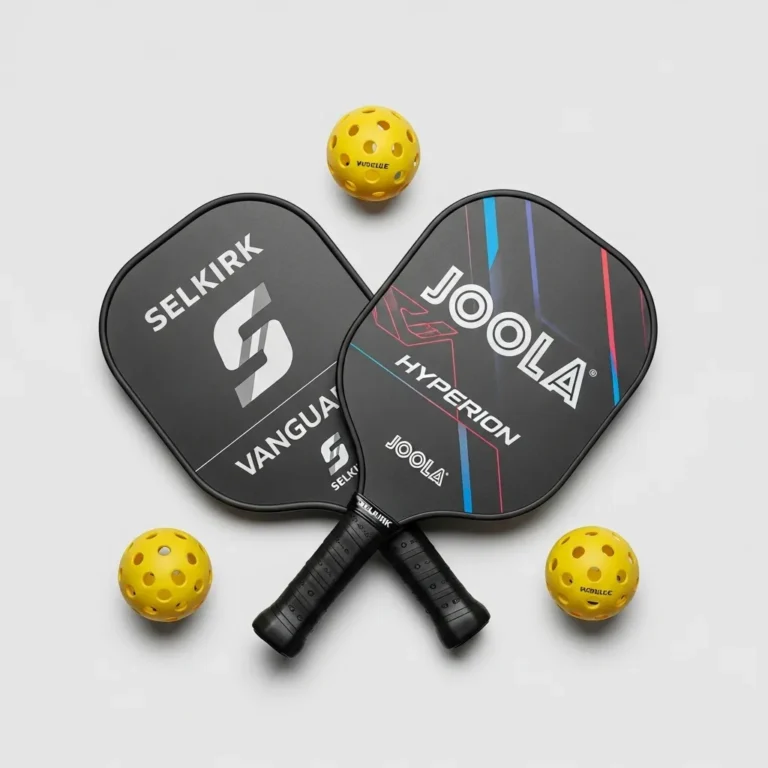
For players trying to choose between the premium thompson pickleball paddles review data and the mass-market Joola Ben Johns Perseus, the decision represents a clear choice between boutique domestic craftsmanship and global, factory-molded designs.
The primary performance discrepancies on the court are detailed in the comparative analysis below:
- Consistency and Sweet Spot Forgiveness: The Thompson 515 Uni wins decisively in sweet spot consistency. The rigid TrueFeel™ urethane sidewall acts as a perimeter weight, keeping the paddle face stable even on extreme, off-center hits. The Joola Perseus, while powerful, has a much more traditional thermoformed foam perimeter, which can feel stiff and highly unpredictable near the edges.
- Vibration Dampening and Joint Comfort: Because Thompson pours solid urethane throughout the paddle core and directly into the handle, it dampens high-frequency vibrations before they reach your wrist. Players recovering from joint fatigue or tendon strain will experience a significantly softer, more comfortable response compared to the stiff, jarring feedback of the Perseus.
- Pop and Hand Speed: At the kitchen line, the Perseus offers a highly aggressive, instant pop off the face. However, its heavier swingweight can make your hand transitions feel slightly slower during rapid fire exchanges. The Thompson 515 Uni, with its ultra-low swingweight of 107, offers faster maneuverability, allowing you to flick your wrist and recover instantly during fast-paced kitchen battles.
Buying Advice in the US: Prices, Demo Kit, and Production
Securing a premium paddle involves navigating a market flooded with private-labeled imports. Thompson Pickleball stands out by keeping their entire design, molding, and finishing processes completely in-house at their facility in Boyne City, Northern Michigan. The standard retail price of $249.00 USD reflects this localized, hands-on manufacturing approach, placing it in the premium tier of high-performance gear.
To help players choose between the Uni and Twill configurations, the brand offers a highly popular 7-Day Paddle Demo Kit. For a flat fee of $30.00 USD, players receive a customized shipping box containing both flagship models. This allows you to test the weights, feel the difference in dwell time, and evaluate the oval grip shapes on your local courts before committing to a final purchase. The demo program includes a prepaid return shipping label, making the process incredibly simple and risk-free for US residents.
Verdict: Are Thompson Paddles Worth Your Money?
The final evaluation of these high-performance paddles depends entirely on your personal playing frequency, your budget, and your appreciation for localized American manufacturing.
- Who Should Buy: Dedicated players seeking maximum long-term durability, competitors looking to eliminate arm strain through advanced mechanical vibration dampening, and athletes who want a consistent, massive sweet spot that never suffers from dead zones.
- Who Should Avoid: Beginners looking for a budget-friendly starter paddle under $100, players who prefer exceptionally thick, widebody paddles, and individuals who dislike making minor manual adjustments to their handle grips.
Frequently Asked Questions (FAQ)
Are Thompson pickleball paddles manufactured entirely within the United States?
Yes. Every single paddle is designed, molded, and finished by hand entirely in-house at their manufacturing facility in Northern Michigan, ensuring exceptional quality control and directly supporting domestic manufacturing jobs.
Can I safely use a standard household glass cleaner to clean the carbon fiber face?
It is highly discouraged. Standard chemical cleaners can leave a microscopic residue that fills the peel-ply textured grit, temporarily reducing spin performance. To clean the face and restore maximum friction, simply wipe the surface down with a damp microfiber cloth or use a dedicated neoprene paddle eraser.
How does the edgeless urethane design affect ground scrapes compared to plastic guards?
Unlike traditional plastic edge guards that can crack, catch on the court, or eventually peel away from the core, the solid thermoset urethane sidewall is permanently molded into the paddle. While it will show minor scuffs and cosmetic scrapes from aggressive kitchen play, its structural integrity remains completely intact.