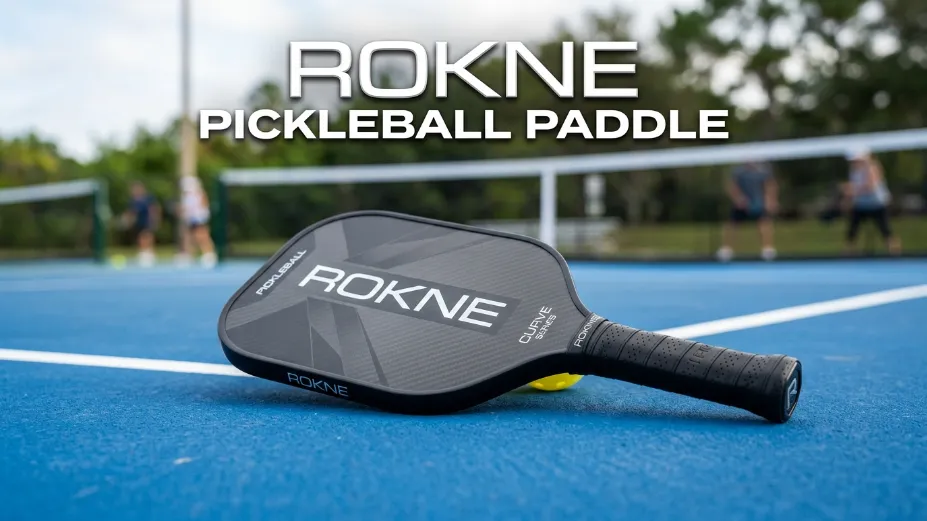
The pickleball court has officially turned into an arms race, and your standard honeycomb paddle isn’t cutting it anymore. While everyone else is busy hype-buying the same three brands they see on TV, serious players are quietly upgrading their control game with the rokne pickleball paddle lineup. It’s not just about hitting the ball harder; it’s about how the textured friction surface grips the ball during a crucial third-shot drop.
If you have been eyeing the Rokne family but cannot decide between the raw power of carbon fiber or the reliable touch of a classic face, you are looking at the exact breakdown that will save you from a costly mid-court mistake. Let us look past the marketing gloss and dissect what these paddles actually do when you are locked in a fast-paced dink battle.
Rokne Curve pickleball paddles comparison: model name, face material, core thickness, average weight, and play style
Rokne Curve — Paddle Comparison
Face Material · Core Thickness · Weight · Play Style
For US players navigating intensive court schedules, the best option depends strictly on your history with joint stress and your typical court conditions. If you prioritize pristine shock absorption, high spin rates, and immediate soft-game control, the flagship rokne curve carbon x pickleball paddle is the superior choice despite its premium retail price. However, players seeking maximum physical pop, offensive power, or those operating on a tighter budget will find the classic 13mm fiberglass model to be an incredibly high-value alternative under the $100 mark.
The rapid expansion of the club scene across the United States has fundamentally altered player expectations regarding specialized gear. Generic starter sets or basic wooden paddles no longer suffice on highly abrasive outdoor courts or during fast-paced competitive tournament matches. With specialized premium layouts arriving on the market, understanding the exact engineering beneath your hands becomes paramount to maintaining technical execution, avoiding wrist fatigue, and maximizing your performance on the court.
Rokne Curve Classic Pickleball Paddle Review: Power, Pop, and Fiberglass Grit
The engineering core of the rokne curve classic pickleball paddle review centers upon its responsive, thin-core construction. While legacy composite paddles relied heavily on standard widebody shapes with thick, heavy cores, this silhouette bridges retro aesthetic styling with the high-velocity requirements of modern offensive pickleball play.
- The 13mm Polypropylene Core: Utilizing a compressed, high-density polymer honeycomb cell matrix, the core offers rapid energy transfer. When the ball makes contact, the stiffer 13mm profile compresses minimally, rebounding the ball quickly to assist with offensive drives and fast hand battles at the kitchen line.
- The PROGrit Fiberglass Face: By implementing an elastic fiberglass face sheet, ROKNE maximizes the trampoline effect. The material flexes upon impact to catapult the ball deeper into the opponent’s court, making it an excellent weapon for tennis players who love to drive from the baseline. You can learn more about how this face material compares to other choices in our comprehensive guide to fiberglass pickleball paddles.
- The Elongated Lever: Spanning a total length of 16.5 inches, this paddle provides an extended reach and added torque. The structural shape leverages the mechanical swing path, generating high-velocity overhead smashes and deep, penetrating serves with less effort.
The raw performance of the Curve Classic is matched by a textured friction surface designed to grip the ball’s plastic shell. This allows players to access easy underspin on slice returns and heavy topspin on rolls. If you are comparing entry-to-intermediate level gear, finding a durable setup that does not break the bank is crucial, as detailed in our analysis of the best pickleball paddles under 100.
The Carbon Evolution: Rokne Curve Carbon X Pickleball Paddle
Navigating the transition from recreational play to high-level competitive tournaments requires tools that favor ball pocketing and consistent touch over raw trampoline power. The development of the rokne curve carbon x pickleball paddle represents ROKNE’s entry into elite-tier control technology, trading away thin-core stiffness for advanced material dampening.
The 16mm Core Damping Matrix
Unlike the stiff response of the 13mm Classic, the Curve Carbon X utilizes a plush 16mm polypropylene honeycomb core. The thicker physical profile deforms elastically upon impact, absorbing a massive amount of incoming ball velocity. This cellular compression increases the ball’s dwell time on the paddle face, giving the player the split-second window needed to control third-shot drops and catch tricky, low dinks. If you are struggling to understand how thickness alters playability, our guide on the 14mm vs 16mm pickleball paddle provides an essential technical breakdown.
Toray T700 Raw Carbon Fiber Surface Technology
To maximize spin rate and mechanical grip, ROKNE wraps the 16mm core in high-grade Toray T700 raw carbon fiber. Instead of relying on a temporary spray-on grit coating, the surface features a naturally abrasive, micro-textured carbon weave. This structure digs into the plastic of the ball, producing extreme friction. The raw carbon fiber surface is exceptionally durable and resists wear, allowing players to generate heavy, professional-level topspin and deep, biting slices over months of daily outdoor play. You can read more about why this material has taken over the sport in our deep dive on the carbon fiber pickleball paddle.
The manufacturing process uses a heat-intensive molding technique that bonds the face sheets directly to the polymer core, creating an incredibly stable and unified structural body. For players looking to match advanced control tools with strategic, tournament-level execution, selecting the right paddle shape and core density ensures your equipment works in perfect alignment with your physical mechanics.
Style Meets Stealth: The Rokne Curve Carbon X Nightfall Pickleball Paddle
For players who prefer a sleek, aggressive aesthetic on the court, ROKNE developed the rokne curve carbon x nightfall pickleball paddle. While many premium paddles feature loud, distracting neon graphics, the Nightfall edition presents a matte, black-on-black colorway that focuses entirely on minimalist design.
Beneath the stealth visual branding, the Nightfall shares the exact same premium engineering as the standard Curve Carbon X. It utilizes the same Toray T700 raw carbon fiber face, a 16mm core, a 16.5-inch elongated length, and a 5.25-inch handle length. On the court, the matte surface keeps the paddle looking pristine, hiding minor scuffs and ball-scrapes that typically show on lighter-colored designs.
The on-court feedback for the Nightfall is exceptionally consistent. The combination of raw carbon grit and a thick core allows players to block aggressive drives and reset the point back into the kitchen with ease. If you are a player who loves to execute tricky spin serves or disguise your drop shots, the muted visual profile of this paddle provides a slight psychological advantage, keeping your opponents guessing until the millisecond of contact.
Choosing the Right Setup: Rokne Curve Classic Pickleball Paddle vs. Carbon X
When choosing between the rokne curve classic pickleball paddle and the Carbon X, players must weigh explosive power against soft-game control. These two paddles approach the game from completely opposing material and structural angles, making a head-to-head comparison essential.
The primary performance differences are highlighted below:
- Power and Pop: The Curve Classic wins decisively on raw power and ball exit speed. Its thin 13mm core and flexible fiberglass face create a noticeable trampoline pop, making it easy to drive balls from the deep baseline or execute fast hand exchanges at the kitchen. The Carbon X features a thicker 16mm core that dampens incoming energy, requiring players to swing with more physical force to generate deep drives.
- Spin Potential and Surface Longevity: The Carbon X dominates the spin category. Its raw Toray T700 carbon fiber weave maintains its micro-grit texture indefinitely. While the Curve Classic’s PROGrit fiberglass surface offers excellent spin out of the box, the applied texture coating is more susceptible to wearing smooth under the abrasive friction of outdoor play.
- Control and Forgiveness: The Carbon X is the superior choice for a soft game. Its thick core absorbs hard shots, widening the sweet spot and preventing the ball from popping up too high on defensive blocks. The 13mm Classic is much less forgiving on off-center hits, requiring clean hand coordination to avoid dead-zone errors. If control is your main priority, check out our selection of the best pickleball paddle for control.
For players transitioning from tennis, the Curve Classic’s long 5.5-inch handle is highly familiar, allowing for easy two-handed backhands. The Carbon X has a slightly shorter 5.25-inch handle, which trade away a tiny bit of two-handed grip clearance to maximize the active hitting area of the paddle face.
The Critical Fit Guide: Elongated Swingweights and Wrist Fatigue
A major information gap across mainstream commercial review spaces is how a paddle’s weight distribution impacts physical joint stress over long sessions. Both flagship ROKNE models utilize a 16.5-inch elongated shape, which alters the polar moment of inertia ($I_{twist}$) and the overall swingweight compared to standard widebody paddles.
Because the elongated shape places more of the paddle’s mass further away from the player’s hand, it creates a slightly head-heavy balance point. In the 13mm Curve Classic (weighing 8.0 – 8.5 oz), this head-heavy feel is highly noticeable. While this layout provides excellent leverage and torque for deep drives and heavy serves, it requires more wrist effort to maneuver quickly. Over a three-hour playing session, this extra torque can place stress on the tendons of the forearm, leading to tennis elbow or wrist fatigue for players who grip the handle too tightly.
To reduce this physical strain, players can customize their paddles using high-density tungsten tape. Placing weighted tape around the throat of the paddle (directly above the handle) pulls the overall balance point back down toward the hand. This simple adjustment reduces the felt swingweight and improves hand speed at the kitchen line without sacrificing the extended reach of the elongated shape.
Exposing the Information Gaps: Real-World Durability and Corporate Policies
While marketing materials highlight the premium aesthetic choices of ROKNE paddles, a deep analysis across independent playing groups reveals distinct wear patterns and important corporate policies that buyers should keep in mind before purchasing.
- Fiberglass Paint Chipping: On fiberglass models with detailed, printed graphics (like the Curve Classic Original series), early paint chipping is a common issue. While cosmetic chipping does not alter the underlying polypropylene core, it can reduce the consistency of the surface texture over time. To ROKNE’s credit, their customer service team is highly responsive, often replacing chipped paddles quickly under their 6-month warranty.
- Boxy Handle Contours: Underneath the standard grip tape, the ROKNE handle core features a boxy shape with pronounced, flat edges. For players who grip the paddle tightly or transition frequently between continental and semi-western grips, these ridges can cause minor discomfort. Adding a thin, cushioned overgrip is often necessary to soften these edges, though this will slightly increase the grip circumference.
- The Return Trial Restocking Fee: ROKNE offers a 30-day return and exchange policy for all purchases made through the official ROKNE website. However, if the paddle has been played with on-court during this trial, a 20% restocking fee is applied upon return. This trial period is non-transferable and applies only to the original purchaser.
- The Tournament Bag Listing Error: On several online retail sites, a data-sync error causes the technical paddle specifications of the Carbon X (16.5″ length, 16mm thickness, etc.) to be copied onto the product page for the “ROKNE Carbon X Tournament Bag”. In reality, the Tournament Bag is made of premium vegan leather, measures approximately 23″ (L) x 14″ (W) x 13″ (H), and is designed to hold up to 10 paddles alongside court shoes and accessories.
Performance on US Courts: Asphalt, Concrete, and Wind Dynamics
Evaluating the performance of ROKNE paddles requires analyzing the highly variable, unpredictable court environments found throughout the United States. The physical properties of these paddles behave fundamentally differently based on court construction and local weather conditions.
On traditional outdoor asphalt or concrete courts, which feature highly abrasive acrylic coatings, the Toray T700 raw carbon fiber surface of the Carbon X excels. The durable weave resists wearing down from accidental ground scrapes during low defensive dinks. Conversely, on damp outdoor courts or during humid evening sessions, the open fiberglass face of the standard Curve Classic can collect surface moisture, causing the ball to slip off the face and reducing spin potential.
For indoor play on smooth wood gymnasium floors (where a softer ball is typically used), the 13mm Curve Classic shines. The soft indoor ball naturally dampens some of the paddle’s raw power, turning the Classic’s stiffer core into a perfect weapon for fast-paced, high-accuracy indoor hand battles. Additionally, the elongated shape acts as a sail in heavy outdoor winds; the slightly lower profile of the Carbon X helps slice through crosswinds, keeping your deep baseline drives on target.
Head-to-Head: ROKNE Curve Carbon X vs. JOOLA Ben Johns Perseus 14mm
For advanced players trying to choose between the premium Curve Carbon X and the famous JOOLA Ben Johns Perseus 14mm, the choice comes down to a fundamental split in design philosophy. Both models command top-tier placement on US courts but approach control and power from completely opposing engineering angles.
The primary performance differences are detailed in the comparison matrix below:
- Exit Velocity and Power: The JOOLA Perseus 14mm wins on raw power and ball speed, recording an average exit velocity of 43.39 MPH compared to the Curve Carbon X’s 41.16 MPH. The thinner 14mm core of the Perseus returns energy more quickly, while the 16mm Carbon X prioritizes ball pocketing and shock absorption.
- Spin Rate and Grip: In spin testing, the Curve Carbon X’s PROGrit raw carbon fiber surface outperformed the Perseus, registering an average spin rate of 1504.44 RPM compared to the JOOLA’s 1446.29 RPM. This extra grip allows players to execute sharper topspin angles from the baseline.
- Torsional Stability (Twist Weight): The ROKNE Curve Carbon X dominates on forgiveness and stability, recording an exceptional twist weight of 35.14 oz·in² compared to the Perseus 14mm’s 29.69 oz·in². This higher twist weight means the paddle resists twisting in your hand on off-center hits, providing a highly predictable, consistent feel.
While the JOOLA Perseus offers a lighter swingweight (834.97 oz·in² vs. the Carbon X’s 856.39 oz·in²), making it slightly quicker in hand battles, the ROKNE Curve Carbon X provides unmatched defensive stability and plush vibration damping for players who prioritize control and precision.
Buying Advice in the US: Prices, Retailers, and Ambassador Codes
Sourcing a premium ROKNE paddle across the US involves navigating a mix of traditional sporting goods retailers and specialized online court channels. The standard MSRP sits at $89.99 for the Curve Classic and $179.99 for the Curve Carbon X, but smart buyers can easily find excellent clearance and promotional options.
Major online retailers like Dick’s Sporting Goods and QVC carry steady stock of the standard colorways, while specialty warehouses like JustPaddles frequently offer clearance discounts, dropping the Curve Classic’s price to around $53.99. For those buying directly from the official brand, utilizing ambassador affiliate codes (such as “librarian” or “cliff pickle ball”) at checkout provides a 10% discount, making these advanced tools highly accessible.
Every adult ROKNE paddle comes with a premium, padded neoprene cover, ensuring your textured surface is protected in your bag. Sizing is highly standard across both lines, utilizing a comfortable 4.25-inch grip circumference that fits the vast majority of adult players without modification.
Verdict: Is a ROKNE Pickleball Paddle Worth Your Money?
The final evaluation of these high-performance paddles depends entirely on your personal playing profile, physical needs, and approach to equipment customization.
- Who Should Buy: Players who want premium, tournament-level technology (such as Toray T700 carbon fiber and high-twist weight cores) without paying the $250+ price tags of larger brands; tennis players who utilize two-handed backhands; and players who value unique, colorful aesthetics on the court.
- Who Should Avoid: Players with chronic tennis elbow who refuse to customize head-heavy paddles with throat weight; players who prefer a standard widebody shape with a low swingweight; and budget-focused players who are highly sensitive to cosmetic paint chipping on graphic models.
Frequently Asked Questions (FAQ)
Are ROKNE pickleball paddles manufactured entirely within the United States?
No. While ROKNE is a proud, family-owned company based in Chicago, Illinois where all conceptual engineering, aesthetic design, and player prototyping are managed, the physical manufacturing and carbon fiber assembly processes are handled by primary manufacturing partners in Asia, matching standard practices across the athletic equipment industry.
What is Structured Cell Technology featured in the ROKNE Republic series?
Featured in ROKNE’s USA-made Republic series, this technology utilizes a domestically fabricated polypropylene core where every single honeycomb cell is engineered to be identical in size, shape, and wall thickness. This uniform cell structure ensures a highly consistent ball response and power transmission across the entire paddle face, minimizing unpredictable hot or dead spots.
How should I clean and maintain the raw carbon fiber surface of my ROKNE paddle?
To maintain the micro-grit texture of your Toray T700 raw carbon fiber face, you should never use liquid cleaners or harsh chemicals. Instead, use a specialized natural rubber paddle eraser (such as a CRBN eraser) to wipe away plastic ball residue and dirt from the face after every session. Keep your paddle stored in its neoprene cover and avoid leaving it in extreme heat, such as inside a hot car trunk.
What is the difference between a thermoformed edge guard and ROKNE’s heat-intensive molding process?
This represents an important structural distinction. A fully thermoformed paddle (like the ROKNE Curve Classic RAW) wraps the carbon fiber face completely around the perimeter and injects high-density foam along the edge, maximizing twist weight and widening the sweet spot. ROKNE’s heat-intensive molding process (used in the Curve Carbon X) cures the raw carbon face sheets directly to a standard polymer honeycomb core without edge foam injection, providing a softer, more traditional feel with natural vibration damping.