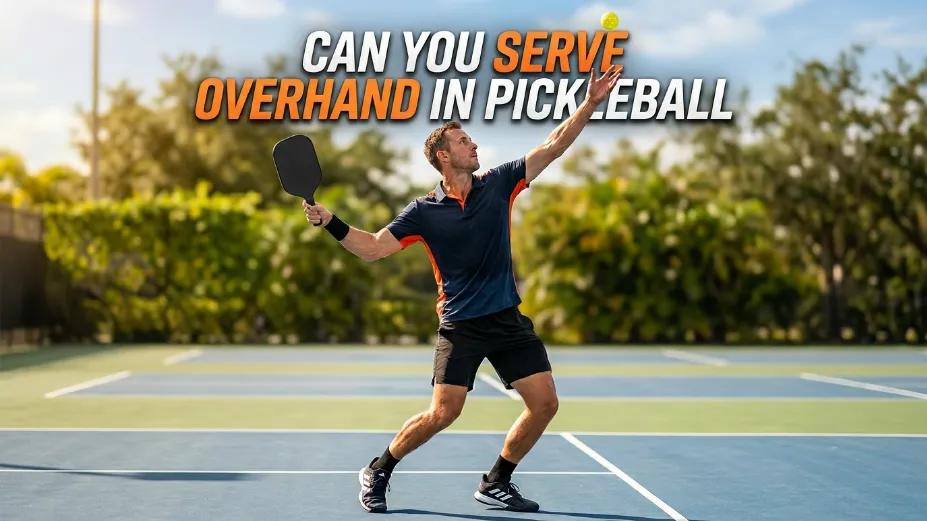
Bringing your explosive tennis serve to the pickleball court feels like a natural power move—until the referee’s whistle blows. If you’ve ever wondered, “can you serve overhand in pickleball” to dominate your opponents right from the baseline, you are actually flirting with an immediate rules violation. Pickleball thrives on keeping rallies competitive and accessible, which means the physics of starting a point are strictly governed. Let’s break down the official USA Pickleball regulations so you can keep your serve legal, lethal, and local to the rulebook.
Pickleball serve types and legality under USA Pickleball rules: traditional volley serve, drop serve, and overhand serve — contact point rule, paddle motion requirement, and main risk or fault
Pickleball Serve Types — Legality Guide
USA Pickleball Official Rules · Contact Point · Paddle Motion · Faults
Ultimately, a traditional overhand serve is strictly illegal in standard pickleball because it violates the game’s core biomechanical requirements. For players seeking the ideal balance of safety, consistency, and tactical flexibility, mastering the drop serve is the superior legal option, while the traditional volley serve remains the go-to choice for advanced competitors who want to generate raw pace within the boundaries of a strict low-to-high underhand arc.
The rapid expansion of the court scene across the United States has fundamentally altered player expectations regarding specialized gear and technical execution. As former tennis players transition to the kitchen line, many instinctively try to bring their heavy, downward overhead swings with them. Understanding why the sport’s founders intentionally “de-weaponized” the serve is paramount to mastering the rules, maintaining fair play, and avoiding unnecessary conflicts during open play.
Comprehensive Guide to the Traditional Volley Serve: The “Out-of-the-Air” Gold Standard
The volley serve, also known as the “out-of-the-air” serve, is the most common serving style used in both recreational parks and pro tournaments. To ensure this serve remains legal, players must strictly follow the non-negotiable mechanical guidelines laid out in the official USA Pickleball Rulebook. In 2026, the governing body added the words “clear” and “clearly” to these requirements to eliminate subjective gray areas that have long caused disputes on the court.
- The Upward Arc: At the moment your paddle contacts the ball, your arm and paddle must be moving in a clear upward trajectory. Downward chopping motions or completely flat sideways sweeps are immediate faults.
- The Paddle Head Position: The highest point of the paddle head must clearly remain below the highest part of your wrist joint (where the wrist joint bends) at the exact millisecond of contact. This ensures the paddle cannot be swung overhand or sidearm with a downward wrist snap.
- The Contact Height Limit: You must strike the ball clearly below your waistline, which the rulebook defines strictly as the level of your navel (belly button). If you attempt to strike the ball at chest or shoulder height, the referee will call an automatic fault.
These strict mechanical constraints are designed to limit serve dominance. If players were allowed to strike the ball out of the air at shoulder height or above, the serve would instantly become an offensive weapon. For a detailed breakdown of how these baseline rules differ from other racquet sports, check out our analytical guide on pickleball vs tennis to see how the court setups and swing mechanics diverge.
The Physics of the Drop Serve: Is It a Legal Overhand Loophole?
Introduced as a permanent addition to the rules, the drop serve offers a simpler, highly consistent alternative. To execute a legal drop serve, you must stand behind the baseline, release the ball from one hand or drop it off your paddle face, let it bounce on the playing surface, and then strike it. The major draw of the drop serve is that the three strict volley serve restrictions (upward arc, paddle head below wrist, and contact below waist) are completely waived once the ball bounces.
This rules waiver often leads transitioning tennis players to ask a highly specific question: If the waist height and upward arc rules are waived after the bounce, can you overhand serve in pickleball using a drop serve?
The short answer is no, because of the strict physical limitations of the drop itself. Under Rule 7.D, you must release the ball from a natural, unaided height under the force of gravity alone. You are strictly prohibited from tossing the ball upward, throwing it downward, or adding any propelling force to make it bounce higher. Mathematically, the bounce of a polymer pickleball is governed by the Coefficient of Restitution (CoR) equation:
Where hd represents the drop height, e is the coefficient of restitution of the ball on court surfaces, and hb is the maximum bounce height. On standard outdoor court surfaces, the coefficient of restitution for a standard outdoor ball is approximately e ≈ 0.65. If a player extends their arm as high as physically possible without jumping, reaching a drop height of hd = 2.0 meters (about 6.56 feet), the maximum height of the bounce will be:
Since 2.77 feet is far below the waist level of an average adult player (which typically sits around 3.2 feet or higher), the ball can never physically bounce high enough to allow for a true downward overhand smash. Trying to force an overhead swing on a ball bouncing this low is biomechanically awkward and practically useless, as the paddle would hit the ground or drive the ball straight into the net. For more details on legal serving options and how to execute a proper swing, check out our guide on how to play pickleball.
Pro Divergence: Major League Pickleball’s High-Contact Serve Rules
If you watch professional matches on television, you might occasionally see players striking volley serves near chest level, prompting you to wonder, can you do an overhand serve in pickleball like the pros? This confusion stems from a major rules divergence between Major League Pickleball (MLP) and standard USA Pickleball regulations.
To eliminate referee subjectivity regarding the “waist height” rule, MLP introduced gameplay updates allowing professional players to contact the ball at any height they want on their body, provided that:
- The ball toss is clearly visible to the referee and receiver.
- The highest point of the paddle head remains clearly below the wrist at the moment of contact.
- The swing path maintains a clear, upward arc.
While this allows MLP pros to hit “head serves” at chest height, it is strictly prohibited in standard tournament play and recreational open play. Trying to replicate these high-contact pro serves in your local club will result in an immediate fault under standard USAP rules. If you are preparing for tournament play, it is essential to align your mechanics with standard guidelines to avoid losing points on your serve.
Head-to-Head: Traditional Volley Serve vs. Drop Serve
For players looking to maximize their baseline game, deciding between the traditional volley serve and the drop serve comes down to a fundamental trade-off between explosive pace and mechanical simplicity.
Pace, Depth, and Angle Generation
The traditional volley serve remains the superior tool for generating raw pace and driving deep, aggressive angles. Because you hit the ball directly out of the air, you can transfer your forward weight into the ball, creating a highly explosive contact point. Conversely, the drop serve requires waiting for the ball to bounce, which absorbs a significant amount of the ball’s natural kinetic energy, making it much harder to hit with extreme velocity.
Spin Potential and Versatility
While the volley serve is excellent for low-to-high brushing to create heavy topspin, the drop serve is a playground for sidearm slices and horizontal chops. Because the upward arc and wrist restrictions are completely waived on the drop serve, you can strike the ball from a wide, sidearm angle, generating heavy sidespin that skips unpredictably off the court surface. If you want to refine your spin mechanics, reading our definitive guide on pickleball serve tips will help you choose the best style for your physical game.
Consistency and Ease of Use
The drop serve is the undisputed champion of consistency, making it the perfect choice for beginners, players under high tournament pressure, or those playing in high-wind conditions. It removes the timing-dependent variable of tossing and striking in mid-air. However, if you are committing too many mechanical violations, shifting to a drop serve will immediately protect you from committing illegal pickleball serves.
The Recreational Play Loophole: Navigating Rule 9.B.4 & 13.D.1.d
One of the most persistent information gaps on court safety and sportsmanship is how serve rules are actually enforced in self-officiated, recreational play across the United States. Many players believe that if they see an opponent serving overhand or hitting the ball above their waist, they can immediately stop play and claim a point. However, the rulebook says otherwise.
According to Rule 9.B.4 (No Enforcement of Other Faults) and Rule 13.D.1.d of the 2026 rulebook:
In non-officiated matches, players only have the authority to call and enforce non-volley zone (kitchen) faults and service foot faults on their opponent’s end of the court. For all other faults—including illegal service motions, hitting above the waist, or paddle head above the wrist—opponents may only mention the specific fault to the player after the rally. They have no legal authority to enforce the fault. The final decision on fault resolution belongs entirely to the player who allegedly committed the fault.
This creates a massive loophole where a player could technically execute a blatant overhead serve, and if they refuse to admit the fault, the point stands. So, how does the US recreational community handle this rules loophole?
- Social Ostracism: In public parks and open-play clubs, players who consistently exploit this loophole to hit illegal, overhand-style serves are quickly judged by the community. Over time, other players will simply refuse to step onto the court with them, forcing them to adjust their mechanics or find somewhere else to play.
- The “Tit-for-Tat” Strategy: In highly competitive recreational circles, some players will respond to chronic illegal serving by serving illegally back to their opponents. While not encouraged by the rulebook, this reciprocal pressure often forces both sides to agree to standard rules.
- Education and Communication: The most productive approach is to approach the player after the game, explain the rules respectfully, and offer to record their serving motion on video. Seeing their swing path in real time usually helps them realize they are violating the rules.
Legal Alternatives: How to Generate Explosive Power Safely
You do not need to violate the rules to hit a lethal, high-performance serve. By adjusting your grip and using proper body mechanics, you can easily weaponize your serve while staying fully legal.
- Brushing Up for Heavy Topspin: Using an Eastern or Continental grip, start your paddle swing low and brush upward against the back of the ball at contact. This low-to-high brushing path creates heavy topspin, causing the ball to dip aggressively over the net and bounce deep into the opponent’s court.
- The Sidearm Drop Serve Slice: Take advantage of the drop serve’s waived restrictions. By swinging with a sidearm, horizontal motion, you can cut across the side of the ball, generating extreme sidespin that kicks sharply to the left or right after bouncing.
- Targeting the Baseline and Corners: Rather than relying on raw overhead speed, focus on placement. Targeting your opponent’s deep backhand corner or serving directly at their body will force weak returns, giving your team an immediate advantage on the third shot.
To learn more about the strategic dimensions of the court and how to position yourself for maximum court coverage, explore our complete guide on what is pickleball.
Conclusion: Protecting the Rally-Based Soul of the Game
The prohibition of the overhand serve is a foundational rule that preserves the unique, strategy-first identity of pickleball. By keeping the serve underhand, the sport ensures that rallies are decided by fast-paced exchanges, dinks, and strategic placements at the net, rather than raw physical dominance from the baseline. While pro leagues like MLP continue to experiment with serve heights, standard play remains firmly anchored in the classic underhand motion, protecting the sport’s balance and inclusivity for players of all ages and athletic backgrounds.
Frequently Asked Questions (FAQ)
Can you serve overhand in pickleball under any official standard rules?
No. Standard USA Pickleball (USAP) and International Federation of Pickleball (IFP) regulations strictly prohibit overhand serves in all standard recreational and tournament matches. Serves must be executed underhand with a clear upward arc.
Is a sidearm serve legal in a traditional volley serve?
A sidearm serve on a traditional volley serve is highly risky. While sidearm motions are not named directly in the rulebook, a horizontal swing path usually violates the requirement of an upward arc, or causes the paddle head to rise above the wrist, resulting in an automatic fault.
Can I serve overhand if I use the drop serve?
No. While the drop serve waives the upward arc, wrist, and waist rules, you are strictly prohibited from tossing or throwing the ball downward on the release. Because a natural drop off gravity cannot bounce high enough, executing a true overhand overhead smash is physically impossible.
Who has the authority to call an illegal service motion during recreational play?
According to Rule 9.B.4, opponents have no authority to enforce a fault or demand a replay for service motion violations in non-officiated play. You may only mention the violation to the server after the rally, and the final decision rests entirely with them.