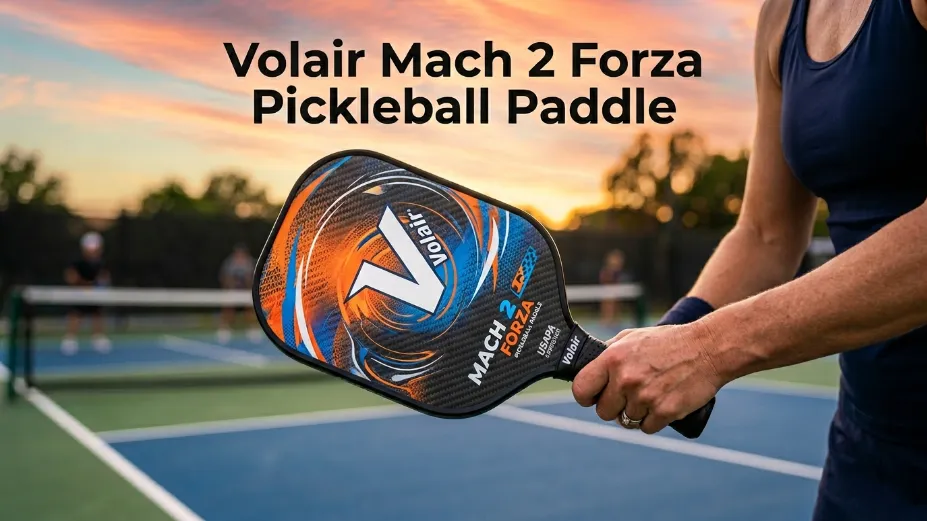
The pickleball paddle market is currently flooded with raw carbon fiber hype, yet very few shapes actually deliver on the promise of maximum spin without sacrificing the sweet spot. When Volair dropped its paddle lineup, the community immediately noticed the distinct aerodynamic engineering tailored for fast hands at the kitchen line. If you are tracking the shift toward thermoformed control, analyzing the volair mach 2 forza pickleball paddle is no longer optional—it is a prerequisite for staying competitive. Let’s dissect whether this widebody design genuinely redefines paddle face stability, or if it just builds on the industry’s current obsession with grit.
Pickleball paddle full feature breakdown: face material, core construction, thickness, weight, length, width, grip length, and grip circumference with technical values and player benefits
Pickleball Paddle — Full Feature Breakdown
Face · Core · Thickness · Weight · Dimensions · Grip
For competitive US players looking to transition to thermoformed performance, the 16 mm model remains our top recommendation due to its superior touch, expanded sweet spot, and elite defensive properties. At a highly competitive price of $119.99 available directly on the official Volair website, the 16 mm core provides the ultimate balance of soft control and top-tier spin, while the lighter 14 mm version acts as a customizable speed weapon for fast-handed kitchen specialists.
The rapid expansion of the competitive pickleball scene in the United States has fundamentally altered player expectations regarding specialized gear. Standard standard-body paddles or outdated non-thermoformed options no longer suffice against aggressive, hard-hitting competitors. With the arrival of the volair pickleball paddle mach 2 forza on the market, understanding the exact technical engineering beneath its raw carbon face becomes paramount to maintaining technical execution at the kitchen line.
volair mach 2 forza pickleball paddle review
The engineering core of the volair mach 2 forza pickleball paddle review centers upon its non-traditional thermoformed widebody setup. While legacy control paddles relied primarily on flexible, cold-pressed frames, this silhouette bridges defensive raw carbon touch with the aggressive, structural rigidity of modern unibody molding.
- The Thermoformed Unibody Matrix: Utilizing high-pressure heat molding, the face and core are fused into a singular cohesive structure. This thermoformed process significantly boosts the paddle’s natural energy return (pop) compared to Gen 1 models, ensuring you still have the offensive power to put away high dinks without needing to over-swing.
- Foam-Injected Perimeter Stabilization: Because thermoformed raw carbon can feel overly stiff, Volair surrounds the outer edges with high-density foam injection. This foam perimeter dampens high-frequency impact vibrations while radically expanding the twist weight to an impressive 7.37, preventing the paddle face from twisting on off-center dinks.
- Raw Carbon Peel-Ply Friction: The face features top-tier Toray T700 raw carbon fiber. Rather than relying on a sprayed-on paint grit that shears off within a few weeks of active play, the peel-ply texture is baked directly into the resin layer, resulting in durable, high-friction ridges that consistently generate spin rates exceeding 2,150 RPM.
The upper curved profile balances aerodynamic speed with defensive surface area, providing an exceptional option for players transitioning to a premium control tool. To compare these core specs with other major models in our database, feel free to read our comprehensive 14mm vs 16mm paddle thickness guide to understand how core depth alters your on-court execution.
16mm vs. 14mm: Deciding on Your Volair Core Thickness
Navigating the Forza lineup requires a clear understanding of the mechanical differences between the plush 16 mm control layout and its thinner, faster 14 mm counterpart. Selecting your specific version of the volair mach 2 forza 16mm carbon fiber pickleball paddle dictates both your physical recovery cycles and your kinetic velocity on court.
The Core Absorption Variance
The 16 mm architecture focuses extensively on energy dampening, dwell time, and physical touch. The thicker polypropylene core absorbs the pace of heavy baseline drives, allowing players to catch the ball deep on the face and easily drop it into the kitchen. Conversely, the 14 mm configuration utilizes a thinner core designed for fast-paced, whip-like hand battles. This gives speed-focused players a sharper, crisper feel at the cost of some defensive forgiveness and a slightly smaller sweet spot.
Maneuverability and Sourcing Metrics
The extra thickness of the 16 mm model introduces a minor weight penalty, bringing the paddle’s static weight to an average of 8.0 ounces with a swing weight of 112. The 14 mm option drops this weight signature to 7.7 ounces with a lightning-fast swing weight of 110, providing an incredibly fast-moving feel at the net. Across commercial retail channels, both versions enter the market at an accessible $119.99, representing a massive value upgrade over legacy $250+ control alternatives.
If you are a competitive player seeking to match elite-tier control tools with an aggressive control style, exploring our detailed best pickleball paddles for control will ensure your entire equipment setup functions in perfect technical alignment.
The Critical Sizing Guide: Why the Elongated-to-Widebody Transition Requires Adjustment
A major missing angle across major commercial e-commerce review spaces is the highly specific spatial adjustment required when switching from an elongated paddle to a widebody shape. When choosing the pickleball paddles volair mach 2 forza, ordering this standard-shaped paddle without adjusting your contact expectations can lead to severe operational issues on court.
The paddle is built around a distinct 15.88-inch widebody frame that is shorter than standard 16.5-inch elongated paddles but boasts a massive 8.12-inch width. This streamlined shape is designed to stop twisting on off-center hits, but it restricts players accustomed to the extended reach of hybrid models. This spatial deficit is amplified by the physical center of mass of the paddle itself.
Because the widebody shape shifts the sweet spot lower down the paddle face (closer to the hand) compared to elongated models, players transitioning to the Forza will frequently strike the ball near the upper tip. The very top edge is the stiffest and deadest part of a thermoformed paddle, causing shots to fall short or crash into the net. Furthermore, because the swing weight drops from an average of 118 down to 112, players frequently swing too early, throwing off their timing on drives and serves. To avoid these limitations, players must adjust their footwork, stepping closer to the ball to compensate for the reach deficit, and practice targeted sweet spot drills to reprogram their muscle memory.
Exposing the Information Gaps: Real-World Durability and the Stiffness Paradox
While mainstream marketing materials highlight the premium aesthetic choices of this raw carbon fiber paddle, deep analysis across independent playing groups reveals distinct technical nuances and maintenance requirements under high-stress conditions.
- The Stiffness and Tennis Elbow Paradox: Because the Forza is marketed as a control paddle, players suffering from tennis elbow often buy it expecting a soft, ultra-plush feel. However, because this is a thermoformed unibody paddle, the core is inherently stiffer than traditional non-thermoformed honeycomb paddles. While the grip includes EVA parts to minimize vibration, players with joint sensitivities must reduce their grip pressure and focus on loose, fluid strokes to prevent elbow stress.
- Surface Friction and Plastic Dust Accumulation: The raw T700 carbon fiber face utilizes a high-friction peel-ply texture. During intense sessions, this textured surface physically grinds down the plastic ball, leaving behind micro-particles of plastic dust embedded in the carbon weave. Without proper maintenance using the included carbon touch-up eraser, this plastic buildup smooths out the surface texture, causing a noticeable drop in spin over 3 to 6 months.
- Edge Guard Shock Dispersal: The soft TPU edge guard provides excellent perimeter protection. However, because the unibody thermoformed edge is highly rigid, hard scrapes against outdoor court surfaces can cause minor superficial scuffs along the plastic guard. Applying protective edge tape is highly recommended to preserve the cosmetic integrity of the paddle over long competitive seasons.
These structural factors are a critical consideration for competitive players who log more than three intense sessions per week. To ensure you are utilizing the absolute highest quality equipment, take a look at our curated list of the raw carbon fiber pickleball paddle designs currently leading the industry.
Customization Protocols: Tuning the Forza with Tungsten and Lead Tape
Evaluating the aerodynamic performance of the Mach 2 Forza requires analyzing how to customize its exceptionally low stock swing weight of 112. The paddle’s head-light balance provides an incredibly clean canvas for players who want to adjust its physical playing properties using weighted tape.
On traditional, stock widebody setups, the defensive hand speed is phenomenal, but some players may find they lack baseline plow-through when defending hard-court drives. Adding tungsten or lead tape along the edge guard completely transforms the paddle’s performance characteristics based on your specific court role:
- The Lower Corners (4 and 8 O’Clock Positions): Applying 3 to 6 grams of weight at these positions significantly boosts the paddle’s twist weight and stability. This expands the horizontal sweet spot, making defensive blocks and resets feel incredibly solid without making the paddle feel sluggish in hand battles.
- The Upper Corners (10 and 2 O’Clock Positions): Placing 3 to 4 grams of weight near the upper aero curve shifts the balance point higher. This elevates the sweet spot closer to the top of the face, helping players who transition from elongated paddles while adding noticeable power to drives, serves, and overhead smashes.
- The Throat Area (5 and 7 O’Clock Positions): Adding weight near the throat increases the paddle’s overall static mass. This stabilizes the face on soft touch shots and drops, keeping the ball low and controlled without altering the quickness of your swing.
To ensure your tape stays secured and clean, always cover the weighted strips with premium protective edge tape. If you are looking to compare the absolute best spin-producers on the market, read our deep-dive analysis of the top-tier pickleball paddles for spin to see where the Forza fits.
Table Tennis Transplants: Why Former Ping-Pong Players Thrive
An overlooked demographic that stands to benefit immensely from the Mach 2 Forza’s architecture is table tennis converts. Transitioning from table tennis to pickleball often involves a difficult adjustment period regarding stroke mechanics, as ping-pong players naturally rely on rapid, wrist-driven movements rather than sweeping, shoulder-dominant strokes.
The Forza’s standard widebody shape directly mirrors the structural feedback of a table tennis blade. Its massive 8.12-inch width provides a wide, immediately responsive sweet spot that matches table tennis hand-eye coordination perfectly. Because the swing weight is so low, former table tennis players can execute rapid, whipping wrist actions to generate extreme topspin drives and dipping drops without straining their joints. Additionally, the 5.5-inch handle offers the perfect grip length to execute single-handed wrist rolls or modern two-handed backhands with comfortable mechanical leverage.
Head-to-Head Shootout: Volair Mach 2 Forza vs. Six Zero DBD vs. Spartus Apollo
For players trying to choose between the premium volair pickleball paddle mach 2 forza and other leading control options, the choice comes down to a fundamental split in design philosophy and materials. All three models command top-tier placement across US retail outlets but approach court stability from completely opposing angles.
The primary differences in on-court performance are detailed in the comparison matrix below:
- Comfort and Touch Profile: The Spartus Apollo utilizes a DuPont Kevlar face, providing a softer, more dampening feel at impact compared to the crisp raw carbon response of the Volair. The Six Zero Double Black Diamond (DBD) employs a hybrid elongated shape, offering slightly more natural reach and pop, but feels noticeably stiffer and less forgiving on off-center drops.
- Handle Leverage and Ergonomics: Volair dominates the usability category with its generous 5.5-inch handle, which easily accommodates double-handed backhands. The Spartus Apollo restricts wide-handed players with its shorter 5.3-inch grip, while the Six Zero DBD features a standard hybrid handle that lacks the immediate whipping leverage of the Volair’s octagonal shaft.
- Price and Overall Value: Priced at $119.99, the Volair Mach 2 Forza offers unmatched value. It represents a highly competitive option compared to the $180.00 price tag of the Six Zero DBD and is comparable to the $129.99 Spartus Apollo, making it an incredibly budget-friendly entry into the elite thermoformed control space.
For a complete, comprehensive overview of alternative paddles currently occupying the competitive US landscape, take a moment to read our detailed Six Zero Double Black Diamond review to choose your ideal fit.
Sourcing and Art Collaborations: Betty Boop and Keith Haring Limited Editions
Tracking down the flagship Volair widebody involves navigating a mix of traditional online retail outlets and premium direct-to-consumer catalogs. The standard baseline retail price hovers consistently around the $119.99 threshold.
To celebrate style and legacy, Volair has released highly limited, licensed collaborations, including the Keith Haring series and the Betty Boop “Sassy” edition. These limited-edition releases pair timeless retro aesthetics with the award-winning Mach 2 Forza 16mm core. Some players wonder if these special editions feature different performance characteristics or structural materials. Under the graphic surface, these collaboration paddles are structurally identical to the standard Mach 2 Forza, utilizing the same polypropylene honeycomb core and raw Toray T700 carbon face. The primary differences lie in the custom packaging—such as the Betty Boop custom box with its premium red velvet-style insert—making them perfect for display or collectors.
Verdict: Is the Volair Mach 2 Forza Worth Your Money?
The final evaluation of this high-performance widebody depends entirely on your personal playing profile, physical injury history, and approach to kitchen hand battles.
- Who Should Buy: Defensive players who prioritize fast hand speed at the net, competitors transitioning from table tennis who rely on wrist-flick mechanics, and anyone looking for a massive, forgiving sweet spot with elite 2,150+ RPM topspin potential.
- Who Should Avoid: Pure baseline bangers who rely on effortless, trampoline-like paddle power to win points, and players with highly sensitive broad-wrist issues who refuse to adjust their tight grip pressure on stiff thermoformed frames.
Frequently Asked Questions (FAQ)
Is the Volair Mach 2 Forza USAPA approved for tournament play?
Yes. The Volair Mach 2 Forza is fully USAPA approved and meets all technical requirements for official competitive and tournament play across the United States.
How often should I clean the raw carbon fiber face with the included eraser?
It is highly recommended to clean the face after every 2 to 3 sessions of play. This removes accumulated plastic ball dust and dirt from the micro-grooves, restoring the peel-ply texture’s maximum spin capabilities.
Does the 5.5-inch handle accommodate a two-handed backhand?
Yes, perfectly. Unlike many widebody paddles that feature shorter 5-inch handles, the 5.5-inch grip length of the Mach 2 Forza offers plenty of room for double-handed shots and provides extra rotational leverage.