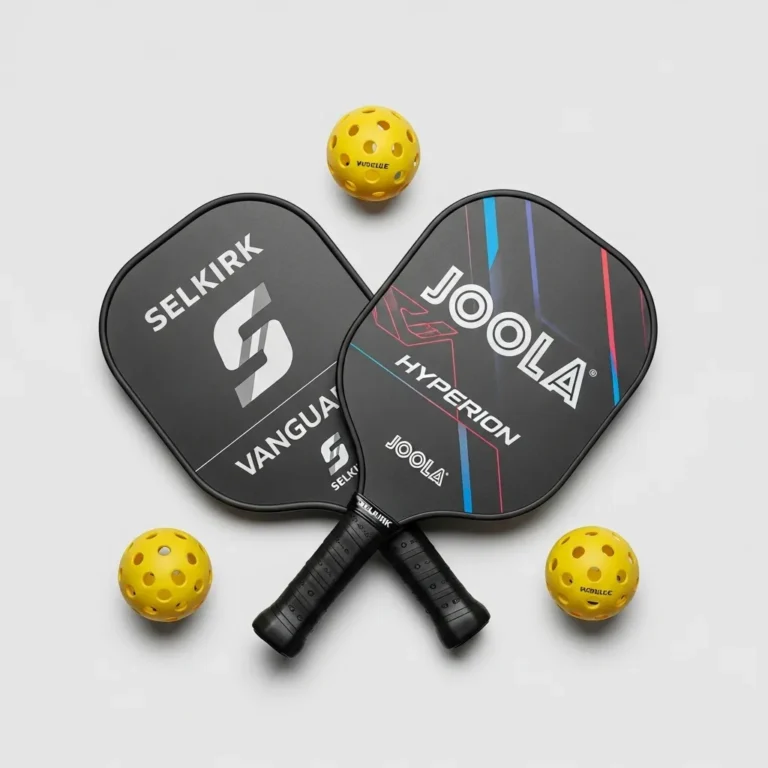
Selkirk Vanguard vs Joola Hyperion
If you have spent any amount of time on the pickleball courts lately, you have probably noticed a divide. It’s almost like a friendly civil war. On one side, you have the loyalists wielding the Selkirk Vanguard, a paddle that has been a staple of consistency for years. On the other side, you have the legion of players who flocked to the Joola Hyperion, largely arguably because the greatest player in the world, Ben Johns, put his name on it.
Choosing between these two isn’t just about picking a brand; it’s about choosing a philosophy. I’ve hit thousands of balls with both, and I’ve seen players struggle with the wrong choice and thrive when they finally found the right match. Modern paddles come with a premium price tag, so the goal is to find the one that best matches your playstyle.
We are going to break this down, not by reading a spec sheet to you, but by looking at how these paddles actually behave when you’re standing at the kitchen line with the game on the line. Whether you are looking for that buttery soft touch or the ability to crush a drive, we’re going to figure out which one belongs in your bag.
Core Performance & Playstyle
This is where the rubber meets the road. Forget the marketing jargon for a second; let’s talk about what happens when the ball hits the face of the paddle. These are the factors that will determine if you leave the court smiling or frustrated.
Which paddle is better for my specific playstyle: Power or Control?
This is the first question you need to ask yourself, and you need to be honest. Are you a banger who likes to drive the ball hard from the baseline, or are you a tactician who wins points with soft dinks and precise drops?
The Selkirk Vanguard (specifically the Control or 2.0 line) is the ultimate “shield.” It is traditionally known for exceptional control. When you block a hard drive with a Vanguard, the paddle absorbs the energy, allowing you to deaden the ball and drop it into the kitchen. It doesn’t have a massive amount of “pop” on its own. You have to generate your own power. If you are a player who over-hits or pops balls up too high, the Vanguard acts like a safety net. It’s predictable. You swing, and the ball goes exactly where your mechanics told it to go.
On the flip side, the Joola Hyperion is a different beast. It is widely loved for its “plush” feel, but don’t let that fool you—it packs a punch. The Hyperion series, particularly the CFS (Carbon Friction Surface) models, has a thermoformed unibody construction (in newer iterations) that provides significant power. It allows you to counter-punch. If someone speeds up the ball at you, the Hyperion allows you to send it back faster. It favors the aggressor. If your game relies on hand speed and finishing points quickly, the Hyperion usually edges out the Vanguard here.
How do the spin capabilities compare between the Selkirk Vanguard and Joola Hyperion?
Spin is the great equalizer in pickleball. It keeps your drives in court and makes your dinks unattackable.
The Joola Hyperion gained massive popularity because of its Carbon Friction Surface (CFS). When this paddle first launched, the spin numbers were off the charts. The surface feels gritty, almost like sandpaper, and it grabs the ball violently. If you love hitting a rolling volley or a heavy topspin drive, the Hyperion feels like a cheat code. You can literally feel the ball biting into the face of the paddle.
The Selkirk Vanguard, historically, used a different approach. Their “QuadCarbon” face (on the 2.0 models) has a texture, but it feels different—smoother, yet grippy in a friction-based way rather than a grit-based way. While Selkirk has introduced “Power Air” models with sprayed grit (more on that later), the classic Vanguard relies more on dwell time. Because the ball stays on the paddle face a millisecond longer due to the soft core, you can “brush” the ball effectively. However, in a raw numbers game, the Joola Hyperion generally produces higher RPMs (Revolutions Per Minute) for the average player.
Related: The Ultimate Joola Pickleball Paddle Buyer’s Guide 2025
Which paddle has a larger and more forgiving sweet spot?
If we were all pros, we’d hit the dead center of the paddle every time. But we aren’t. We mishit balls, especially when we are scrambling on defense.
The Joola Hyperion utilizes a unique shape—the “Aero-Curve” top. It’s slightly rounded. Combined with the foam injection around the perimeter (a technique Joola popularized), the sweet spot is massive. It feels solid even if you hit the ball near the edge guard. You get very little twisting in your hand on off-center hits. This stability is why so many intermediate players leveled up instantly when they switched to the Hyperion; it forgives your mistakes.
The Selkirk Vanguard has a very consistent face, but depending on the shape you buy (Invikta, Epic, or S2), the sweet spot changes. The S2 (the one with the short handle) has the largest sweet spot in the Selkirk line. However, the elongated Invikta shape, which compares most closely to the Hyperion, can have a few dead zones near the bottom corners. Selkirk paddles provide amazing feedback—you know exactly where you hit the ball—but the Hyperion generally feels more “solid” from edge to edge thanks to that foam wall technology.
How does the “feel” at the net (dinking and resetting) differ between the two?
This is the hardest thing to quantify, but arguably the most important. “Feel” is the connection between your brain and the ball.
The Joola Hyperion is often described as “muted” or “plush.” When you dink, it feels like the ball sinks into a pillow before leaving. This gives you a lot of confidence to hold the dink line. It doesn’t make a loud “pop” sound; it’s more of a “thud.” This is great for resetting hard bangs because the paddle absorbs the pace effortlessly.
The Selkirk Vanguard feels “crisp.” It’s responsive. When you tap the ball, it comes off the face with a little more liveliness and a sharper sound. Players who have a background in table tennis or squash often prefer the Vanguard because of this feedback. You feel more connected to the shot. While the Hyperion dampens the vibration, the Vanguard communicates it. If you like knowing exactly how hard you hit the ball through tactile feedback, the Vanguard wins. If you want a paddle that softens the game for you, it’s the Hyperion.
Physical Specs & Ergonomics
Comfort isn’t just a luxury; it’s the difference between playing for three hours or going home after one because your arm hurts.
Is one paddle significantly heavier or more “head-heavy” than the other?
This is a huge topic of conversation in online communities.
The Joola Hyperion (especially the original CFS 16mm) has a reputation for being head-heavy. Because of the elongated shape and the edge foam, the swing weight is high. Swing weight is how heavy the paddle feels when you swing it, not just what it weighs on a scale. A high swing weight gives you more power (plow through), but it slows your hands down at the kitchen line. Many players find the Hyperion tiring to use over long sessions.
The Selkirk Vanguard is famous for being incredibly balanced. Selkirk has mastered the art of weight distribution. Even their elongated Invikta models feel light and whippy in the hand. If you engage in fast hands battles (volleys at the net), the Vanguard feels faster. You can react quicker. If you struggle with hand speed, the heavy swing weight of the Hyperion might be a hindrance, whereas the Vanguard will feel like an extension of your arm.
Which paddle is safer for players prone to tennis elbow?
Disclaimer: I am just a pickleball enthusiast, not a doctor. If you have pain, see a professional. However, equipment choice plays a role in arm fatigue.
Typically, tennis elbow is aggravated by two things: vibration and heavy swing weight.
The Selkirk Vanguard is often cited as one of the best paddles for tennis elbow. The core material and the lightweight, balanced nature of the paddle mean there is less torque on your elbow when you swing, and the vibration dampening is top-tier. It doesn’t force your forearm muscles to overwork.
The Joola Hyperion is a double-edged sword here. On one hand, it is incredibly stable. Stability is good because the paddle doesn’t twist in your hand, which reduces the strain on your arm. However, the weight is the issue. If you do not have the forearm strength to maneuver a head-heavy paddle for two hours, your muscles will fatigue, your form will break down, and that is when discomfort can set in. If you are strong but hate vibration, Joola is great. If you prefer a lighter feel to minimize fatigue, Selkirk is the more comfortable choice.
How do the handle lengths and grip circumferences compare for two-handed backhands?
The modern game is evolving, and the two-handed backhand is becoming essential.
The Joola Hyperion usually comes with a 5.5-inch handle. This is the “gold standard” length for tennis converts. It provides ample room for two hands to fit comfortably without one hand resting on the paddle face. The grip circumference is usually around 4.125 to 4.25 inches, which is standard and allows for plenty of wrist action.
The Selkirk Vanguard offers more variety, but it can be confusing.
- The Invikta shape has a long handle (approx 5.25 to 5.5 inches), good for two-handers.
- The Epic represents a standard handle (approx 5.25 inches).
- The S2 has a very short handle (approx 4.5 inches). Do not buy the S2 if you use a two-handed backhand.
Generally, the Joola handle feels slightly more substantial and “tennis-like,” while Selkirk handles are octagonal but sometimes feel a bit thinner, which some players build up with overgrips.
Durability & Value (Long-Term Purchase)
You are about to drop somewhere between $200 and $250. You want to know if this thing is going to last until next season.
Does the surface grit wear off quickly on the Joola Hyperion compared to the Selkirk Vanguard?
This is the most common complaint you will find on Reddit regarding Joola. The Joola Hyperion relies on a “peel ply” texture. In the earlier batches of the Hyperion, there were widespread reports of the grit wearing down smooth after just a few months of intense play. When the grit goes, the spin potential drops significantly. While Joola has improved their manufacturing in newer “C2” models, it is still a surface treatment that degrades over time.
The Selkirk Vanguard (specifically the carbon fiber weave models) relies more on the texture of the material itself rather than a sprayed-on grit. While it starts with less spin than a fresh Joola, it maintains that level of playability for much longer. It is consistent. You won’t wake up one day and realize your paddle has lost 30% of its spin.
However, if you are looking at the Selkirk Power Air variants (which are different from the standard Vanguard), those use a sprayed coating that also wears off over time. But comparing the standard Vanguard to the Hyperion? The Vanguard’s face is generally more durable long-term.
Is the price difference justified by the performance features?
Both paddles sit in the premium tier.
The Joola Hyperion justifies its price through performance technology. You are paying for the thermoformed unibody, the foam-injected walls, and the carbon friction surface. These are genuine performance enhancers. If you are a competitive player,the extra 20− 40 is worth it for the sweet spot expansion and power alone.
The Selkirk Vanguard justifies its price through quality control and craftsmanship. Selkirk paddles are made in the USA (mostly), and the fit and finish are usually flawless. You aren’t just paying for performance; you are paying for a product that feels premium and doesn’t have loose bits rattling inside (a somewhat common issue with thermoformed paddles from other brands).
How do the warranty policies compare (Selkirk’s Lifetime Warranty vs. Joola’s Policy)?
This is often the tie-breaker for undecided buyers, and Selkirk wins this battle by a landslide.
Selkirk offers a Limited Lifetime Warranty against manufacturer defects. They are legendary for their customer service. If your edge guard comes loose or the core goes dead prematurely, Selkirk usually replaces it with very little hassle. They stand behind their product like almost no other company in the sport.
Joola typically offers a limited warranty (often 6 months to a year, depending on the region and specific terms at purchase) that covers defects. While they have improved their support as they have grown, they do not offer the “no questions asked” peace of mind that Selkirk does. If you plan to keep one paddle for 2 or 3 years, Selkirk offers a longer warranty period..
Model Variants & Customization
Just when you thought you decided, you look at the store page and see ten different versions. Let’s clear up the confusion.
What is the difference between the standard Selkirk Vanguard Control and the Vanguard Power Air when comparing to the Hyperion?
This is critical. The “Vanguard” name is used for two very different paddle lines.
- Vanguard Control (or 2.0): This is the paddle we have mostly compared so far. It is a thick-core, soft, control-oriented paddle. It is the opposite of the Joola Hyperion in terms of power. It is for the soft-game player.
- Vanguard Power Air: This is the one with the hole in the throat (the Air Dynamic Throat). It is thin, incredibly aerodynamic, and edgeless. It hits very hard and has massive spin.
If you are comparing the Joola Hyperion to the Vanguard Power Air, the conversation changes. The Power Air is stiffer, harder to control, and has a smaller sweet spot than the Hyperion, but it is faster through the air. The Hyperion is a hybrid (power + control), whereas the Power Air is pure offense.
Should I choose the 14mm or 16mm core thickness for these paddles?
Both Joola and Selkirk offer these thickness options, and the rule of thumb is the same for both.
The 16mm (16 millimeters):
This is the most popular choice for both the Hyperion and the Vanguard. A thicker core absorbs more energy. It gives you a softer feel, better blocking ability, and more control. If you struggle with resetting the ball or popping dinks up, get the 16mm. The Joola Hyperion 16mm is the paddle Ben Johns made famous.
The 14mm (14 millimeters):
A thinner core is stiffer. The ball spends less time on the face and rebounds faster. This gives you more “pop” and power, but the sweet spot usually shrinks, and the paddle vibrates more. If you feel like the 16mm is too mushy and you can’t put the ball away, the 14mm will give you that extra hand speed and punch. However, for the Vanguard specifically, the 14mm can feel very stiff. The Hyperion 14mm retains some plushness but moves faster.
The Verdict
So, which one goes in your cart?
Choose the Selkirk Vanguard if you value hand speed, durability, American manufacturing, and a warranty that has your back for life. It is the paddle for the tactician, the reset artist, and the player who wants to outlast their opponent with consistency.
Choose the Joola Hyperion if you want the modern “do-it-all” paddle. If you want that plush feel combined with the ability to crush a drive and generate massive spin, this is the one. Just be prepared for a heavier swing weight and the potential for the surface to wear down faster.
See you on the courts!
Looking for a deeper dive? While this comparison covers the Vanguard series, you can explore our new comprehensive guide on selkirk pickleball paddles, which breaks down the latest 2026 technology, including the Power Air and Luxx Control models.