The Evolution of a Technical Masterpiece: ruby 6.0 pickleball paddle review
In this comprehensive ruby 6.0 pickleball paddle review, we analyze why this specific model has disrupted the US market from the public courts of Florida to the indoor hubs of Arizona.
The 6.0 ruby pickleball paddle is not just another thermoformed release; it is a refined tool engineered for the advanced player who requires a generous sweet spot but refuses to compromise on the “pop” necessary to win hand battles.
While many early reviews compared it strictly to the Double Black Diamond (DBD), long-term play testing reveals a “plush” feedback that bridges the gap between the stiffness of carbon fiber and the forgiving nature of fiberglass.
For those looking to dominate the kitchen with a strategic, spin-heavy mindset, this is arguably the best pickleball paddle for spin and control in 2025.
It rewards the player who can transition from a defensive block to a clinical cross-court dink with zero vibration.
However, before you spend your hard-earned USD, it is crucial to understand the intricate 6.0 Ruby specifications that make this paddle behave so differently in the humid air of the East Coast compared to the dry, high-altitude courts of the West.
Technical Breakdown: 6.0 ruby pickleball paddle Specifications
The heart of the 6.0 ruby pickleball paddle lies in its revolutionary material composition.
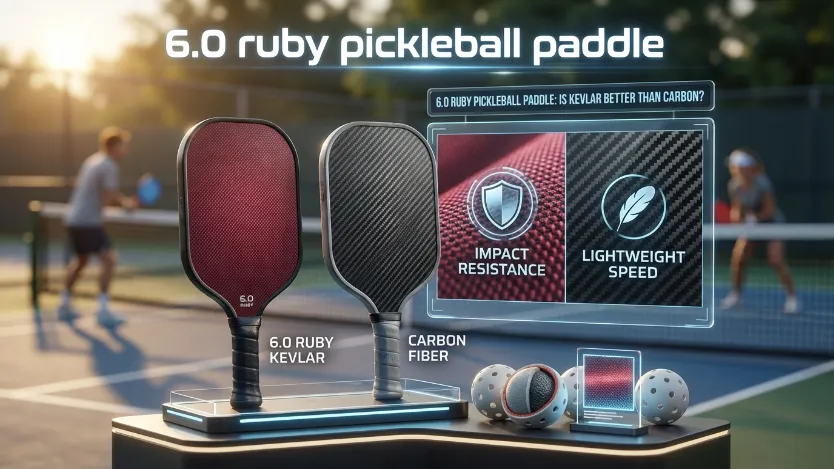
Unlike the standard advanced pickleball paddles that rely on T700 carbon fiber, Six Zero utilized a 100% Raw Aramid Fiber face to ensure the surface remains “gritty” long after carbon competitors have gone smooth.
Here are the key technical highlights:
- 100% Raw Aramid Fiber Face: Sourced fromDuPont™ Kevlar®, providing 6x the strength of steel and unmatched thermal stability.
- Carbon Fusion Edge Technology: A specialized thermoformed pickleball paddles process that uses foam injection and a carbon seam to unify the edges.
- 3D Carbon Forged Handle: The aramid face extends through the full length of the handle, molded under heat to eliminate the common “snapping” point at the neck.
- Variable 16mm Honeycomb Core: Designed to balance the high-power output of a thermoformed build with a dampened, “plush” impact feel.
- Aerodynamic Flared Shape: A hybrid design (16.3″ length) that optimizes reach without the sluggishness of traditional elongated models.
The 6.0 ruby pickleball paddle price typically sits around $199.00 in the United States, positioning it as a premium alternative to the double black diamond pickleball paddle.
For players debating between different thicknesses, checking out the latest data on 14mm vs 16mm paddles is essential for understanding the trade-off between baseline power and kitchen-line forgiveness.
The “All-Court” Typology: Why the Hybrid Shape Matters
While most “power” paddles opt for a strictly elongated rectangle, the 6.0 ruby pickleball paddle maintains a strategic hybrid shape with a tapered neck.
This design choice is fundamental to its identity, providing a twist weight of 6.8, which is remarkably high for a paddle of this agility.
This means that even if you hit the ball toward the edge of the face, the paddle resists “turning” in your hand, maintaining a massive sweet spot.
Do not be misled by the “all-court” label.
Unlike traditional control paddles that feel “dead,” the Ruby features a moderately high swing weight (117).
This weight distribution provides the “plow-through” needed for deep serves and aggressive drives, while the aramid face dampens the jarring feedback often found in stiff carbon paddles.
It is this specific balance that makes it a top contender for players moving from a 3.5 to a 4.5 DUPR rating, allowing for a more versatile game that adapts to both “bangers” and “dinkers.”
Battle of the Gems: 6.0 Ruby vs Double Black Diamond
A constant debate in the American pickleball community is the 6.0 Ruby vs Double Black Diamond (DBD) comparison.
While both paddles share the same iconic hybrid mold, they serve different playstyles.
The DBD is a pure carbon fiber tool—crisp, “poppy,” and demanding.
It offers a more traditional feedback that many former tennis players prefer for its “crunchy” feel on impact.
In contrast, the ruby 6.0 pickleball paddle review data suggests that the Ruby offers “controllable power.”
The aramid fibers allow the ball to “sink” into the face (increased dwell time), which generates significantly more topspin than the DBD.
If you find yourself popping up resets at the kitchen or struggling with the “bounciness” of carbon fiber, the Ruby is the superior choice.
Furthermore, the Ruby has addressed the vibration issues; while the DBD is stable, the aramid face of the Ruby acts as a natural shock absorber, making it the preferred choice for players guarding against tennis elbow.
The Missing Angles: What Other Reviews Won’t Tell You
Most commercial reviews ignore the long-term reality of playing with advanced composites in various US climates.
The 6.0 ruby pickleball paddle, as a high-performance aramid tool, has specific maintenance needs and environmental sensitivities.
Here are the “missing angles” you need to consider:
1. The 10-Hour “Break-In” Period
Fresh out of the box, the 100% Raw Kevlar can feel unexpectedly stiff.
Many US players make the mistake of returning the paddle after one session.
In reality, the honeycomb core and the aramid weave require approximately 10 to 15 hours of play to “soften.”
Once broken in, the “plush” feel becomes much more evident, and the sweet spot expands significantly.
If the paddle feels too “hard” on day one, give it two weeks of consistent drills before judging its control.
2. The “Trunk Test” and Thermal Stability
Pickleball paddles are essentially advanced plastics and adhesives.
In states like Texas or Florida, leaving your 6.0 ruby pickleball paddle in a hot car trunk can lead to premature degradation.
The heat can weaken the epoxy bond of the thermoformed edges, potentially leading to “core crush” or delamination.
To maintain the integrity of the aramid fiber, always store your paddle in a climate-controlled environment and use the provided neoprene cover to shield it from rapid temperature shifts.
3. The “Eraser” Controversy and Kevlar Fraying
A recurring topic on Reddit is whether to use a rubber cleaning eraser on the Ruby face.
While erasers are standard for raw carbon fiber, Six Zero initially advised against them for the Ruby.
Users reported that aggressive rubbing could pull out tiny red fibers (fraying) from the aramid weave.
The “missing angle” here is that while the first batch had some “tufting” issues, newer models are more robust.
However, the safest maintenance routine remains using a damp microfiber cloth to remove ball plastic without risking the “fuzzing” of the expensive aramid surface.
On-Court Performance: Stability from the Baseline to the Kitchen
During high-level testing for this 6.0 ruby pickleball paddle review, the standout feature was torsional stability.
When defending against overhead smashes, the paddle feels like a brick wall.
The foam-injected walls and high twist weight ensure that the paddle does not “wobble” on off-center hits.
This stability allows for higher accuracy on third-shot drops, which are the hardest shots to master in the game.
At the net, the textured surface “bites” the ball with a reported 2,250+ RPM.
For players who use a two-handed backhand roll, the Ruby provides an unfair advantage—the ball dips so sharply that opponents often miss-hit the return.
While it doesn’t have the “raw sledgehammer” power of a 14mm power paddle, the extra mass ensures that when you do decide to speed up the ball, it stays compressed and follows a predictable, lethal path.
Frequently Asked Questions (US Audience)
Q: Does the 6.0 Ruby stain the pickleballs red?
A: This was a concern with the very first “Alpha” batch where some loose red dye or fibers would transfer. However, in the current production models, this has been completely resolved. Your yellow X-40s are safe.
Q: Is the Ruby Pro significantly different from the original 16mm Ruby?
A: Yes. The Ruby Pro is a 14mm model featuring “Diamond Tough” grit—an epoxy infused with actual industrial diamond dust for 4x the grit life. It is “poppier” and faster, whereas the original 16mm is the king of control.
Q: Can I add lead tape to the 6.0 Ruby?
A: While the Ruby is already 8.2oz, many advanced players add weight at the 4 and 8 o’clock positions (the throat) to further increase the sweet spot and stability for resets without making the head feel too heavy for hand battles.
Q: Why is the handle 5.5 inches instead of the standard 5 inches?
A: The elongated handle is a direct response to the growth of the two-handed backhand in the US. It provides enough “real estate” for both hands to grip comfortably without hitting the face of the paddle.
Final Verdict: Should You Buy the 6.0 ruby pickleball paddle?
The 6.0 ruby pickleball paddle is a specialized weapon designed for the “strategic competitor.”
It is not intended for the beginner who just wants the cheapest gear, nor is it for the pure “power banger” who ignores the soft game.
It is for the player who enjoys the “grind”—the one who wins by being more consistent, generating more spin, and refusing to pop the ball up under pressure.
With its premium 100% Raw Aramid Fiber, advanced vibration dampening, and a unique hybrid balance that offers a “safety net” for off-center hits, it justifies its premium price tag.
If you are willing to respect the initial break-in period and avoid leaving it in a scorched car trunk, this paddle will undeniably elevate your tactical game.
For the 2025 season, the Ruby remains the “Gold Standard” (or rather, the Ruby Standard) for controlled, high-spin power on the US pickleball circuit.