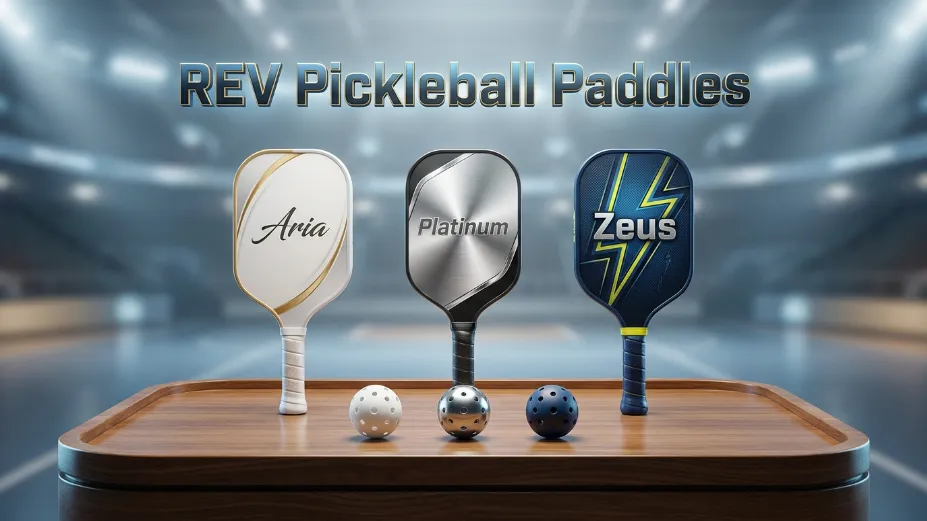
The corporate uniformity of pickleball gear has officially hit a wall. While most brands keep shifting the same raw carbon fiber sheets and calling it innovation, a quiet revolution is happening at the kitchen line. If you have spotted that distinctive, aerodynamic throat cutout on the courts lately, you already know we are talking about rev pickleball paddles. These are not just standard paddles with a fresh coat of paint; they are a mechanical re-engineering of swing speed and wind resistance.
Whether you are leaning toward the surgical control of the Aria or the raw, punishing drive of the Platinum, choosing your next paddle requires looking past the marketing hype and into the actual on-court physics.
Paddle Model Comparison
Core · Face · Weight · Performance · Price (USD)
For advanced players searching for the best balance between elite spin generation, controllable power, and modern thermoformed construction, the Aria Pro and Zeus currently represent the strongest values in the REV lineup. Players prioritizing defensive resets, kitchen precision, and lower arm fatigue should gravitate toward the Aria or Radiance, while fast-handed doubles specialists will appreciate the aerodynamic responsiveness of the Platinum.
The REV Technical Matrix: Comparative Specifications
The biggest reason rev pickleball paddle models have exploded in popularity is simple: REV attacked the market from an engineering-first perspective instead of relying on sponsorship-heavy branding. In a space dominated by premium pricing from brands like Joola, Selkirk, and CRBN, REV entered with aggressive direct-to-consumer pricing while still integrating advanced technologies typically reserved for paddles above the $180 threshold.
Most competitors rely heavily on superficial upgrades. REV instead focused on three overlooked performance variables:
- Aerodynamic throat geometry
- Polarized swing weight optimization
- Material-layer responsiveness under rotational acceleration
This is where the market separation begins.
The majority of traditional rectangular paddle designs create excess air resistance near the throat and shoulder transition zones. REV’s open-throat architecture reduces drag during rapid exchanges at the kitchen line, particularly during backhand counters and wrist-roll speedups.
That difference becomes immediately noticeable in high-level doubles play.
Instead of feeling sluggish during hand battles, the paddle accelerates through contact with less rotational resistance. This directly improves reaction timing during firefights at the non-volley zone.
If you want a deeper technical explanation of carbon fiber paddle structures, this breakdown on carbon fiber pickleball paddle engineering provides useful background context.
Deep Dive: REV Aria vs. Aria Pro (Control vs. Power)
The comparison between the rev aria pickleball paddle and the Aria Pro is where REV’s engineering philosophy becomes crystal clear. These paddles may appear visually similar at first glance, but their internal construction characteristics create dramatically different performance behaviors on court.
16mm Honeycomb Dampening & Control Physics
The standard Aria uses a traditional 16mm polypropylene honeycomb core paired with a raw T700 carbon fiber face. This combination prioritizes dwell time — the fraction of a second the ball remains on the paddle surface during impact.
Longer dwell time translates directly into:
- More controlled third-shot drops
- Enhanced reset consistency
- Reduced rebound explosiveness
- Superior kitchen touch
- Improved directional accuracy
The 16mm thickness also creates stronger vibration dampening. Intermediate and advanced players dealing with mild elbow discomfort often notice reduced shock transmission compared to thinner thermoformed power paddles.
Unlike painted texture surfaces that lose grit over time, the raw T700 carbon fiber maintains friction consistency much longer. This allows players to generate reliable topspin rolls and dipping passing shots without depending on artificial grit coatings.
For players still deciding between thicker and thinner core constructions, this guide on 14mm vs 16mm pickleball paddle performance breaks down the differences extremely well.
Aria Pro Thermoformed Construction Explained
The Aria Pro changes the equation entirely.
Instead of relying solely on a standard honeycomb structure, the Pro version incorporates thermoformed unibody construction with foam-injected perimeter reinforcement.
This matters more than most players realize.
Thermoforming compresses the paddle structure into a unified shell, increasing structural rigidity and energy transfer efficiency. When the ball impacts the face, less energy dissipates into frame flex and more transfers directly back into the shot.
The result:
- Higher ball exit velocity
- Heavier drives
- More aggressive putaways
- Faster counterattack potential
- Improved baseline penetration
The foam-injected perimeter walls also increase the paddle’s polar moment of inertia. In practical terms, that means improved torsional stability during off-center contact.
Translation?
The sweet spot effectively expands.
Mishits lose less energy, and defensive blocks remain surprisingly stable even under heavy pace.
This is one of the reasons thermoformed paddles have rapidly gained traction among tournament-level competitors. If you want additional insight into the manufacturing science, this technical guide on thermoformed pickleball paddles explains the process in greater detail.
The Grip Dilemma Nobody Talks About
One overlooked issue within the original Aria design is the stock 4.35-inch grip circumference.
For players with smaller hands or aggressive wrist-based mechanics, the thicker grip slightly restricts wrist articulation during topspin acceleration. This can reduce whip generation on aggressive forehand rolls and backhand flicks.
The Aria Pro’s optimized 4.2-inch grip circumference solves much of this problem.
That smaller diameter increases:
- Wrist mobility
- Spin acceleration
- Grip customization flexibility
- Faster grip transitions
This is a “missing angle” many competing reviews completely ignore, despite grip circumference being one of the most influential variables in spin mechanics.
Head-to-Head: Aria vs. Platinum vs. Zeus
Most paddle comparisons online stay painfully surface-level. They discuss “feel” without analyzing why the feel exists.
Here is the deeper reality:
- Aria = maximum reset control and defensive consistency
- Platinum = fastest hand speed and quickest volley acceleration
- Zeus = highest raw offensive ceiling and spin aggression
The Zeus delivers the strongest combination of spin and power in the REV lineup due to its Gen 3 thermoformed structure and explosive rebound characteristics.
However, advanced players should understand the tradeoff:
Higher rebound efficiency also means less forgiveness during soft resets.
Meanwhile, the Platinum thrives during chaotic hand battles because its aerodynamic shape reduces rotational inertia. Fast exchanges feel cleaner and more reactive compared to traditional box-shaped paddles.
The Aria remains the safest choice for strategic doubles players who prioritize consistency over highlight-reel power.
Analyzing the REV Platinum Edgeless Design
The rev platinum pickleball paddle represents one of the most mechanically unique paddles in its price category.
Aerodynamics & Throat Hole Engineering
Most manufacturers still underestimate the importance of airflow management.
REV did not.
The Platinum’s throat cutout reduces drag by allowing air to pass directly through the frame during swings. This decreases resistance during rapid rotational movement.
The measurable effect?
- Faster swing acceleration
- Higher tip speed
- Quicker volley reactions
- More efficient wrist-roll counters
- Reduced fatigue during long doubles sessions
During hand battles, even tiny aerodynamic advantages matter because reaction windows are measured in milliseconds.
That is why many high-level players immediately notice the Platinum feels “quicker” despite weighing nearly the same as competing paddles.
Carbon/Fiberglass Hybrid Surface Dynamics
The Platinum combines rigid carbon fiber with flexible fiberglass layering.
This hybrid structure creates an unusually dynamic launch profile.
Carbon fiber stabilizes the face for directional consistency, while fiberglass introduces elastic rebound energy that increases shot pop.
Combined with the thinner 13mm core, the paddle produces:
- Explosive baseline drives
- Fast punch volleys
- Aggressive speedups
- High launch responsiveness
However, thinner cores naturally reduce dwell time. That means players transitioning from softer 16mm paddles may initially struggle with resets and touch shots.
This is where player adaptation becomes critical.
Edgeless Construction: Pros & Cons
Edgeless paddles are polarizing for good reason.
Advantages include:
- Reduced drag
- Cleaner swing path
- Lower edge turbulence
- Faster reaction speed
But there are tradeoffs competitors rarely discuss:
- Tighter sweet spot margins
- Higher vulnerability to edge damage
- Less structural forgiveness on mishits
This is why many advanced players apply protective edge tape immediately after purchase.
For a broader overview of aerodynamic paddle concepts, this guide on edgeless pickleball paddles explains the category extremely well.
Advanced Material Physics: EPP Foam (Radiance) & USAP Compliance
A true rev pickleball paddle review cannot ignore the Radiance because it introduces one of the most interesting material innovations currently available: a 100% EPP foam core.
Expanded Polypropylene vs. Traditional Honeycomb
Traditional honeycomb paddles rely on segmented internal cells.
The Radiance replaces that architecture entirely with Expanded Polypropylene foam.
This changes impact behavior dramatically.
Instead of localized vibration transmission through hollow chambers, EPP foam disperses energy isotropically across the paddle structure.
Benefits include:
- Softer impact sensation
- Reduced vibration spikes
- More plush contact feel
- Improved comfort during extended sessions
- Enhanced reset forgiveness
This type of vibration management becomes especially valuable for older players or competitors recovering from arm fatigue.
USA Pickleball Compliance & COR Testing
Modern paddle development is increasingly constrained by regulation.
Every serious manufacturer must comply with standards established by USA Pickleball’s official governing body.
One of the most important metrics is the Paddle-Ball Coefficient of Restitution (COR), which measures rebound efficiency.
The formula is:
COR = (Rebound Velocity ÷ Incoming Velocity)
Higher COR values create more explosive rebound behavior, but excessive rebound can push paddles beyond legal performance thresholds.
This is why modern Gen 3 thermoformed paddles are under increasing scrutiny.
Manufacturers now walk a razor-thin line between elite power generation and regulatory compliance.
Pro-Tier Customization: Tuning Your REV Paddle
One of the biggest mistakes recreational players make is assuming stock paddle configurations are optimal.
They are not.
Advanced players frequently customize:
- Swing weight
- Twist weight
- Balance point
- Grip thickness
- Handle weighting
Lead Tape & Tungsten Customization
Adding lead or tungsten tape at the 3 and 9 o’clock positions increases torsional stability.
Benefits include:
- Larger effective sweet spot
- Improved block stability
- Reduced paddle twisting
- More consistent counter volleys
Meanwhile, adding weight near the paddle tip increases plow-through power and shot penetration.
However, this also raises swing weight and slows reaction speed.
Customization always involves tradeoffs.
Edge Guard Protection Matters More Than You Think
Players obsess over carbon fiber weave patterns while ignoring structural durability.
That is a mistake.
Thermoformed paddles — especially edgeless designs — benefit enormously from protective edge tape.
Without protection, repeated court contact gradually weakens the perimeter bonding structure.
This can eventually affect:
- Frame rigidity
- Vibration consistency
- Sweet spot integrity
- Long-term durability
Where REV Fits in the Modern Paddle Market
REV occupies a fascinating position in the current market because it aggressively targets the performance gap between mid-tier pricing and elite-tier technology.
Instead of relying purely on celebrity endorsements, REV invested heavily into:
- Aerodynamic geometry
- Thermoformed reinforcement
- Advanced face layering
- Swing speed optimization
This creates genuine engineering differentiation rather than cosmetic branding.
For players researching broader paddle options across multiple brands, this curated list of top pickleball paddles provides additional comparisons.
Likewise, players focused primarily on soft-game precision should explore this breakdown of the best pickleball paddle for control.
Spin-focused competitors can also benefit from this analysis of the best pickleball paddle for spin.
And if you are newer to the sport itself, this introductory guide explaining what pickleball is and how it works provides useful foundational knowledge.
Final Verdict: Are REV Pickleball Paddles Actually Worth It?
Yes — but only if you understand what each model is engineered to accomplish.
The REV lineup is not built around superficial cosmetic variation. Each paddle targets a distinct performance identity:
- Aria = precision control and soft-game mastery
- Aria Pro = balanced all-court aggression
- Platinum = elite hand speed and aerodynamic acceleration
- Zeus = maximum offensive pressure
- Radiance = plush comfort and vibration dampening
The most important takeaway is this:
REV succeeded because it addressed overlooked engineering variables that directly impact real-world match performance.
That includes:
- Airflow efficiency
- Grip ergonomics
- Polarized weighting
- Thermoformed stability
- Material-layer responsiveness
Those are not marketing gimmicks.
They are measurable performance variables that serious players feel immediately once rallies speed up and reaction windows shrink.
Frequently Asked Questions About REV Pickleball Paddles
Are REV pickleball paddles approved for tournament play?
Yes. Most REV paddle models are designed to comply with USA Pickleball standards and are suitable for sanctioned tournament play, provided they remain on the approved paddle list.
Which REV paddle generates the most spin?
The Zeus currently offers the most aggressive spin and power combination due to its Gen 3 thermoformed structure and raw carbon fiber face.
Is the REV Platinum good for doubles players?
Absolutely. The Platinum excels during fast kitchen exchanges thanks to its aerodynamic throat design and rapid hand-speed characteristics.
Which REV paddle is best for control?
The Aria and Radiance are the strongest control-oriented options in the lineup because of their softer feel and improved vibration dampening characteristics.
Do thermoformed paddles really make a difference?
Yes. Thermoformed paddles generally create more structural rigidity, improved energy transfer, larger sweet spots, and higher rebound efficiency compared to standard construction methods.
What skill level are REV paddles best suited for?
REV paddles cover a broad spectrum, but the Aria Pro, Platinum, and Zeus are especially appealing to intermediate and advanced players in the 3.5–5.0 USAPA range.