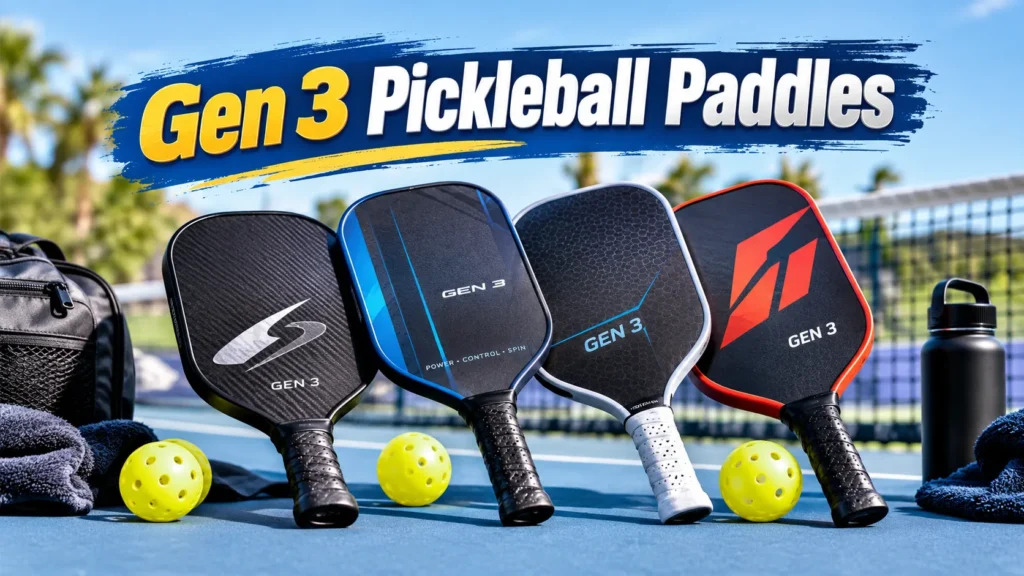
The court is faster, the drives are heavier, and the margin for error is razor-thin—which is why the equipment arms race shifted dramatically with the engineering breakthrough behind gen 3 pickleball paddles. While earlier generations focused merely on raw grit or basic thermoforming, today’s landscape is defined by engineered core stability and explosive trampoline effect that completely redefines court dominance.
If you are tracking the ongoing debate of gen 3 vs gen 4 pickleball paddle performance or searching for a comprehensive Gen 3 pickleball paddles review, understanding how these second-wave powerhouse paddles distribute kinetic energy is the single edge separating recreational players from tournament podiums. Below, we break down the definitive data shaping the current US market to help you secure the best gen 3 pickleball paddle for your playstyle.
Best Gen 3 Pickleball Paddles
Verified specifications & compliance (2026) · By optimal playing style
Comprehensive Gen 3 pickleball paddles review: Anatomical Breakdown and Core Performance
The engineering core of the best gen 3 pickleball paddle centers upon its non-traditional thermoformed unibody setup. While legacy paddles relied primarily on basic cold-pressed honeycomb, these silhouettes bridge aerospace materials with the rigorous kinetic constraints of modern court sports.
- The Thermoformed Matrix: Utilizing high-density foam injected into the perimeter edges, the primary engine offers exceptional kinetic bounce. When struck, the entire carbon face flexes inward, storing kinetic energy before violently snapping back and transferring that energy directly into the ball.
- Core Crushing Vulnerability: Because the polypropylene honeycomb walls are exceptionally thin, the trampoline effect creates intense lateral shear stress. A distinct drawback of Gen 3 is that over time, these cell walls can buckle, permanently deforming and creating an illegal “hot spot” that launches the ball unpredictably.
- Surface Friction Mechanics: Modern formulations incorporate multi-directional structural carbon weaves that maintain up to 2,100 RPM of spin. This allows players to execute sudden topspin rolls near the kitchen without catching the tape, giving a massive advantage over spray-on grit that degrades quickly.
The outer layer balances ultra-lightweight structural integrity with protective edge guards. For players analyzing options across the entire market, evaluating the dedicated structural differences in our guide to thermoformed pickleball paddles provides clear contextual background before buying.
14mm vs. 16mm: Deciding on your best gen 3 pickleball paddles
Navigating the product family requires a clear understanding of the mechanical differences between core thicknesses. Selecting your specific version of a gen 3 pickleball paddle dictates both your launch angle and your kinetic velocity on court.
The Dwell Time Variance
The 16mm architecture focuses extensively on energy absorption and control. The thicker composite provides an expansive sweet spot that resists torquing during heavy defensive resets. Conversely, the 14mm configuration employs a thinner profile designed for low-to-the-ground responsiveness. This gives speed-focused players a flatter launch angle, preventing pop-ups, but significantly less vibration dampening during heavy baseline exchanges.
Weight and Commercial Discrepancies
The extra material in the 16mm core introduces an undeniable weight penalty, pushing swing weights noticeably higher. The 14mm option drops this weight signature, providing lightning-fast hands for nimble kitchen exchanges. This variance reflects clearly across the market, where premium flagship models command high prices, while budget disruptors like Friday Pickleball enter at a highly accessible $99 threshold.
If you are a high-level competitor seeking to match advanced paddle dynamics with elite-tier mechanics, exploring the definitive rules in our guide to pickleball kitchen rules will ensure your entire tactical setup functions in perfect alignment.
Head-to-Head: JOOLA Perseus 3S Dual vs. Friday Fever Gen 3
For players trying to choose between premium flagship models and budget disruptors, the choice comes down to a fundamental split in investment philosophy. Both paddles command attention across US courts but approach market dominance from completely opposing angles.
The primary differences in on-court performance are detailed in the comparison matrix below:
- Certification and Compliance: The JOOLA 3S Dual wins decisively on regulatory peace of mind, engineered to pass both the strict USA Pickleball 0.43 PBCoR standard and the UPA-A PEF metrics. The Friday Fever offers elite power but forces players to monitor evolving compliance landscapes carefully.
- Sweet Spot and Forgiveness: JOOLA dominates the stability category through its highly engineered Propulsion Core, which locks the edges down completely to absorb off-center hits. The Friday Fever provides excellent fluid power but yields slightly more vibration on extreme, high-velocity defensive blocks.
- Lifespan and Value: The $200 investment in the JOOLA delivers pro-level refinement and extended core durability. The lighter $99 Friday Fever offers unbeatable entry-level value for thermoformed technology, serving as a perfect transition paddle.
For a complete, comprehensive overview of the broad variety of choices currently occupying the competitive landscape, take a moment to read our detailed breakdown of top pickleball paddles alongside our independent evaluation of the best pickleball shoes for men to complete your ideal structural fit.
Frequently Asked Questions (FAQ)
What is the main difference in the gen 3 vs gen 4 pickleball paddle debate?
Gen 4 technology completely abandons the honeycomb core in favor of solid, multi-zone foam to permanently eradicate the core crushing issue. However, Gen 4 sacrifices the crisp, acoustic tactile feedback that high-level players rely on, making Gen 3 the preferred choice for those who value superior sensory connection to the ball.
Are these paddles legal for all USAP tournaments?
It depends strictly on the model. Dual-certified paddles (like the JOOLA 3S series) meet both USAP and UPA-A standards. However, older banned Gen 3 models exceed the strict 0.43 PBCoR limit and are entirely illegal for USA Pickleball-sanctioned competitive play.
How does the launch angle impact my drives?
The aggressive trampoline effect of a Gen 3 face causes the ball to pocket deeper into the core. During an upward swing, this results in a noticeably higher vertical launch angle. Players transitioning to this equipment must actively adapt by compacting their backswing and applying heavier topspin to keep drives inside the baseline.