The U.S. pickleball equipment economy shifted permanently the exact microsecond Ben Johns stepped onto a PPA Tour court holding a piece of engineering that completely rewrote the laws of kinetic transfer. Beneath the sleek aesthetic of the joola ben johns hyperion cfs pickleball paddle lies a quiet structural paradox: a multi-million-dollar industry standard built on a legacy architecture that competitors have spent years trying to decode, replicate, and occasionally outrun. If you are still evaluating this former flagship through the lens of generic marketing sheets or outdated DUPR forum advice, you are stepping onto a tournament court with a blindfold on—and the margins at the kitchen line are far too unforgiving for guesswork.
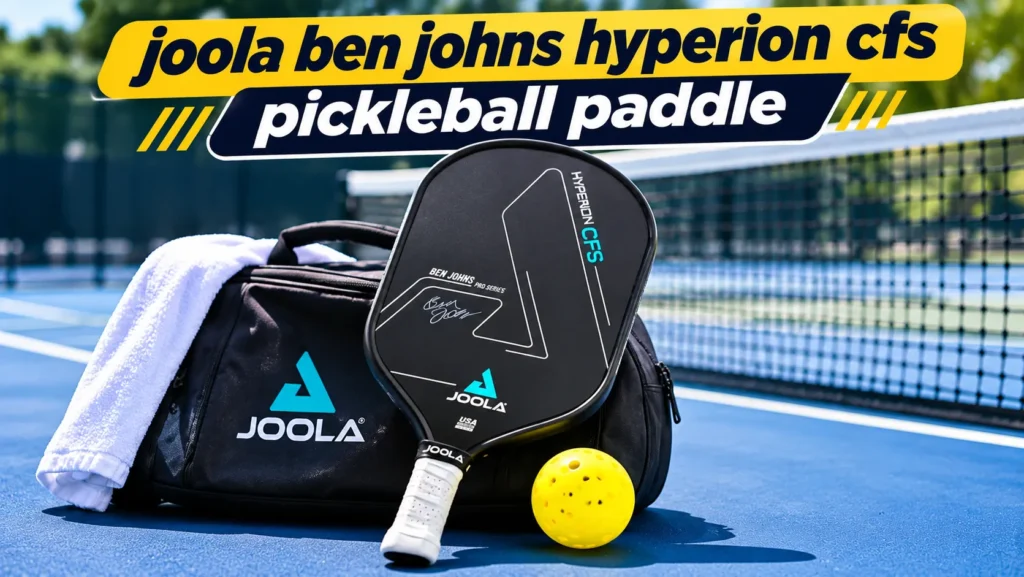
JOOLA Ben Johns Hyperion CFS 16mm
Pickleball Paddle · Official Specifications · Updated 2026
Joola Ben Johns Hyperion CFS Pickleball Paddle Review
Evaluating the joola ben johns hyperion cfs 16 pickleball paddle in 2026 requires understanding its strategic market repositioning. Upon its initial launch, this paddle commanded a premium MSRP of $219.95, positioning it as an ultra-premium flagship. Today, JOOLA has aggressively reduced the price to an accessible $159.95. This pricing shift moves it from a luxury tour-level purchase into the highly contested mid-tier bracket, making it an undisputed standout for 3.5 to 4.5 players who want proven, championship-winning technology without paying the “latest generation” premium tax. If you are reading contemporary pickleball paddle reviews, you will quickly notice that this former flagship still outperforms many modern paddles released at higher price points.
Anatomical Breakdown and Core Performance
The engineering architecture of this paddle is meticulously designed to bridge the gap between aggressive offensive leverage and highly forgiving defensive stability. Unlike traditional rectangular elongated shapes, the proprietary Aero-Curve head profile is rounded at the top. This aerodynamic curvature marginally reduces drag during your swing, attempting to counteract the paddle’s inherently heavy static weight of 8.4 ounces.
Internally, the 16mm Reactive Polypropylene Honeycomb Core provides maximum dwell time—the microsecond duration the ball stays compressed against the face. This thick core absorbs incoming kinetic energy from fast-paced drives, allowing you to execute soft resets into the non-volley zone with incredible precision. Surrounding this core is the Hyperfoam Edge Wall. By injecting a specialized high-density foam into the perimeter beneath the edge guard, JOOLA achieved two things: superior acoustic dampening and a massive lateral expansion of the sweet spot. When you strike a ball off-center, the peripheral mass prevents the paddle from twisting in your hand, keeping your shot on target.
The 5.5-inch CX-Forged handle is another critical asset. It offers plenty of real estate for players who utilize a two-handed backhand—a staple mechanic for modern players transitioning from tennis. The carbon-forged internal structure provides a calculated degree of flex upon impact, helping to transfer energy back into the ball.
Kinematic Performance: The Swing Weight Reality
To truly understand the joola ben johns hyperion cfs 16mm pickleball paddle, you must look past its static weight and examine its dynamic swing weight. Independent laboratory bench testing confirms this paddle carries a remarkably high swing weight, generally measuring between 118 and 127 kg·cm² depending on manufacturing variance. It is decisively head-heavy.
On the court, this head-heavy balance acts as a kinetic sledgehammer. For baseline drives, deep penetrating serves, and mid-court resets, the paddle dictates the momentum. You do not need to over-exert your shoulders or over-swing to generate pace; the paddle’s mass simply plows through the ball effortlessly. However, this same mass creates a distinct trade-off at the kitchen line. During rapid-fire, flat-paddle volley exchanges, the inertia required to move the paddle from a forehand to a backhand position takes fractions of a second longer than a lighter, head-light paddle. Players transitioning from lightweight equipment often find themselves late on counter-attacks initially, requiring them to utilize more compact stroke mechanics.
Carbon Friction Surface (CFS) Spin Mechanics
The Carbon-Flex5 surface is responsible for the paddle’s elite spin characteristics, averaging over 2,100 RPM in third-party testing. However, a massive information gap exists regarding how this spin is generated. Many consumers mistakenly assume the physical woven carbon fibers are grabbing the ball. In reality, the CFS utilizes a resin-based peel-ply imprint. The microscopic peaks and valleys are cast directly into the hardened epoxy resin that coats the carbon fiber. This allows players to execute dipping third-shot drops and aggressive roll volleys that dive sharply downward, exploiting fluid dynamics to force opponents to hit upward.
Durability Expectations and Structural Diagnostics (The Missing Gaps)
While marketing materials highlight the championship pedigree, a deep analysis of player feedback reveals specific structural constraints inherent to this Gen 2 architecture. Being aware of these vulnerabilities is crucial before visiting the JOOLA Ben Johns Hyperion CFS 16mm Official Site to make a purchase.
- The Handle Snapping Phenomenon: The original Hyperion CFS is not a “thermoformed unibody” paddle. The paddle face and the core are manufactured separately from the handle structure and joined together using polymer adhesives. Under high-torque situations—such as extreme mishits near the top edge during aggressive overhead smashes—the epoxy joint can experience sheer failure, causing the paddle to snap at the neck. While modern thermoformed pickleball paddles have resolved this, Hyperion users must be mindful of severe ground strikes.
- Grit Degradation Timeline: Because the elite spin relies on microscopic resin peaks rather than raw exposed carbon pores, the grit is highly susceptible to frictional wear. Advanced players report that the surface smooths out after three to six months of intense, multi-day-a-week play. Once the resin shears off, the RPM potential drops noticeably, altering the player’s ability to keep aggressive drives inside the baseline.
- Identifying Core Crushing: Over time, the fragile hexagonal cell walls of the internal polypropylene core can fatigue and collapse under high-velocity impacts. This alters the paddle’s responsiveness, causing it to randomly trampoline balls out of bounds. To accurately diagnose this, utilize the “Thumb Press Test.” Press your thumbs firmly into the dead center of the paddle face. If you hear a distinct crackling or crunchy sound, the internal cells have structurally failed. Do not squeeze near the edge guard, as the Hyperfoam will mask the issue.
Advanced Customization: Modifying Weight Distribution
Competitive players frequently utilize aftermarket weights to alter the paddle’s mass distribution, aiming to mitigate its head-heaviness or further expand the sweet spot. If you want to refine your equipment to perfectly match your best pickleball strategy, understanding the physics of lead tape for pickleball paddles is mandatory.
Expanding the Sweet Spot (Throat Weighting)
Applying 3 to 6 grams of high-density tungsten tape to the 4 o’clock and 8 o’clock positions (near the lower corners of the paddle face, just above the throat) increases the paddle’s twist weight with minimal detrimental impact on the swing weight. Because this mass is placed close to your hand, it doesn’t make the paddle feel much heavier to swing, but it drastically increases torsional stability. If a high-velocity ball strikes the outer edge, the added mass resists the twisting force, salvaging the shot’s directional accuracy during defensive blocks.
Counteracting Head-Heaviness (Tail-Weighting)
If you are struggling with sluggish hand speed at the net, adding weight directly to the butt cap achieves a mechanical illusion that makes the paddle swing faster. By adhering weight to the extreme bottom of the handle, the balance point of the paddle shifts downward, moving closer to your hand (the fulcrum). In the physics of levers, moving the center of mass closer to the fulcrum drastically reduces the swing weight. An 8.8 oz tail-weighted paddle will actually maneuver much faster through the air than an unmodified 8.4 oz head-heavy paddle, providing the definitive solution for defensive net players.
Head-to-Head: JOOLA Hyperion CFS 16mm vs. The Pro V Evolution
To fully contextualize the value of this paddle, it is necessary to compare it directly against JOOLA’s modern evolutionary successors, specifically when deciding if the joola ben john’s hyperion cfs 16mm pro pickleball paddle architecture still holds up against the newer unibody designs found in the JOOLA Pro IV pickleball paddles and Pro V generations.
Hyperion CFS 16mm vs. JOOLA Perseus (Pro IV / Pro V)
The Perseus represents a massive generational leap, abandoning the traditional two-piece construction for advanced thermoformed unibody engineering.
- Durability and Structure: The unibody construction of the Perseus virtually eliminates the neck-snapping defect of the original Hyperion, offering a vastly superior lifespan under heavy tournament stress.
- Kinematic Maneuverability: The Perseus features a squared-off top edge and a more neutral balance point, resulting in a significantly lower swing weight and drastically improved hand speed at the kitchen line. If you prioritize lightning-fast reflexes, the JOOLA Perseus MOD TA-15 Pro Player Edition or standard Perseus variants are superior.
- Touch and Forgiveness: Here is where the Hyperion wins. The thermoforming process makes the Perseus incredibly stiff and “poppy.” The legacy non-thermoformed construction of the Hyperion provides unmatched plush control, absorbing pace far better for players who rely on delicate dink rallies and drop shots.
Hyperion CFS 16mm vs. JOOLA Scorpeus
While the Hyperion is elongated (16.5 inches) for extended baseline reach, the JOOLA Scorpeus pickleball paddle utilizes a widebody shape. The Scorpeus sacrifices offensive leverage in exchange for an absolutely massive lateral sweet spot, making it the ultimate defensive reset tool. The Hyperion remains the choice for all-court aggressors, while the Scorpeus caters to defensive walls.
Navigating the Strict Manufacturer Warranty Framework
Given the documented vulnerabilities regarding core crushing and neck snapping, understanding the JOOLA warranty ecosystem is paramount. JOOLA operates one of the strictest warranty programs in the sporting goods industry, and reading joola ben johns hyperion cfs pickleball paddle reviews reveals that many consumers inadvertently void their coverage through simple oversight.
Newer iterations of the paddle feature an embedded Near-Field Communication (NFC) chip inside the handle base. Standard warranty coverage is strictly limited to 6 months. However, you can unlock an extended 12-month warranty if you execute a precise digital protocol: you must download the JOOLA Infinity App, tap your smartphone to the paddle handle, and upload a digital copy of an authorized sales receipt within exactly 14 days of the original purchase. Missing this 14-day window permanently limits you to the standard 6-month tier.
Furthermore, a massive trap exists in the secondary market. The warranty is strictly non-transferable. Buying used pickleball paddles or even “new in box” items from unauthorized third-party platforms—including eBay, Reddit classifieds, or Facebook Marketplace—completely excludes you from manufacturer protection, leaving you with zero recourse if the core fails.
Final Verdict: Is the Hyperion CFS 16mm Your Next Paddle?
The JOOLA Ben Johns Hyperion CFS 16mm is an incredibly potent, value-driven weapon when placed in the right hands. It is explicitly recommended for the 3.5 to 4.5 intermediate players who want top-tier spin, exceptional baseline plow-through, and a plush, shock-absorbing feel that modern thermoformed paddles lack. It is particularly brilliant for tennis converts relying on heavy topspin groundstrokes and two-handed backhands.
However, if you are a fast-hands net player who wins purely on reflex speed, or if you require maximum lightweight maneuverability to avoid arm fatigue, the heavy swing weight makes it a paddle you should pass on in favor of lighter, aerodynamically optimized alternatives. (Don’t forget to pair your high-performance paddle with proper footwear to maintain court traction; reviewing the best pickleball shoes for 2026 is highly recommended to complete your competitive setup).
Frequently Asked Questions (FAQ)
Does the Carbon Friction Surface (CFS) texture wear down over time?
Yes. The CFS texture is created using a peel-ply resin imprint, not by exposing raw, woven carbon fibers. Under intense, competitive use (playing 3 to 5 times a week), the microscopic resin peaks will naturally wear down due to friction, resulting in a noticeable drop in topspin RPM after approximately three to six months.
How can I definitively tell if my paddle has a crushed core?
To diagnose a crushed core without confusing it with standard face delamination, utilize the “thumb press test.” Press your thumbs firmly into the dead center of the paddle’s hitting surface. If you hear a distinct crackling or crunchy sound, the internal polypropylene honeycomb cell walls have collapsed. This is considered a manufacturing defect if it occurs early in the paddle’s lifespan and is covered under warranty.
Is this paddle too heavy for fast kitchen line exchanges?
For many players, yes. The combination of an 8.4 oz average static weight and the perimeter-weighted Hyperfoam Edge Wall results in a high, head-heavy swing weight (typically measuring between 118 and 127). This makes rapid directional changes during volley battles more strenuous compared to lighter, thermoformed paddles with neutral balance points.