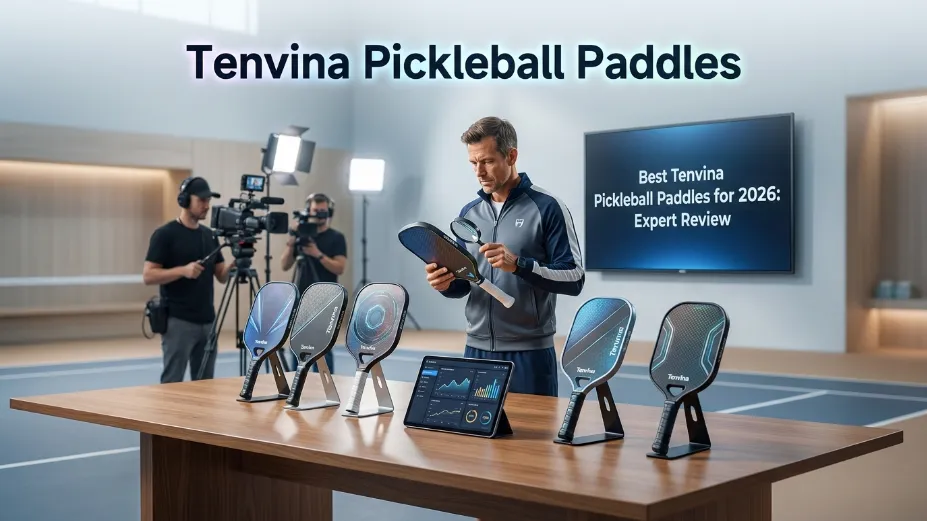
The perfect pickleball drive doesn’t come from your wrist; it comes from a sub-milimeter texture on your paddle’s surface that most brands overcharge for. While legacy names keep raising prices on thermoformed technology, a quiet shift is happening on local courts as more players switch to tenvina pickleball paddles. This isn’t another generic review talking about grip comfort. Instead, we are dissecting the exact core physics, grit longevity, and deflection rates of the entire Tenvina lineup to see if these paddles actually deliver pro-level spin, or if they are just another budget-friendly shadow in the crowded USAPA-approved market.
Hercules & Powernova Paddles — 2026 Comparison
Face · Core · Weight · Control & Power Ratings · USAPA
For players demanding the ultimate balance of aggressive spin and tournament compliance, the Tenvina Hercules Pro (Thrust) 16mm is the absolute best recommendation. It provides premium unibody thermoforming and raw Japane Poise shape to maximize their defensive reset consistency.
1. The USAP Certification Controversy: Demystifying the NHYHN Registry and the 2026 Approval Pivot
One of the most intense debates across local US courts and online communities like Reddit stemmed from a perceived lack of transparency regarding tournament legality. Early buyers of the tenvina pickleball paddle expressed serious skepticism when they noticed the USA Pickleball (USAP) “Approved” emblem printed directly on the throat, yet searching the digital database for “Tenvina” yielded zero matching manufacturers. This discrepancy led many competitive players to fear sudden tournament disqualifications.
The technical truth lies in the structural dynamics of overseas Original Equipment Manufacturing (OEM). Tenvina paddles are engineered and registered under the patent-holding corporate parent entity NHYHN. For months, local tournament directors relying solely on name-brand listings disallowed the paddle mid-bracket, causing massive friction. However, this compliance gap has been officially resolved. The official official USA Pickleball equipment database lists TENVINA under NHYHN ownership as fully passing, with the flagship tenvina hercules pickleball paddle receiving official, verified USAP approval on February 23, 2026. The paddle passed testing with a standardized 16mm depth, an 8mm polymer cell matrix, and a frosted friction finish, securing its complete eligibility for all sanctioned tournament brackets.
However, players must remain highly vigilant. Because these paddles are distributed through various third-party online marketplaces, some early-production “open-box” batches or design replicas feature graphic lines that vary slightly from the schematic photos registered at the USAP lab. In strict tournament environments, minor graphical variations can still trigger a red flag during pre-match paddle inspections. Ensuring your purchase matches the updated 2026 golden-edge parameters is highly recommended to guarantee absolute compliance on the USA Pickleball approved paddle list.
2. Surface Material Performance: Toray T700SC Carbon Fiber vs. DuPont K29 Aramid Composite
Analyzing the Tenvina Hercules Pickleball Paddle Carbon Layup
To understand the performance profile of the tenvina hercules pickleball paddle, we must analyze its structural layup. Unlike generic budget paddles that spray a temporary layer of sand grit over a cheap fiberglass face, the Hercules Pro utilize a genuine, hot-pressed 4-layer T700SC raw carbon fiber composite. T700SC is an aerospace-grade material sourced from Toray Industries in Japan, woven to deliver a massive tensile strength of approximately $700\text{ ksi}$.
By employing a specialized Dry Jet-Wet Spinning process, the fibers achieve extreme structural density. When the ball impacts the face, this dense weave prevents localized surface deformation, allowing the microscopic, raw carbon fibers to act as teeth gripping the plastic ball. This structural stiffness dramatically increases the coefficient of static friction, yielding spin rates exceeding $1,900\text{ RPM}$ under aggressive upward brushing paths. For intermediate players looking to transition to a high-end carbon fiber pickleball paddle, the Hercules Pro delivers consistent ball compression without the typical high-tier price tag.
The Powernova K29 Aramid Hybrid Dynamics
For players seeking a softer feel and a more complex deflection arc, Tenvina introduced the Powernova Pro series, which replaces the pure carbon surface with a hybrid 4-layer K29 Aramid and carbon weave. DuPont K29 Aramid (commonly known as Kevlar) introduces entirely different molecular mechanics to the paddle face. While raw carbon fiber is highly rigid and responsive, aramid possesses immense impact resistance and lateral elasticity.
When executing high-velocity drives, the K29 aramid strands deform elastically upon impact, absorbing a portion of the ball’s kinetic energy before rapidly snapping back to shape. This thermodynamic absorption increases the ball’s “dwell time” (the duration of ball-to-paddle contact). With the ball compressed deeper into the hybrid weave, players can actively shape their shots, executing extreme topspin angles and sharp backspin slices that are incredibly difficult to replicate on purely rigid faces. Additionally, the K29 hybrid layup acts as a natural dampening barrier, scattering high-frequency shock waves before they travel down the shaft, making it a highly forgiving surface for players managing minor wrist stress.
3. Core Engineering & Manufacturing Biomechanics: Unibody Thermoforming and Foam Edge Injection
The durability and stability of modern paddles are dictated by their internal edge engineering. Tenvina has successfully integrated elite-tier unibody thermoforming across its entire line, separating it from cold-pressed options that are highly susceptible to core crushing and delamination over time. To understand the immense value of this design, players should review how these specs compare to other thermoformed pickleball paddles on the market.
During the thermoforming process, the polymer honeycomb core, the perimeter foam walls, and the 4-layer carbon/aramid face sheets are fused together under intense heat and pneumatic pressure. Rather than sealing the edge guard with standard glue, Tenvina wraps three carbon fiber layers entirely around the paddle’s perimeter, injecting high-density polyurethane foam directly into the internal edge gaps. This design creates a completely sealed unibody frame that completely eliminates the risk of “core rot” (when the inner honeycomb separates from the outer walls).
Furthermore, the injected perimeter foam dramatically alters the paddle’s polar Moment of Inertia (MOI). By redistributing the mass along the outer edges, the paddle resists twisting when making off-center contact. The physical torque ($\tau$) experienced during a lateral mishit is calculated as:
$$\tau = F \cdot r$$
where $F$ is the impact force of the ball and $r$ is the distance from the longitudinal center axis. By placing dense foam at the edges, Tenvina effectively counteracts this rotational force, expanding the sweet spot to the absolute perimeter of the face and preventing weak, unpredictable deflections on off-center resets.
Inside the core, Tenvina offers two highly distinct polymer honeycombs:
- THC (Polymer Honeycomb Control Core): Standard on the 16mm Hercules Pro, this core focuses on vibration absorption and plush ball feedback, optimizing control for soft dinks and slow resets.
- TPC (Polymer Speed Core): Available in the 13mm variants, the TPC honeycomb utilizes tighter cell structures with thicker walls, enhancing the paddle’s energy return (coefficient of restitution) to deliver explosive pop and fast hand speed during close-quarters hand battles.
4. Custom Shapes & Playstyle Optimization: Elongated “Thrust” vs. Defensive “Poise” Configurations
The Elongated “Thrust” Design ($16.4″ \times 7.5″$) and Handle Leverage
The Thrust shape is engineered specifically for aggressive, baseline-heavy offensive players. Measuring exactly 16.4 inches in length and 7.5 inches in width, this design narrows the paddle face to extend the leverage arm. By moving the center of mass further away from the player’s hand, the Thrust shape dramatically increases the paddle’s swingweight.
Using the parallel axis theorem, the rotational inertia ($I_{\text{swing}}$) of the paddle about the wrist pivot is:
$$I_{\text{swing}} = I_{\text{cm}} + M \cdot d^2$$
where $M$ is the total mass and $d$ is the distance from the grip to the center of mass. The elongated Thrust shape maximizes $d$, allowing players to generate immense tip speed on full baseline swings. This translates directly to deeper, more penetrating drives that force opponents backward. Additionally, the Thrust shape features a generous 140mm (5.5 inches) grip length, providing the exact physical clearance required for a clean, stable two-handed backhand drive, making it a favorite for former tennis players.
The Widebody “Poise” Design ($16.0″ \times 8.0″$) and Kitchen Defense
Conversely, the Poise shape is a defensive masterpiece optimized for players who dominate the non-volley zone (kitchen). Measuring 16.0 inches in length and a full 8.0 inches in width, this widebody configuration prioritizes structural stability and raw surface area. By distributing the paddle’s mass wider rather than longer, the Poise shape lowers the swingweight, allowing for lightning-fast reflex adjustments during intense hand battles at the net.
The wider face profile means the sweet spot is vastly wider laterally, minimizing the rotational wobble that typically occurs when blocking high-velocity body drives. The Poise handle is shortened to 133mm (5.25 inches), placing the hand closer to the face’s center of gravity. This ergonomics shift maximizes wrist maneuverability, allowing defensive specialists to effortlessly roll their wrists for sharp kitchen dinks and quick defensive resets.
5. Tenvina Pickleball Paddle Reviews: Real Court Performance and Wear Analysis
To provide a truly transparent tenvina pickleball paddle review, we must look beyond standard out-of-the-box impressions and analyze how these paddles handle real-world wear over extended periods of competitive play. According to extensive player feedback on local courts, the structural integrity of the unibody thermoformed frame remains exceptionally high, with virtually no reports of core rattling or delamination—a common defect in older cold-pressed paddles.
The T700SC carbon face on the Hercules series receives immense praise for its ability to maintain high spin performance across months of continuous use. However, when reading multiple tenvina pickleball paddle reviews, a clear wear pattern emerges regarding the K29 aramid face. While the K29 composite provides exceptional control and an incredibly soft feel out of the box, several intermediate players noted that the proprietary matte-textured finish on the aramid face can show smooth patches within 3 to 4 weeks of heavy, daily play. This micro-grit smoothing slightly reduces the maximum RPM potential on brushed shots, though the underlying core stability remains fully intact.
In terms of handle feedback, players appreciate the ergonomic, perforated synthetic leather grip. It actively absorbs moisture during intense summer sessions, preventing slippage during rapid wrist turns. The medium-pitched contact sound is also highly praised, offering a satisfying, solid “thump” that is much quieter and less obnoxious than cheap, hollow-sounding graphite starter paddles.
6. Competitive Market Matrix: How Tenvina Compares Under $100
The under-$100 price bracket is highly crowded, with budget brands competing fiercely for dominance. To see if Tenvina is truly worth the investment, we must compare it directly to the established industry benchmarks:
- Tenvina Hercules Pro ($50 – $60): Offers full unibody thermoforming, perimeter foam walls, and 4-layer raw T700SC carbon fiber. It delivers a highly balanced, stable all-court feel with tournament legality, representing an unbeatable value. For budget-conscious competitors, it stands out as one of the best pickleball paddles under $100.
- Vatic Pro Prism Flash ($90 – $100): The Vatic Pro pickleball paddle remains a legendary control option. Using a Gen 1.5 cold-pressed construction, the Prism Flash offers a softer, more plush feel on dinks. However, because it lacks thermoformed edge injection, it delivers significantly less power and pop compared to the Tenvina Hercules Pro.
- Friday Aura / Aura Pro ($80 – $95): Known for vibrant designs and excellent raw carbon surfaces. While the Friday Aura generates explosive offensive power, court data indicates its surface texture wears down slightly faster than Tenvina’s T700SC matte face, resulting in a quicker drop in spin performance.
- Roore Solana Gen 2 ($30): A fantastic entry-level Kevlar-composite paddle that offers solid stability for beginners. However, it lacks the advanced unibody thermoforming, perimeter foam walls, and custom shape configurations found in the Tenvina Hercules Pro series.
Tenvina Pickleball Paddles – FAQ
Is the Tenvina Hercules Pro officially approved for tournament play by USA Pickleball?
Yes. While there was initial confusion because Tenvina is manufactured by NHYHN, the TENVINA Hercules Pro model (MD# HERCULES PRO) was officially tested and passed by the USAP lab on February 23, 2026. It is fully legal for all sanctioned tournament brackets.
What is the difference between the Thrust and Poise shape options?
The elongated Thrust shape ($16.4″ \times 7.5″$) features a longer handle ($140\text{mm}$), optimizing tip speed and reach for aggressive offensive players and two-handed backhands. The widebody Poise shape ($16.0″ \times 8.0″$) utilizes a shorter handle ($133\text{mm}$) to maximize lateral stability, swing control, and defensive resets at the net.
Should I choose the 13mm or the 16mm core thickness?
The 16mm core is designed for maximum vibration dampening, offering a larger sweet spot and superior touch for control-focused, defensive playstyles. The 13mm core is thinner and stiffer, returning more kinetic energy to the ball for faster reflexes, pop, and aggressive baseline drives.
How long does the raw carbon face texture last before losing spin?
The T700SC raw carbon face utilizes a hot-pressed matte-textured surface that chemically bonds with the composite layers. Unlike cheap painted-on grit, this texture is highly resistant to wear and maintains exceptional spin rates for several months of competitive play, provided the face is cleaned regularly with a rubber paddle eraser.