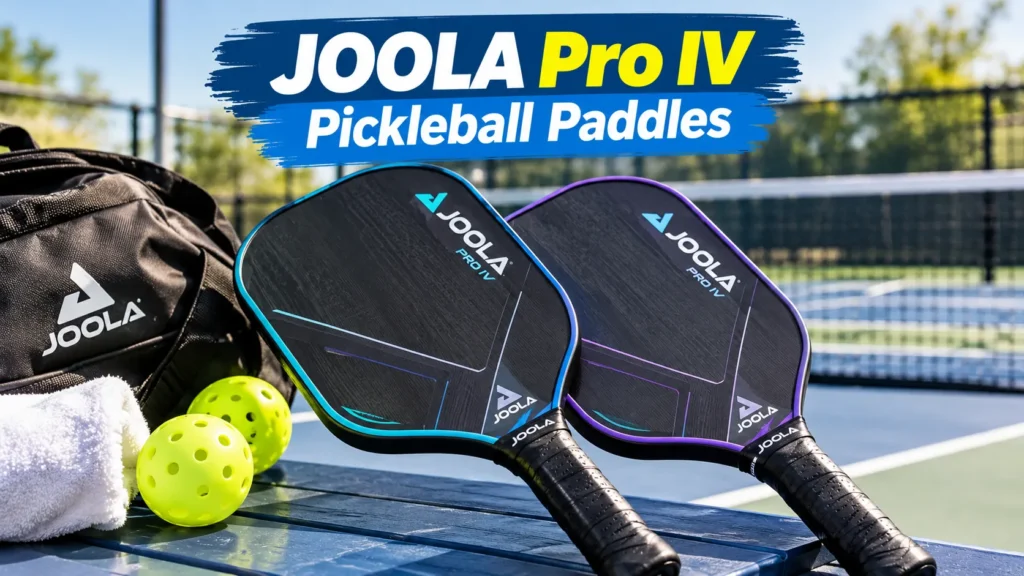
Competitive pickleball is won in the microscopic margins of equipment engineering, where a fraction of an ounce and a millimeter of core thickness dictate whether a third-shot drop dies softly in the kitchen or explodes past an outstretched hand. When elite players dissect the current gear landscape across the United States, the conversation inevitably circles back to the dominance of joola pro iv pickleball paddles.
Engineered to satisfy the brutal demands of tournament play, these hyper-responsive blades are rewriting performance metrics—making a deep dive into variants like the joola ben johns perseus pro iv pickleball paddle, the joola ben johns perseus pro iv 16mm pickleball paddle, and the joola ben johns perseus pro iv 14mm pickleball paddle indispensable for every serious competitor. Whether you are hunting for an exhaustive Joola Pro IV pickleball paddle review or trying to pinpoint which core profile matches your swing mechanics, the precise architectural breakdown below exposes the structural differences that separate baseline grinders from podium finishers.
Joola Pro IV Pickleball Paddles
Verified Specs & Performance Data · 2026
Comprehensive Joola Pro IV pickleball paddle review: Technical Anatomy
The engineering core of the joola pro iv pickleball paddle centers upon its non-traditional floating core setup. While early pickleball paddles relied on static honeycomb components glued directly to the edges, this silhouette bridges maximum kinetic energy return with the rigorous defensive constraints of modern court battles.
- TechFlex Power Edge Wall: Utilizing specialized high-density EVA foam placed outside the primary frame but underneath the edge guard, this system creates a mechanical buffer. During high-velocity impacts, it allows the internal core to compress and rebound, creating a massive trampoline effect for effortless offensive power .
- Propulsion Polymer Core: Because the honeycomb interior is not rigidly fixed to the outer edges, it requires a structural countermeasure. The dynamic core flexes violently under heavy loads (like baseline drives) while remaining stiff on delicate non-volley zone resets, providing dynamic stability precisely when you need it most .
- Carbon Friction Surface: The textured raw carbon face interacts directly with the deep pocketing effect of the core. This allows players to execute sudden, heavily shaped topspin rolls from the transition zone, generating spin rates that regularly exceed 1,000 RPM in independent laboratory testing.
The perimeter construction balances an ultra-lightweight swing with protective structural integrity. This combination prevents immediate loss of stability during low defensive lunges, though unlocking its full potential often requires precise customization. For players analyzing options across the entire market matrix, evaluating the dedicated structural differences outlined in our analytical look at the joola pickleball paddle lineup provides clear contextual background before buying.
14mm vs. 16mm: Deciding on your joola ben johns perseus pro iv pickleball paddle
Navigating the product family requires a clear understanding of the mechanical differences between the flagship 16mm layout and its thinner counterpart. Selecting your specific version of the joola ben johns perseus pro iv pickleball paddle dictates both your defensive reset capabilities and your kinetic velocity during blistering hands battles.
The Dwell Time Variance
The joola ben johns perseus pro iv 16mm pickleball paddle focuses extensively on energy return and physical dwell time. The thicker core resists rotational torque and allows the ball to sink deeper into the face, delivering unmatched plow-through power on full groundstrokes and a massive, forgiving sweet spot. Conversely, the joola ben johns perseus pro iv 14mm pickleball paddle employs a stiffer face designed for low-dwell, instant responsiveness. This gives speed-focused doubles players a sharper sense of pop, resulting in explosive blocks and counters, though it demands vastly superior touch to prevent unwanted pop-ups.
Ergonomic and Customization Discrepancies
The extra thickness of the 16mm foam introduces a larger 4.25-inch grip circumference and a slightly heavier static weight of around 8.1 ounces. The 14mm option drops this specification noticeably, utilizing a slimmer 4.125-inch handle that provides a highly fluid sensation for nimble grip changes at the net . To maximize the 14mm’s potential and cure its naturally lower twist weight, elite 5.0+ players often apply specific 28mm-wide edge guard tape and precise tungsten weights to the 4 o’clock and 8 o’clock rim positions, drastically expanding lateral stability without sacrificing its elite hand speed .
If you are a high-level competitor seeking to match advanced paddle dynamics with elite-tier mechanics, exploring the definitive structural breakdown detailed in our guide to the ben johns pickleball paddle will ensure your entire equipment setup functions in perfect technical alignment.
Head-to-Head: JOOLA Pro IV vs. JOOLA Pro V
For players trying to choose between the aggressively discounted Pro IV and the newer $299.95 Pro V, the choice comes down to a fundamental split in design philosophy. Both models command top-tier placement across American tournaments but approach court stability and power generation from completely opposing angles.
The primary differences in on-court performance are detailed in the comparison matrix below:
- Launch Consistency and Flex: The Pro IV utilizes TechFlex Power, which delivers massive “free pop” but can occasionally produce an unpredictable flyer that sails past the baseline during chaotic rallies. The Pro V introduces a KineticFrame throat that flexes uniformly, providing a highly predictable, linear exit trajectory that requires the player to supply their own raw power and high swing speed.
- Core Fatigue and Durability: The Pro IV’s aggressive trampoline effect puts immense repetitive stress on the internal honeycomb cells, which inevitably leads to a “core crush” (identifiable by a hollow crunching sound and erratic rebound speeds). The Pro V attempts to solve this exact vulnerability via added internal carbon reinforcements near the throat, though it trades away that signature effortless pop to achieve this structural longevity.
- Warranty Strategies and Authentication: Both generations feature an embedded NFC chip on the handle base for anti-counterfeit scanning. However, players submitting a warranty claim for a crushed Pro IV core must precisely document the dead spot by pressing on the center of the paddle face in their video evidence; claims showing edge damage are notoriously dismissed by support as standard wear and tear.
For a complete, comprehensive overview of the broad variety of choices currently occupying the competitive landscape across the country, take a moment to read our detailed breakdown of the 14mm vs 16mm pickleball paddle alongside our independent evaluation of mastering the pickleball dink to select your ideal structural fit.
JOOLA Pro IV Pickleball Paddles – FAQ
How do I authenticate my paddle to ensure it is not a counterfeit?
Locate the smart scan logo tag on the factory handle wrap. Unlock your NFC-enabled smartphone and hold it near the top of the handle (tilting it slightly to the side for iOS devices, or holding it completely vertical for Androids). A genuine paddle will immediately trigger a prompt linking directly to the official JOOLA registration database.
What exact size edge guard tape should I use for optimal protection?
Due to the specific structural dimensions of the Hyper-Foam perimeter, you must purchase 28mm wide tape for any 14mm model, and 30mm wide tape for any 16mm model. Using the incorrect size will cause the adhesive to overlap onto the carbon friction surface, negatively altering your spin dynamics.
Why did the retail price drop so significantly, and is it a red flag?
Initially launched at a premium $279.95, the series was aggressively discounted to $149.95 following the release of newer generations and community feedback regarding its durability. This adjustment simply transformed the paddle into a highly competitive, accessible weapon for players who view its finite lifespan as a worthwhile recurring investment for peak tournament performance.