proton pickleball paddle
It feels like everywhere you look on the pickleball court these days, the gear is getting flashier and the tech is getting wilder. If you’ve been hanging around the local courts or scrolling through forums lately, you’ve almost certainly heard the whispers—or perhaps the loud cracks—of a proton pickleball paddle.
It’s not just another brand in a sea of carbon fiber clones. Proton has burst onto the scene with a vibe that feels less like a sporting goods company and more like a skunkworks science project that accidentally created something incredible. Based in Arizona, the company didn’t start with a marketing budget; they started with aerospace engineering. That’s the origin story here. They looked at the standard honeycomb cores and raw carbon faces dominating the market and asked, “Can we use actual rocket science to make this better?”
The result is a distinctive lineup of paddles known for their unique look, sound, and spin potential. With a premium price point, natural questions arise regarding value. Does the performance match the reputation? Let’s explore the features of these paddles, from their specific technology to how they manage grip during intense exchanges at the kitchen line.
General Product Information & Technology
When you first pick up a Proton, you realize this isn’t the same paddle your friend bought at a big-box store. The attention to detail is palpable. But to understand why people are obsessed with proton pickleball paddles, we have to look under the hood.
What makes Proton pickleball paddles different from other brands (Joola, Selkirk, CRBN)?
If you put a Joola Perseus or a CRBN 1X next to a Proton, the first thing you’ll notice is the surface. Most top-tier paddles today use “Raw Carbon Fiber.” It’s a great material—it’s gritty, it’s durable, and it works. However, Proton decided to take a different route.
The big differentiator is their background in aerospace coating. They don’t just rely on the texture of the fabric; they use a proprietary surface technology that feels almost rubbery to the touch when it’s brand new. This isn’t just about friction; it’s about adhesion. While brands like Selkirk focus on power and air vents, and Joola focuses on charged carbon surfaces, Proton is all about that connection between the ball and the paddle face. They are trying to maximize the legal limit of roughness and friction in a way that creates a unique “grab” on the ball. It’s less of a sandpaper feel and more of a tacky sensation, which changes the physics of how the ball leaves the paddle.
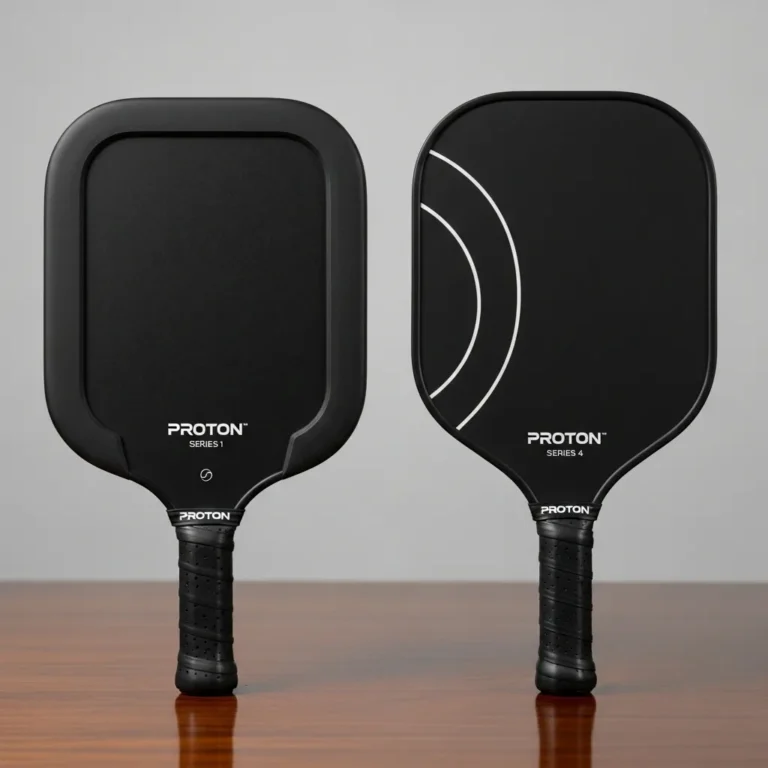
What is the difference between the Proton Series 1, Series 2, Series 3, and Series 4?
Navigating the “Series” lineup can be a bit confusing if you’re new to the brand, but think of it as an evolution of shape and material.
- Series 1: This is the paddle that started it all. It has a distinctive wide, almost square shape (though it comes in elongated versions too). It’s known for that massive sweet spot and the original introduction of their surface tech. It’s a stable, reliable plow-horse of a paddle.
- Series 2: Here, they moved toward a more traditional elongated shape, favored by singles players and those looking for extra reach and leverage. It slimmed down the profile slightly compared to the boxier Series 1.
- Series 3: This is where things got spicy with materials. The proton series 3 pickleball paddle often incorporates Kevlar (or Aramid fiber) into the face material. This gives it a distinct look (often reddish or yellowish hues) and a very different feel—stiffer, with more pop, yet incredibly durable.
- Series 4: The latest evolution. The Series 4 focuses heavily on aerodynamics and speed. If the Series 1 was a tank, the Series 4 is a sports car. It features a curved top and a design meant to cut through the air faster, reducing the drag that often plagues thicker power paddles.
How does the “Nanotac” surface technology work, and is it legal?
This is the million-dollar question. “Nanotac” is Proton’s fancy word for that aerospace coating I mentioned earlier. Imagine a surface that has microscopic peaks and valleys, but also a chemical composition that creates a high coefficient of friction.
When the ball hits a standard carbon paddle, it slides slightly before the grit catches it. With Nanotac, that slide is virtually eliminated. The ball “sticks” for a split second longer. This allows you to brush up on the ball and generate RPMs (revolutions per minute) that are consistently at the top of the charts in data tests.
And yes, it is legal. Every proton pickleball paddle that hits the market goes through the rigorous testing of USA Pickleball. They push the limits right up to the line of what’s allowed for surface roughness, but they stay within the rules. It feels like a cheat code, but it’s sanctioned.
related
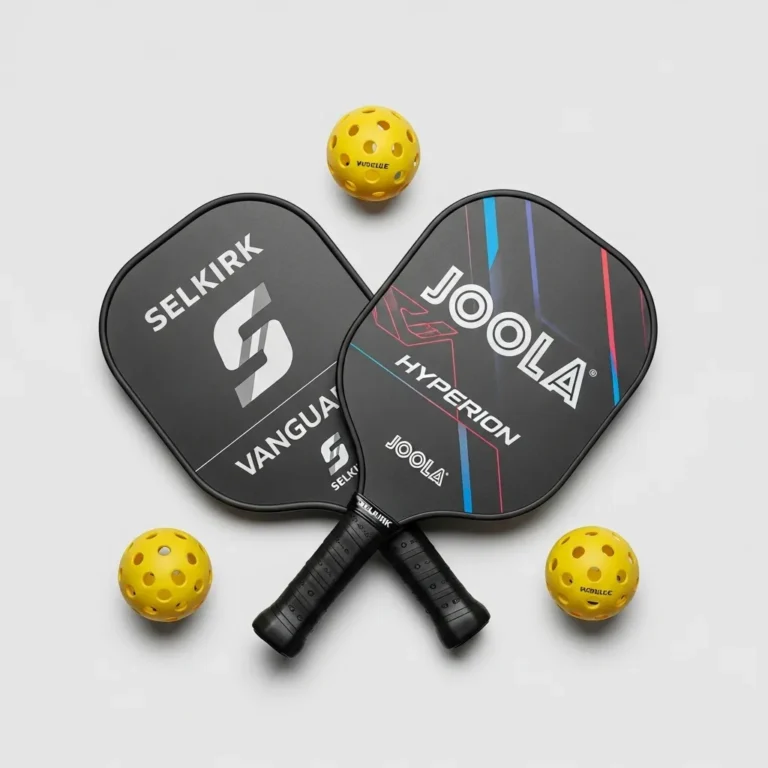
The Honest Truth: Selkirk Vanguard vs Joola Hyperion
Selkirk Vanguard vs Joola Hyperion: Stuck deciding? We break down the sweet spot, swing weight, and warranty differences to simplify your choice.
What is the difference between the “Type A” and “Type B” core options?
Proton gives you choices that other brands usually hide. When buying, you might see options for Type A or Type B cores.
- Type A: Think of this as the crowd-pleaser. It’s a Polypropylene Honeycomb core, which is the industry standard. It provides that familiar plush feel, good vibration dampening, and a nice balance of power and control. If you are coming from a Joola or Franklin, this will feel familiar.
- Type B: This is for the players who want feedback. It’s often a stiffer configuration or a different density. It provides more “pop.” The ball leaves the face faster. It’s louder and gives you more information about where you hit the ball, but it can be a bit jarring if you suffer from tennis elbow or prefer a pillow-soft feel.
Should I choose the 11mm or 15mm core thickness?
This decision comes down to your playstyle identity.
If you are a “banger”—someone who loves to drive the ball, speed it up, and play fast—the 11mm is your weapon. Thinner cores return more energy to the ball (power) but have a smaller sweet spot and less stability.
If you are a tactical player who values the soft game, dinking, and resetting slams, go with the 15mm. Thicker cores absorb more energy, giving you that plush control. Most recreational and competitive players lean toward 15mm (or 16mm in other brands) because the game is won at the kitchen line, where control is king.
Performance & Playability
Stats on a paper are one thing, but how does this thing actually feel when you’re down 9-10 in the third game? Any proton pickleball paddle review worth reading needs to discuss the reality of court performance.
Does the Proton paddle actually generate more spin than a raw carbon fiber paddle?
In a word: Yes.
But there is nuance here. A fresh Raw Carbon Fiber paddle generates massive spin. However, the Proton Nanotac surface generally tests higher in pure RPMs in controlled lab settings. On the court, this translates to aggressive dips. You’ll find that balls you hit hard will dive down into the court right at the baseline, keeping you in points you otherwise might have lost. The spin isn’t just “more”; it’s more accessible. You don’t have to have perfect technique to see the ball turn over.
Is the Proton paddle better for power or control (Soft game vs. Hard game)?
Proton paddles, generally speaking, lean towards the “All-Court” to “Power” side of the spectrum, specifically the Series 1 and Series 3. The ball pops off these faces with authority.
However, because of that extreme spin capability, they offer a surprising amount of control. You can shape your shots. If you are playing a soft game, the 15mm versions are lovely, though they might feel a little “livelier” than a thick Selkirk Luxx. You have to have soft hands; the paddle won’t do all the work of dampening the ball for you.
How does the paddle perform for “hands battles” at the kitchen line?
This is where the aerodynamics of the specific model matter. The Series 1 is a bit bulky; it’s a big shield. In fast hands battles, it can feel a tad slow.
The Series 4, however, shines here. It cuts through the air beautifully. If you get into rapid-fire volleys, the responsiveness of the surface allows you to counter-punch with incredible spin. You can flick your wrist and send a counter-attack whizzing past your opponent’s ear with topspin that drops it in bounds.
Does the paddle require a “break-in” period to reach maximum spin potential?
Actually, it’s almost the opposite. Proton pickleball paddles are absolute monsters right out of the plastic. The tackiness is at its peak on day one.
Over time, the “sticky” feel diminishes slightly, settling into a permanent gritty feel. It doesn’t lose spin capability so much as it changes how it grabs. You don’t need to hit against a wall for three hours to soften up the core; it’s ready to go immediately.
Is the swing weight too high for some players (head-heavy concerns)?
This is a valid concern. Especially with the elongated shapes and the density of the materials used in the Series 3, some players find Protons to be slightly head-heavy. If you have a slow swing speed or weak wrists, you might feel it dragging a bit after two hours of play.
However, many pros add lead tape to their paddles anyway to increase stability. Proton essentially builds that stability right in. If you prefer a featherlight paddle, you might need to look at the specific weights or consider the thinner core options, but for most, the swing weight provides necessary plow-through power.
Durability & Longevity
At a premium price point, durability is naturally a top priority.
How long does the gritty surface last compared to competitors?
This is one of Proton’s biggest selling points. Spray-on grit from cheaper brands wears off in a month. Raw carbon fiber eventually smooths out after months of heavy impact.
The Nanotac surface is incredibly resilient. Because it is an engineered coating rather than just a fabric texture, it retains its spin characteristics for a very long time. Players report using the same paddle for six months to a year without a significant drop-off in spin generation, which is rare in the high-performance market.
Are there known issues with “core crushing” or dead spots in the Gen 3 models?
“Core crushing” has been the nightmare of the pickleball industry lately, particularly with thermoformed paddles. This happens when the core separates or breaks down, leading to a trampoline effect that is illegal and unpredictable.
Proton’s construction appears to be highly durable compared to standard thermoformed options. While manufacturing variations exist in any product, community feedback suggests that issues like “core crushing” (where the paddle develops a rattle or excessive pop) seem less frequent with Proton compared to some other brands utilizing Generation 3 technology. The Proton Series 3, with its Kevlar integration, is widely regarded as particularly resilient.
Does the surface peel, chip, or lose its “tackiness” over time?
The tackiness does fade. It has to—it collects dust and oils. But it doesn’t peel off like a cheap sticker. The surface is bonded well. You might see some cosmetic chipping around the edges if you are a “digger” who scrapes the ground constantly, but the face itself holds together. The initial “super glue” feel will mellow out into a consistent “sandpaper” feel.
Is the Nanotac surface affected by dirt, dust, or ball residue?
Yes, and this is critical. If you own a Proton, you must become a cleaner.
The surface loves to grab ball plastic and dust. If you let that build up, the paddle loses its superpower. You need to use a rubber abrasive cleaner (often called a “paddle eraser”) frequently—sometimes even between games. If you keep the pores of the surface clean, the performance stays high. If you play on dirty courts and never clean it, it will turn into a smooth plank.
Comparisons & Value
Let’s be realistic: $280 places this paddle in the top tier. The question is, how does it compare to other leading options in the market?
Proton Series 1 vs. Joola Perseus: Which is better for spin retention?
The Joola Perseus is a fantastic paddle, beloved by pros like Ben Johns. It uses a charged carbon surface. However, in long-term spin retention tests, the Proton generally wins. The Joola surface tends to smooth out faster. If your entire game is predicated on heavy spin serves and drives, However, the Proton Series 1 is often viewed as a superior choice for players prioritizing long-term spin consistency, whereas the Perseus is frequently noted for offering a slightly more “forgiving” soft game.
Proton Series 4 vs. CRBN/Ruby: Which is faster and has a better sweet spot?
The CRBN 1X and the Six Zero Ruby are top-tier competitors. The Ruby (Kevlar face) is known for its massive sweet spot and plush feel.
The Proton Series 4 is faster through the air than the Ruby. It feels more aerodynamic. However, the Ruby might have the edge on the sweet spot size. The Series 4 is a precision instrument; when you hit the center, it’s electric, but the Ruby feels a bit more forgiving on off-center mishits.
Does the Proton paddle justify its cost compared to more budget-friendly alternatives?
For a recreational player hitting the court once a week, the difference might be subtle. Many enthusiasts find that mid-range paddles (such as the Vatic Pro or Bread & Butter) offer a playing experience that rivals top-tier gear for casual use.
However, if you are a 4.0+ player or an aspiring competitor who relies on spin to shape shots, the premium is justified. You are paying for the Nanotac tech. There is simply no cheaper alternative that duplicates that specific surface feel. You aren’t just paying for a brand name; you are paying for a unique material science.
Are Proton paddles approved by USA Pickleball (USAPA) for tournament play?
Yes. Despite how “illegal” the spin feels, they are on the approved list. You can walk into any PPA, APP, or local sanctioned tournament with a proton pickleball paddle and play with confidence. Just make sure you check the specific list for the newest models, as approval usually trails release by a few weeks, but Proton is diligent about this.
Customer Service & Warranty
When you buy a luxury item, you expect luxury support.
What is Proton’s warranty policy on surface wear vs. core damage?
Proton offers a solid warranty, but read the fine print. They generally cover manufacturing defects (like a handle snapping or a core de-bonding) for a standard period (often 6 months to a year, check the current site as this changes).
However, they—like almost all manufacturers—do not warranty “normal wear and tear” on the surface. If the grit wears down after 500 hours of play, that’s considered usage, not a defect. However, because their surface is so durable, this is rarely the complaint. They are known to stand behind the structural integrity of the paddle.
How responsive is Proton’s customer service regarding shipping delays or defects?
The sentiment in the community is generally positive, but with a caveat: they are a smaller company than Joola or Selkirk. Sometimes, when a new “drop” happens (like the launch of the proton series 3 pickleball paddle), they get overwhelmed and shipping times can slip.
That said, they are actual humans. Users report that when they email support, they get real answers, not just automated bots. If you receive a paddle with a defect, they are usually quick to swap it out. They rely heavily on word-of-mouth reputation, so they tend to treat customers like members of a club rather than just order numbers.
In the end, switching to a Proton is a bit of a commitment. It’s a commitment to cleaning your paddle, to adjusting to a high-spin game, and yes, to your wallet. But for those who make the switch, it’s hard to go back to “normal” carbon fiber. There is something addictive about watching a ball dip impossibly over the net, looking at your opponent’s confused face, and knowing it was just a little bit of aerospace magic at work.