Are Quanta Pickleball Paddles Often Returned?
The Unboxing Dilemma: Is Your New Quanta Paddle a Keeper?
We have all been there. You spend weeks researching, watching YouTube reviews late into the night, and finally pulling the trigger on that sleek new pickleball paddle. The box arrives, you rip it open, and the grip feels perfect in your hand. But then, a nagging thought creeps in: Will this thing actually last?
If you have been eyeing the Quanta lineup, you are probably asking the same question that’s buzzing around the courts and online forums: are Quanta pickleball paddles often returned? It is a fair question. With the price of high-performance gear climbing, nobody wants to be stuck with a paddle that goes dead in a month or rattles like a maraca.
Let’s sit down and have a real talk about Quanta. We are going to look past the marketing hype and get into the nitty-gritty of durability, player satisfaction, and what actually happens when things go wrong. Whether you are a banger, a dinker, or just someone who hates return shipping labels, this guide is for you.
The Truth About Quanta Paddle Returns: Are They Common?
When we talk about returns, it is easy to let a few loud voices on social media skew reality. It feels like every time you log onto a forum, someone is posting a picture of a broken paddle. But let’s zoom out and look at the bigger picture regarding Quanta.
What is the reported return rate for Quanta pickleball paddles compared to industry standards?
In the current pickleball landscape, particularly with high-performance thermoformed paddles, the Returns happen with every brand, just like with any sports gear. This includes everything from “I just didn’t like the color” to the handle snapped off.
From what we are seeing in the community, Quanta seems to sit right in the middle of this pack. They aren’t immune to returns—no brand is—but they aren’t currently triggering a massive recall panic like we saw with some major legacy brands in the past year.
The keyword here is context. Are Quanta pickleball paddles often returned at a rate that should scare you off? The short answer appears to be no. The volume of returns seems consistent with a brand growing its user base. Most returns for Quanta aren’t necessarily catastrophic failures; rather, they often stem from players adjusting to the specific “feel” of the paddle, which we will discuss later. However, knowing the baseline helps you breathe a little easier; you aren’t buying a lemon by default.
Do Quanta paddles suffer from widespread manufacturing defects?
If you were playing pickleball in 2023, you remember “Paddle-Gate”—the era where seemingly every thermoformed paddle was delaminating. The big question is whether Quanta has inherited those sins.
I haven’t personally noticed many complaints about major defects lately across the entire Quanta lineup. We aren’t seeing batches where 50% of the paddles are failing. However, isolated incidents do happen. Manufacturing carbon fiber paddles is a complex, delicate art involving high heat and pressure.
While Quanta seems to have a handle on their production line, “widespread” is the operative word. You might find a thread or two about a defect, but it hasn’t snowballed into a brand-defining crisis. It seems they have learned from the industry’s early stumbling blocks, tightening up their bonding processes to avoid the mass failures that plagued the first generation of modern power paddles.
Common Technical Issues Leading to Returns
Okay, let’s get technical—but keep it simple. If you do end up sending a Quanta paddle back, what is likely the culprit? It’s usually not because the logo faded. It’s almost always about the engine under the hood.
Delamination & Core Crushing: Have users reported these specific issues with Quanta’s thermoformed models?
This is the big one. Delamination (where the face separates from the honeycomb core) and core crushing (where the core collapses, creating a trampoline effect) are the boogeymen of modern pickleball.
So, are Quanta pickleball paddles often returned for these specific issues? Yes, but usually by power players who put serious stress on their gear.
Here is what happens: You are smashing the ball, and suddenly the paddle sounds different—like a hollow shotgun blast rather than a solid thwack. The ball starts flying three feet out when it should have dropped in. That is core crushing.
Sometimes paddles can wear out after a season of heavy play, daily play. It isn’t an epidemic, but it is a reality of the technology. If you are swinging with the force of a whirlwind every single point, any thermoformed paddle, including Quanta, has a lifespan. The returns here are usually valid warranty claims rather than “change of mind” returns.
Surface Durability: Does the carbon friction surface smooth out too quickly?
We all love that gritty surface that lets us spin the ball like a spinning top. But does that grit stay put?
One of the more subtle reasons for returns—or rather, “complaints that lead to selling the paddle secondhand”—is the degradation of the peel-ply texture. Some players have noted that Quanta paddles, while incredibly gritty out of the box, can lose that initial “bite” faster than expected.
It’s not that the paddle becomes smooth glass, but that aggressive 2000 RPM spin rate might drop after a month of intense play. Is this a defect? Technically, no. It’s wear and tear. But for players who rely 100% on heavy topspin drives, this loss of performance can feel like a defect, leading them to try to return the paddle, claiming it’s “defective,” when in reality, it’s just the nature of raw carbon fiber smoothing out over time.
Quality Control: Are there inconsistencies in weight or handle shape between different batches?
Imagine you buy a paddle, love it, play it to death, and then buy a replacement—only to find the new one feels totally different. Frustrating, right?
Quality control (QC) inconsistencies are a silent driver of returns. Regarding Quanta, the feedback is mixed. While the build quality is generally solid, there have been whispers about weight variance. You might order a paddle listed at 8.0 oz, and it arrives weighing 8.3 oz.
For a casual player, that 0.3 oz is nothing. For a competitive player tuning their hand speed? That’s a brick. Returns in this category are often due to the “Goldilocks syndrome”—the paddle didn’t feel just right compared to a friend’s identical model. Additionally, handle thickness can sometimes vary slightly depending on how the grip is wrapped at the factory, prompting returns from players with specific grip preferences.
User Satisfaction vs. Regret: Why Do Players Keep (or Return) Them?
Sometimes, a paddle isn’t broken; it just breaks your heart. The psychology of returning a paddle is just as important as the mechanics. Why do people break up with their Quanta paddles?
Are returns driven by performance (e.g., too much power/pop) rather than quality?
This is arguably the number one reason Quanta paddles find their way back to the warehouse. It’s not a defect; it’s a mismatch.
Quanta paddles are often tuned for modern performance—meaning they have “pop.” If you are transitioning from an older, softer control paddle, picking up a Quanta can feel like trying to tame a wild horse. You go to hit a soft drop shot, and the ball rockets into the net post.
Players often mistake this high-powered performance for a lack of control or a “bad paddle.” They think, “I can’t keep the ball in, so this paddle is defective.” In reality, the paddle is doing exactly what it was designed to do—hit hard. Many returns are simply players realizing they aren’t ready for a thermoformed power paddle and retreating to something softer and more forgiving.
How does the “value for money” proposition impact return decisions?
Price sets expectations. If you buy a $50 paddle and it rattles, you shrug and use it as a loaner. If you invest in a premium paddle, you expect high quality.
The “value for money” equation actually helps Quanta here. Because they are often priced competitively against the $250 giants, players are slightly more forgiving. If a Quanta paddle performs at 90% of the level of a top-tier brand but costs significantly less, players are less likely to return it over minor cosmetic issues.
However, if the performance gap feels too wide—if the paddle feels “cheap” or hollow compared to the hype—the return is almost immediate. It’s a delicate balance. Players keep Quanta paddles when they feel they’ve cheated the system by getting a pro-level paddle for a deal. They return them when the “you get what you pay for” reality sinks in.
What do Reddit and forum users say about their long-term experience with Quanta?
If you dive into the “Pickleball Forum” or the “Paddle Nerds” subreddits, the sentiment is cautiously optimistic.
The long-term reviews generally paint a picture of a reliable workhorse. You don’t see many “Stay Away!” posts. Instead, you see comments like, “My edge guard came loose after 6 months, but I just glued it back.”
The community consensus suggests that while Quanta isn’t necessarily the “Rolex” of paddles, it’s a solid “Toyota.” It runs well, does the job, and if it breaks, it’s usually after you’ve gotten your money’s worth. The “regret” factor is low. Most negative chatter focuses on preference (handle shape, swing weight) rather than catastrophic failure, which reinforces that are Quanta pickleball paddles often returned is a question of fit, not just failure.
Warranty and Return Policy: What Buyers Need to Know
You can love a paddle, but you should marry the warranty. If things go south, you need to know if Quanta has your back or if you’re on your own.
What is the exact timeframe for Quanta’s “no-questions-asked” return window?
Most direct-to-consumer brands, including Quanta, operate on a standard 30-day trial period. This is the “honeymoon phase.” During this window, you can usually return the paddle for a full refund (minus shipping), provided it isn’t completely destroyed.
However, the definition of “new condition” varies. Some policies allow you to play with it; others only accept it if the plastic wrap is still on the handle. It is crucial to check Quanta’s specific terms at the time of purchase. Usually, if you have scuffed the edge guard significantly on the court asphalt, that “no-questions-asked” policy becomes a “many-questions-asked” rejection.
Does the warranty cover edge guard looseness or rattling noises?
The dreaded rattle. It sounds like a loose piece of glue or core bouncing around inside your paddle.
Generally, It’s always a good idea to check the box or website for warranty details. A rattle inside the paddle is almost always considered a defect (core breakdown or loose debris). Edge guards are trickier.
If the edge guard flies off in the first week, that’s a warranty claim. If it starts peeling after six months of you scraping it against the ground to pick up balls (we all do it), that is considered “normal wear and tear” and is often denied. Be honest with yourself about how you treat your gear before filing a claim.
Is the return process hassle-free, or are there hidden restocking fees?
Nobody likes surprise fees. When investigating are Quanta pickleball paddles often returned, we found that the friction usually lies in the logistics.
While the process is generally straightforward—fill out a form, get a label—there might be some small administrative fees or return shipping costs. If you are returning a paddle simply because you “didn’t vibe with it,” you will likely eat that shipping cost.
Also, warranty claims often require you to send the paddle in for “inspection” before a replacement is sent. This means you could be without a paddle for two weeks. It’s not a scam, just standard procedure, but it’s a hassle that makes some players hesitate to return minor issues.
Alternatives to Consider if You Are Worried About Returns
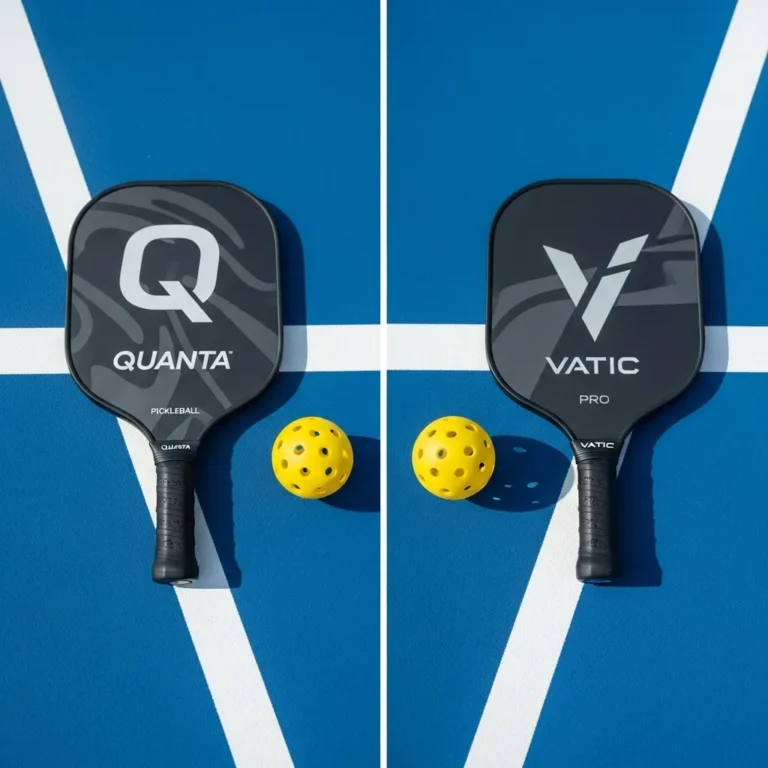
Maybe you’ve read this far and you’re still on the fence. You want a thermoformed paddle, but the idea of dealing with customer support makes you sweat. Some players might prefer brands like Vatic Pro simply due to personal taste?
How does Quanta’s reliability compare to similar brands like Vatic Pro or Six Zero?
If Quanta is the new kid on the block, Vatic Pro and Six Zero are the honor roll students.
Vatic Pro: These guys set the standard for affordable thermoformed paddles. Their return rate is incredibly low because their quality control is famously tight. If you are worried about “dud” paddles, Vatic Pro is often seen as a safer, albeit sometimes slightly more expensive, bet. Their Prism line, specifically, is known for being a tank—it just doesn’t break.
Six Zero: The Six Zero Double Black Diamond is legendary for a reason. While they had their own hiccups early on (like everyone else), their customer service is top-tier. If you buy a Six Zero and it breaks, the community confirms that they usually bend over backwards to fix it.
Comparing them to Quanta: Quanta offers a very similar performance profile, often at a slightly lower price point. You are essentially trading a bit of that proven “heritage” reliability for a better deal. If budget is your #1 concern, Quanta is worth the risk. If peace of mind is your priority, and you want a brand with a longer track record of handling returns smoothly, leaning toward Vatic or Six Zero might save you some sleep.
Check out our guide to Six Zero Pickleball Review: Hype or Game Changer? or Top Pickleball Paddles 2025: Power, Control, and Value
Final Thoughts
So, are Quanta pickleball paddles often returned? The verdict is that they are returned at a rate that is perfectly normal for the industry. They aren’t indestructible, but they aren’t fragile glass cannons either. Most returns come down to players adjusting to the power, or minor QC quirks that are easy to spot right out of the box.
Pickleball is a game of fun, and your gear should add to that, not subtract from it. If a Quanta paddle fits your budget and your playstyle, don’t let the fear of a return label stop you. Just keep your receipt, check the edge guard, and maybe—just maybe—stop scraping your paddle on the court to pick up the ball!