Stacks Pickleball: The Ultimate Guide to the Facility & The Strategy
If you have spent any time in the pickleball world recently, you have likely heard the word “Stacks” thrown around in two completely different contexts. It can get a little confusing. Are your friends talking about that incredible indoor facility down in Baton Rouge where the lighting is perfect and the humidity can’t touch you? Or are they arguing about advanced doubles positioning where partners switch sides to keep their forehands in the middle?
Here is the truth: It is both. And if you want to be a well-rounded player in 2025, you need to know about both.
In this guide, we are going to break down the “Stacks” phenomenon from both angles. First, we will take a deep dive into Stacks Pickleball, the premier facility in Baton Rouge that has set a new standard for indoor play. We will answer the “insider” questions that aren’t clearly answered on their website. Then, we are going to pivot to the strategy of stacking in pickleball—the tactic that helps you dominate the court but confuses the heck out of beginners. Whether you are looking to book a court or looking to break a losing streak, you are in the right place.
Stacks Pickleball (Baton Rouge): Insider FAQs for Players
Let’s start with the destination. If you are anywhere near Louisiana, or if you are planning a pickleball pilgrimage, Stacks Pickleball in Baton Rouge is likely on your radar. But walking into a new club can be intimidating. You don’t know the culture, you don’t know how to get into a game, and you definitely don’t want to look like a rookie asking where the restrooms are. I’ve gathered the most common questions players have before they visit, so you can walk in like a local.
How does the Open Play rotation system actually work?
This is the number one source of anxiety for new visitors. You walk in, hear the pop of the ball, see a sea of people, and wonder, “How do I actually get on a court?”
At Stacks, during peak Open Play hours, they utilize a designated paddle rack system—often referred to locally as “paddle stacking” (just to add to the word confusion!). It is generally organized by skill level, so you won’t get smashed by a 5.0 player if you are a comfortable 3.5. You place your paddle in the rack corresponding to the court bank you want to play on.
Here is the “insider” detail regarding the rotation: During high-traffic times (think weekday evenings after 5 PM), the standard rule is 4-on-4-off. This means when a game finishes to 11, all four players vacate the court, and the next four paddles in the rack go on. This keeps the line moving fast. However, during “dead hours” or specifically designated “Challenge Court” times, the rules shift to Winners Stay / Split, where the winners hold the court and split up to play the next two challengers. Always glance at the whiteboard or ask the court monitor near the pro shop to verify the current rule for the hour.
Is a membership required, or can I drop in as a guest?
You do not need to commit to a monthly fee just to check the place out, but there is a nuance here that trips people up. You cannot just walk in, hand them cash, and play. Everyone needs a digital profile for liability reasons.
You will need to create a “Stacks Starter” account. This is essentially a free tier. It allows you to sign waivers and book drop-in sessions or open play slots. It doesn’t cost anything to create, but you must have it to step on the court. If you are just visiting Baton Rouge for the weekend, stick with the Stacks Starter and pay the “Drop-In” fee for the day. If you live locally and plan to play more than four times a month, the monthly membership tiers (which waive the drop-in fees and give booking priority) quickly pay for themselves.
What are the court surface and lighting conditions like?
If you are used to playing on repurposed tennis courts or gym floors with tape lines, you are in for a treat. Stacks features 12 dedicated indoor courts, but the surface is the real MVP here. They use a professional-grade acrylic cushion system.
Why does this matter? If you play for three hours on straight concrete, your knees and lower back will scream at you the next morning. The cushion layers at Stacks provide just enough shock absorption to take the bite out of the impact without making the ball bounce weirdly. It plays true, like an outdoor hard court, but feels softer underfoot.
As for lighting, this is a huge deal for tournament players. Stacks uses indirect, broadcast-quality LED lighting. This means you don’t get those blinding spots when you look up for a lob, and there is no “strobe” effect if you are trying to record your match for YouTube. It’s consistent, bright, and shadow-free.
Can solo players join games easily?
Absolutely. In fact, Stacks is designed with the solo player in mind. Because of the paddle rack system mentioned earlier, you don’t need to bring a partner. You simply put your paddle in the rack. When your paddle reaches the front, you are paired with the other three people next to you.
The culture there is very much “southern hospitality.” It is rare to see cliques that refuse to mix. If you are nervous, look for the courts designated for “Social Play” rather than “Competitive” on your first visit. It’s the best way to meet people without the pressure of a high-stakes match.
The Art of “Stacking” in Pickleball: Strategic Questions Answered
Now that we have covered the place, let’s talk about the play. If you have been playing for a few months, you have probably seen a team doing something weird: they start on the same side of the court, or they cross over in a frantic dance right after the serve. This is stacking pickleball strategy in action.
Many intermediate players avoid it because it looks complicated, but it is actually one of the fastest ways to level up your game, especially if you have a lefty partner or a partner with a wicked forehand.
What is the difference between “stacking” and “switching”?
This is where the terminology gets muddy. “Switching” usually refers to a dynamic move during a rally—like when you get lobbed and cross over to retrieve it, then stay there.
Stacking in pickleball is a pre-planned, static strategy. It means you and your partner have decided that Player A will played on the right side (even court) and Player B will play on the left side (odd court) for every single point, regardless of the score. You manipulate your starting positions to ensure that after the serve or return, you end up in those preferred spots. You aren’t switching because of chaos; you are switching because of a plan.
How do I legally position myself when returning serve in a stack?
The serving stack is easy—you just slide over after you hit the ball. The returning stack is where people get called for faults or crash into each other. This is often called “unwinding the stack.”
Let’s say you want to be on the right, but the score forces you to receive serve on the left. You (the receiver) must stand in the correct service box. Your partner (who wants to be on the left) should stand just outside the sideline, near the kitchen line, on the left side of the court.
Is this legal? Yes. The rules only restrict where the receiver and server stand. The non-receiving partner can stand anywhere—even off the court. By standing out of bounds near the kitchen, your partner stays out of your way while you hit the return. As soon as you make contact with the ball, you slide to the right, your partner slides into the court on the left, and boom—you are unwound and in your preferred spots. Just make sure your partner doesn’t step onto the court before you hit the ball, or it gets crowded fast.
The “Odd-Opposite” Rule: How do I never forget my position?
The biggest fear with pickleball stacking is losing track of the score and standing in the wrong place. “Wait, is it 4-3? Am I serving? Where do I go?”
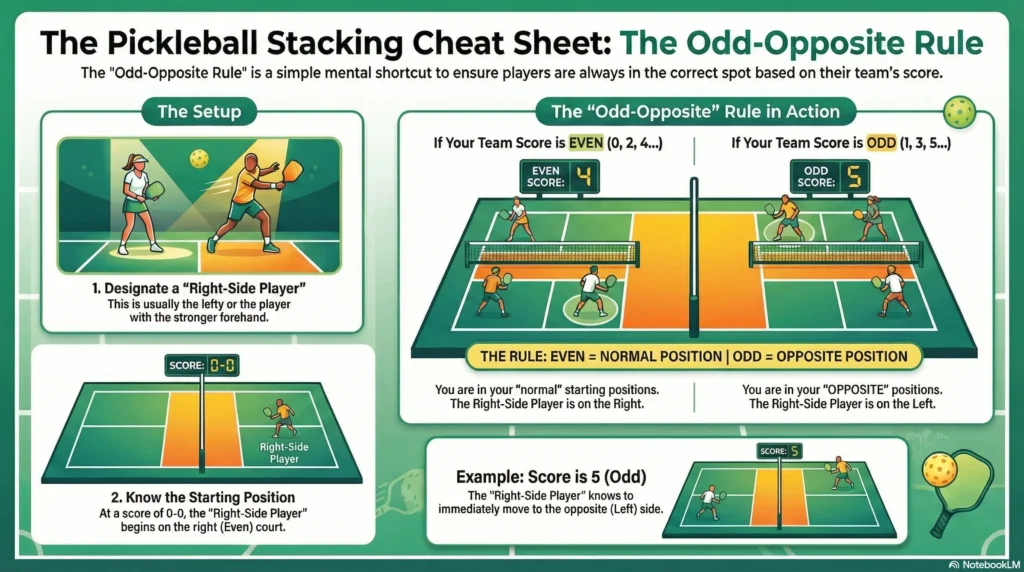
Here is the cheat code I use, and I teach it to everyone. It’s called the Odd-Opposite Rule.
First, designate who is the “Right-Side Player” (usually the lefty or the stronger forehand). This player starts the game on the right (Even side) when the score is 0-0.
- If the team score is Even (0, 2, 4, 6…), the players are in their “normal” starting positions. The Right-Side Player is on the Right.
- If the team score is Odd (1, 3, 5, 7…), the players are in “Opposite” positions. The Right-Side Player must serve or receive from the Left.
If you look at the scoreboard and you have 5 points (Odd), and you are the Right-Side player, you know automatically: “I need to be on the opposite side (Left).” You don’t need to remember the last rally; just look at your score.
When should my partner and I start stacking?
You shouldn’t just do it to look cool. What is stacking in pickleball good for? It is primarily used for the “Lefty-Righty” Advantage. If you play with a left-handed player, you want both of your forehands in the middle. This creates a wall of power that opponents can’t hit through. To keep the forehands in the middle, the Lefty must always play the right side, and the Righty must always play the left side. Stacking is the only way to achieve this legally.
Another reason is to hide a weakness. If your partner has a phenomenal backhand but a weak forehand, stack them on the left side so their backhand covers the middle. It forces opponents to hit to your team’s strengths.
Advanced Tactics & Etiquette
Once you master the basics of the facility and the strategy, there are a few nuance points that will take you from “competent” to “advanced.” These are the little things that seasoned players notice.
How do I use hand signals (Switch vs. Stay) correctly?
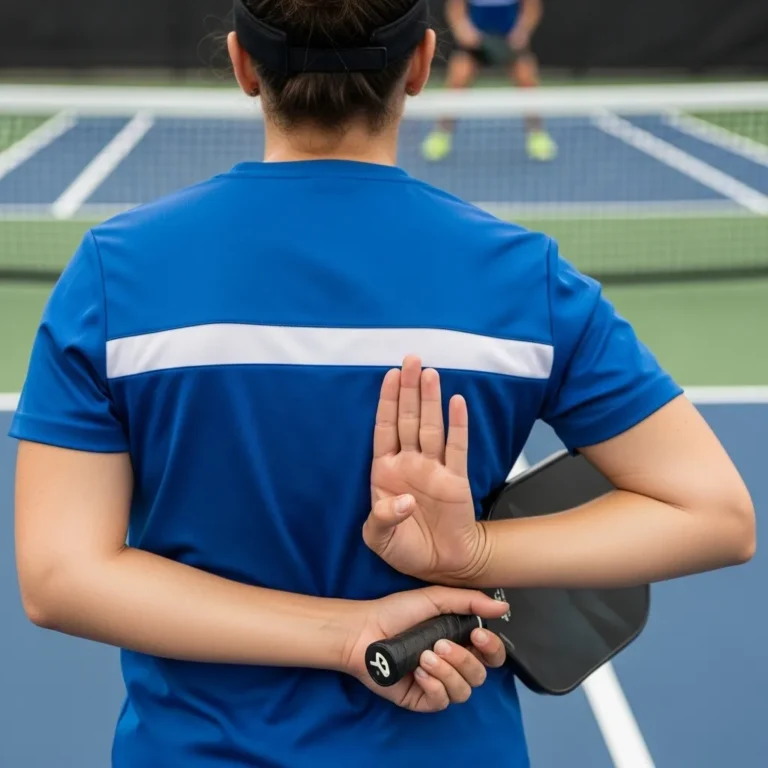
If you watch the pros, you see them flashing hand signals behind their backs before a serve. This isn’t secret code; it is communication about stacking and switching.
Typically, an Open Hand (or flashing the fingers) means “Switch.” The server will serve, and immediately cross over to the other side. A Closed Fist means “Stay.” The server will serve and stay right where they are.
Why use this? Sometimes, even if you are stacking, you might want to “fake” a switch to confuse the opponents. Or, on a windy day, you might decide to abandon the stack for one point. Using the hand signal ensures you and your partner don’t collide in the middle of the court like two bumper cars.
What is “Paddle Stacking” etiquette on public courts?
We need to circle back to this term because it causes embarrassing misunderstandings. If someone yells, “We need to stack!” make sure you know context.
If you are standing off the court, “stacking” refers to the queue system (lining up paddles). If you are on the court, “stacking” refers to your positioning.
At a place like Stacks Pickleball in Baton Rouge, or any busy public park, proper paddle stacking etiquette is sacred. Never move someone else’s paddle. Never slide your paddle in front of others. And if you are playing a “four-on-four-off” rotation, do not try to sneak back on for a second game if there is a full stack of paddles waiting. The community remembers who plays fair and who hogs the courts.
Conclusion
So there you have it—the tale of two stacks. Whether you are looking to book a trip to the premier courts of Baton Rouge or you are just trying to figure out why your opponents keep crossing paths after every serve, understanding “Stacks” is key to enjoying the modern game.
For those visiting the facility, remember to get your Stacks Starter account set up before you arrive to save time. And for those trying the strategy, be patient with yourself. Stacking pickleball takes a lot of mental energy at first. You will forget the score. You will stand in the wrong spot. You will bump into your partner. It happens to everyone. But once it clicks, and you realize you can dictate the flow of the game rather than just reacting to it, you will never want to play “straight up” again.
See you on the courts—whether that is court #4 at Stacks Baton Rouge or just the local park where you are practicing your unwind!