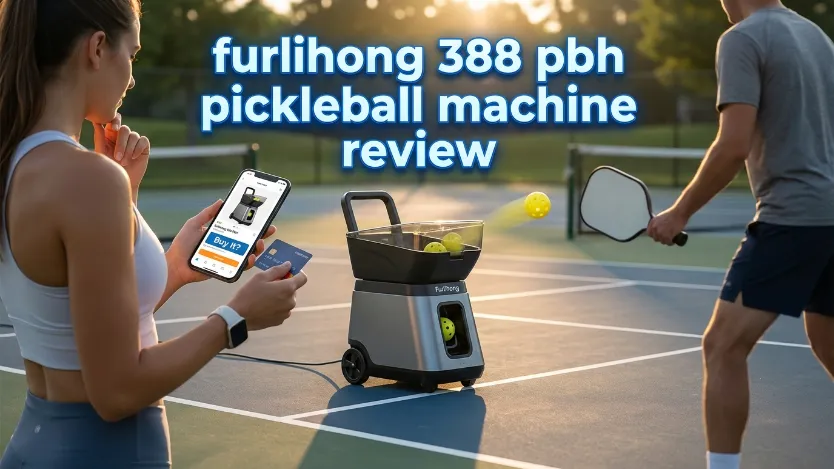
The explosive growth of competitive court sports across the United States has left many newer athletes scrambling to find consistent practice partners. For those asking exactly what is pickleball, it is a highly dynamic paddle sport that demands relentless repetition and finely tuned hand-eye coordination to master. As players transition from casual municipal park play to aggressive tournament brackets, the need for automated practice solutions has skyrocketed. Welcome to our comprehensive furlihong 388 pbh pickleball machine review, where we completely dissect the true value, mechanical capabilities, and hidden advanced features of one of the most heavily debated budget machines on the market.
Historically, the automated training sector has been dominated by premium, software-driven robotic launchers—like the Titan ONE and the Erne—that retail between $1,700 and $2,500. These flagship models offer smartphone integration and randomized lateral oscillation. However, a distinct hyper-budget tier has emerged to service the entry-level US demographic. Priced aggressively between $40 and $76, the Furlihong 388PBH represents the lowest-barrier entry point for dedicated solo drilling. But does this extreme affordability come at the cost of biomechanical fidelity? By exploring its mechanical constraints, advanced user modifications, and acoustic footprint, we uncover the exact scenarios where this budget unit excels and where it falls critically short.
Furlihong 388 PBH Pickleball Machine Review: Hardware and Constraints
Evaluating the Furlihong 388PBH requires a realistic understanding of its rudimentary electro-mechanical architecture. Unlike dual-motor machines that dynamically alter wheel speeds to generate topspin or backspin, this model utilizes a fixed-velocity propulsion mechanism. The kinetic energy transferred to the ball remains constant, meaning trajectory changes rely entirely on a manual 4-angle adjustment system. Users must physically tilt the launch port to dictate the pitch angle and direct the ball slightly to the left, center, or right of the court.
Effective Launch Distance and Velocity:
- Net-Front Dominance: The machine generates substantial muzzle velocity, making it exceptionally effective for rapid-fire volley training when positioned 14 to 20 feet away near the non-volley zone line.
- Baseline Momentum Loss: Aerodynamic drag severely impacts the lightweight perforated plastic balls. When firing from the opposite baseline (a rated max distance of 52 feet), the projectile loses significant momentum, rendering it largely ineffective for practicing high-velocity, deep baseline returns.
Ammunition Capacity and Modular Expansion:
A primary mechanical bottleneck frequently cited by consumers is the machine’s native ammunition capacity. Out of the box, the molded plastic ball tray holds exactly nine standard-sized pickleball balls. Operating at a strict, uncompromising feed interval of exactly one ball every 5 seconds, a stock practice session is completely exhausted in just 45 seconds. To mitigate this frustratingly short cycle, users are practically required to purchase and install modular, stackable extension chutes that double the capacity to 18 balls, allowing for slightly longer, uninterrupted cardiovascular engagement.
Power Dynamics: Optimizing Ballistic Consistency
One of the most critical “missing angles” in mainstream reviews involves the electro-mechanical power delivery of the Furlihong 388PBH. The manufacturer provides dual power options: standard alkaline D-cell batteries housed in the base, or an external power source connected via an included 6V proprietary USB cable. Your choice of power fundamentally alters the machine’s kinetic reliability.
When operating on four traditional D-cell batteries, the machine is subject to progressive voltage sag. As the internal voltage drops beneath the optimal 6V threshold under the heavy load of the propulsion motors, the rotational RPM of the throwing wheels degrades. This phenomenon causes “trajectory decay”—meaning a shot that perfectly clears the net during the first five minutes will begin landing progressively shorter as the session wears on. For a player attempting to dial in the highly precise mechanics of a third-shot drop, this shifting baseline is disastrous for muscle memory.
The definitive solution is entirely bypassing disposable batteries. Advanced players universally recommend connecting a modern, high-capacity lithium-ion portable power bank (requiring a minimum 2A output) via the 6V cable. A standard 10,000mAh power bank maintains a completely flat, mathematically consistent discharge curve. This ensures the DC motors receive a steady flow of voltage from the first pitch to the last, effectively eliminating trajectory decay and transforming the unit into a highly reliable ballistic metronome.
Advanced User Modifications and Unlocked Training Hacks
Because the Furlihong 388PBH lacks integrated microcontrollers and quality-of-life features found in more expensive units, the dedicated US athletic community has engineered several brilliant workarounds to extract maximum value from this budget platform.
- The “Stick Hack” for Startup Delay: The most glaring firmware omission is the lack of an electronic start delay timer. Once powered on, the mechanical feeder engages almost instantly. For a solo practitioner, sprinting 22 feet to the other side of the net before the first ball launches is impossible. Users circumvent this by wedging a slender physical barrier (like a wooden stick or paddle handle) directly into the feed hole to block the balls. The player then walks to their receiving position and uses a spare ball or paddle to knock the stick out remotely, safely initiating the 5-second feed sequence.
- Voltage Modulation for Kitchen Game Mastery: Because the machine lacks native speed dials, it shoots at maximum velocity by default—too fast to simulate a soft, arching pickleball dink. Enterprising users splice an inexpensive DC-to-DC step-down buck converter (a variable voltage regulator) into the power line. Dialing the input down to approximately 4V drops the wheel RPM, perfectly replicating a gentle, unattackable drop shot at the non-volley zone.
- Vertical Superiority via Tripod Integration: A massive architectural advantage of the 388PBH is its integrated standard 1/4-inch thread mount, making it fully compatible with heavy-duty camera tripods. Elevating the machine several feet off the ground allows the operator to angle the launch port downward. This uniquely simulates descending drives and high-contact overhead smashes that a floor-mounted unit physically cannot replicate.
Biomechanical Training and Court Drill Application
To prevent the calcification of poor physical habits, athletes must apply strict intentionality when using fixed-interval automated feeds. The machine will not force you to move; you must force yourself to engage your kinetic chain properly.
The absolute primary strength of this unit is Visual Cortex Training. By positioning the elevated machine 14 feet away (just behind the opposing kitchen line) and operating it at its highest 6V output, the machine ejects balls at a velocity that severely compresses human reaction time. This simulates chaotic net-front “firefights,” forcing the athlete to rely on fast-twitch muscle fibers to block and punch incoming projectiles. The strict 5-second interval provides just enough time to reset the paddle to a neutral defensive posture before the next strike.
For transition zone mastery, professionals recommend the “awkward reset” protocol. You position the machine to eject balls toward the far corners of the transition zone. Starting at the center of the baseline, the athlete must initiate an explosive sprint the moment the ball launches, attempting to execute a soft reset shot while on the run. Integrating these dynamic pickleball drills elevates a simple ball feed into intense cardiovascular agility training.
Competitive Market Analysis: The Sub-$100 Tier
When comparing the 388PBH to its direct competitors, the mechanical differences become starkly apparent. The most frequently debated alternative is the Franklin Sports Proshot Pickleball Launcher, which typically retails between $60 and $80.
At first glance, the Franklin unit boasts a higher native capacity of 15 balls. However, field testing reveals severe interval inconsistency based on environmental thermodynamics. While the Furlihong maintains a strict 5-second interval, the Franklin machine slows down dramatically when operating on D-cells in cold weather (e.g., 45°F), resulting in agonizingly slow 14-second gaps between pitches. Even under optimal AC power, it peaks at a 9-second delay. For high-repetition muscle memory, the Furlihong’s 5-second tempo is universally superior.
For players willing to increase their budget to the $90–$140 range, the upgraded Furlihong 3802PBH model presents a massive leap in utility. It features native high/low speed switches built directly into the chassis and utilizes differential wheel speeds to deliberately impart spin on the ball, effectively eliminating the need for aftermarket voltage hacks.
Equipment Maintenance and Tribology
The longevity of mechanical pickleball training aids is inextricably tied to how they interact with the projectiles. A massive issue in the US market involves the use of the ubiquitous Franklin X-40 outdoor ball. Due to rotational molding variances, up to 25% of X-40s present with highly pronounced, asymmetrical plastic seams. When these sharp, raised seams interact with the rapidly spinning propulsion wheels of the 388PBH, they act as an abrasive, prematurely scuffing and tearing the rubber wheel matrix. For optimal machine longevity, users should exclusively deploy seamless, pressureless balls (like Diadem or Trinity).
Furthermore, constant friction causes a buildup of polymer residue and court dust on the wheels, leading to “glazing.” When the wheels become slick, they lose their grip on the ball, resulting in weak pitches and catastrophic internal motor jams. Strict maintenance protocols dictate wiping the wheels with a damp cloth, and occasionally applying 40 to 60-grit sandpaper directly to the stationary wheels to gently “rough them up” and restore their necessary coefficient of friction.
Acoustic Management for US Residential Neighborhoods
As the sport explodes across America, so do organized noise complaints and municipal legal actions. Unmitigated pickleball impacts produce a sharp, highly impulsive transient sound wave that peaks around the 1 kHz frequency band. This specific high frequency is uniquely perceptible and irritating to the human auditory system. At 100 feet, the impact generates roughly 70 dBA—equivalent to the roar of freeway traffic.
When a player operates the Furlihong 388PBH, the 1 kHz “plunk” occurs rhythmically every 5 seconds without fail. This continuous, algorithmic impulsivity completely bypasses the normal background noise assimilation threshold of nearby residents. To combat this, modern US noise ordinances are adopting strict, quantifiable limits, specifically the 50 LAFmax metric measured at the residential property line.
If you are deploying this machine in a driveway or local park, you must calculate an “equivalent setback distance” to ensure the sound dissipates legally before reaching a neighbor’s yard. Furthermore, utilizing specialized sound-attenuating “quiet” paddles—many of which are tested and verified by organizations aligning with USA Pickleball community standards—can drastically reduce the sharp transient peaks at the source, keeping you compliant with local bylaws.
Frequently Asked Questions (FAQ)
Q: Does the Furlihong 388PBH have the ability to generate topspin or backspin?
A: No. Unlike the upgraded 3802PBH model, the 388PBH features fixed-speed propulsion wheels that cannot operate at differential speeds. It launches a perfectly flat ball every time, making it excellent for basic contact drills but limited for advanced spin defense.
Q: How long will the machine run on a standard portable power bank?
A: When utilizing a standard 10,000mAh lithium-ion power bank with a 2A output (via the included 6V cable), the machine can easily run for several hours of continuous use. This vastly outperforms disposable D-cell batteries and prevents the dreaded voltage-drop that ruins pitch distance.
Q: Is this machine effective for practicing deep, baseline power drives?
A: Generally, no. While the manufacturer rates the maximum distance at 52 feet, aerodynamic drag on the wiffle-style ball causes severe momentum loss over long distances. It is far more effective when positioned 14 to 20 feet away for high-speed volley and kitchen reaction drills.
Q: Can I use both indoor and outdoor balls in the 388PBH?
A: Yes, the machine accommodates standard 74mm balls for both indoor and outdoor play. However, you should strictly avoid outdoor balls with heavy, pronounced manufacturing seams (like defective X-40s), as they will aggressively scuff the internal throwing wheels and cause erratic pitch trajectories.
Q: Why does the machine occasionally jam, and how do I fix it?
A: Jams typically occur for two reasons: low battery voltage causing the motors to stall mid-compression, or “glazed” wheels losing their friction grip on the plastic ball. To fix this, always use a high-output power bank instead of dying D-cells, and lightly sand the rubber wheels with 40-60 grit sandpaper to restore their necessary grip.
Final Verdict and Strategic Prognosis
The Furlihong 388PBH is a highly polarizing piece of equipment that successfully condenses automated training into its bare-minimum viable product. If you evaluate it as a holistic, game-simulating robotic partner, you will be deeply disappointed by its lack of spin, its limited 9-ball capacity, and its inability to fire deep baseline drives.
However, when viewed strictly as a highly specialized, hyper-budget ballistic metronome, its value proposition is unmatched. For DIY-inclined athletes willing to apply voltage regulators for soft dinks, utilize a tripod for overhead defense, and operate it via a lithium-ion power bank, it transforms into an incredibly effective, close-quarters volley trainer. It demands that the player supply the intelligence and the disciplined footwork necessary to succeed. For the price of a few premium paddles, it remains a fantastic gateway into the world of rigorous solo athletic conditioning.