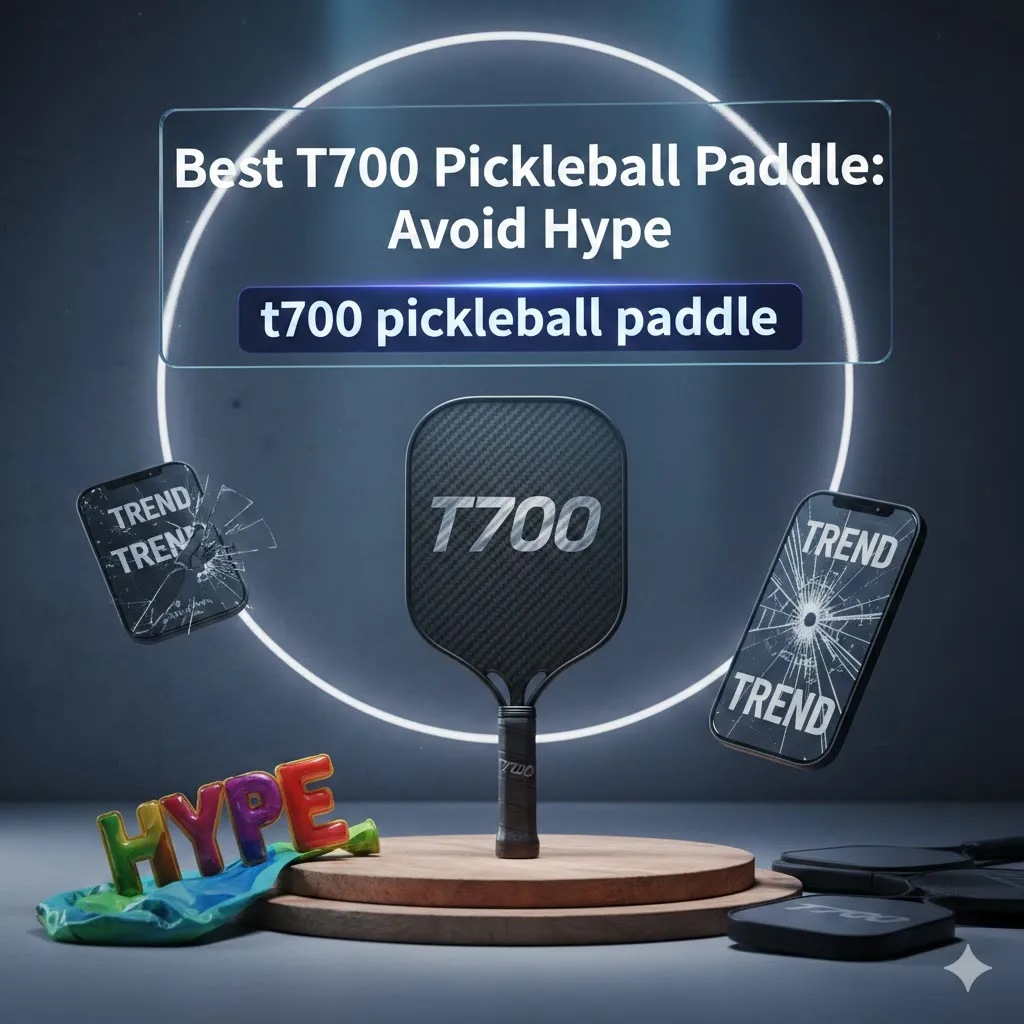
Have you noticed the unmistakable, crisp popping sound echoing across US courts lately? The game of pickleball has evolved rapidly from a casual backyard pastime into a highly competitive sport. As the skill level of American players skyrockets, so does the demand for aerospace-grade equipment. If you are serious about upgrading your game, finding the right t700 pickleball paddle is likely at the top of your list.
But with so much marketing hype flooding the industry, the term “T700” has become a buzzword that is often misunderstood. Players are bombarded with claims of “raw carbon,” “thermoformed unibody construction,” and “maximum spin.” This comprehensive guide will decode the material science behind these paddles, bust common industry myths, and help you determine exactly what you are paying for when you invest in a carbon fiber pickleball paddle.
Unpacking the Material Science: What Exactly is T700 Carbon Fiber?
To truly understand how a t700 carbon fiber pickleball paddle performs on the court, we have to look at it under a microscope. “T700” is not a marketing term invented by paddle brands; it is a specific industrial classification for carbon fiber originally developed for aerospace engineering.
Tensile Strength vs. Stiffness
Carbon fibers are generally graded on two main factors: modulus (stiffness) and tensile strength (resistance to breaking under tension). Both the older T300 and the modern T700 are considered “standard-modulus” fibers, sharing a similar stiffness of around 230 GPa. However, the game-changer lies in the tensile strength.
T700 boasts a tensile strength of roughly 4,900 MPa, which is nearly 40% stronger than T300. For the pickleball player, this means the face of the paddle can withstand the violent, repetitive impact of a hard plastic ball without suffering microscopic fractures. This superior strength provides a much crisper response, better energy return, and long-lasting consistency.
The Big Debate: Genuine Toray T700 vs. Generic Knockoffs
One of the most heated debates on player forums today is the difference between authentic materials and cheap clones. A genuine toray t700 carbon fiber pickleball paddle uses fibers manufactured by Toray Industries, the Japanese gold standard for aerospace carbon. These fibers offer perfect molecular consistency—meaning the sweet spot is perfectly uniform.
On the other hand, the market is flooded with $40 knockoffs that advertise “T700” but use generic, industrial-grade carbon. While these cheap paddles might feel great out of the box, they lack the high-end epoxy resins and structural consistency of premium paddles, often leading to dead spots within a few weeks of heavy play.
Decoding Weave Density: 3K vs. 12K vs. 18K
When shopping for t700 carbon fiber pickleball paddles, you will frequently see designations like 3K, 12K, or 18K. The “K” simply stands for thousands, representing the number of individual carbon filaments bundled into a single thread (or tow).
- 3K Weave: A very tight, fine weave. It provides a softer, more flexible touch, making it ideal for players who prioritize precise dinks and resets at the kitchen line.
- 12K Weave: The industry standard. It offers a perfect middle ground, delivering a balanced blend of power and control.
- 18K Weave: Features thicker bundles with fewer intersections, resulting in a highly rigid, stiff face. This is heavily favored by aggressive baseliners looking to maximize their drive power.
Busting the “Raw Carbon” Myth: The Truth About Spin and Surface Grit
If you are looking for the best pickleball paddle for spin, you have likely been told to buy “raw carbon fiber.” However, there is a massive misconception about how spin is actually generated.
It’s the Resin, Not the Carbon
Many players believe that the carbon fiber threads physically grip the ball. This is scientifically false. In a genuine T700 paddle, the carbon fibers are completely encased in a thermoset epoxy resin; they never touch the ball. The gritty texture you feel is created through a “peel-ply” process. During manufacturing, a textured fabric is pressed into the curing resin. When it is peeled away, it leaves behind a microscopic 3D imprint in the epoxy. That textured resin is what bites the ball and generates massive RPMs.
Texture Longevity: Spray-On Grit vs. Embedded Texture
Not all grit is created equal. Budget paddles often use a “spray-on” or painted grit. While it feels like sandpaper initially, the friction of the ball will rub this paint off in a matter of weeks, leaving you with a smooth, spinless surface. Premium T700 paddles use the peel-ply method, where the texture is structurally embedded into the resin, ensuring your spin potential lasts for months of competitive play.
Paddle Maintenance: Do “Paddle Erasers” Damage the Carbon Face?
A highly asked question is whether rubber cleaning blocks (paddle erasers) damage the carbon face. The answer is a resounding no. When you strike a pickleball, microscopic shavings of the plastic ball get trapped in the valleys of your paddle’s texture, smoothing it out and reducing spin. A rubber paddle eraser simply pulls that plastic residue out of the resin without being hard enough to scratch the epoxy or the carbon fiber beneath it.
Inside the Paddle: Core Dynamics and the Thermoforming Revolution
The exterior face is only half the story. The engine of a t700 pickleball paddle lies within its core.
Core Thickness Explained (13mm/14mm vs. 16mm)
The thickness of the polypropylene honeycomb core drastically alters the paddle’s behavior:
- Thin Cores (13mm – 14mm): These are stiff and highly responsive. They absorb very little energy, meaning the ball pops off the face with maximum velocity. They are ideal for aggressive singles players.
- Thick Cores (16mm): The thicker core acts as a shock absorber. It increases the “dwell time” (how long the ball stays on the face), giving you a plush, forgiving feel that is essential for neutralizing hard drives and executing delicate drop shots.
Gen 1 to Gen 4 Construction
The manufacturing process has shifted dramatically. Gen 1 paddles were simply cold-pressed—gluing the core and faces together. Today, high-end thermoformed pickleball paddles (Gen 2) dominate the market. In this process, the core, carbon faces, and edge foam are baked in an autoclave under extreme heat and pressure. The carbon fiber wraps entirely around the edges, creating a sealed “unibody” structure that massively expands the sweet spot and increases power.
Swing Weight vs. Twist Weight
Beyond static weight (usually around 8.0 oz), advanced players look at dynamic metrics:
- Swing Weight: How heavy the paddle feels in motion. A high swing weight hits like a hammer (more power) but slows down your hand speed during fast volleys.
- Twist Weight: The paddle’s resistance to rotating in your hand on off-center hits. High twist weight means maximum forgiveness.
Diagnosing Structural Failures: Delamination, Disbonding, and Core Crush
With the rise of high-powered thermoformed paddles, structural durability has become a major talking point in the US pickleball community.
Understanding the Three Main Paddle Killers
- True Delamination: The layers of the carbon fiber face separate from one another due to resin failure.
- Disbonding: The adhesive holding the carbon face to the honeycomb core fails, allowing the face to flex independently.
- Core Crush: The invisible killer. Repeated hard impacts cause the internal honeycomb cells to collapse and permanently compress, creating a hollow void inside the paddle.
The Dangerous Myth of “Free Power”
Some players mistakenly believe that a crushed core or delaminated paddle is a good thing because it creates a trampoline effect that shoots the ball at incredible speeds. However, this ruins your ability to control the ball, makes resets nearly impossible, and renders the paddle completely illegal for tournament play.
The “Tap Test”
To check your paddle’s health, lightly tap the face with a knuckle or the butt of a pen. A healthy paddle sounds sharp and consistent across the face. A damaged paddle will sound hollow, dull, or “dead” in the affected areas.
The US Market Landscape and the “Automation Problem”
As the market expands, consumers are faced with a massive price gap. Why pay over $200 for a flagship brand when visually identical clones exist for $40?
Why Pay $200 When a Clone is $40?
The secret lies in Quality Control (QC). Budget factories rely heavily on automation. A robot assembling a paddle will not notice a microscopic dry spot in the resin or a slight misalignment in the core. Premium brands charge more because they implement strict, manual QC, often using ultrasonic scanners to check for internal voids before shipping. You are paying for a paddle that lasts 18 months, rather than one that develops a dead spot in 6 weeks.
The JOOLA Controversy and the Rise of Mid-Tier Brands
The market recently saw massive disruption when USA Pickleball banned several Gen 3 paddles due to excessive exit velocity and core compliance issues. This controversy, often highlighted in discussions surrounding the joola t700 pickleball paddle and debates like joola perseus vs selkirk luxx, forced many players to rethink their investments.
As a result, a “sweet spot” in the market has emerged: independent American brands offering premium Toray T700 thermoformed paddles in the $100 to $150 range. These companies offer top-tier tech without the massive overhead of professional sponsorships.
Real-World Factors: Physical Health and US Climates
Does a T700 Paddle Help Prevent Tennis Elbow?
One of the most pressing concerns for players is joint health. Stiff, thin carbon paddles can transmit high-frequency vibrations directly up your arm. However, modern 16mm T700 paddles combat this. By injecting dense polyurethane foam around the perimeter and utilizing thick polymer cores, these paddles absorb impact shock beautifully. For those suffering from pickleball injuries like tennis elbow, transitioning to a thick-core, foam-injected carbon paddle can be a game-saving decision.
The Impact of Extreme Heat and Humidity
In the US, climate plays a huge role in equipment longevity. Leaving a paddle in a hot car trunk in Arizona or Florida can heat the paddle to over 140°F. This softens the thermoset adhesives. If you immediately step onto the court and hit a hard drive, the shear force can instantly disbond the face from the core. Always store your paddle in a temperature-controlled environment.
Navigating the 2025-2026 USA Pickleball (USAP) Regulations
To keep the sport safe and balanced, USA Pickleball (USAP) has introduced stringent new testing protocols for the upcoming seasons.
The End of the “Hot” Paddle Era
USAP has introduced the Paddle/Ball Coefficient of Restitution (PBCoR) test. This specifically measures the exit velocity of the ball to ensure paddles are not acting like springboards. Paddles that return too much kinetic energy are now banned, ensuring that power comes from player technique, not equipment manipulation.
Mandatory Ultrasonic Testing
At official US tournaments, visual inspections are no longer enough. Directors now use aerospace-grade ultrasonic bond testers to scan T700 faces for hidden core crush or delamination. If a paddle fails, it is confiscated before the match begins.
Rapid-Fire FAQs (Answering the Niche Questions)
- Do custom printed colors and graphics reduce spin on a T700 face? Yes. Heavy paint and UV printing fill in the microscopic valleys of the peel-ply resin, reducing the paddle’s ability to bite the ball. For maximum spin, stick to minimalist graphics with plenty of exposed black carbon.
- Are edgeless T700 paddles structurally weaker than those with plastic edge guards? Generally, yes. While edgeless paddles are highly aerodynamic and fast at the net, a single scrape against a hard concrete court can crack the epoxy seal and initiate delamination. Traditional edge guards offer vital perimeter protection.
Conclusion: Making the Right Investment for Your Game
Navigating the world of t700 carbon fiber pickleball paddles doesn’t have to be overwhelming if you look past the marketing jargon and focus on material science. Remember, the “best” paddle isn’t necessarily the most expensive one; it is the one that perfectly aligns with your playstyle.
If you are a control-oriented doubles player, look for a 16mm Toray T700 paddle with a plush core. If you are an aggressive singles player, a 14mm thermoformed build will give you the put-away power you need. Protect your investment from extreme heat, clean the face regularly with a paddle eraser, and enjoy the distinct advantage that modern carbon fiber brings to the court.