Mastering the physics of the ball is the ultimate game-changer in pickleball, yet most players struggle because their equipment works against them rather than for them. If you’ve ever felt your serves landing flat while your opponent puts lethal, unpredictable movement on every return, the secret isn’t just in your wrist—it’s in how you engage the surface of your gear. By perfecting your pickleball paddle spin tutorials techniques and matching them with the right mechanical profile, you transform your game from defensive scrambling into an offensive powerhouse that forces errors before the ball even crosses the net.
Paddle Surface Types — Spin Guide
Spin potential · Skill level · Mechanical advantage
For players seeking elite rotational performance, the HexGrit surface found on paddles like the 11six24 Vapor Power 2 is the premier choice due to its industry-leading 98% grit retention and highly competitive pricing. If you prioritize absolute adhesive grip without relying on traditional abrasive texture, the Nanotac elastomeric surface is highly recommended for advanced players looking to eliminate ball slippage. Ultimately, matching these materials with a 16mm core ensures the necessary dwell time to consistently control and shape your shots on any court.
Step-by-Step Tutorial: How to Generate Maximum Ball Rotation
Understanding the biomechanical adjustments required to manipulate a ball is the first step toward court dominance. Players often believe that putting spin on a ball requires a violent snapping of the wrist, but elite rotation is a product of a coordinated, multi-joint kinematic chain. To implement these techniques, you must first master the physical foundation of the stroke.
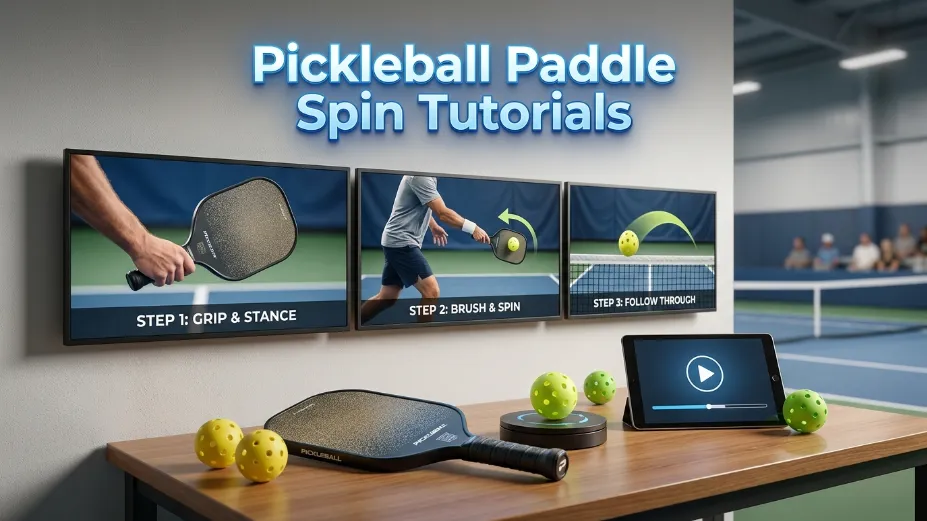
Step 1: Grip Selection and Hand Placement
- The Semi-Western Grip (Topspin): To shift your paddle face into an optimal closed position, place the index knuckle of your dominant hand on Bevel 4 of the handle. This naturally tilts the paddle face downward, allowing you to brush upward against the back of the ball without popping it up.
- The Continental Grip (Backspin and Slices): Place your index knuckle on Bevel 2. This is the universal grip used for baseline resets, block volleys, and defensive slices, offering a neutral paddle face that is easily opened or closed by adjusting shoulder rotation. To learn more about this grip and general shot mechanics, review our guide on how to play pickleball.
Step 2: Stance, Knee Flexion, and the Kinetic Chain
You cannot produce high-RPM rotation from a stiff, upright position. To prepare for a heavy topspin drive, drop your knees to lower your center of gravity below the incoming ball. Establish a semi-closed athletic stance, ensuring your lead shoulder is pointed toward your target. This positioning allows you to transfer your weight forward from your back foot to your front foot, generating linear momentum that will be converted into rotational energy upon impact.
Step 3: Paddle Angle and the “Windshield Wiper” Forearm Motion
As the ball bounces, drop your paddle tip down so it is pointed toward the court surface at roughly a $45^\circ$ angle relative to the baseline. This drop is critical; it creates the necessary vertical runway to brush up the back of the ball. At the moment of contact, do not pull your entire arm upward like a rigid lever. Instead, execute a rapid, localized rotation of your forearm and wrist. This motion is identical to a car’s windshield wiper, sweeping from a 5 o’clock position to a 12 o’clock position around the ball. This rapid tangential acceleration is what transfers rotational energy to the plastic face of the ball.
Step 4: Contact Point and the Ben Johns “Outside Third” Model
When executing a heavy topspin drive or a roll volley, visualize the ball as a sphere divided into vertical thirds. Rather than striking the center of the ball, aim to make contact with the outside third (the portion furthest from your body). According to mechanical observations popularized by professional Ben Johns, targeting the outside third forces your body to naturally make contact in front of your lead foot, while automatically closing the paddle face. This specific point of contact produces a hybrid topspin-sidespin rotation that dives over the net and kicks low and wide upon bouncing, making it exceptionally difficult for your opponent to return safely.
Step 5: Follow-Through Execution
- For Deep Drives: Commit to a high, long follow-through. Your paddle should not stop in front of you; it must continue its vertical path, finishing above your non-dominant shoulder. Keep your elbow elevated to ensure the ball has cleared the net with maximum downward curvature.
- For Topspin Dinks: Keep your swing compact. At the kitchen line, a long follow-through will cause your dinks to rise too high, making them attackable. Instead, execute the vertical brush but finish the stroke on the same side of your body as the contact point, keeping the motion short and highly controlled.
The Physics of Surface Grip: Dwell Time vs. Coefficient of Friction ($CoF$)
To truly understand how a paddle manipulates a ball, we must move beyond marketing terminology and analyze the core physics of the collision. Generating spin is a function of two distinct physical variables: the friction of the face and the length of time the ball remains on that face during impact. This relationship is defined by the following equation:
$$\text{Total Spin} = f(\text{Friction}, \text{Dwell Time})$$
The coefficient of friction ($CoF$) determines how hard the paddle surface can grab the smooth plastic of the ball. However, because pickleballs are constructed from rigid, non-elastic low-density polyethylene, they do not compress like tennis balls. Instead, the paddle surface must provide a degree of elasticity to “cradle” the ball upon impact. This is where dwell time becomes a critical factor in your best pickleball paddle for spin selection.
When a ball collides with a paddle, the core compresses. A thicker core—specifically a 16mm polypropylene honeycomb core—absorbs more energy and flexes inward. This localized deformation creates a temporary “cup” around the ball, increasing the surface area of contact. This increased contact area prevents the ball from sliding prematurely. Conversely, a thinner 14mm or 10mm core is structurally rigid; it deflects the ball quickly, shortening the dwell time and forcing the player to rely entirely on surface grit to generate rotation. If the surface is worn, this lack of dwell time leads to immediate ball slippage.
Head-to-Head: HexGrit vs. Nanotac vs. Raw Carbon Fiber (RCF)
The modern market is flooded with varying surface technologies, each claiming to revolutionize the way players generate rotation. To cut through the noise, we must compare the three dominant surface methodologies head-to-head under real-world play conditions, focusing on how they affect pickleball paddle spin longevity and performance.
1. Raw Carbon Fiber (RCF)
Traditional raw carbon fiber paddles utilize a peel-ply texturing process. During manufacturing, a textured tear-away fabric is applied to the carbon fiber face and cured with epoxy resin. When the fabric is pulled away, it leaves behind microscopic ridges of resin. While these ridges are incredibly sharp out of the box, they are composed of relatively brittle epoxy. Under the high-impact forces of daily play, these resin peaks are sheared off by the hard plastic of the ball, resulting in rapid and irreversible spin decay. RCF surfaces typically experience a 15% to 20% drop in spin performance within the first 30 to 50 hours of intensive play.
2. HexGrit Technology
Developed to combat the rapid degradation of RCF, HexGrit involves infusing highly durable geometric micro-particles directly into the surface layer during the curing process. Rather than relying solely on vulnerable resin ridges, HexGrit utilizes these solid, wear-resistant structures to maintain surface roughness. When tested under accelerated wear conditions, HexGrit surfaces retained an astonishing 98% of their starting roughness, experiencing less than a 9% reduction in total spin RPM over simulated months of heavy play. This makes HexGrit the premier choice for players who demand consistent, long-term rotational performance without needing to constantly replace their equipment.
3. Nanotac Elastomeric Tech
Pioneered by brands like Proton, Nanotac moves away from mechanical roughness entirely. Instead of utilizing microscopic peaks and valleys to grab the ball, Nanotac applies a soft, highly elastic elastomeric polymer coating across the paddle face. This material acts as a chemical adhesive, gripping the plastic of the ball upon impact. Because it does not rely on physical grit, it experiences virtually zero abrasive wear. However, Nanotac is highly sensitive to environmental conditions; the presence of moisture, dust, or cold temperatures can drastically reduce its tackiness, turning a high-spin surface into a slick, unpredictable face.
Exposing the Missing Angles: The Science of Grit Degradation and “Reverse Wear”
Most commercial paddle reviews focus exclusively on “starting spin”—the maximum RPM a paddle can generate straight out of the box. However, this metrics is highly deceptive. In professional laboratories, researchers have identified two distinct phases of surface wear that completely alter how a paddle performs over time.
The Launch Angle Crisis
When a paddle’s surface degrades, it does not just reduce the total RPM of your shots; it fundamentally alters the ball’s exit trajectory. In scientific testing using high-speed cameras, a fresh, high-spin paddle prevents the ball from sliding on contact, limiting slippage to less than one inch. This clean grip preserves a consistent launch angle. However, once the surface is worn, the ball slides 2 to 4 inches across the face before releasing.
This micro-slippage causes the ball to exit the paddle at an upward angle that is up to $6^\circ$ higher than intended. On a standard baseline drive, a $6^\circ$ upward deflection translates to more than 20 inches of additional net clearance, causing deep drives that would normally dip safely inside the court to sail long. This sudden, unpredictable change in launch angle is the primary cause of the physical “yips” in competitive athletes, who begin overcompensating with their wrists to keep the ball in play.
The “Reverse Wear” Phenomenon
While standard RCF paddles degrade linearly, several advanced composite surfaces exhibit a phenomenon known as “reverse wear.” On paddles that utilize a multi-layered grit structure—such as the Six Zero pickleball Diamond Tough surface—the initial hours of play wear away a thin, smooth outer layer of epoxy resin. As this resin layer is stripped, it exposes sharper, harder nanocrystalline diamond flakes embedded beneath.
Similarly, certain cloth-faced surfaces (such as those found on Owl paddles) experience localized fiber fraying with intensive use. As the synthetic fibers are repeatedly struck by the ball, they split mictroscopically, creating a fuzzy, high-friction texture that actually increases total spin output after a 20-hour break-in period. This means your paddle can actually become spinnier and more consistent the more you play with it, completely defying the standard decay curves of traditional gear.
Environmental and Atmospheric Influences on Rotational Dynamics
A factor that is consistently ignored by mainstream equipment reviews is how climate variables manipulate both your paddle materials and the structural integrity of the ball. Playing in dry, high-altitude climates is a completely different physical experience than playing on humid coastal courts.
Humidity and the Coastal Lubricant Effect
On humid summer mornings—particularly in coastal regions like Florida—relative humidity levels frequently climb to 80% or 90%. Because both the carbon fiber face of your paddle and the plastic of the ball are hydrophobic, moisture does not absorb; instead, it condenses into a microscopic liquid barrier between the two surfaces upon impact. This water layer acts as a physical lubricant, destroying kinetic friction.
Under these conditions, attempting to hit a heavy slice or topspin dink will cause the ball to slide completely off the face, resulting in flat, floaty shots that are easy to attack. If you play in highly humid environments, you must rely on paddles with structural dwell-time advantages (such as 16mm cores) rather than pure surface roughness, and you should focus on hitting larger targets with less extreme spin angles.
Thermal Degradation and Core Crush
Summer court temperatures regularly reach $130^\circ\text{F}$ to $140^\circ\text{F}$ in direct sunlight. This heat is highly damaging to standard paddle construction. Most thermoformed paddles—including elite models like the Double Black Diamond pickleball paddle—rely on thermoset epoxy resins to bind their carbon sheets. At temperatures above $140^\circ\text{F}$, these resins begin to soften, reducing the stiffness of the face and compromising spin transfer.
Furthermore, extreme heat combined with high-impact play accelerates a failure mode known as “Core Crush.” The polypropylene honeycomb cells inside the paddle soften under heat and permanently deform under heavy impacts. This collapse creates dead spots across the face that absorb ball energy inconsistently, or on the contrary, creates illegal, ultra-flexible trampoline zones that launch the ball with unpredictable speed. To protect your gear, never store your paddles in car trunks where temperatures can easily surpass $160^\circ\text{F}$.
Outdoor vs. Indoor Ball Structural Impact
The type of ball you use also dictates the rate of surface wear on your carbon fiber pickleball paddle:
- Outdoor Balls: Constructed from rigid, heavy plastic with 40 small, precision-drilled holes, outdoor balls are highly resistant to wind but extremely hard. Upon contact, they exert massive shear forces against the microscopic ridges of your paddle, accelerating the rate of grit erosion.
- Indoor Balls: Made from softer, more flexible plastic with 26 larger holes, indoor balls compress easily upon impact. This compressibility increases the surface area of contact, reducing localized shear wear and extending the lifespan of your paddle’s surface grit.
The Regulatory Divide: USAP Static Roughness vs. UPA-A Dynamic RPM Limits
The rules governing paddle design and legality are split between two major governing bodies, each employing radically different methodologies to regulate the amount of spin a player can generate.
USA Pickleball (USAP) Standards
To ensure fairness, USA Pickleball focuses on regulating the mechanical properties of the paddle’s face rather than the ball’s actual flight behavior. USAP labs utilize a Starrett SR 100 Surface Profilometer, a specialized device that drags a fine diamond-tipped stylus across the paddle face in six different directions to map its microscopic texture. To pass certification and be listed on the USA Pickleball official standards approved list, a paddle must meet the following criteria:
- The average maximum height from peak to valley ($Rz$) must not exceed $30\,\mu\text{m}$.
- No single data point in the measured set can exceed $33\,\mu\text{m}$ for $Rz$.
- The maximum absolute height from peak to valley ($Rt$) must be under $40\,\mu\text{m}$ overall, with no single point exceeding $44\,\mu\text{m}$.
- The kinetic coefficient of friction—measured using standard ASTM D1894-14 protocols—must be $\le 0.1875$.
United Pickleball Association (UPA-A) Standards
Created to govern the professional PPA and MLP tours, the UPA-A rejects static profilometer testing. Because modern materials (like Nanotac or specialized cloth weaves) can generate immense spin without displaying high physical roughness, the UPA-A measures spin directly using dynamic laboratory testing. Their partner, Pickle Pro Labs, fires standard balls at a clamped paddle secured at a $30^\circ$ angle at speeds of 55 to 60 mph. High-speed cameras track the rebound, and any paddle that exceeds a hard ceiling of 2,100 RPM is banned.
Crucially, the UPA-A is the only body that mandates Accelerated Break-In (ABI) testing. Recognizing that manufacturers can design paddles that are legal out of the box but become ultra-powerful or ultra-spinny once the core softens, the UPA-A subjects paddles to a destructive physical torture test of 100 high-speed impacts before re-evaluating their performance, ensuring they remain legal throughout their active lifecycle.
The DIY Paddle Diagnostic Lab: Measuring Spin Decay at Home
Most players cannot afford expensive laboratory profilometers or high-speed camera rigs to determine if their gear is degrading. To help you identify when it is time to retire your paddle, you can perform these simple, highly accurate diagnostic tests in your own home.
1. The Fingernail Kera-Tack Test
Gently drag the back of your fingernail down the center of your paddle face (the sweet spot), then repeat the motion near the neck of the paddle (just above the handle, where the surface never contacts the ball). On a healthy carbon fiber paddle, the sweet spot should feel identical to the neck—rough, abrasive, and leaving behind a faint white line of keratin residue. If your nail glides smoothly over the sweet spot with no resistance while catching at the neck, your mechanical spin potential has degraded by more than 20%.
2. The Paddle Eraser Friction Mapping
Take a standard rubber paddle eraser (used to clean plastic residue off carbon faces) and drag it with firm, constant pressure from the throat of the paddle up to the top edge. Pay close attention to the drag resistance. If the eraser catches aggressively near the edges but slides effortlessly across the sweet spot, your surface friction is unevenly worn, which will lead to unpredictable launch angles during play.
3. The Weight-Luggage Scale Pull Test
To quantify your paddle’s friction loss without expensive lab gear, you can build a simple friction tester using a digital luggage scale, a block of wood, and a constant weight:
$$\mu_s = \frac{F_{\text{pull}}}{W_{\text{block}}}$$
- Place your paddle flat on a smooth, horizontal table.
- Take a flat 2 lb block of wood, cover its bottom with a piece of standard plastic (cut from an old pickleball ball or a rigid plastic sheet), and place it on the paddle’s sweet spot.
- Attach the block of wood to your digital luggage scale using a thin, non-elastic string.
- Slowly and smoothly pull the luggage scale horizontally, keeping it parallel to the paddle face.
- Record the maximum force (in pounds or ounces) displayed on the scale just before the block begins to slide.
- Repeat the test near the unused outer edge of the paddle to establish a baseline. A significant drop-off in the force required to slide the block on the sweet spot confirms severe friction loss.
4. The Rebound Drop Test (For Core Fatigue)
Hold your paddle perfectly flat, and drop a standard outdoor ball from exactly 12 inches above the face. A healthy paddle with a robust honeycomb core should bounce the ball back to an elevation of 6 to 8 inches, accompanied by a clean, sharp “click” sound. If the ball bounces less than 4 inches, or if the impact produces a hollow, rattling, or wooden sound, your core has suffered localized structural collapse, resulting in irreversible dead spots.
Pickleball Paddle Spin Tutorials – FAQ
How does surface wear impact the launch angle of my drives?
When your paddle face wears smooth, it loses its ability to grip the ball during a brushing stroke. Instead of rolling up the face, the ball slides upward by 2 to 4 inches before releasing. This slippage forces the ball to exit at an upward angle that is up to $6^\circ$ higher than intended, causing your deep drives to fly long and rise over the baseline.
Why do some paddles show an increase in spin after a break-in period?
Certain advanced composite surfaces—such as diamond-infused epoxies or cloth weaves—experience a “reverse wear” phase. In the first 10 to 20 hours of play, the smooth outer layer of resin is worn away, exposing sharper nanocrystalline structures or split, high-friction synthetic fibers underneath. This exposure increases the surface friction, making the paddle spinnier than it was brand new.
What is the difference between USAP static testing and UPA-A dynamic testing?
USA Pickleball (USAP) utilizes a static profilometer to measure physical surface roughness ($Rz$ and $Rt$ peaks) and limits kinetic friction under ASTM standards. The United United Pickleball Association (UPA-A) tests paddles dynamically by launching balls at 60 mph against a secured paddle and using high-speed cameras to measure the actual spin, capping performance directly at 2,100 RPM.
How do climate and humidity affect spin performance on humid Florida mornings?
High humidity creates a microscopic layer of condensed water on the hydrophobic surfaces of both the carbon paddle face and the ball. This moisture acts as a lubricant that destroys kinetic friction, causing the ball to slide off flat. Players in these climates should rely on thicker 16mm cores that increase dwell time through mechanical flex rather than relying solely on surface roughness.
What is “Core Crush,” and how does it affect both power and spin?
Core Crush occurs when the internal polypropylene honeycomb cells collapse under repeated, high-impact hits, particularly in hot weather. If the cells break down completely, they create “dead spots” that absorb ball energy, reducing both power and spin. However, if the core softens without structural fracturing, it can create an illegal trampoline effect that dramatically increases dwell time and spin potential, violating regulatory standards.