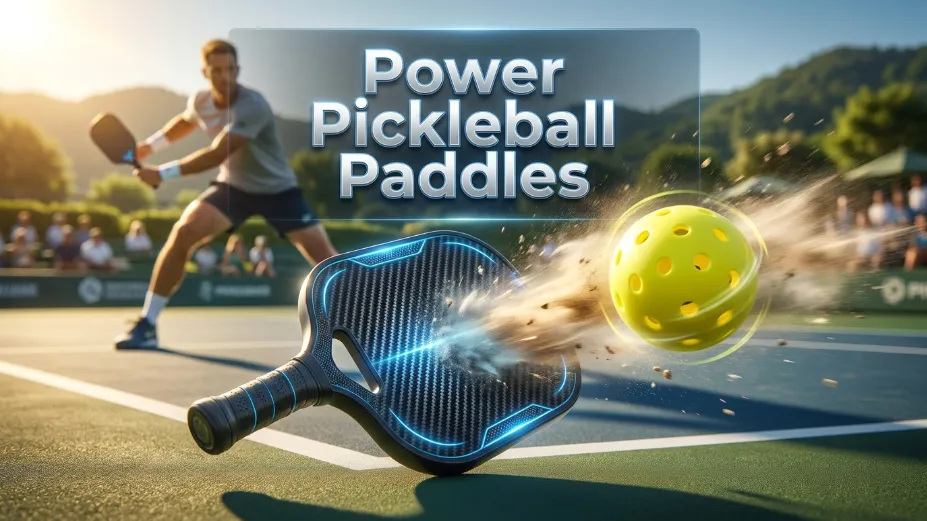
Every heavy hitter on the court eventually hits the same wall: the struggle to balance explosive put-away power with the surgical precision required for the kitchen line. When your game relies on closing out points with velocity, a standard paddle is no longer just a piece of gear—it is a bottleneck. We have stress-tested the latest power pickleball paddles designed to shift the kinetic energy balance of your swing, ensuring every drive reaches the baseline with lethal intent while maintaining the touch needed to survive long-form rallies.
Best Pickleball Paddles — Power Comparison
Core Tech · Power Rating · Swing Weight · USAP Approval
For elite tournament players seeking the maximum legal threshold of raw power and massive spin, the Selkirk Labs Project Boomstik stands as the ultimate premium selection. Intermediate players and value-seekers will find the Spartus P1 Hybrid provides the ideal balance of highly durable spin and controllable power. If tournament sanctioning is not a concern, the 11six24 Vapor Power2 delivers unmatched hand speed and long-term grit performance at an accessible price point.
Choosing the Best Power Pickleball Paddle for Your Game
When selecting the best power pickleball paddle, players often face an overwhelming array of marketing terms that obscure the underlying physics of paddle construction. To find the optimal balance of speed and consistency, you must look beyond aesthetic designs and understand how key technical specifications interact with your biomechanical swing profile.
- Core Thickness: Core thickness is the single most influential factor in determining a paddle’s native power profile. A 14mm vs 16mm pickleball paddle represents a fundamental trade-off: thinner 14mm cores offer less energy absorption, translating to high “pop” and fast hand speed, while thicker 16mm cores cushion the ball to increase dwell time and dinking precision.
- Shape and Leverage: Elongated paddles (typically 16.5 inches in length) leverage classical mechanics to increase the tip speed of your swing. This architectural lengthening raises the paddle’s rotational inertia, yielding deeper drives but narrowing the sweet spot compared to traditional widebody shapes.
- Face Materials: Modern raw carbon fiber paddles dominate the power tier because they combine lightweight stiffness with extreme tensile strength. The physical rigidity of high-modulus carbon sheets ensures that minimal kinetic energy is lost during impact, propelling the ball deep into the opponent’s court.
Ultimately, the perfect power paddle is not the one with the highest laboratory-tested exit velocity, but the one that maximizes pace while staying within your specific “tolerance threshold.” If your technique cannot handle an explosive face, you will find your drops sailing long and your dinks popping up. High-level players transition to elite power setups only when their physical soft-game fundamentals are muscle-memorized and secure.
Understanding the USA Pickleball Power Paddle Ban
The regulatory landscape of competitive pickleball underwent a massive shift following the historic usa pickleball power paddle ban. As manufacturers pushed the boundaries of material engineering, paddles began exhibiting spring-like behaviors that threatened to transform pickleball from a tactical game of chess into a high-speed sport of pure reaction time.
To preserve the sport’s integrity and protect physical safety, USA Pickleball implemented strict testing protocols designed to measure and cap the energy returned to the ball. The primary mechanism used is the Paddle/Ball Coefficient of Restitution ($\text{PBCoR}$) test, which measures the ratio of outbound ball velocity to inbound ball velocity under controlled laboratory conditions:
$$\text{PBCoR} = \frac{v_{\text{out}}}{v_{\text{in}}} \le 0.43$$
Under this standard, any paddle returning more than 43% of the incoming ball’s kinetic energy is deemed to have an illegal “trampoline effect” and is banned from the USA Pickleball approved paddle list. This rule led directly to the decertification of several highly hyped models, most notably the entire JOOLA Gen 3 propulsion line and the Gearbox Pro Power Elongated series.
Additionally, USA Pickleball enforces strict physical limits on surface texture to prevent excessive, un-returnable spin rates. Using an optical profilometer, the organization measures microscopic surface topography, enforcing a strict limit where the average peak-to-valley roughness ($R_z$) cannot exceed $30\,\mu\text{m}$ and the maximum individual profile height ($R_t$) is capped at $40\,\mu\text{m}$. A coefficient of friction test based on the ASTM D1894-14 standard is also applied, capping the maximum kinetic coefficient of friction ($\mu_k$) at $0.1875$.
To enforce these rules at the highest professional tiers, the United Pickleball Association of America (UPA-A) established steep fines starting at $1,000 for first-time manufacturer violations, escalating up to $50,000 for repeat offenders in 2026. This aggressive regulatory environment ensures that manufacturers prioritize compliant, skill-based engineering rather than chasing dangerous, unchecked ball velocity.
Finding the Best Pickleball Paddles for Power and Control
For players who refuse to compromise, finding the best pickleball paddles for power and control is the ultimate goal. Historically, these two attributes sat on opposite ends of a linear spectrum. However, the emergence of Gen 4 manufacturing has redefined what is possible, enabling “all-court” hybrids that offer explosive pop on full swings and dampening plushness on soft resets.
The secret to this dual-performance profile lies in the development of multi-phase polymer (MPP) cores and perimeter foam injection. Unlike traditional honeycomb builds that behave identically regardless of impact velocity, these advanced materials exhibit non-linear physical properties. On soft dinks, the core absorbs and disperses energy, yielding a controlled, predictable launch angle. On high-velocity drives, the structural layers stiffen under load, maximizing kinetic transfer to generate lethal pace.
Leading the charge in this category is the Six Zero pickleball lineup, which utilizes thermoformed raw carbon fiber with injected perimeter foam to expand the sweet spot and stabilize off-center hits. Similarly, JOOLA pickleball paddles featuring the new KineticFrame technology utilize a specialized flex-point architecture that allows the paddle head to compress and rebound in a linear path, dramatically reducing launch-angle deviation while maximizing energy transfer on attacking shots.
Why Core Design Matters: The Physics of Core Crushing
The defining technological gap between legacy paddles and modern elite equipment lies in how the core handles long-term physical stress. Traditional paddles utilize a polypropylene honeycomb core. While lightweight and highly predictable when brand new, honeycomb cells are highly susceptible to a destructive structural phenomenon known as core crushing.
During a high-velocity overhead smash or drive, the vertical walls of the plastic honeycomb cells compress under extreme local pressure. Over hundreds of games, this repetitive mechanical stress causes the cell walls to buckle, permanently collapsing the internal structure. This collapse leads to delamination, where the carbon fiber face separates from the collapsed core beneath it.
Without the rigid support of the core, the un-bonded carbon face is free to flex inward and snap back rapidly upon ball impact. This creates an unregulated, highly illegal trampoline effect. While core-crushed paddles deliver extreme, “hot” ball speeds that can overwhelm opponents, they destroy your control game, creating unpredictable launch angles, erratic dinks, and highly inconsistent sweet spots. Gen 4 foam-core paddles solve this issue entirely by replacing hollow honeycomb cells with solid, highly resilient polymer foams that are physically immune to cell buckling and core crushing.
Head-to-Head Comparison: The Titans of Power
To help pickleball paddles for power players translate engineering to the court, we conducted a direct, head-to-head analysis of the four hardest-hitting paddles on the market as of May 20, 2026.
1. Selkirk Labs Project Boomstik vs. 11six24 Vapor Power2
The Selkirk Labs Project Boomstik represents the absolute peak of explosive, stiff-face power. Built with an EPP foam core and heavily weighted with integrated 15g perimeter weights, the Boomstik hits with an unmatched “thuddy” impact feel. The 11six24 Vapor Power2, utilizing a multi-phase polymer (MPP) core, plays with a softer, more connected feel.
While the Boomstik delivers slightly higher top-end drive speeds, the Vapor Power2 excels in rapid hand battles at the kitchen line due to its lighter swing weight ($111\,\text{g}\cdot\text{cm}^2$ vs. the Boomstik’s $118\,\text{g}\cdot\text{cm}^2$). The trade-off is regulatory: the Boomstik is fully USAP-approved, while the Vapor Power2 is limited to UPA-A certified events due to its aggressive HexGrit face.
2. Spartus P1 Hybrid vs. Bread & Butter Loco
Though both paddles share a similar internal EPP foam core structure with an EVA perimeter ring, they play like entirely different instruments on the court. The Bread & Butter Loco utilizes a composite layer of carbon fiber and fiberglass, producing a loud, hollow, and exceptionally poppy response that immediately launches the ball.
The Spartus P1 Hybrid is wrapped in a thick, US-applied PermaGrit ceramic coating. This PermaGrit layer dampens vibration, making the P1 feel significantly denser, softer, and more controlled than the Loco. For players who rely on spin to shape their drives and keep power shots in play, the P1’s highly durable grit offers a massive tactical advantage, whereas the Loco appeals to players who want instant, effortless pop out of the box.
Advanced Customization: Tuning Your Swing and Twist Weights
Many advanced players overlook the fact that a paddle’s stock specifications are merely a starting point. By understanding the math of rotational inertia, you can manually customize your paddle to achieve the ultimate balance of power and stability using tungsten or lead tape.
- Swing Weight (SW): This measures a paddle’s resistance to rotation around your wrist joint. Adding weight to the very tip of the paddle (the 12 o’clock position) raises the swing weight mathematically, dramatically increasing plow-through and raw drive velocity on full swings at the expense of maneuverability.
- Twist Weight (TW): This measures resistance to twisting along the central vertical axis. Placing 5-gram weights at the 3 and 9 o’clock positions raises the twist weight, expanding the sweet spot to the outer edges and preventing the paddle face from rotating on off-center defensive resets.
For hybrid paddles like the 11six24 Vapor Power2 or the Spartus P1, adding a small amount of weight to the lower throat (the 4 and 8 o’clock positions) is highly recommended. This strategic placement raises the twist weight significantly while keeping the overall swing weight agile, giving you a massive sweet spot for defensive blocks without compromising your hand speed during high-speed volley exchanges.
The Sleeper Trend: Acoustic Masking and Quiet Approved Power
A fascinating development in the United States pickleball market is the rise of “Quiet Approved” equipment. Driven by municipal noise complaints near residential properties, USA Pickleball established strict acoustic guidelines, requiring approved paddles to reduce decibel levels below $80\,\text{dB}$ and drop the pitch frequency to under $600\,\text{Hz}$ (compared to standard paddles that exceed $1,000\,\text{Hz}$).
However, this acoustic engineering has created an unexpected tactical loophole. Paddles like the Diadem Hush replace rigid carbon fiber with a thick eTPU (expanded thermoplastic polyurethane) foam face. While eTPU effectively dampens the sharp, high-pitched “crack” of a plastic ball into a quiet, low-frequency “thump,” its highly elastic polymer structure acts like a trampoline, launching drives at speeds exceeding $50\,\text{mph}$.
This creates a powerful phenomenon known as acoustic masking. Human players rely heavily on auditory feedback to estimate the speed, spin, and launch depth of an opponent’s shot. Because a quiet paddle hides the sound of hard contact, opponents are stripped of their primary auditory cues. This consistently delays their reaction time by crucial milliseconds, turning a quiet, neighbor-friendly paddle into a deceptive, point-scoring weapon on the court.
Frequently Asked Questions About Power Pickleball Paddles
1. What is the main difference between pop and power?
Pop refers to the instantaneous exit velocity of the ball during short, compact strokes (like punch volleys or block resets near the net), driven primarily by face stiffness. Power is the deep-court acceleration generated during full-swing groundstrokes (like drives and serves), driven by swing momentum and core leverage.
2. Can I use a banned USA Pickleball paddle in recreational play?
Yes. USA Pickleball certification rules technically only apply to sanctioned tournaments and leagues. However, bringing an exceptionally hot or decertified paddle to public park open play can be socially contentious, especially if you are hitting aggressive shots at beginner or senior players.
3. How can I tell if my carbon fiber paddle is core crushed?
Press firmly on the center of the paddle face with your thumbs (avoiding the edge guard). If you hear a distinct crunching, squeaking, or crackling sound, the internal honeycomb cells have permanent structural damage. This creates erratic launch angles and a loss of sweet-spot predictability.
4. What is the difference between EPP and MPP foam cores?
EPP (Expanded Polypropylene) foam is highly resilient, returning energy quickly to produce maximum pop and a stiff, traditional feel. MPP (Multi-Phase Polymer) foam is denser and absorbs more vibration, offering a plush, linear feel that maximizes ball control on soft shots while still delivering strong put-away power on fast swings.
5. Why does the 11six24 Vapor Power2 lack USAP approval?
The Vapor Power2 utilizes an innovative HexGrit face designed for long-lasting spin. This texture is physically too rough to pass USA Pickleball’s static profilometer roughness test, even though it passes the UPA-A’s dynamic spin test which caps direct ball rotation at $2,100\,\text{RPM}$.