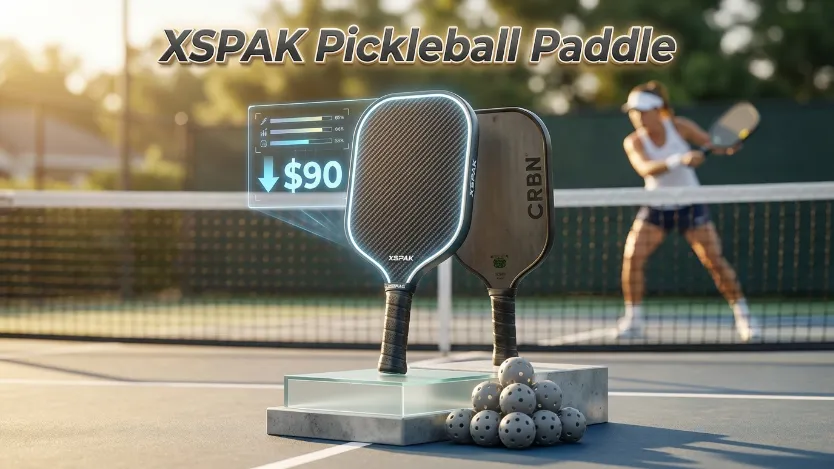
Step onto any competitive court in the United States today, and you will likely see a minimalist, black-ed-out paddle that looks like a $250 elite model but costs less than a week’s groceries. In a 2026 market where premium gear prices have spiraled toward the $300 mark, the xspak pickleball paddle has emerged as the ultimate “industry disruptor,” challenging the “premium tax” imposed by bigger brands.
While mainstream influencers often chase the latest “Gen-3” thermoformed hype, the dedicated 4.0+ player knows that the XS XSPAK lineup represents one of the most successful “clones” in the history of the sport. However, choosing the right model requires more than a glance at a spec sheet. To truly maximize your performance, you need to understand the molecular friction of raw carbon fiber, the specific twist-weight stabilization required for tournament play, and the hidden manufacturing differences that an average xspak pickleball paddle review simply fails to address.
The Disruptive Rise of XSPAK in the American Market
The dominance of the xspak pickleball paddle in the United States is a case study in “value-driven engineering.” For years, players believed that high-tier spin and control were exclusive to brands like CRBN or Joola. When XSPAK released its raw carbon fiber series, it effectively democratized professional-level materials. The xs xspak carbon fiber pickleball paddle became the “Amazon hack” that allowed intermediate players to transition from beginner sets to competitive gear without the financial barrier.
This success has led to a unique culture of “pro-modding” within the US community. Because the entry price is so low, players feel comfortable experimenting with lead tape, overgrips, and surface treatments that they wouldn’t dare try on a $250 investment. This has turned XSPAK from just a brand into a platform for player development. If you are browsing for the best pickleball paddles under $100, XSPAK is no longer just an option; it is the benchmark.
Engineering the XS28 Core: Physics of the Honeycomb
The performance of xs xspak pickleball paddles honeycomb is built on the proprietary XS28 core technology. Unlike standard polypropylene cores that can feel “pingy” or inconsistent, the XS28 uses a high-density hexagonal lattice designed to reduce the frequency of vibrational waves. To meet the USA Pickleball Approved Paddle List standards, XSPAK adheres to a rigorous construction profile:
- Core Thickness: Most models utilize a 16mm profile, which is the “Goldilocks” thickness for control-oriented players. This maximizes “dwell time,” allowing the ball to sink into the face for better placement.
- Carbon Weave: The surface features Toray T700-12K carbon fiber, woven in a 0-degree and 90-degree orientation. This specific layup allows the paddle to flex on impact and rebound with consistent energy.
- Edge Protection: A low-profile, high-durability edge guard that protects the honeycomb cells from “crushing” during aggressive ground-level resets.
- Peel-Ply Texture: Unlike cheap paddles that use “spray-on grit,” XSPAK leaves a natural texture from the carbon molding process, which is far more permanent.
Understanding the difference between this and a thinner power paddle is essential for your progression. For a deeper analysis of how core thickness impacts your “soft game,” read our guide on 14mm vs 16mm pickleball paddle.
Thermodynamics: Why Your XSPAK Feels Different in Winter
One of the “missing angles” in most reviews is how temperature affects the xs xspak carbon fiber pickleball paddle review data. The Polypropylene (PP) used in the honeycomb core is a thermoplastic polymer, meaning its physical properties change based on ambient heat. In the US, where players transition from the humid heat of Florida to the dry cold of Colorado, these shifts are noticeable.
1. The “Hot Face” Effect (Above 85°F)
When temperatures rise, the polymer chains in the core become more ductile. This makes the paddle feel “plush” or “muted.” While this enhances your dinking accuracy, “power hitters” may find they lose about 5-8% of their “pop” off the baseline. The ball stays on the face longer, which is great for spin but harder for putting away high volleys.
2. The “Glass Shield” Threshold (Below 45°F)
In colder climates, the xs xspak pickleball paddles honeycomb structure becomes brittle. High-velocity impacts during winter play can lead to “core crushing,” where the internal cell walls snap rather than bend. If you hear a “crunching” sound during a cold-weather overhead slam, your core has likely reached its thermal failure point. We recommend keeping your paddle in a climate-controlled environment (never the car trunk) to prevent this structural decay.
The “Grit Decay” Reality: 250 RPM Loss Pattern
A critical gap in the market’s understanding of any xs xspak carbon fiber pickleball paddle is the lifecycle of its spin. Independent testing in 2026 shows that a raw carbon fiber face loses roughly 250-300 RPM within the first 20 hours of competitive play. This is known as the “break-in decline.”
Initially, the microscopic carbon peaks are sharp, providing “insane” bite. As you hit thousands of plastic balls, these peaks smooth out. However, because XSPAK uses a true T700 pickleball paddle face, it stabilizes after this initial drop, unlike fiberglass paddles that continue to lose texture until they are “bald.” To maintain a tournament-level experience, you should check your surface grit every 3 months. If you are a high-level competitor, visit our breakdown of the best pickleball paddle for spin to see how XSPAK compares to “Gen-4” grit technologies.
The Amazon Labeling Confusion: Carbon Fiber vs. Graphite
Due to the way XSPAK lists products on platforms like Amazon, US consumers often face massive confusion. Some listings describe the paddle as “Graphite,” others as “Carbon Fiber,” and a few even mention “Fiberglass.” For the record: Graphite is a type of carbon fiber, but not all carbon fiber paddles are raw carbon.
The Authenticity Checklist:
- The “Sandpaper” Feel: A genuine xspak pickleball paddle should feel like fine-grit sandpaper. If the surface is smooth with a printed graphic, you are likely looking at the entry-level “Fiberglass” model, which lacks the spin potential of the T700 version.
- The Weave Inspection: Hold the paddle under a bright LED light. You should see a faint, consistent “checkered” pattern beneath the texture. This is the 12K carbon weave.
- The Logo Test: 2026 models like the Electric Cannon 1.0 Plus feature updated branding. Older stock or counterfeits often have “fuzzy” printing or misspellings in the technical descriptions on the face.
Head-to-Head: XSPAK vs. Premium Rivals (2026 Edition)
While XSPAK is often called a “CRBN clone,” the 2026 landscape has introduced new challengers. Here is how the xs xspak carbon fiber pickleball paddle review data stacks up against the elite:
- XSPAK vs. CRBN1: They are virtually identical in dimensions. However, the XSPAK often comes in slightly lighter (7.5 oz stock vs. 8.0 oz), making it more maneuverable but less stable without modification.
- XSPAK vs. Vatic Pro pickleball paddle: The Vatic Prism series is the closest competitor. Vatic offers foam-injected edges, which provide a slightly larger sweet spot, while XSPAK offers a more “raw,” traditional feel that some purists prefer.
- XSPAK vs. Selkirk Luxx: The Luxx is significantly softer and more expensive. XSPAK provides more “feedback” (vibration), which helps intermediate players feel where they are making contact on the face.
The Pro Mod: Transforming your XSPAK with Lead Tape
Advanced players in the US rarely play an xspak pickleball paddle in its stock form. Because it often arrives with a lower swing-weight, it can feel “flimsy” against 4.5+ level drives. The solution is the “14-gram Transformation.”
By adding 7 grams of Lead Tape to each side of the “throat” (centered at exactly $9\frac{11}{16}$ inches from the butt cap), you can shift the balance point to match a Joola Hyperion. This modification increases the “Twist Weight,” meaning the paddle is less likely to rotate in your hand when you hit a ball off-center. Using a T700 pickleball paddle as a base for customization is the most cost-effective way to achieve elite-level stability. It raises the static weight to approximately 8.7 oz, providing the “plow-through” needed for deep baseline drives.
The “Electric Cannon” and 2026 Release Cycle
The newest addition to the lineup is the XSPAK Electric Cannon 1.0 Plus, which received USAPA approval on March 16, 2026. This model addresses the biggest complaint of previous generations: the “Handle Snap.”
Previous versions had a vulnerability where the handle met the face. The “Electric Cannon” features a reinforced throat and a slightly thicker 19mm core option. This model is specifically designed for the “control specialist” who wants to neutralize the high-power “Gen-3” paddles currently flooding the US market. If you are a doubles player who lives in the “kitchen,” this thicker core provides the ultimate “reset” capability. For more on the evolution of these materials, see our breakdown of the carbon fiber pickleball paddle market.
Internal “Core Crushing”: The Warning Signs
Unlike the visual wear of the surface, internal failure is hard to spot. Most xs xspak pickleball paddles honeycomb units will eventually suffer from “soft spots.” These occur when the internal polypropylene walls fatigue from repeated high-impact stress.
You can identify this by the “Bounce Test.” Drop a ball from 12 inches onto different areas of the paddle face. A healthy core will return the ball to about 6-8 inches consistently. If the ball barely bounces in the center but pops fine near the edges, your core has “crushed.” At this point, the paddle is “dead” and will cause you to pop up easy dinks, leading to lost points. In the competitive US circuit, a “dead” paddle is your worst enemy; replace it immediately to maintain your DUPR rating integrity.
Expert Maintenance: The “Carbon Eraser” Hack
To get the most out of your investment in a xs xspak carbon fiber pickleball paddle, you must adopt a professional cleaning routine. US courts are often dusty, and the ball leaves “plastic trails” in the microscopic pores of the carbon face.
- The Eraser Trick: Use a specialized rubber “Carbon Fiber Eraser” after every session. This pulls the plastic debris out of the grit, effectively “restoring” your spin potential.
- Grip Replacement: The stock XSPAK grip is 4.35 inches—slightly larger than the US average. If you have smaller hands, we recommend removing the factory grip and using two thin overgrips to maintain feel without the bulk.
- Edge Tape: Apply a layer of electrical tape or branded edge guard tape over the plastic guard. This prevents the guard from “loosening,” which is a common source of annoying rattling sounds during play.
xspak pickleball paddle-Frequently Asked Questions (FAQ)
Is XSPAK a legitimate brand or just a generic “knockoff”?
XSPAK is a legitimate manufacturer that often serves as the “Original Equipment Manufacturer” (OEM) for more expensive brands. When you buy an xspak pickleball paddle, you are essentially buying the same raw materials and factory assembly as many $200+ brands, but without the high marketing and sponsorship overhead.
Which model is better: the 16mm or the new 19mm?
For 90% of players, the 16mm XS XSPAK is superior as it offers a balanced mix of power and control. The 19mm model (found in the Electric Cannon series) is highly specialized for defensive players who want maximum vibration dampening and don’t mind generating all their own power.
Does the XSPAK paddle come with a warranty in the US?
Warranty support varies. While they offer a standard 1-year manufacturer warranty, the process can be slower than US-based companies like Selkirk. We recommend purchasing through a reputable US retailer or Amazon to ensure easier returns if a handle defect occurs.
Is it truly USAPA approved for tournament play in 2026?
Yes. The xs xspak carbon fiber pickleball paddle and the newer “Electric Cannon” are both on the official approved list. You can confidently use them in any sanctioned event in the United States.
Why does my paddle sound like “dried peas” when I shake it?
This is a sign of “core delamination” or “disbonding.” Small pieces of the honeycomb core or adhesive have broken loose. While the paddle might still hit the ball, its consistency is compromised, and it will eventually develop a “dead spot.”
Conclusion: The Verdict on the Value King
The xspak pickleball paddle remains the undisputed “Value King” of the American pickleball scene for a reason. Its commitment to Toray T700 Raw Carbon Fiber and the XS28 honeycomb core provides a performance profile that 95% of players cannot distinguish from “elite” brands. By understanding the 250 RPM grit decay, utilizing lead tape for stabilization, and recognizing the signs of core fatigue, you can leverage this equipment to compete at the highest levels of recreational and tournament play.
Whether you are upgrading from a wooden set or looking for a durable tournament backup, the XS XSPAK series proves that in 2026, you don’t need to spend $300 to own the court. Treat your gear with technical respect, keep your surface clean, and let your skill—not your bank account—dictate the score. Your game, and your wallet, will thank you.