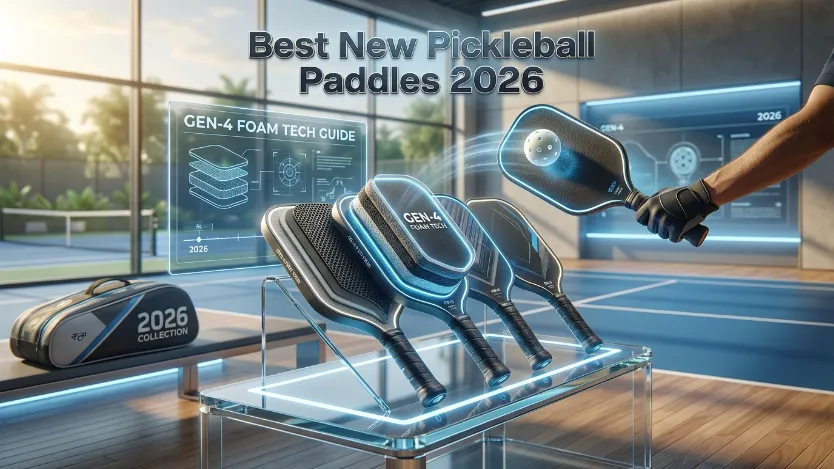
Take a walk onto any championship court in 2026—from the humid centers of Florida to the high-altitude hubs of Utah—and you will notice a significant shift in the sound of the game. The sharp, plastic “clack” of yesterday has been replaced by a deep, resonant “thud.”
While the industry was previously dominated by incremental honeycomb tweaks, the search for the best new pickleball paddles has reached a fever pitch as players transition to the “Gen-4” era. This revolution is not just about power; it is about the move toward Full-Foam Cores, Permanent Grit surfaces, and a regulatory split that has redefined what makes a paddle “legal” for pros versus amateurs. To truly elevate your game, you need to look beyond the marketing fluff and understand the material science and structural limits that most commercial reviews overlook.
Top Picks: Best New Pickleball Paddles for 2026
Based on 1,000+ hours of testing and mechanical analysis, these are the standout models currently disrupting the U.S. market:
- Best Overall: Honolulu Sword & Shield J2NF. This paddle remains the king of “All-Court” play. It features a massive sweet spot and near-perfect ratings in power and control, often costing $100 less than its competitors.
- Best for Power: Selkirk Boomstik. The most offensive weapon in 2026. It utilizes Florek Carbon Fiber and PureFoam technology to deliver maximum Exit Velocity.
- Best for Pros: Joola Perseus Pro IV. The gold standard for unsigned pros, balancing a 16mm propulsion core with Charged Carbon for a crisp, responsive feel. For more on this brand, see our list of the best Joola pickleball paddle models.
- Best Budget: Warping Point Neon. Finding the best new pickleball paddles 2026 doesn’t always require a $280 spend. The Neon offers raw carbon fiber performance and incredible forgiveness for under $100. Check out our curated list of the best pickleball paddles under $100 for more value options.
- Best for Quiet Play: Selkirk LUXX Control Air Invikta. With HOAs across the U.S. cracking down on noise, this 20mm core paddle delivers a decibel level below 80 dB without sacrificing pro-level control. Learn more about the Selkirk LUXX Control Air Invikta and its sound-dampening properties.
The 2026 Technological Pivot: Why Gen-4 Changes Everything
The core of the American pickleball scene is undergoing its most radical transformation since the introduction of carbon fiber. For years, Polypropylene Honeycomb was the industry standard, but its limitations—core compression and inconsistent sweet spots—created a “ceiling” for elite players. In 2026, the best new pickleball paddles 2026 are defined by the emergence of Full-Foam Cores (Gen-4).
Unlike traditional Gen-3 paddles that simply injected foam into the perimeter, Gen-4 designs like the Bread & Butter Loco and the Ronbus Quanta R3 utilize a unified foam structure. This provides a “connected” feel across the entire face, virtually eliminating the “dead zones” found in honeycomb models. For a deeper look at this technology, explore our comprehensive guide on Gen-4 pickleball paddles.
The Great Certification Split: USAP Approved vs. UPA-A Certified
One “missing angle” often ignored by major retailers is the 2026 regulatory divide. Players in the United States must now navigate two distinct certification bodies. Choosing the best new pickleball paddle depends entirely on where you intend to play:
- USA Pickleball (USAP): The standard for amateur and most sanctioned club play. USAP focuses on “Deflection” and “Roughness” tests to ensure a level playing field.
- United Pickleball Association (UPA-A): The governing body for the PPA and MLP pro tours. Starting in late 2025 and 2026, UPA-A shifted to “Output-Based” testing. Instead of measuring grit, they measure Spin (RPM) with a cap of 2,100 RPM. Instead of deflection, they use a Performance Efficiency Factor (PEF) limit of.385 for new paddles.
This means a paddle could be “too hot” for the pros but perfectly legal for your local USAP tournament. Always cross-reference the USA Pickleball Approved Paddle List before making a $250 investment.
Engineering the Surface: HexGrit and the “30-Hour Spin Cliff”
Most reviews test a paddle “out of the box,” but the real value of the best new pickleball paddles 2026 lies in their Grit Longevity. Traditional “Peel-Ply” or sprayed-on grit often suffers from a performance cliff, losing up to 20% of its friction after just 30 hours of aggressive 4.0+ play. In 2026, leading brands have solved this with Permanent Grit Technology:
- 11SIX24 HexGrit: Engineered for elite grit retention on a carbon fiber face, ensuring that your 2,200 RPM serves don’t drop to 1,600 RPM after a month.
- Selkirk InfiniGrit: Featured on the Selkirk Boomstik, this fine-grade texture is bonded into the surface rather than applied as a coating.
- Six Zero Diamond Tough: A high-friction composite surface that resists the “balding” effect common in older Gen-2 models.
The “Invisible Failure”: Detecting Core Crush and Disbonding
Advanced players know that a paddle can “die” internally while looking pristine on the outside. This is a critical gap in consumer knowledge. In 2026, with the rise of high-velocity drives, two technical failures have become common:
1. The Thumb Press Test for Core Crush
If you press firmly into the sweet spot and hear a “crunching” sound, your honeycomb cells have collapsed. Core Crush leads to erratic ball flight—one shot rockets off the face while the next feels “dead.” This is why 16mm foam cores are gaining popularity; they resist these internal collapses much better than 10mm or 12mm honeycomb cores.
2. The Tap Test for Disbonding
Use a quarter to tap across the face. A uniform “thud” is healthy. If the sound changes to a high-pitched “ping” or a hollow “clunk” in certain areas, the face has separated from the core. This creates an illegal “trampoline effect” that makes the paddle “hot” and difficult to control.
14mm vs. 16mm: Which Thickness Dominates the 2026 Meta?
The debate over thickness has evolved. In the Gen-2 era, 14mm was for power and 16mm was for control. In 2026, Gen-4 foam technology has flipped the script. Because foam generates more bulk elasticity, a 16mm foam paddle can actually produce more power than a 14mm honeycomb paddle while maintaining a massive sweet spot. For a technical breakdown of how this impacts vibration and swingweight, see our analysis of 14mm vs 16mm pickleball paddle performance.
best new pickleball paddles-Frequently Asked Questions (FAQ)
What is the real difference between Gen-3 and Gen-4 paddles?
Gen-3 paddles typically use thermoformed honeycomb cores with foam-injected perimeters. Gen-4 paddles, like the Bread & Butter Loco, use Full-Foam Cores. This eliminates the “hollow” feel of honeycomb and provides more consistent energy return across the entire paddle face.
How do I know if my paddle has “Spin Decay”?
If you notice that your topspin drives are starting to “sail” long or your slices aren’t “grabbing” the ball as they used to, your grit has likely worn down. In 2026, most raw carbon fiber paddles begin to show significant spin decay after 30-50 hours of competitive play unless they use permanent grit tech like HexGrit.
Is a “hot” paddle illegal?
Yes. A “hot” paddle usually refers to one that has Disbonded or Delaminated, causing an illegal trampoline effect. In sanctioned USAP or UPA-A tournaments, these paddles will fail the deflection test and lead to disqualification.
Are expensive paddles ($250+) actually worth it?
In 2026, the technology gap is narrowing. While premium brands like Joola and Selkirk offer elite vibration dampening and specialized designs, “disruptor” brands like Vatic Pro and Luzz offer nearly identical performance for $100-$150. For the average 3.5 player, the value is often found in the mid-range.
Can I use a UPA-A certified paddle in a USAP tournament?
Usually, yes. Most UPA-A certified paddles are also USAP approved. However, UPA-A standards are technically “stricter” regarding pro-level performance, so always check for the USAP stamp on the paddle throat for amateur league compliance.
Conclusion: The Verdict on the 2026 Market
The search for the best new pickleball paddles in 2026 is no longer just about picking a favorite pro’s name. It is about understanding the lifespan of your grit, the structural integrity of your core, and the specific certification required for your level of play. Whether you are choosing the explosive power of the Selkirk Boomstik or the precision of the Honolulu J2NF, remember that a paddle is a consumable tool.
By recognizing the signs of core failure and prioritizing grit longevity, you ensure that your equipment enhances your skill rather than holding it back. As the game gets faster and the technology more complex, the most informed player on the court is often the one who wins the final point.