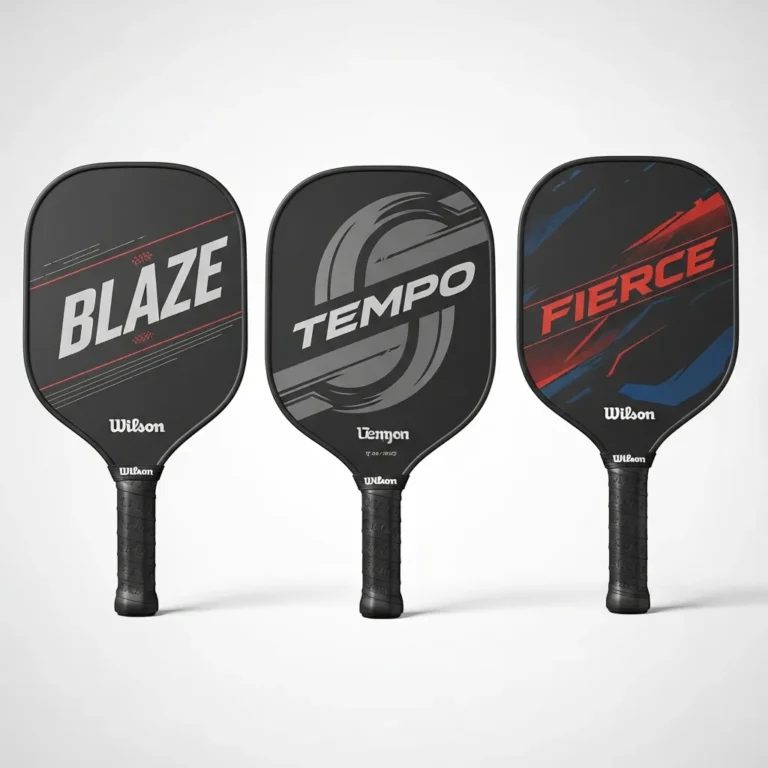
wilson pickleball paddles
Wilson Pickleball Paddles: A Legacy Brand in the Kitchen
If you have ever stepped foot on a tennis court, a baseball diamond, or even thrown a football in your backyard, you know the “Big W.” Wilson is a giant. They are the titans of sports equipment, a brand that has been woven into the fabric of American athletics for over a century. But recently, you might have noticed that familiar red logo popping up in a place that feels a little different: the local pickleball courts.
It brings up a really interesting dynamic. On one hand, you have the die-hard pickleball purists who swear by brands that were born in the driveway—companies that only make pickleball gear. On the other hand, you have Wilson, bringing decades of racket-science engineering to the table. It leaves a lot of us wondering: Can a tennis giant really capture the soul of pickleball, or are they just trying to crash the party?
If you are in the market for a new paddle, you have probably hovered over a Wilson pickleball paddle online, wondering if the tech matches the reputation. Whether you are a convert coming over from tennis or a fresh face to racket sports, navigating the Wilson lineup can feel a bit like learning a new language. Let’s sit down and walk through everything you need to know about Wilson pickleball paddles, from the skepticism to the sweet spots, just like we’re chatting on the bench between games.
Brand Reputation & Value (The “Tennis vs. Pickleball” Debate)
When Wilson first announced they were getting serious about pickleball, the community reaction was a mixed bag. You had the excited tennis players who trusted the brand implicitly, and then you had the skeptics who viewed it as a corporate “cash grab.” It is a fair hesitation. Just because you can make a tennis racket doesn’t mean you understand the nuances of the kitchen game.
Is Wilson actually a good brand for pickleball, or should I stick to “pickleball-first” companies?
This is the big question. When you look at companies like Selkirk or Joola, their entire identity is wrapped up in the wiffle ball. So, is Wilson just a tourist here?
Here is the reality: Wilson isn’t starting from scratch. They are starting with a century of data on aerodynamics, grip ergonomics, and carbon fiber layups. While a pickleball wilson paddle might look different from a Blade tennis racket, the engineering DNA is shared.
Wilson isn’t just slapping a logo on generic honeycomb cores. They are actually innovating. They have brought over their “Power Foam” and specialized handle shapes that mimic the feel of a tennis racket, which is a godsend for players transitioning sports. If you want a paddle that feels substantial and premium, Wilson is absolutely a “good” brand. However, if you are looking for the gritty, grassroots, garage-brand vibe, they might feel a little polished for your taste. But regarding performance? They are the real deal.
you may like it
Top Pickleball Gifts 2025:From Stocking Stuffers to Pro Gear
Looking for unique pickleball gifts? We break down practical gear, funny apparel, and budget-friendly ideas to help you surprise the player in your life.
Are Wilson paddles worth the premium price tag compared to budget options?
Money talks, right? You look at a high-end Wilson paddle, and then you look at a knock-off on Amazon for $40, and you have to wonder where that extra money is going.
When you buy pickleball paddles Wilson manufactures, you are largely paying for Quality Assurance (QA). One of the biggest complaints in the pickleball world right now is inconsistency—one paddle feels great, the next one from the same batch feels dead. Wilson’s manufacturing standards are incredibly high because they have to be; they have too much to lose reputation-wise.
So, are they worth the premium? If you are a casual player hitting once a month, maybe not. A generic wooden or cheap composite paddle will move the ball just fine. But if you are playing weekly and care about consistency—meaning your dink drops in the same spot every time you hit it correctly—the premium for lines like the Blaze or the Vesper is justified by the materials and the build quality. You’re paying for the assurance that the paddle won’t rattle or fall apart after three months.
Do professional pickleball players actually use Wilson paddles?
We all look for that stamp of approval. If the pros aren’t using it, why should we? For a long time, the pro tours (PPA/APP) were dominated by the endemic pickleball brands. Wilson was a bit late to the sponsorship party.
However, that tide is turning. You are starting to see more pros making the switch, or at least testing the waters. Wilson has been aggressive in signing younger, athletic talent—often players with tennis backgrounds who are crossing over. While they might not have the sheer volume of sponsored athletes that Joola has right now, the players who do use Wilson often praise the “familiarity” of the handle and the swing weight. It’s a validating factor: the gear is holding up at 100 mph hand battles, which means it will definitely hold up for our Saturday morning rec play.
Choosing the Right Paddle (Selection Guide)
Okay, so you’re sold on the brand. Now you’re staring at a wall of paddles (or a web page) and seeing words like “Blaze,” “Tempo,” “Fierce,” and “Juice.” It can get overwhelming fast. Let’s break it down so you can match the paddle to your hand.
Which Wilson paddle is best for a beginner vs. an advanced player?
If you are just starting out, you don’t need a Ferrari to learn how to drive. You need something forgiving.
For beginners, the Wilson Fierce or the Juice Team lines are fantastic starting points. These paddles generally have a wider face, meaning the “sweet spot” (the area where the ball pops off nicely) is huge. When you are learning, you are going to miss the center of the paddle a lot. These lines are designed to help you keep the ball in play even on off-center hits. They are also usually lighter, which helps you react faster at the net without tiring out your arm.
For the advanced player—the person who dreams about third-shot drops and ernes—you are looking at the Blaze or Tempo lines. These are performance paddles. They are often a bit heavier, have more texture for spin, and are designed to reward a full, proper swing path. They won’t fix your mistakes like the beginner paddles, but they will let you do things with the ball that the entry-level paddles simply can’t.
What is the difference between the Wilson Blaze, Tempo, and Fierce lines?
Think of it like a role-playing game where you have to choose your character class.
- The Blaze: This is your “Warrior” class. It is built for power and speed. If you are a banger—someone who likes to drive the ball hard from the baseline and speed up the ball at the net—the Blaze is for you. It usually features a slightly elongated shape, which gives you more leverage and reach, translating to more pop on the ball.
- The Tempo: This is your “Mage” or “Rogue.” It’s all about control and finesse. If your game is built on patience, soft dinks, and placing the ball on a dime, the Tempo line is your best friend. It often has a standard shape that feels very balanced in the hand, giving you maximum connection to the ball.
- The Fierce: This is the “Paladin” or all-rounder. It tries to strike a middle ground. It has decent pop and decent control. It’s great for the all-court player who hasn’t quite decided if they want to be a power hitter or a control freak yet.
Should I choose the “Power” or “Control” version of the Wilson Vesper?
Now we get to a specific and very popular model: the Wilson Vesper pickleball paddle. This paddle has garnered a lot of attention because it looks distinct and feels incredibly premium. But Wilson, in their wisdom, often offers variations within the same line.
When deciding between the Power and Control versions of the Vesper, look at two things: core thickness and throat shape.
Usually, the Control version will have a thicker core (think 16mm). A thicker core acts like a pillow; the ball sinks in a bit more, staying on the face longer. This gives you that plush, buttery feel that makes resetting a hard smash easier.
The Power version often has a thinner core (around 13mm or 14mm). A thinner core is stiffer. The ball rebounds off it faster, like a trampoline. If you find that you struggle to put the ball away—if your smashes are coming back—you might want the Power version.
Also, look at the throat (the hole near the handle). The Vesper design often utilizes unique geometry here to manage airflow and flex. The Power variants are stiffer in the throat to transfer energy, while the Control variants might allow a tiny bit of flex to absorb shock.
Technical Specifications & Performance
We’ve covered the marketing names; now let’s look under the hood. This is for the gear-heads who want to know why a paddle feels the way it does.
Does Wilson offer “raw carbon fiber” paddles, and how do they compare to fiberglass faces?
If you have been reading forums, you know “Raw Carbon Fiber” (T700) is the buzzword of the decade. It refers to the face material having a natural, gritty texture created by the carbon weave itself, rather than a spray-on grit.
Yes, Wilson has joined the party. Their high-end performance paddles (specifically in the Blaze Tour and Vesper lines) now feature raw carbon faces.
So, how does this compare to fiberglass? Fiberglass (often found on the entry-level pickleball wilson paddle) is poppy. It provides a lot of rebound energy, which is great if you need help getting the ball over the net. However, fiberglass is usually smoother.
Raw carbon fiber is different. It’s not as “bouncy,” but it grabs the ball. That friction generates massive spin. If you want to hit that dipping drive that drops right at your opponent’s feet, or a slice return that skids away, raw carbon fiber is superior. Wilson’s implementation of this is excellent—they haven’t just glued carbon on; they’ve integrated it well with their core so it doesn’t feel dead.
How does the handle length on Wilson paddles compare to standard paddles?
This is Wilson’s secret weapon. Because they come from tennis, they understand the two-handed backhand better than almost anyone.
Standard pickleball paddles often have short handles (around 4.5 to 5 inches) because the original game was all about wristy, one-handed shots. But the modern game is changing. Power players use two hands.
Many Wilson paddles, especially the Blaze line, feature extended handles (5.5 inches or more). For a tennis player, this feels like coming home. It gives you room to get that second hand on the grip comfortably without choking up on the paddle face. Even if you play one-handed, that longer handle moves the weight of the paddle further away from your hand, creating more whip and leverage on your serve and overheads.
What is the “sweet spot” size like on Wilson paddles?
The “sweet spot” is that magical area on the face where the hit feels perfect—no vibration, maximum power.
Wilson has done some interesting work with their “edgeless” designs and their perimeter weighting. On the Vesper and some Blaze models, you might notice the lack of a traditional plastic edge guard overlapping the face. Sometimes, removing that bulk expands the usable surface area.
However, generally speaking, Wilson paddles are known for a “focused” sweet spot on their power paddles, and a “generous” sweet spot on their control paddles. If you buy a Blaze, be aware that you need to be accurate. If you hit near the edge, you might lose some power. The Juice and Fierce lines, being wider, are much more forgiving. You can mishit a block and it will still likely wobble over the net.
How much do Wilson paddles weigh, and can I customize them with lead tape?
Most pickleball paddles Wilson sells fall into the “mid-weight” category, usually between 7.8 and 8.2 ounces. This is the Goldilocks zone for most players—heavy enough to block a drive, light enough to win a hand battle.
But can you customize them? Absolutely. In fact, Wilson paddles are very friendly to lead tape modification. Because the handles are often substantial and the balance is usually neutral or slightly head-light (in the control lines), adding lead tape to the throat or the top edges is a common practice.
If you have a Wilson Tempo and want a bit more punch, putting a few grams of lead tape at the 12 o’clock position (the very top) works wonders. The flat edge guards (or edgeless sides) on models like the Vesper make applying tape smooth and easy.
Durability & Warranty
It’s the question nobody wants to ask until it’s too late: What happens if it breaks? Pickleball is hard on equipment. We are smacking hard plastic balls thousands of times.
What is the warranty period for Wilson pickleball paddles, and what does it cover?
Standard industry practice is changing, but Wilson generally sticks to a 1-year limited warranty against manufacturing defects.
This is important to clarify. This covers things like the handle snapping effectively on its own, or the face delaminating (peeling apart) within that year under normal use. It does not cover you smashing your paddle against the ground because you missed a dink (we’ve all been there, but Wilson won’t pay for it).
Compared to some newer brands offering “lifetime” warranties, this might seem short. However, Wilson’s customer service is legendary. They are a massive infrastructure. If you have a legitimate claim, you aren’t emailing a random person in a garage; you are dealing with a global support team. They usually honor claims quickly and efficiently.
Do Wilson paddles suffer from “core crushing” or delamination issues?
“Core crushing” is a term that haunts the dreams of pickleball players. It happens in thermoformed paddles when the honeycomb core collapses, leading to dead spots or, conversely, illegal “trampoline” spots.
Wilson has been somewhat insulated from this hysteria. Why? Because they didn’t rush the thermoforming trend as recklessly as some others. Their core construction tends to be denser. While no paddle is immune to physics—eventually, all cores break down—Wilson paddles have not been plagued by the widespread “disbond” or “crushed core” issues that affected the early batches of some other popular brands. They tend to fail gracefully over time rather than failing catastrophically in month two.
How long does the grit/texture last on the paddle face before it smooths out?
This is the Achilles heel of all modern paddles. That sandpaper-like grit that helps you spin the ball? It’s a consumable resource. It wears down like tires on a car.
On the Wilson Vesper pickleball paddle and other raw carbon models, the texture is part of the fibers. This lasts significantly longer than the “spray-on” grit found on cheaper paddles. You can expect high-performance spin for about 6 to 9 months of heavy play before you notice a drop-off. It won’t go completely smooth, but that bite you feel on day one will soften. This is industry standard, and Wilson performs right in the middle of the pack here—better than the cheap stuff, but subject to the same laws of physics as the $250 competitors.
Maintenance & Care
You spent good money on this paddle. Let’s keep it playing like new for as long as possible.
How do I clean my Wilson paddle to maintain its spin capability?
If you have a raw carbon fiber Wilson paddle, you will notice white dust accumulating on the face after a few games. That isn’t the paddle disintegrating; it’s plastic shavings from the ball getting stuck in the carbon weave. If you leave it there, it clogs the texture and kills your spin.
The best tool is a rubber abrasive block (often called a carbon fiber eraser). It looks like a big pencil eraser. You just rub it up and down the paddle face, and it pulls that plastic dust right out. It’s oddly satisfying to do. Avoid using water or harsh chemicals, as these can seep into the edge guard or affect the core over time. Just a dry rub with the eraser is all you need.
Can I replace the grip on a Wilson paddle with a standard tennis overgrip?
Yes, and you absolutely should! This is where Wilson’s tennis heritage shines. The handle shape on a pickleball wilson paddle is practically begging for a standard tennis overgrip.
Factory grips are fine, but they get slippery with sweat. Putting a fresh overgrip (the thin tape you wrap over the existing handle) allows you to customize the thickness and the “tackiness” of the handle. Since Wilson handles are similar to tennis handles, any standard overgrip (like the Wilson Pro Overgrip, which is iconic for a reason) fits perfectly. It’s the cheapest upgrade you can make to improve your game immediately.
At the end of the day, choosing a paddle is personal. But there is a comfort in going with a brand like Wilson. You know they aren’t going to disappear overnight. They have poured a century of sports knowledge into lines like the Blaze and the Vesper, creating equipment that bridges the gap between the clay courts of the past and the hard courts of the pickleball future. whether you are looking for the power to put away a high ball or the touch to reset a scramble, there is likely a “Big W” paddle that fits your hand perfectly. See you in the kitchen!
you may like it