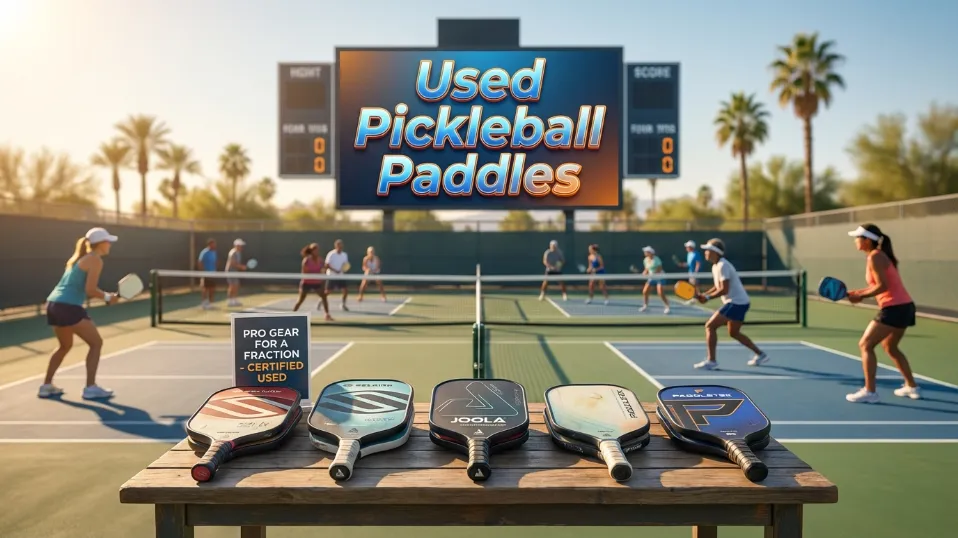
Pickleball is officially America’s fastest-growing sport, but keeping up with the latest premium gear can quickly drain your wallet. What if you could play with the exact same high-end paddles the pros use, but for a fraction of the cost? The secret is simple: buying used pickleball paddles. Whether you are hunting for a hidden gem to start your journey or looking to upgrade your tournament gear without breaking the bank, navigating the second-hand market is a game-changer. Let’s uncover exactly how and where to score top-tier equipment today.
The Economics of Pre-Owned Performance
The explosion of the pickleball market has seen flagship models from brands like Selkirk and JOOLA soar past the $250 mark. For many enthusiasts, the used pickleball paddles market offers a strategic entry point to elite technology without the financial sting. However, understanding “Paddle Hours” is more critical than the chronological age of the equipment. Unlike a tennis racket that can be restrung, a pickleball paddle used heavily undergoes internal fatigue that cannot be reversed.
High-end Carbon Fiber Pickleball Paddles typically retain about 60% to 80% of their value if they have less than 50 hours of play. Beyond that, “Performance Death” begins to set in, where the internal honeycomb cells lose their elasticity. If you are shopping for your first real upgrade, checking out Best Beginner Pickleball Paddles in used condition can save you enough money to afford professional lessons or court fees.
pickleball paddle used or demo sale
One of the safest ways to acquire high-performance gear is through a professional pickleball paddle used or demo sale. Major US retailers like Pickleball Central and JustPaddles run dedicated “Demo Programs” where players can test a model for 30 days. When these paddles are returned, they are inspected, graded, and resold as “Gently Used” or “Demo” units.
- Demo Paddles: Often in “Like New” condition, these are the gold standard of the used market because they come with a limited 30-day warranty from the retailer, which is rare in private sales.
- Open Box Returns: These are essentially brand-new items where the packaging was opened, but the paddle has zero to five hours of play.
- Factory Seconds (Blemished): Some manufacturers sell “Factory Seconds” which have minor cosmetic ink errors but are structurally perfect. These offer the best value for players who don’t mind a slight visual imperfection.
If you are looking for a reliable JOOLA Ben Johns Blue Lightning or a premium Selkirk model, these authorized demo sales are far more reliable than a random local listing.
Smart Sourcing: Top Secondary Marketplaces in America
Beyond authorized retailers, the peer-to-peer (P2P) market in the United States is thriving. However, each platform has its own risk profile. When searching for a pickleball paddle used sale, your choice of platform determines your level of buyer protection.
EBay and Mercari: These platforms offer broad selections but require a “Buyer Beware” mindset. Always look for listings with at least 10 high-resolution photos. eBay is particularly useful for finding discontinued models that are no longer in production but still legal for recreational play.
SidelineSwap: This is a dedicated sports equipment marketplace. It is highly recommended because the platform holds your payment in escrow until you receive the paddle and confirm it matches the description. It’s a favorite for finding a used paddle pickleball deal from serious athletes who upgrade their gear every season.
Facebook Groups & Reddit: Groups like “Anti-Scammer Pickleball Buy/Sell/Trade” and the subreddit r/paddleswap are the heartbeat of the community. Here, you can often find “Pro-Grade” gear. The golden rule for these social platforms is to only use PayPal Goods & Services. If a seller insists on Zelle, CashApp, or Venmo “Friends & Family,” it is a major red flag for a scam.
The Structural Integrity Checklist: Beyond the Scratches
A used paddle might look beautiful on the outside but be “dead” on the inside. When evaluating used pickleball paddles, you must look for two catastrophic failures: Core Crushing and Delamination.
Thermoformed Pickleball Paddles are particularly susceptible to delamination, where the face material separates from the core. This creates a “trampoline effect” that makes the ball fly off the face with illegal speed. On the flip side, Core Crushing happens when the internal polypropylene cells collapse, creating “dead spots” where the ball simply thuds and drops.
- The Audible Tap Test: Bounce a ball across the entire surface. A healthy paddle has a consistent, crisp “pop.” A dead spot will sound like a dull thud or a “hollow bonk.”
- The Squeeze Test: Firmly press your thumbs into the center of the face. If you hear a “crunching” or “crackling” sound (like stepping on dry leaves), the core is crushed and the paddle is junk.
- Edge Guard Integrity: A loose edge guard isn’t just annoying; it can vibrate and cause tennis elbow over time.
The Regulatory Trap: Banned Paddles to Avoid in 2025-2026
Before you commit to a pickleball paddle used sale, you must check its legal status. The governing bodies, USA Pickleball (USAP) and UPA-A, have recently implemented stricter PBCoR (coefficient of restitution) standards. This has led to the banning of several popular models from sanctioned tournament play.
The most notable “Regulatory Trap” involves the JOOLA Gen 3 series and the JOOLA Mod TA-15, which were removed from the USA Pickleball Approved Paddle List. While these paddles are incredibly powerful and fun for recreational play, they will get you disqualified from any official tournament starting July 2025. Always verify the current status of any model on the official USA Pickleball Equipment Standards page before buying.
If you are an intermediate player looking for a long-term investment, you might want to look at the Best Selkirk Pickleball Paddles, as they have a strong history of maintaining approval and offer industry-leading build quality.
Advanced Home Inspection: How to Test Spin and Grit
The most common “Hidden Flaw” in a used paddle pickleball is the loss of surface grit. A raw carbon fiber surface is designed to “grab” the ball to generate spin. However, research shows that a paddle can lose up to 50% of its friction coefficient within just 50 to 100 hours of competitive play.
The Fingernail Test: Run your fingernail gently across the sweet spot. A new or healthy paddle should feel like fine sandpaper (320 grit). If it feels as smooth as a chalkboard, the spin potential is gone. While you can’t restore the grit, some players use “Paddle Erasers” to clean out ball debris, which can sometimes reveal the remaining texture.
The “Bonk” Test: Drop a pickleball from exactly 12 inches onto the face. A high-performance used paddle should return the ball to a height of at least 6 to 8 inches. If it barely bounces 4 inches, the internal cells are fatigued, and you are losing power on every drive.
Spotting Counterfeits and “AliExpress” Clones
With the rise in prices, the US market has been flooded with counterfeit used pickleball paddles. These “Clones” often look identical to a $280 JOOLA Perseus but are made with cardboard cores or inferior fiberglass instead of T700 carbon fiber.
- NFC Chip Verification: Modern paddles from JOOLA and CRBN now include built-in NFC chips in the handle. You can scan the handle with your smartphone to verify authenticity and register the warranty. If a seller claims they “lost” the ability to scan it, walk away.
- Graphic Discrepancies: Look for blurry logos, spelling errors, or signatures that look too large or small compared to manufacturer photos.
- The Weight Red Flag: Authentic paddles have very tight weight tolerances. If a paddle is advertised as a “Midweight” (8.0 oz) but weighs 7.4 oz on a kitchen scale, it is likely a fake.
Sustainability and the Future of Used Gear
Buying a pickleball paddle used isn’t just about saving money; it’s an environmentally conscious choice. Pickleball paddles are made from non-biodegradable composites, resins, and plastics. By extending the lifecycle of a paddle through the secondary market, you are keeping high-tech waste out of landfills.
Some organizations, like Trade Wise, even allow you to donate your older paddles to schools or community centers in exchange for a credit toward new gear. This “circular economy” is vital as the sport continues to scale to 40 million+ players in the US. Whether you are hunting for a bargain or clearing out your gear bag, the used market is the engine that keeps pickleball accessible to everyone.
Used Pickleball Paddles-Frequently Asked Questions
How many hours does a raw carbon fiber surface actually last?
Peak spin performance typically lasts 100 to 200 hours of play. After this, the “Grit” begins to smooth out, though the paddle remains structurally sound for much longer.
Can a core-crushed paddle be fixed?
No. Once the internal honeycomb cells are crushed or delaminated, the paddle is permanently altered. In fact, playing with one in a tournament is illegal as it provides an unfair power advantage.
Is a demo paddle better than a standard used one?
Usually, yes. Demo paddles from major retailers are professionally inspected and often come with a 30-day return window, providing a safety net that private sellers don’t offer.
How do I ensure a safe transaction on Facebook Marketplace?
Always ask for a “Timestamped” photo (the paddle next to a piece of paper with the seller’s name and today’s date). Never pay with Zelle or Venmo without buyer protection; stick to PayPal Goods & Services.