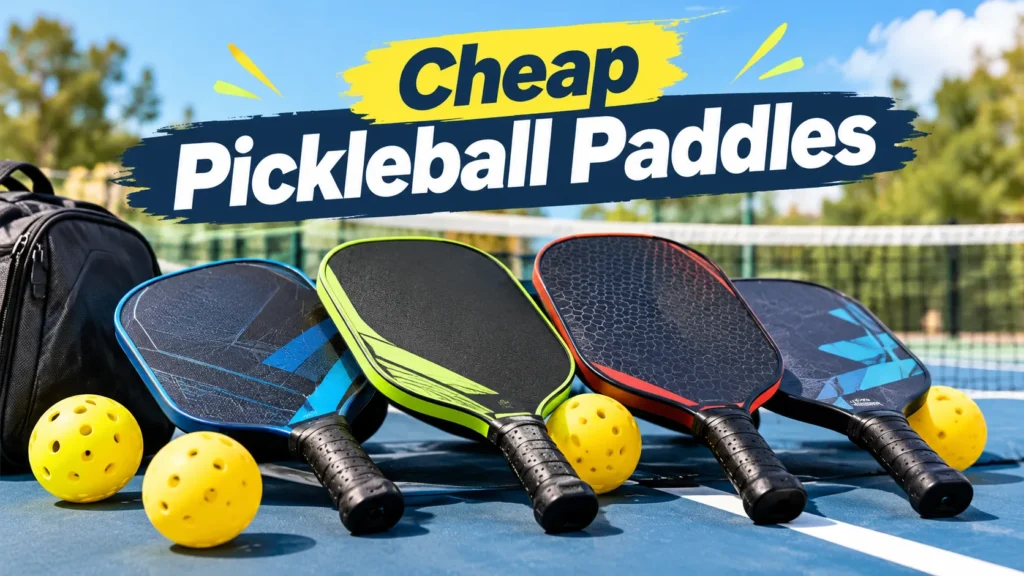
Dropping two hundred and fifty dollars on a carbon fiber surface is a fast track to buyer’s remorse when a fraction of that investment delivers identical core responsiveness and spin control. The current court landscape has evolved past the era where premium performance came exclusively with a luxury price tag, forcing manufacturers to rethink how they engineer cheap pickleball paddles.
Whether you are hunting for the best cheap pickleball paddle to upgrade your weekend rec games, searching high and low for pickleball paddles cheap enough to kit out a whole family, or simply evaluating the best cheap pickleball paddles on the market, the numbers speak for themselves. Finding a reliable cheap pickleball paddle that balances grit, touch, and durability is no longer a gamble. Dive into the comprehensive data breakdown below to discover how modern budget engineering is rewriting the rules of the game.
Best Cheap Pickleball Paddles
Verified rates & specs (October 2026) · By ideal play style
Comprehensive best cheap pickleball paddle Review: Technical Anatomy
The engineering core of the best cheap pickleball paddle centers upon its non-traditional internal setup. While legacy budget equipment relied primarily on standard compressible foam or basic fiberglass variants, modern entry models bridge advanced aerospace materials with the rigorous kinetic constraints of today’s competitive formats.
- The Core Matrix: Utilizing expanded polypropylene (EPP) or premium 16mm honeycomb polymer, the primary cushioning engine offers exceptional mechanical bounce. When blocking high-velocity drives, the cellular structure absorbs massive kinetic energy before rebounding immediately to assist the next shot.
- The Surface Boundary: Because raw carbon fiber provides intense friction for high spin rates, it requires a structural countermeasure to maintain longevity. The internal thermoformed chassis wraps around the perimeter, locking the sweet spot into place during sharp lateral swings and extreme angles.
- Grip Mechanics: The inclusion of ergonomic, hexagonal handle technology alongside a designated balance point positioned near the throat allows players to execute sudden 360-degree defensive resets without losing paddle face awareness or dropping their guard.
The surface layer balances ultra-lightweight structural carbon with a protective low-profile edge wrap. This durable shield prevents immediate premature wear caused by continuous court-scraping during low defensive dinks. For players analyzing options across the entire market, evaluating the foundational rules and mechanics outlined in our guide on what is pickleball provides clear contextual background before buying.
Check Best Pickleball Paddles Under $100 Guide
Static Weight vs. Swing Weight: Deciding on your pickleball paddles cheap options
Navigating the budget product family requires a clear understanding of the mechanical differences between raw static mass and the dynamic swing weight layout. Selecting your specific version of pickleball paddles cheap dictates both your physical endurance limits and your kinetic velocity on the court during fast-paced kitchen exchanges.
The Swing Weight Variance
The swing weight architecture focuses extensively on energy return and momentum generation. A paddle with a high swing weight (typically 118+) resists structural twisting, offering incredible plow-through on baseline drives. Conversely, a low swing weight configuration employs an ultra-light balance designed for immediate, low-to-the-ground responsiveness. This gives speed-focused players a sharper sense of court feel but significantly less kinetic dampening during heavy blocking sequences.
Core Thickness Discrepancies
The extreme density of a 16mm core introduces an undeniable stability factor, pushing the sweet spot out to the edges and adding superior touch. The 14mm option drops this weight signature noticeably, providing a floating sensation for nimble attackers. This variance reflects clearly across US commercial retail channels, where premium 16mm versions dominate overall consistency, while the 14mm variant serves players seeking pure aerodynamic speed.
If you are a competitor seeking to match advanced court dynamics with elite-tier control tools, exploring the definitive structural mechanics detailed in our guide on 14mm vs 16mm pickleball paddle will ensure your entire equipment setup functions in perfect technical alignment.
Head-to-Head: Best Cheap Pickleball Paddles (Vatic Pro Prism vs. 11SIX24 Pegasus)
For players trying to choose between the premium control of the Vatic Pro Prism and the highly forgiving 11SIX24 Pegasus, the choice comes down to a fundamental split in design philosophy. Both models command top-tier placement among the best cheap pickleball paddles across United States retail outlets but approach court stability from completely opposing angles.
The primary differences in on-court performance are detailed in the comparison matrix below:
- Sweet Spot and Forgiveness: The 11SIX24 Pegasus wins decisively on instant forgiveness, delivering a plush, massive sweet spot thanks to its widebody shape. The Vatic Pro Prism features a slightly more elongated structural layout that requires a more precise swing path but rewards the player with unmatched extended reach.
- Power Generation and Pop: The Pegasus dominates the speed category through its hybrid fiberglass and carbon surface, which provides a snappy exit velocity. The softer, cold-pressed system used by the Vatic Pro provides excellent fluid control but yields slightly less power under extreme, high-velocity overhead smashes.
- Lifespan and Surface Degradation: The heavy raw carbon texture on the Vatic Pro easily delivers 9 to 12 months of high-RPM spin integrity under harsh conditions. The hybrid surface of the Pegasus generally maintains its peak grit for a solid duration but may require a more disciplined cleaning schedule to maintain maximum friction.
For a complete, comprehensive overview of the broad variety of choices currently occupying the competitive landscape across American clubs, take a moment to read our detailed breakdown of a carbon fiber pickleball paddle alongside our independent evaluation of the best budget pickleball paddle to select your ideal structural fit.
Frequently Asked Questions (FAQ)
Are unapproved cheap pickleball paddles from overseas marketplaces worth buying for recreational play?
No. While all conceptual design work and player prototyping are managed at international corporate hubs, skipping official certification means you cannot use them in any sanctioned matches. To verify if your gear meets tournament standards, always cross-reference the official USA Pickleball approved paddle list. Furthermore, many unapproved models suffer from rapid core degradation and lack the consistent quality control found in certified equipment.
How long does a raw carbon fiber surface typically last on a budget paddle?
A high-quality raw carbon surface on a budget paddle will typically maintain optimal spin for 6 to 12 months of intense, regular play. Unlike spray-on grit that deteriorates quickly, the natural peel-ply texture of raw carbon ensures long-lasting friction and consistent ball rotation. For exact testing thresholds regarding surface roughness, refer to the official USA Pickleball Equipment Standards Manual.
Is it better to buy a lighter paddle and customize its weight later?
Yes. Purchasing a lighter stock paddle allows you to strategically apply tungsten or lead tape to the perimeter. This customized weighting approach lets you fine-tune the twist weight and swing weight, expanding the sweet spot and perfectly matching the paddle’s balance to your specific biomechanical swing path without making the gear feel overly sluggish.