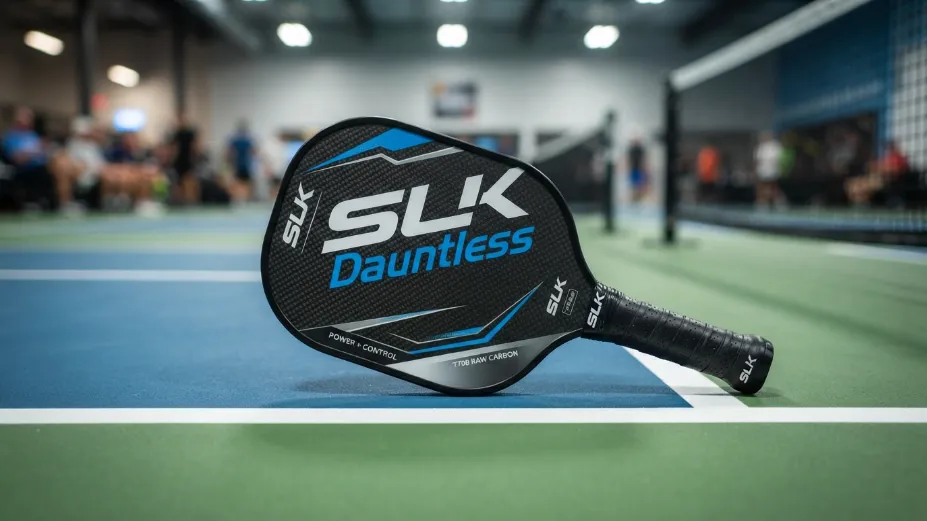
The pickleball paddle market is currently flooded with over-hyped, $200+ carbon fiber options, but the slk dauntless quietly challenges whether mid-tier players actually need to spend that much to command the kitchen line. Selkirk engineered this specific model to bridge the gap between raw power and soft reset control, making it a critical talking point in local clubs across the United States. If you are looking to dissect whether this paddle elevates your third-shot drops or simply blends into the background of standard fiberglass gear, the real-world performance metrics below will settle the debate.
Selkirk SoloCore — Widebody & Elongated
Core · Face · Weight · Grip · USAPA
If you are seeking elite-tier vibration dampening and a plush, control-first feel in local US clubs, the Widebody version of the slk dauntless is highly recommended at its $150 direct price point. However, players demanding explosive, put-away power or those seeking long-term surface grit durability should consider the Elongated shape or look toward raw carbon alternatives with premium textured surfaces. Ultimately, it provides the most comfortable, stable reset platform on US courts for progressing players seeking a structural upgrade from basic honeycomb gear.
slk dauntless review
The on-court playability of the selkirk slk dauntless is characterized by an ultra-soft, highly dampened impact response. When evaluating the slk dauntless paddle, players immediately notice the deep “ball-pocketing” sensation that occurs during soft net play. On aggressive drives, the paddle absorbs a significant portion of incoming kinetic energy, which makes executing precise third-shot drops and resets remarkably intuitive. While other competitive models in this price tier can feel stiff and pingy, the slk dauntless review process reveals that this paddle excels at taking the heat off hard-struck balls, effectively slowing down fast-paced firefights at the kitchen line.
However, this focus on a plush touch comes with an inevitable trade-off in explosive power. The ball does not fly off the face with high exit velocity, meaning that aggressive players (“bangers”) who rely on raw speed to win points from the baseline may find themselves working harder to hit put-aways. The selkirk slk dauntless pickleball paddle is firmly positioned as an “all-court paddle with a distinct control lean,” designed to help intermediate players master placement, dinks, and resets rather than dominate through sheer power.
The 2026 SLK Portfolio Overhaul: Decongesting the Paradox of Choice
The release of the Dauntless coincides with a major strategic restructuring of Selkirk’s mid-tier brand lineup. Historically, players looking at selkirk pickleball paddles faced an overwhelming array of overlapping product lines, including multiple iterations of the Halo, Amped, and Vanguard series. This led to “decision paralysis” among US consumers, who struggled to identify clear differences in performance and value.
In response, Selkirk implemented a streamlined four-paddle progression for the slk pickleball paddle family:
- SLK Valkyrie ($80): Replaces the Atlas and Latitude as the uncomplicated, forgiving entry point for beginners.
- SLK Geo ($100): Replaces the EVO series, offering a modern raw carbon face for committed intermediates.
- SLK Dauntless ($150-$180): Replaces the Halo (Control and Pro), Amped Control, and Vanguard Control, serving as the high-performance control flagship.
- SLK ERA Power ($200): The existing flagship power model designed for maximum aggression and ball velocity.
By retiring complex legacy lineups, Selkirk has created a clear, logical upgrade path. Progressing players who have outgrown their starter fiberglass paddles now have a dedicated, performance-focused option specifically engineered to help them transition into competitive tournament play.
The Identity Fallacy: Is the Dauntless a “Budget Boomstik” or a Repackaged Project 008?
A common misconception across US pickleball forums and Reddit communities is that the Dauntless is a budget-friendly alternative to Selkirk’s elite Labs Project Boomstik. Driven by the prominent placement of perimeter weights, many players purchased the Dauntless hoping for high-end explosive power at half the price. However, deep-dive technical comparisons reveal that this is an identity fallacy.
The Dauntless does not share its DNA with the power-focused Boomstik; instead, it is a commercialized, mass-market version of the experimental Selkirk Labs Project 008. The Project 008 was developed to test the limits of ultra-plush control, and the Dauntless carries over this exact performance profile. Rather than delivering a stiff, lively response, the paddle’s core feels incredibly soft and absorbed. For players seeking the premium, velvety control of a Labs paddle without the premium price tag, the Dauntless offers an outstanding value proposition—provided they do not expect the high-octane pop of a true power paddle.
Deep-Dive Core Physics: PureFoam SoloCore & IsoFlex Cutout
At the center of the paddle’s performance is Selkirk’s patent-pending SoloCore PureFoam construction. Most standard paddles utilize hollow polypropylene honeycomb cores, which are highly susceptible to “core crushing”—a mechanical breakdown where the plastic chambers permanently collapse under repeated high-velocity impacts. This core crushing creates unpredictable dead spots on the paddle face, ruining consistency and control.
To solve this, Selkirk engineered the SoloCore with a one-piece, high-density PureFoam slab. This solid foam structure is highly resistant to crushing and deformation, ensuring consistent performance over its entire lifespan. To prevent the solid core from feeling too stiff, Selkirk integrated their IsoFlex technology, a engineered perimeter cutout that loosens the outer edge of the core. This cutout increases face elasticity and significantly enhances vibration dampening.
For US players who log multiple hours on hard outdoor asphalt courts, this vibration dampening is a critical feature. By absorbing the high-frequency kinetic energy generated upon ball contact, the SoloCore minimizes the physical shock transferred to the player’s wrist and elbow, offering genuine protection against tennis elbow and muscle strain. This makes it an ideal choice for players deciding between a 14mm vs 16mm pickleball paddle who prioritize joint health and soft comfort during long play sessions. Knowing how to pick a pickleball paddle that aligns with your body’s physical needs is just as important as matching your playing style.
Geometric Variants: Widebody Stability vs. Elongated Leverage
The Dauntless is offered in two distinct shapes, each tailored to different tactical needs and movement profiles. Both shapes feature an upgraded octagonal handle design that mimics traditional tennis grips, offering superior feedback and faster hand exchanges during rapid net exchanges.
- Widebody Shape: Measuring 15.95″ in length and 8.0″ in width, this variant features a 5.6″ handle. It is engineered with an average swingweight of 109 and a massive twistweight of 7.4. This high twistweight makes the Widebody incredibly stable, resisting twisting on off-center hits and providing a massive, forgiving sweet spot across the entire paddle face.
- Elongated Shape: Measuring 16.5″ in length and 7.45″ in width, this shape features a 5.8″ handle. It carries a higher swingweight of 118 and a twistweight of 6.9. The extra length provides added reach and leverage, allowing players to generate higher head speed on drives and overheads while providing ample room for two-handed backhands.
The Widebody is the ultimate defensive weapon for players who want a steady, predictable face to block hard drives and control the dink game. The Elongated version is better suited for players progressing into competitive singles or doubles who want to generate heavier drives and reach difficult, low-lying balls.
The MOI Tuning System: Perimeter Weighting & Tinkering with Lead Tape
Selkirk’s MOI (Moment of Inertia) Tuning System is an engineered approach to paddle balance that utilizes pre-installed, semi-permanent perimeter weights embedded in the edge guard. By strategic placing mass at the outer regions of the frame, Selkirk has stabilized the paddle against torsional rotation during off-center contact, successfully expanding the sweet spot without dramatically raising the static weight.
For enthusiasts who love to customize their gear, the Dauntless offers an unexpected advantage. The pre-installed MOI weights on the Dauntless are significantly thinner than the older, thicker MO1 weights found on the Boomstik series. This low-profile design allows players to easily layer custom lead or tungsten tape directly over the factory weights without creating an awkward bulge or disrupting the aerodynamics of the edge guard. This makes the paddle a highly versatile “tinkerer’s platform” for players who want to adjust their swingweight over time.
Warning: The pre-installed MOI medallion weights are semi-permanent. Attempting to pry them out of the edge guard can cause severe structural damage to the perimeter frame and will immediately void the manufacturer’s warranty.
The Surface & Durability Gap: T700 Raw Carbon vs. The Missing InfiniGrit
To support spin generation, Selkirk utilized a high-grade carbon fiber pickleball paddle face featuring Raw Spin Technology. This premium T700 raw carbon surface provides outstanding dwell time, allowing the ball to compress against the face and enabling players to shape complex roll volleys and heavy topspin drives.
However, a critical review of the paddle’s long-term durability reveals a noticeable gap: the Dauntless lacks Selkirk’s premium, wear-resistant InfiniGrit coating. In official laboratory testing, traditional raw carbon surfaces lose a significant portion of their textured grit after roughly 50 abrasive cycles, leading to rapid “spin decay” on court. In contrast, surfaces treated with InfiniGrit can withstand up to 150 cycles before showing similar wear.
Because the Dauntless relies on a standard raw carbon face, heavy players in the US will notice a gradual decline in maximum spin potential after a few months of intense use. To combat this spin decay and maintain peak friction during competitive play, many players choose to apply USAPA-approved protective skins to extend the useful life of their surface. When selecting the best pickleball paddle for control, factoring in the longevity of the surface texture is vital for maintaining a consistent soft game.
Explore Our Best Control Paddles Guide
Head-to-Head: Selkirk SLK Dauntless vs. Enhance MPP Turbo vs. Bread & Butter Loco
To understand the Dauntless’s place in the 2026 US market, it must be compared directly against its closest technological and financial competitors. While the Dauntless relies on a solid foam slab core, other innovative brands are leveraging alternative materials to capture the interest of intermediate players.
The primary performance and structural differences are detailed below:
- Core Technology & Feel: The SLK Dauntless features a solid, high-density PureFoam core that offers a highly dampened, quiet, and plush feel. The Enhance MPP Turbo utilizes a micro-cellular polypropylene (MPP) core with a floating EPP foam edge, while the Bread & Butter Loco relies on a thermoformed EPP core. The MPP and EPP structures of the Turbo and Loco provide significantly more natural “pop” and ball speed, whereas the Dauntless focuses strictly on absorbing pace and maximizing reset control.
- Surface Texture & Grit: Both the Enhance MPP Turbo ($99) and the Bread & Butter Loco ($160-$180) feature chemically enhanced, highly durable textured surfaces that resist wear far better than the Dauntless’s standard T700 raw carbon face, which experiences faster spin decay.
- Value & Warranty: The Enhance MPP Turbo enters the market at an incredibly aggressive $99 price point, making it highly competitive for players looking to explore foam-edge technology on a budget. The Bread & Butter Loco matches the Dauntless in the $160-$180 price bracket. Crucially, the Dauntless is backed by a 1-year limited warranty—standard for the SLK brand—which falls short of the lifetime warranties offered on Selkirk’s premium lines.
For players transitioning from raw beginners to competitive intermediates, researching the best beginner pickleball paddles and best pickleball paddles for intermediate players can help put these technological differences into perspective before making a purchase.
Value Evaluation: Is It Worth $180 in 2026?
The financial positioning of the Dauntless has created some confusion in the US market. While Selkirk lists the paddle on its official website for $150, major US retail stores—such as Pickleball Central and Tennis Warehouse—regularly list it at an MSRP of $179.99. At nearly $180, the Dauntless can be difficult to justify for budget-conscious players, given the rise of high-performing sub-$100 raw carbon options.
Additionally, the 1-year warranty of the SLK brand represents a compromise compared to Selkirk’s flagship premium lines, which feature limited lifetime warranties. However, for players who demand the comfort, build quality, and distinct soft touch of a genuine Selkirk-engineered foam core without paying the $280+ required for a Labs paddle, the Dauntless remains a highly credible, high-value option.
Final Buyer’s Verdict: Who Should Upgrade and Who Should Pass?
The Selkirk SLK Dauntless is a specialized tool designed with a clear tactical purpose. To determine if this paddle is the right fit for your game, consider the following recommendations:
- Who Should Buy:
- Progressing intermediate players who have outgrown their basic fiberglass pickleball paddles and want a professional, consistent feel.
- Players who prioritize maximum vibration dampening to protect their joints and avoid tennis elbow.
- Soft-game specialists who win points through patient dinking, precise placement, and mastering the pickleball kitchen rules.
- Customizers who want a stable base paddle with a thin MOI profile to easily apply custom lead tape configurations.
- Who Should Avoid:
- Aggressive, power-first players who rely on massive exit velocity and heavy drives to overpower opponents.
- Budget-focused buyers who want the absolute highest ratio of surface durability to cost.
- Players who expect the premium lifetime warranty coverage associated with Selkirk’s top-tier product lines.
Frequently Asked Questions (FAQ)
Are these court paddles manufactured entirely within the United States?
No. While all conceptual design, engineering, and prototyping are managed at Selkirk’s corporate headquarters in the United States, assembly and production of the SLK line are handled by primary manufacturing partners in China, matching standard practices across the mid-tier athletic market.
Can I remove the pre-installed MOI medallion weights to lighten the paddle?
It is highly discouraged. The MOI Tuning System is semi-permanent, and attempting to pry or force the medallion weights off the edge guard can cause irreversible structural damage to the perimeter frame and will immediately void your one-year limited warranty.
How does the 16mm PureFoam core compare to traditional honeycomb cores?
Traditional polypropylene honeycomb cores feature hollow chambers that are prone to mechanical breakdown and “core crushing” over time, creating unpredictable dead zones. The solid PureFoam SoloCore is a dense, high-density foam slab designed to resist dynamic structural deformation, offering superior longevity and vibration dampening.