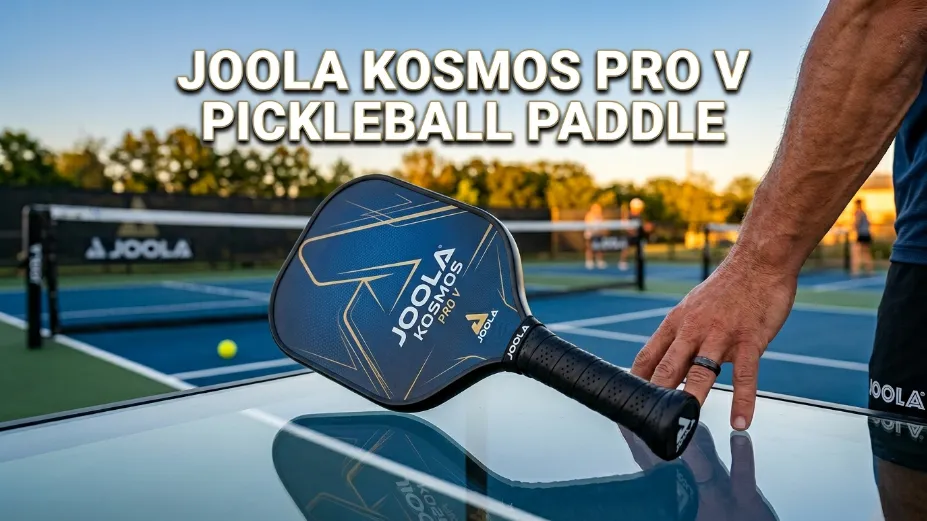
The pickleball paddle arms race just hit a critical tipping point, and JOOLA is aiming straight for the baseline. While most manufacturers are busy recycling last year’s carbon fiber tech with a fresh coat of paint, the release of the JOOLA Kosmos Pro V Pickleball Paddle signals a massive shift in how we generate spin without sacrificing sweet-spot reliability. If you’ve felt your soft game slipping or your hand speed lagging during intense kitchen battles, this elite-tier paddle promises to redraw the boundaries of your court presence. Let’s find out if it actually delivers on the court or if it’s just marketing noise.
Pickleball paddle feature profile technical specifications: face material and friction, core technology, flex engineering, and weight and geometry with on-court performance impact
Pickleball Paddle — Feature Profile
Face · Core · Flex Engineering · Weight & Geometry
For US players navigating highly competitive club schedules, the best option depends strictly on your skill bracket and playstyle preference. If you prioritize pristine defensive resets, plush ball feedback, and high dink precision, the 16mm Federico Staksrud signature model is the superior choice at the standard $299.95 USD price point. However, fast-hands bangers and baseline-driving singles players seeking a stiffer rebound and quicker reactions will find more explosive long-term value in Tyson McGuffin’s 14mm version. Both premium models are currently widely available on the JOOLA Official Store with free two-day shipping on orders over $100.
Comprehensive joola kosmos pro v review: Technical Anatomy
The engineering core of the joola kosmos pro v review centers upon its non-traditional frame flex setup. While legacy thermoformed paddles relied primarily on uniform face compression or rigid perimeter structures, this hybrid silhouette bridges modern golf and hockey kick-point engineering with the rigorous lateral constraints of high-speed pickleball.
- The KineticFrame Matrix: Utilizing patent-pending flex-point throat architecture inspired by hockey shafts, the primary throat engine offers exceptional energy transfer. When driving from the baseline, the throat absorbs massive horizontal kinetic forces before snapping back parallel to its original plane to assist your stroke.
- The Propulsion Core Barrier: Because raw polymer cores can sometimes produce erratic velocity, JOOLA incorporated structural reinforcements. The internal Propulsion Core honeycomb remains intact, but engineers placed an extra carbon fiber shield between the outer Hyperfoam edge wall and the polymer cells along the upper arch, preventing core crushing.
- Aero-Curve Mechanics: The textured carbon fiber face is mated to a hybrid Kosmos shape (16.3″ x 7.7″) replacing the old Magnus shape. This flat-top geometry provides greater torsional stability on off-center hits than standard curved-top paddles, letting players execute sudden angled roll volleys with complete confidence.
The outer composite layer balances raw textured carbon fiber with an intricate protective edge guard designed to minimize the risk of counterfeits. This unified assembly prevents premature face wear caused by accidental court scrapes during low defensive dinks. For players analyzing options across the entire brand matrix, evaluating the dedicated structural differences outlined in our analytical look at the JOOLA pickleball paddle provides clear contextual background before buying.
Check Best Pickleball Paddles Guide
16mm vs. 14mm: Deciding on Your joola pro v kosmos
Navigating this premier hybrid family requires a clear understanding of the mechanical differences between the flagship 16mm layout and its thinner, stiffer counterpart. Selecting your specific version of the joola pro v kosmos dictates both your physical recovery cycles and your kinetic velocity on the court.
The Cushioning Variance
The 16mm Federico Staksrud signature model focuses extensively on dwell time and plush soft-game consistency. The thicker honeycomb core absorbs high-velocity pace, providing unmatched ball pocketing for drops, resets, and precise kitchen dinks. Conversely, Tyson McGuffin’s 14mm signature configuration employs a thinner, stiffer polymer bedding designed for low-to-the-ground responsiveness. This gives speed-focused bangers a sharper, faster ball rebound during rapid hands battles, but with a noticeable reduction in soft-game forgiveness.
Weight and Commercial Discrepancies
The extra material density of the thicker 16mm core introduces a minor weight penalty, pushing the static weight of the Staksrud version to roughly 8.1 ounces with a higher swing weight of 115. The 14mm McGuffin variant drops this weight signature to a nimble 7.9 ounces and a swing weight of 110, providing a floating sensation for fast reactions. Despite these physical variances, both models retail at a premium $299.95 USD MSRP, although limited-edition Rally Rocket colorways enter the market at an exclusive $329.95 price point.
If you are an advanced competitor seeking to match advanced footwear dynamics with elite-tier control tools, exploring the definitive structural mechanics detailed in our guide to the best pickleball paddle for spin will ensure your entire equipment setup functions in perfect technical alignment.
The Critical Playability Guide: Sizing and Break-In for the joola kosmos pro v pickleball paddle
A major missing angle across major commercial e-commerce review spaces is the highly specific volumetric grip geometry and initial stiffness of the paddle face. When choosing the joola kosmos pro v pickleball paddle, expecting instant out-of-the-box perfection can lead to severe operational issues on the court.
The paddle is built around two distinct grip sizes: Federico’s 16mm version utilizes a wider 4.250-inch grip, while Tyson’s 14mm variant tapers aggressively to a slim 4.125-inch grip circumference. This streamlined shape is designed to maximize wrist maneuverability during explosive drives, but it restricts players possessing larger hand profiles if not adjusted. The playability is further affected by the structural stiffness of the fresh carbon fiber face itself.
Because the highly tensioned thermoformed face sits stiffer during its first few sessions than generic honeycomb options, the vertical clearance of the sweet spot feels compressed. The ball can initially feel dead or unresponsive off the face. During violent stop-and-start actions at the kitchen, this lack of break-in forces the player into persistent kinetic adjustments, often causing frustration and minor muscle fatigue within the first fortnight of use.
To avoid these performance limitations, players must adjust their expectations and allow a designated break-in window of 12 to 15 hours of active drilling. After this period, the internal cell structure softens, the dwell time increases, and the paddle activates its true high-performance profile. For players with larger hands executing two-handed backhands, selecting the 16mm and adding a high-tack overgrip is essential to provide adequate spatial tolerance.
Exposing the Information Gaps: Real-World Durability Under the Microscope
While mainstream marketing materials highlight the premium aesthetic choices and pro-level endorsement of this lineup, deep analysis across independent US playing groups reveals distinct manufacturing limitations and accelerated wear patterns under high-stress conditions.
- The Upper Frame Core Crushing Phenomenon: Despite the brand’s new top-arch carbon fiber reinforcements, high-frequency bangers can still experience core degradation over months of intense court play. The internal honeycomb core remains prone to localized delamination, which can cause a sudden hollow change in sound and unexpected dead spots.
- Surface Texture Face Wear: The raw peel-ply carbon fiber surface offers superb initial spin potential, but completely lacks an engineered long-lasting grit formula. As a result, the repeated abrasive actions of balls at high velocities put intense stress on the raw fabric, causing the texture to smooth out noticeably within 2 to 3 months of heavy play.
- Internal Handle Friction: The KineticFrame throat design introduces added handle flex. Players who execute extreme whip-heavy wrist motions will experience immense rotational stress near the neck, which can cause micro-slippage within the internal adhesive bonds, altering the acoustic pitch of the paddle over time.
These persistent structural concerns require budget-conscious buyers to monitor their equipment closely. While the functional traction matrix remains highly competitive out of the box, the rapid degradation of the raw surface texture is a critical factor to weigh before spending $300 on a high-performance carbon fiber pickleball paddle.
Performance on US Courts: Hard Balls, Soft Balls, and Outdoor Wind
Evaluating the textured carbon fiber face requires analyzing the highly variable, unpredictable court environments found throughout the United States. The overall hybrid Kosmos geometry behaves fundamentally differently based on your local choice of ball and physical weather conditions.
On premium outdoor courts utilizing stiff, heavy balls like the LT48, the parallel translation flex works beautifully. The frame manages hard impacts effectively, allowing for predictable, controlled drives without sudden, erratic launch-angle deviations. However, when playing on windy outdoor courts with softer recreation balls, the plush 16mm core can feel slightly dead, requiring a full tennis-style swing to generate adequate depth.
Head-to-Head: joola kosmos pro v vs. Six Zero Ruby
For players trying to choose between the premium joola kosmos pro v and the legendary Six Zero Ruby, the choice comes down to a fundamental split in core engineering philosophy. Both models command top-tier placement across US retail channels but approach court performance from completely opposing angles.
The primary differences in on-court playability are detailed in the comparison matrix below:
- Comfort and Break-In Period: The Six Zero Ruby features a thermoformed Kevlar face that requires a minimal break-in period, delivering a plush, consistent out-of-the-box feel. The joola kosmos pro v starts significantly stiffer, demanding a rigorous 15-hour play transition before the face softens and matches the Ruby’s deep ball pocketing.
- Core Resilience and Longevity: Six Zero employs a Gen 4 foam-core structure that virtually eliminates core crushing and provides immense structural lifespan. The polymer honeycomb propulsion core used by JOOLA offers sharper acoustic feedback and defined tactile sensation, but yields quicker under extreme impact stress.
- Power Delivery and Launch Angle: The Six Zero Ruby relies on uniform face compression which can occasionally launch the ball higher than expected on rapid volleys. The patent-pending KineticFrame on the JOOLA model wins on placement precision, offering a highly consistent, perpendicular trajectory that keeps fast counters inside the baseline.”
For a complete, comprehensive overview of the broad variety of high-performance tools currently occupying the competitive US landscape, take a moment to read our detailed breakdown of the best pickleball paddle for control alongside our independent evaluation of alternative best pickleball paddles for advanced players to select your ideal structural fit.
Buying Advice in the US: Prices, Retailers, and Colorways
Sourcing this elite hybrid design across the United States involves navigating a mix of premium online specialty retailers and official corporate distribution channels. The standard retail price hovers consistently at the $299.95 USD RRP threshold, but authorized clubs often bundle purchases with valuable on-court accessories.
Official packages shipped directly from the brand include premium retail boxes loaded with a free extra roll of Feel-Tec overgrip and clear protective edge-guard tape. Sizing runs from Tyson’s slim-handle 14mm up to Federico’s stable-handle 16mm. Aesthetic updates have expanded from the standard Surge Green accents into limited-edition Rally Rocket configurations priced at $329.95 USD, ensuring premium players can stand out during highly public DUPR tournament brackets.
Verdict: Is the joola pro v kosmos review Worth Your Money?
The final evaluation of this high-end hybrid platform depends entirely on your personal athletic mechanics, budget approach, and current competitive bracket.
- Who Should Buy: Competitive intermediate-to-advanced doubles players (3.5+ DUPR) who want an all-court paddle that blends reach with massive sweet-spot forgiveness, recover quickly in net exchanges, and prioritize precise placement over effortless pop.
- Who Should Avoid: Pure beginners who struggle to generate self-power, budget-focused recreational athletes who expect a single honeycomb core to survive years of punishing daily bangers, and players who dislike a stiff, long break-in curve.
Frequently Asked Questions (FAQ)
Is the cosmetic “honeycomb shadow” reflecting through the face a sign of core crushing?
No. This visual phenomenon—known as telegraphing—occurs when the thin carbon fiber face conforms tightly over the polypropylene core under extreme thermoforming heat and pressure. It does not impact spin, durability, or performance.
Can I safely use an electric massage gun to speed up the 15-hour break-in period?
It is highly discouraged. High-frequency mechanical vibration can shear the internal adhesive bonds between the carbon fiber face and the honeycomb core, causing premature delamination, core crushing, and localized dead spots.
Does the KineticFrame throat flex actually help prevent tennis elbow?
While the Hyperfoam edge wall and 16mm core help dampen impact vibrations, the head-heavy swing weight of the Kosmos can still place torque on your wrist and forearm. For arm relief, adding lead counterweight tape below the grip is recommended to make the balance headlight.