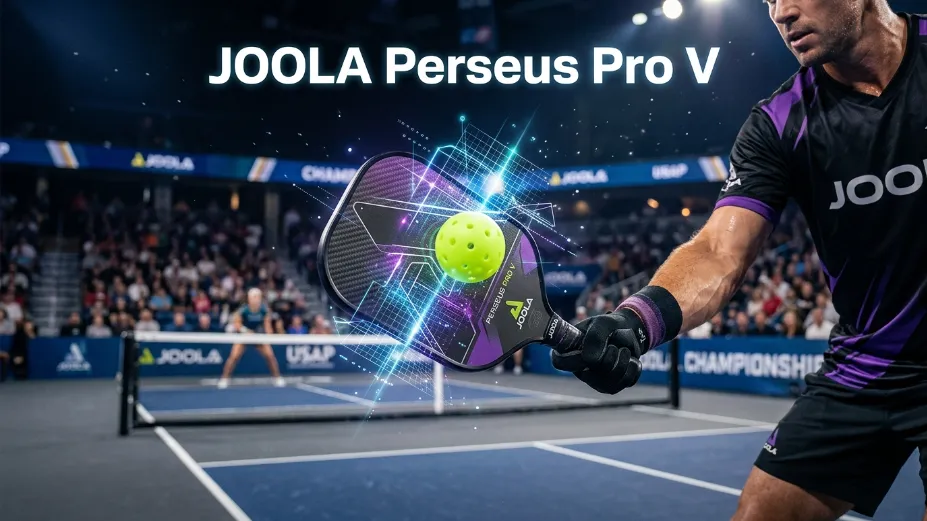
The kitchen line just got faster, and your current paddle is officially on notice. When JOOLA drops a new weapon, the pickleball community braces for a shift in the meta, but the arrival of the joola perseus pro v isn’t just another product launch—it is a calculated recalibration of raw power and plush control. If you are tracking every millimeter of deflection and wondering whether this flagship model justifies the premium price tag on American courts, you are looking for physics, not marketing hype. Let’s cut through the noise and see exactly how this perimeter-weighted beast handles real-world hand battles.
JOOLA Perseus Pro V 16mm pickleball paddle technical specifications 2026: core thickness, average weight, paddle length, paddle width, grip length, grip circumference, face material, and USAPA approval with on-court performance impact
JOOLA Perseus Pro V 16mm — Specifications
Genuine Measurements & On-Court Performance Impact · June 2026
Comprehensive JOOLA Perseus Pro V 16mm Pickleball Paddle Review: Technical Anatomy
The engineering core of the joola perseus pro v review centers upon its non-traditional core setup. While legacy power paddles relied primarily on standard thermoformed polymers that produced a harsh, springy trampoline effect, this silhouette bridges maximum perimeter stability with a highly controlled energy transfer.
- The Core Matrix: Retaining the core architecture from the 3S and Pro IV models, the center is constructed with an uncompressed polypropylene honeycomb center. This core is surrounded by a thermoformed, horseshoe-shaped EVA foam band and a specialized Hyper-Foam edge wall to provide uniform compression and eliminate dead spots on off-center hits.
- The Propulsion Core and Upper Boundary: To prevent the structural failures and core crushing issues that plagued older hybrid models, JOOLA integrated a structural carbon fiber strip between the honeycomb core and the EVA foam ring along the upper perimeter of the paddle face. This reinforcement specifically targets the upper arch—the zone most vulnerable to material separation and localized collapsing under high-velocity overhead impacts.
- The Perimeter Stabilization (Hyperfoam Edge Wall): A specialized foam injection around the perimeter of the paddle adds localized weight and stability, raising the twist weight to 6.04–6.35 to expand the effective sweet spot. This allows players to execute steady, off-center resets and defensive blocks without experiencing a jarring twist in their grip.
The outer face utilizes a cutting-edge Textured Carbon Fiber surface, utilizing an advanced coarse peel ply textured finish for maximum mechanical friction. While it does not change the raw grit compared to last year’s predecessor, the increased dwell time of the core allows the textured carbon fiber to bite the ball significantly longer, delivering massive topspin. For players looking to understand how this premium face technology stacks up against previous generations, reviewing our technical analysis on the JOOLA Ben Johns Perseus Pro IV provides vital background on the evolution of raw carbon faces.
Check the Official JOOLA Store
16mm vs. 14mm Cores: Deciding on your JOOLA Pro V Perseus
Navigating the product family requires a clear understanding of the mechanical differences between the flagship 16mm layout and its stripped-back 14mm counterpart. Selecting your specific version of the joola pro v perseus dictates both your physical defensive recovery cycles and your kinetic velocity at the kitchen line.
The Cushioning Variance and Dwell Time
The 16mm configuration of the joola perseus pro v 16mm pickleball paddle focuses extensively on energy absorption, stability, and control. The 16mm core thickness increases the dwell time—the split-second the ball sits on the paddle face—allowing players to guide the ball on drops and dinks with high accuracy. Conversely, the 14mm layout is engineered for a snappier, quicker rebound and faster hand speeds at the net. This gives offensively-minded players a sharper, more immediate pop on speed-ups but significantly less vertical dampening on heavy defensive resets.
Weight, Grip Sizes, and Cosmetic Discrepancies
Unlike standard generic paddles where signature models are purely cosmetic, the Pro V series implements highly specific physical adjustments tailored to player demographics. The Ben Johns Signature Model (Blaze Red) is available in both 16mm and 14mm core thicknesses, featuring a standard 4.250-inch grip circumference. The Simone Jardim Signature Model (Breeze Blue) is offered exclusively with a 16mm core, but is engineered with a slimmer 4.125-inch grip circumference to comfortably accommodate players with smaller hands and facilitate quick wrist rolls. The static weight also varies slightly, averaging 8.1 ounces for the 16mm models and 7.9 ounces for the 14mm variants.
If you are trying to decide which core thickness matches your strategic goals on the court, exploring the definitive structural mechanics detailed in our guide to thermoformed pickleball paddles will help you align your equipment selection with your swing mechanics.
The Critical Playability Guide: Why You Must Adapt to the Kinetic Frame Dwell Time
A major missing angle across major commercial e-commerce spaces is the highly unique physical feedback of the patent-pending KineticFrame throat geometry. When choosing this paddle, playing with your standard, stiff swing mechanics can lead to severe operational issues on the court.
Traditional elongated paddles flex like a “diving board” under load, causing the paddle head to tilt backward relative to the handle on impact. This angular deflection causes the ball’s launch angle to fluctuate depending on swing speed, occasionally producing unexpected “hot shots” that sail past the baseline. The KineticFrame throat resolves this by replacing the traditional foam-only inserts with a carbon fiber structure encased in foam. Under load, this allows the paddle face to displace on a parallel plane relative to the handle, keeping the face vertical during maximum flexion to deliver highly predictable launch angles.
Because the KineticFrame thins selectively to store momentum, the paddle requires a deliberate, full-kinetic-chain swing to “activate” its power ceiling. Players who are used to the effortless, springy trampoline pop of previous models will find the out-of-the-box response surprisingly stiff, wooden, and muted. The ball does not jump off the face on short, lazy strokes; instead, you must actively guide and drive the ball using your body. If you attempt a lazy “tap to drop” technique, the ball will fall short into the net, demanding that players learn to swing with intent and make solid, centered contact.
To fully master this unique feel, players must adjust their positioning and preparation metrics. It is highly recommended to commit to at least 15 hours of adaptation play to synchronize your timing with the parallel flex of the throat. For players who transition directly from a fully broken-in previous model, this physical change can feel stark, but once dialed, the accuracy on full drives is unmatched.
Exposing the Information Gaps: Real-World Durability Under the Microscope
While mainstream marketing highlights the premium cosmetic aesthetics and the joola perseus pro v release date of Tuesday, February 24, 2026, deep independent analysis across competitive playing groups reveals distinct manufacturing limitations and core degradation patterns under high-stress conditions.
- The Core Crushing Risk: Despite the added carbon fiber strip along the upper perimeter, the underlying core material remains a polymer honeycomb. Under continuous high-velocity impact, the cell walls can buckle over time, creating localized “hot zones” or dead spots. While the reinforcement significantly improves longevity compared to the Pro IV, hard hitters will still notice core softening after several months of intense play.
- Grit Wear and Face Degradation: The raw carbon fiber surface uses the same textured peel ply finish as previous models. While the spin is exceptionally high out of the box (averaging 2170–2288 RPM), this physical texture wears down gradually under heavy topspin play, slowly smoothing out and reducing ball-shaping capabilities after 4 to 6 months of regular club matches.
- The NFC Warranty Safeguard: To protect players against early material degradation, JOOLA has embedded an NFC chip in the paddle handle. By tapping your smartphone to the handle, you can authenticate and register your paddle to unlock a 12-month manufacturer’s warranty. This allows for up to three warranty replacements, providing essential peace of mind for budget-conscious buyers.
These durability considerations make the warranty registration absolutely critical. While some competitive players have core crushed their paddles in under two months of daily play, the accessible replacement program ensures you can maintain a fresh, legal paddle face without constantly paying the premium $299.95 retail price.
Performance on American Courts: Cushioned Acrylic, Outdoor Concrete, and High-Wind Arenas
Evaluating the textured carbon fiber face requires analyzing the highly variable, unpredictable court environments found throughout the United States. The playability of the Perseus Pro V behaves fundamentally differently based on the surface configuration and climate of your local venue.
On indoor cushioned acrylic courts (such as those at premier indoor facilities or dedicated playing venues), the muted and dampened profile of the Pro V shines beautifully. The softer, foam-enhanced face absorbs incoming pace on fast-paced hand battles at the kitchen, giving you ample cushion to execute precise dinks. However, on highly abrasive, outdoor concrete courts during typical windy conditions, the head-heavy stock balance of the paddle requires careful physical mechanics. The wind can catch the elongated 16.5-inch profile, requiring a tight, controlled grip to avoid off-center mishits near the outer edge guard.
Furthermore, because the parallel-flexing throat lowers the ball trajectory on full-force drives, baseline players can swing with 100% effort without worrying about the ball sailing long. This lower launch angle is highly effective for wind-resistance, allowing you to cut through crosswinds with heavy, dipping topspin. However, if you are playing with a softer, recreational ball in humid outdoor environments, the paddle face can feel excessively dead, requiring you to utilize a complete, athletic kinetic chain to generate baseline depth.
Head-to-Head: JOOLA Perseus Pro V vs. RPM Friction Pro (V2)
For players trying to choose between the flagship JOOLA model and the highly acclaimed RPM Friction Pro (V2), the choice comes down to a fundamental split in design philosophy. Both models represent premium options but approach stability and spin from different angles.
The primary differences in on-court playability are detailed in the comparison matrix below:
- Comfort and Break-In Period: The JOOLA Pro V features a distinct, multi-phase break-in timeline. It starts highly rigid and wooden, but after 15 to 30 hours of play, it softens into a plush, dampened, and highly comfortable sweet spot. The RPM Friction Pro (V2) offers more immediate comfort and a highly responsive pop straight out of the box, requiring a minimal break-in period.
- Launch Consistency and Angle: JOOLA dominates the trajectory control category through its carbon fiber KineticFrame throat. By flexing in a parallel plane, it stabilizes the launch angle on fast drives. The RPM Friction Pro utilizes a more traditional throat flex, which provides a poppier, livelier feel but can occasionally lead to slightly higher launch angles on full-power counters.
- Dwell Time and Spin Control: Thanks to its plush, dampened core, the JOOLA Pro V delivers incredible dwell time, allowing you to physically feel the ball on the face to shape dinks and find sharp angles. While the RPM Friction Pro (V2) delivers exceptional raw RPM spin, the JOOLA Pro V provides superior precision and placement on specialized, heavy topspin cuts.
For a complete, comprehensive overview of how JOOLA’s design choices compare to other premium options on the market, take a moment to read our detailed guide on the best pickleball paddles for advanced players to select your ideal structural match.
Tuning and Customization: Lead Tape Weight Configurations
In its stock configuration, the 16mm model of the JOOLA Pro V exhibits a slight physical mismatch: a head-heavy balance point of 24.4–24.5 cm paired with a relatively light stock swing weight of approximately 116–117. This combination can make the paddle feel slightly disconnected and out of sync through your swing path. To resolve this and expand the effective sweet spot, players can apply adhesive lead or tungsten tuning tape to customize the weight distribution.
Applying exactly 3.0 grams of high-density tuning tape (about 6 inches of tape) just above the handle on each side of the throat lowers the physical balance point to 23.9 cm. This shifts the balance closer to your hands, making the swing feel noticeably more natural and highly maneuverable during fast hand battles at the kitchen. Additionally, this setup raises the twist weight from 6.22 to 6.73, which stabilizes the outer edges and significantly reduces paddle twist on off-center hits. For players who prefer a heavier, more traditional elongated feel in the 120+ swing weight range, adding an extra inch of tape to the two top corners of the face will provide maximum plow-through on baseline drives.
To ensure your custom tuning setup is completely aligned with professional competitive standards, cross-referencing your adjustments with the official DUPR pickleball ratings guidelines will help you calibrate your equipment speed to match your DUPR skill level.
Verdict: Is the JOOLA Perseus Pro V Worth Your Money?
The final evaluation of this high-performance paddle depends entirely on your personal playing profile, physical swing speed, and approach to seasonal equipment replacement.
- Who Should Buy: Advanced players (typically 4.5+ DUPR level) who generate their own physical swing speed, doubles players who prioritize clinical placement, buttery soft drops, and consistent launch angles, and those who want the security of a multi-replacement 12-month manufacturer’s warranty.
- Who Should Avoid: Intermediate or beginner players who rely on the paddle to manufacture easy, springy pop, players who dislike a muted and dampened contact feel, and budget-conscious buyers who are unwilling to navigate the NFC registration and warranty replacement process.
Frequently Asked Questions (FAQ)
Are these court paddles constructed with a solid-foam core?
No. While some marketing terms imply a full-foam build, the Pro V series uses an uncompressed polymer honeycomb center surrounded by a thermoformed EVA foam horseshoe and a Hyper-Foam edge wall. It is not a solid-foam core paddle.
Can I use standard household cleaners to clean the carbon fiber face?
No. Harsh household chemicals can degrade the resin bonding on the raw carbon fiber surface. To maintain maximum grit friction and spin, hand cleaning with a specialized rubber paddle eraser or a damp microfiber cloth is highly recommended.
How does the overall stack height and throat flex impact response speed at the net?
The KineticFrame throat allows the paddle head to move on a parallel plane, which improves launch consistency. While this provides unmatched precision on blocks, the slightly muted face response trades away a small amount of instantaneous pop compared to previous generations.