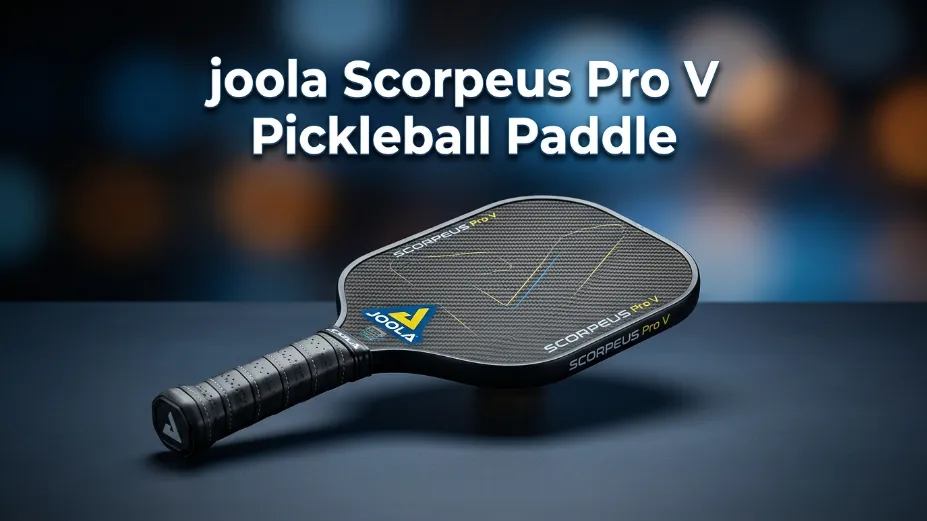
The kitchen line just got meaner, and JOOLA is banking on a single letter to redefine your paddle grid: “V”. As the official weapon of choice for PPA powerhouse Anna Bright, the joola Scorpeus Pro V Pickleball Paddle isn’t just a subtle refresh of a fan favorite—it is a complete metallurgical and aerodynamic overhaul designed for players who refuse to compromise between lightning-fast hand speed and plush, forgiving resets. If you are questioning whether the newly engineered core dynamics justify the premium price tag, or how the dampening profile of the 16mm variation actually behaves during a high-stakes fire fight, you are looking at the exact data breakdown that separates marketing hype from real court authority.
JOOLA Scorpeus Pro V comparison: 16mm control reset versus 14mm speed pop — player signature, core thickness, average weight, surface material, dimensions, grip, sweet spot rating, and MSRP
JOOLA Scorpeus Pro V — 16mm vs 14mm
Control/Reset (16mm) vs Speed/Pop (14mm) — Side-by-Side
For competitive doubles players who prioritize kitchen resets, drops, and maximum forgiveness, the JOOLA Scorpeus Pro V 16mm is the superior pick due to its extended ball dwell time and ultra-stable twist weight. Aggressive, fast-twitch players who prefer to drive the ball or prioritize lightning-fast reflex volleys should instead opt for the 14mm version, which delivers instantaneous pop and immediate paddle response. Both choices sit at the premium price point of $299.95, meaning your selection should be dictated purely by your positional style and comfort preferences.
joola Scorpeus Pro V Pickleball Paddle review: On-Court Performance and Mechanics
When examining the overall landscape of the premium JOOLA pickleball paddle catalog, the Pro V series stands out as a radical departure from the hyper-springy dynamics of previous releases. In this comprehensive joola Scorpeus Pro V Pickleball Paddle review, we seek to unmask how this widebody weapon behaves when subjected to tournament conditions. The playability is anchored in the standard 16″ x 8″ dimensions, a layout that trades elongated reach for lateral surface forgiveness. When striking a ball off-center, standard elongated models suffer from significant angular torque, forcing the player’s wrist to absorb the twist. The Scorpeus design resists this rotation beautifully, providing a rock-solid, predictable platform.
The on-court feel of the joola anna bright scorpeus pro v pickleball paddle differs significantly depending on whether you choose the 14mm or 16mm variation. Evaluating the differences between a 14mm vs 16mm pickleball paddle is essential here. The 16mm core option absorbs incoming pace effortlessly, slowing the game down on resets and allowing for soft, “buttery” touch plays. The 14mm core, while slightly less forgiving on off-center hits, has an immediate, crisp rebound that aggressively minded players can leverage to win fast hand battles. At the official Joola scorpeus pro v pickleball paddle price of $299.95, this paddle represents an investment in technical execution and mechanical consistency rather than raw, effortless speed.
During competitive net play, dinks feel highly predictable. Unlike older thermoformed models that would occasionally “trampoline” and launch the ball deep, the Pro V series emphasizes “connected touch.” The ball sits on the textured carbon face just long enough for you to shape your shot, allowing for precise cross-court angles. For players who have struggled with the chaotic pop of modern paddles, this controlled feel represents the ultimate on-court benefit.
The Science of KineticFrame: Parallel Flex vs. Traditional Neck Flex
The core innovation introduced in the Pro V series is the patent-pending KineticFrame throat technology. In standard paddle designs, the head experiences a cantilevered deflection under load, acting like a diving board. When a ball makes contact with the upper half of a traditional paddle, this cantilevered flex causes the paddle face to tilt backward relative to the handle, shifting the ball’s launch angle and causing soft resets to sail deep.
The KineticFrame resolves this issue by integrating a dual-pivot flex-point system directly into the throat. This architecture allows the paddle face to translate parallel to its original vertical alignment rather than pitching backward at an angle. To demonstrate this difference mathematically, the angular deviation of a traditional cantilevered beam under a localized impact load at an effective length from the throat is expressed as:
In contrast, the guided parallel-deflection mechanics of the KineticFrame limit the rotational angular deviation, forcing the face to remain true through impact:
This parallel recovery path minimizes launch-angle deviation, ensuring that identical swing paths yield consistent ball trajectories, regardless of vertical contact location. The KineticFrame works in tandem with the Propulsion Core, which adds a spring-like response to compress and store energy during high-velocity swings while maintaining a damp, highly controllable touch on defensive resets and soft blocks at the kitchen line. Furthermore, the injected Hyper-Foam Edge Wall provides continuous perimeter weighting, absorbing localized vibrations and expanding the horizontal sweet spot across the standard 8-inch width.
The Durability Debate: Core Crushing and Carbon Fiber Reinforcements
A persistent concern among competitive pickleball players regarding thermoformed paddles is the susceptibility to core crushing, or core degradation. This structural issue occurs when the internal polypropylene honeycomb cell walls collapse under high-velocity impacts, typically resulting from hard drives or overhead smashes. When these internal cells degrade, the paddle face loses its structural uniformity, leading to localized “dead spots” or, conversely, an illegal, ultra-elastic trampoline effect.
In the development of the Pro V series, engineering modifications were implemented to address these structural vulnerabilities. The lower corners of the paddle face and the upper perimeter of the throat have been reinforced with additional layers of high-modulus carbon fiber. This reinforcement forms a rigid chassis that distributes stress more evenly across the face during high-impact collisions. Additionally, the modified perimeter foam structure stabilizes the interface between the core and the outer shell, preventing the edge walls from separating.
Despite these structural enhancements, real-world player feedback indicates that the underlying polymer core remains susceptible to gradual mechanical breakdown over extended periods of heavy play. While the carbon fiber reinforcements effectively prevent the rapid, premature core failures common in earlier models, the core still undergoes dynamic changes. To address long-term durability concerns, JOOLA offers a comprehensive warranty program. The paddle is covered under a standard 6-month limited manufacturer’s warranty against defects in materials and workmanship. However, players who authenticate and register their paddle can double this coverage to a 12-month warranty, providing a robust safety net against premature structural failures.
Operational Break-In Lifecycle and Rebound Progression
Evaluating the Scorpeus Pro V requires an understanding of its distinct, multi-stage break-in lifecycle. Out of the box, the paddle plays exceptionally stiff and muted, which can initially disappoint players expecting immediate power or responsiveness. This progression is characterized by three distinct physical phases:
- Phase One: The Stiff Compression State (0 to 10 Hours): In this initial period, the internal polymer honeycomb walls and the thermoformed carbon fiber face exist in their highest state of structural tension. The paddle feels highly damp, offering exceptional control but requiring significant physical effort to drive the ball deep. Off-center hits may produce a harsh, vibrating feedback through the handle.
- Phase Two: The Touch Stabilization State (10 to 20 Hours): With continuous play, the internal cell walls undergo microscopic softening, reducing localized structural tension. Tactile feedback transitions to a plush, consistent touch, commonly described by players as a “buttery” feel. Harsh vibrations on off-center hits smooth out, and the sweet spot expands to its full operational width.
- Phase Three: The High-Dwell Rebound State (20 to 30+ Hours): As the core fully stabilizes, the paddle’s rebound elasticity, or “pop,” increases significantly. The surface delivers a livelier response on fast drives, yet it retains a soft feel during low-velocity dinks because of its high ball-dwelling capabilities. Unlike previous models that lost control once broken in, the Pro V maintains a consistent launch angle due to the stabilizing effect of its perimeter foam edge wall.
Conversely, the paddle’s spin generation follows a descending progression. While the textured carbon fiber face delivers exceptional spin out of the box (exceeding 2,100 to 2,290 RPM), the surface texture is not permanent and will gradually wear down over months of friction, resulting in a progressive decline in spin performance.
Stock Weight Dynamics and Optimized Lead/Tungsten Customization
The stock Scorpeus Pro V 16mm exhibits a highly balanced weight distribution, featuring a neutral balance point of approximately 24.1 cm (9.25 inches) and an average static weight of 8.2 ounces. The standard widebody shape yields an exceptionally high twist weight of 7.15, indicating immense native resistance to twisting on off-center hits. The measured swing weight of 112.1 is below the average for competitive paddles, providing rapid maneuverability in quick net exchanges.
For advanced players seeking to alter the paddle’s performance, adding weighted lead or tungsten adhesive tape can modify its swing weight, twist weight, and power output. The table below maps specific weighting configurations and their direct mechanical effects:
- Lower Corners (4 & 8 o’clock): Adding 0.15 to 0.25 oz in this region increases twist weight significantly, broadening the lateral sweet spot. This is highly recommended for maximizing stability on defensive blocks and dampening vibrations on mis-hits.
- Mid-Sides (3 & 9 o’clock): Adding 0.20 to 0.30 oz results in a moderate increase in plow-through on drives while expanding the mid-face sweet spot for steady kitchen resets.
- Upper Corners (10 & 2 o’clock): Adding 0.10 to 0.20 oz shifts the balance point upward, maximizing power and pop on overheads and baseline drives, though it slightly increases swing weight.
- Throat Region (above grip): Adding 0.20 to 0.40 oz adds overall static mass to stabilize the KineticFrame flex point without reducing hand speed or making the paddle head-heavy.
When modifying a widebody paddle like the Scorpeus, placing heavy weight at the 12 o’clock position is generally discouraged. Because of the paddle’s shorter 16-inch length, adding weight to the extreme tip shifts the balance point too far forward, increasing the swing weight and neutralizing the quick-hand maneuverability that defines the Scorpeus shape.
Head-to-Head Widebody Battles: How the Scorpeus Pro V Defends Its Turf
To fully appreciate the positioning of the Scorpeus Pro V, we must stack it directly against its closest premium widebody rivals in the United States market: the Franklin Aurelius C45, the Selkirk Omni 16mm, and the Six Zero Coral Pro 16mm. These options represent the peak of widebody engineering but reward very different playing styles.
JOOLA Scorpeus Pro V vs. Franklin Aurelius C45 (ALW Signature)
The Franklin Aurelius C45, built around Anna Leigh Waters’ lightning-fast specifications, is an absolute speed demon. It features a thinner profile and a shorter handle designed for rapid-fire hand battles. While the Aurelius excels in quick-reaction flick speedups and net-front dominance, it feels noticeably less stable and far less forgiving than the Scorpeus. The Scorpeus Pro V prioritizes a calmer, more planted feel with superior twist weight, absorbing heavy drives with a high level of composure that the raw speed of the Franklin Aurelius cannot match.
JOOLA Scorpeus Pro V vs. Selkirk Omni Widebody 16mm
The Selkirk Omni Widebody 16mm ($300) is a direct competitor in the premium price bracket. The Omni features Selkirk’s proprietary Gen 4 solid foam core, giving it an incredibly plush feel and an even higher twist weight of 7.75. However, while the Omni excels at absolute ball pocketing and defensive dinks, it lacks the crisp contact definition of the JOOLA. On drives and offensive speedups, the Scorpeus Pro V’s Propulsion Core responds with a firmer, more positive pop that makes finishing points significantly easier.
JOOLA Scorpeus Pro V vs. Six Zero Coral Pro 16mm
For budget-conscious players seeking widebody control, the Six Zero Coral Pro 16mm ($220) is a compelling alternative. The Coral Pro provides a very dense, highly muted sensation at contact, offering superb predictability on resets. However, the Coral Pro plays noticeably slower than the Scorpeus. When swinging aggressively from the baseline, the Scorpeus Pro V displays a much more dynamic, parallel throat flex that translates to greater ball exit velocity without sacrificing control.
Value Analysis: Scorpeus Pro V vs. Pro IV and Marketplace Placement
At the standard retail price of $299.95, the Pro V series sits in the highest tier of the market. This high price tag requires a careful look at whether the upgrade from the older Scorpeus Pro IV is truly justified. The older Pro IV remains highly popular and can often be found discounted between $179.95 and $229.95, creating a noticeable price gap.
The primary difference between the generations is a shift in playing philosophy. The Pro IV was designed for “free, elastic power,” acting as a trampoline off the face. While this made generating deep drives easy, it led to unpredictable “hot spots” where resets would randomly sail long. The Pro V smooths this out completely, sacrificing a tiny bit of effortless speed for a massive increase in launch-angle predictability and control. If you are an advanced player who plays 4+ hours a week, the added consistency of the Pro V’s KineticFrame can justify the premium price. However, casual players looking for accessible power might find better overall value in a discounted Pro IV or previous-generation JOOLA Ben Johns Perseus Pro IV.
For players searching for elite control options across the broader market, the Pro V is a top contender. It is frequently rated among the best pickleball paddles for advanced players who want a traditional widebody shape. It combines top-tier control with enough built-in technology to compete at any tournament level.
Authenticity Verification and NFC Warranty Registration
Because of the massive popularity and high price of JOOLA’s Pro series, counterfeit paddles have become increasingly common on unauthorized online marketplaces. These cheap look-alikes mimic the graphic design and colorways of the Scorpeus Pro V but lack the critical internal technologies, such as the parallel-flexing KineticFrame, the Propulsion Core, or the perimeter foam edge walls. Under regular play, fake paddles experience rapid face delamination, internal core cracking, and complete structural failure.
To combat counterfeiting and protect consumers, JOOLA embeds an encrypted Near Field Communication (NFC) chip directly into the handle of every authentic Pro V paddle. By enabling NFC on a smartphone and tapping it against the grip, players are redirected to the JOOLA Connect mobile platform, which instantly verifies the paddle’s unique digital signature. Completing this registration process is highly recommended; it doubles the standard 6-month limited manufacturer’s warranty to a full 12 months, protecting your premium investment against premature core issues or defects.
Frequently Asked Questions (FAQ)
Are JOOLA Pro V paddles manufactured within the United States?
No. While all conceptual design, engineering, and professional prototyping are managed at JOOLA’s corporate headquarters in the United States, primary material assembly, carbon fiber thermoforming, and core manufacturing are handled by the brand’s production partners in Asia.
Does the Scorpeus Pro V utilize a full-foam core?
No. While some competitors have moved to Gen 4 foam-only cores, JOOLA remains committed to its Gen 3 polymer honeycomb design. The core features an advanced polypropylene honeycomb propulsion grid wrapped in a perimeter foam edge wall, which provides a sharper, more defined contact feel than foam-only platforms.
Can I wash the textured carbon fiber face with water to restore spin?
It is highly discouraged. Washing the paddle with water or abrasive chemicals can degrade the face and damage the perimeter edge guard. Instead, use a specialized pickleball paddle eraser to remove plastic ball dust and dirt from the textured grit, ensuring the surface retains its friction without wearing down the carbon fibers.
What is the difference in grip size between the Anna Bright and Collin Johns models?
The Anna Bright signature model features a slimmer 4.125-inch grip circumference (small) designed to accommodate players with smaller hands or those seeking increased wrist whip. The Collin Johns signature model features a wider 4.250-inch grip circumference (medium) designed for players with larger hands who want a steadier, more vibration-dampened grip feel.