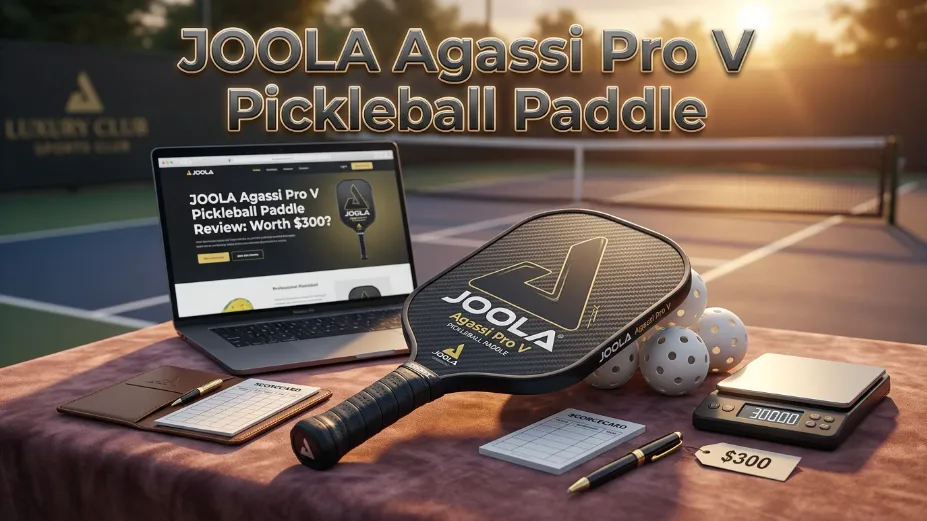
When Andre Agassi stepped off the tennis court and onto the pickleball turf, the industry knew a paradigm shift was coming. The result of that transition isn’t just another graphite slab; it’s a surgical instrument engineered for players who refuse to compromise on baseline power or kitchen-line reset control. If you have been tracking the buzz around the joola agassi pro v pickleball paddle, you already know it promises to blend tennis-born aggression with modern paddle physics. But under the hood of this high-profile release lies a specific core dynamics configuration that will either elevate your soft game or completely disrupt your shot timing. Let’s strip away the marketing hype and look at the raw data.
Pickleball Paddle — CAS Surface Specifications
Face · Core · Weight · Grip · Shape
Comprehensive JOOLA Agassi Pro V Pickleball Paddle Review: Technical Anatomy
The engineering core of this agassi pro v review centers upon its non-traditional throat setup. While legacy carbon paddles relied on uniform, rigid frames that flexed uniformly like a diving board, this signature joola agassi pro v layout bridges traditional racket dynamics with modern pickleball aerodynamics.
- The KineticFrame Matrix: Utilizing a patent-pending carbon-fiber reinforced flex-point system in the throat, the paddle flexes on dual axes during impact. Instead of standard head-heavy deflection, the KineticFrame forces the face to move parallel, stabilizing the launch angle for more precise ball placement.
- The Propulsion Core: Built around a responsive polypropylene honeycomb, the internal core creates a controlled, spring-like trampoline effect. This allows players to generate deep baseline power without sacrificing critical touch on soft drops.
- The Hyper-Foam Edge Wall: Injected high-density foam runs around the entire perimeter of the paddle. This added perimeter mass expands the sweet spot upward and outward, providing extreme stability against off-center mishits.
The raw carbon surface leverages JOOLA’s Textured Carbon Fiber to grip the ball, facilitating heavy topspin on drives and precise slice drops. For competitive players seeking to pair advanced paddle dynamics with the perfect footwear, reading our complete analytical breakdown of skechers viper court pro pickleball-shoes will ensure your entire physical setup functions in perfect alignment.
Check Best Top Pickleball Paddles Guide
14mm vs. 16mm: Deciding on your JOOLA Agassi Pro V
Navigating the product family requires a clear understanding of the mechanical differences between the 14mm and 16mm models. Selecting your specific thickness of the agassi pro v pickleball paddle dictates both your physical recovery cycles and your kinetic hand speed at the non-volley zone.
The Cushioning and Flex Variance
The 16mm version is engineered with a thicker core that maximizes ball contact time (dwell time). This absorbs massive downward energy on hard resets, providing an incredibly soft, cushioned feel. Conversely, the 14mm core uses a thinner, stiffer polypropylene structure. The ball springs off the face much faster, giving you a reactive, crisp pop that is ideal for quick reflex battles but offers noticeably less raw forgiveness on off-center drops.
Weight and Commercial Discrepancies
The 16mm model carries an average static weight of 8.1 ounces, creating a solid, stable feel on heavy drives. The 14mm model drops to a lighter average of 7.9 ounces, providing maximum hand speed at the kitchen line. Across US retail channels, both models command a premium price tag of $299.95 USD. If you are trying to match this elite control tool with a comprehensive setup, exploring our guide to the selkirk pickleball bag options will keep your gear protected.
The Critical Fit Guide: Grip Volumetrics on the Agassi Pro V
A major missing angle across mainstream e-commerce spaces is the highly specific volumetric interior geometry of the handle. When choosing the agassi pro v, selecting your thickness also means selecting your physical grip diameter, which directly impacts hand fatigue and wrist action.
The 16mm model features a standard 4.250-inch grip circumference, designed for players with medium-to-large hands who want a stable, lock-down feel that reduces forearm strain. The 14mm model features a slimmer 4.125-inch grip circumference, allowing smaller hands to completely wrap around the handle or enabling players to use heavy wrist snap for extreme spin. Because both options utilize the premium Feel-Tec Pure grip, they offer excellent sweat-wicking properties, but broad-handed players who purchase the 14mm must apply overgrips to prevent painful blisters during long tournament blocks.
Exposing the Information Gaps: Real-World Durability Under the Microscope
While marketing materials highlight the premium aesthetic choices of this elite paddle, deep analysis across independent United States playing groups reveals distinct manufacturing limitations and wear patterns under high-stress play.
- Face Texture and Grit Wearing: The Carbon CAS peel-ply texture is not an indestructible grit formula. After 2 to 3 months of heavy, continuous competitive play (3-4 sessions a week), the micro-textures along the sweet spot begin to wear smooth, gradually lowering the paddle’s spin-generation potential.
- The Core Crushing Dilemma: To address past structural issues where the polymer core would degrade or crush near the top, JOOLA added a carbon-fiber reinforcement layer between the outer foam wall and the polymer core. This significantly improves the compression strength of the head, though high-level players still report a minor drop in trampoline feedback after months of aggressive baseline drives.
- The Streamlined Taper Reality: Officially, both versions list a standard 5.5-inch handle. However, because the tapered throat geometry flares so gradually without sharp plastic corners, the effective grip length is closer to 5.75 inches. This makes it an absolute dream for players executing two-handed backhands.
- Agassi Pro V vs. Graf Pro V: Many players wonder if there is a physical difference between the Agassi and Steffi Graf models. Officially, they use the exact same technology, materials, and core structures. The only differences are the cosmetic colorways and the default grip size (the Graf model only comes in a slim 4.125-inch grip, while the Agassi model offers both sizes depending on thickness).
To ensure you maintain peak performance, mastering the basic mechanics is just as critical as your gear. Take a look at our guide on how to play pickleball to refine your baseline positioning.
Performance on United States Courts: Damp Outdoor, Grit Wear, and High-Speed Indoor Play
Evaluating the textured carbon face requires analyzing the highly variable, unpredictable court environments found throughout the United States. On dry, outdoor asphalt courts, the CAS carbon surface behaves beautifully, biting the ball to generate nasty topspin on deep drives. However, the open throat and textured face feature no moisture-wicking treatments; when playing on typical humid or damp outdoor courts in the Pacific Northwest or Eastern Seaboard, surface condensation immediately neutralizes the texture, leading to unpredictable launch angles.
Conversely, on indoor wood or high-friction acrylic courts found in dedicated clubs, the paddle shines. The KineticFrame absorbs the violent ball impact, allowing you to execute extremely tight dinks and delicate kitchen drops. For players looking to maximize their control and prevent joint stress indoors, checking our guide on the best pickleball paddle for control will help you construct the ultimate defensive setup.
Head-to-Head: JOOLA Agassi Pro V vs. Six Zero Ruby
For players trying to choose between the premium joola agassi pro v and the legendary Six Zero Ruby, the choice comes down to a fundamental split in core materials and swing weight dynamics.
The primary differences in on-court performance are detailed in the comparison matrix below:
- Comfort and Break-In Period: The Agassi Pro V features a slightly stiffer, more performance-oriented feel out of the box, requiring 10 to 15 hours of play to fully break in and soften. The Six Zero Ruby, built with a 100% DuPont Kevlar face, offers a plush, energetic feel from your very first swing without a heavy break-in period.
- Core Flex and Stability: The patent-pending KineticFrame throat design on the Agassi Pro V provides a more stable, parallel launch angle on fast drives. The Ruby relies on traditional thermoformed carbon/Kevlar boundaries, which deliver excellent perimeter stability but lack the dual-pivot throat flex of the JOOLA.
- Lifespan and Value: The Kevlar surface of the Six Zero Ruby easily outlasts the peel-ply carbon face of the Agassi Pro V under heavy spin demands. Furthermore, the Ruby enters the market at an accessible $199.99 USD, making it a highly attractive value option compared to the premium $299.95 MSRP of the JOOLA model.
For a complete, comprehensive overview of alternative premium paddles, explore our detailed analysis of the 6.0 ruby pickleball paddle alongside our independent evaluation of the best andre agassi pickleball paddle transitions.
Buying Advice in the US: Prices, Retailers, and Colorways
Tracking down this flagship silhouette across the United States involves navigating a mix of major online sports retailers and authorized regional pickleball dealers. The standard baseline retail price sits firmly at the $299.95 USD MSRP. If you want to purchase directly from the source with a full 12-month manufacturer warranty, your best option is to visit the official JOOLA website to ensure you receive authentic accessories including the overgrip, edge tape, and premium packaging.
Verdict: Is the JOOLA Agassi Pro V Worth Your Money?
The final evaluation of this high-performance signature paddle depends entirely on your personal playing profile, structural swing speed, and financial approach to seasonal gear replacement.
- Who Should Buy: Strategic all-court players, former tennis players executing long, fast-swing drives, and advanced competitors who demand a predictable launch angle and muted, plush impact feedback.
- Who Should Avoid: Beginners and low-intermediate players who require a highly forgiving, wide sweet spot, and budget-focused recreational players who want a single paddle to survive a full calendar year without texture wear.
Frequently Asked Questions (FAQ)
Are these court paddles constructed entirely within the United States?
No. While all conceptual design work and professional prototyping are managed at JOOLA’s corporate headquarters in Rockville, Maryland, the primary manufacturing and synthetic assembly of the polypropylene cores are handled by specialized partners in China.
Can I safely utilize a household washing machine cycle or abrasive liquid to clean the carbon face?
No. It is highly discouraged. Using any liquid or harsh chemical on the Carbon CAS surface will dissolve the delicate outer resin coating, accelerating texture wear and voiding your warranty. Use a specialized rubber paddle eraser to clean ball plastic residue.
How does the throat flex of the KineticFrame compare to the previous Tech Flex Power (TFP) design?
The older TFP system focused primarily on weight distribution and general throat forgiveness. The new patent-pending KineticFrame dual-pivot system is engineered to flex parallel to the face upon impact, which actively prevents head twisting and ensures a far more consistent launch angle during rapid net hand battles.