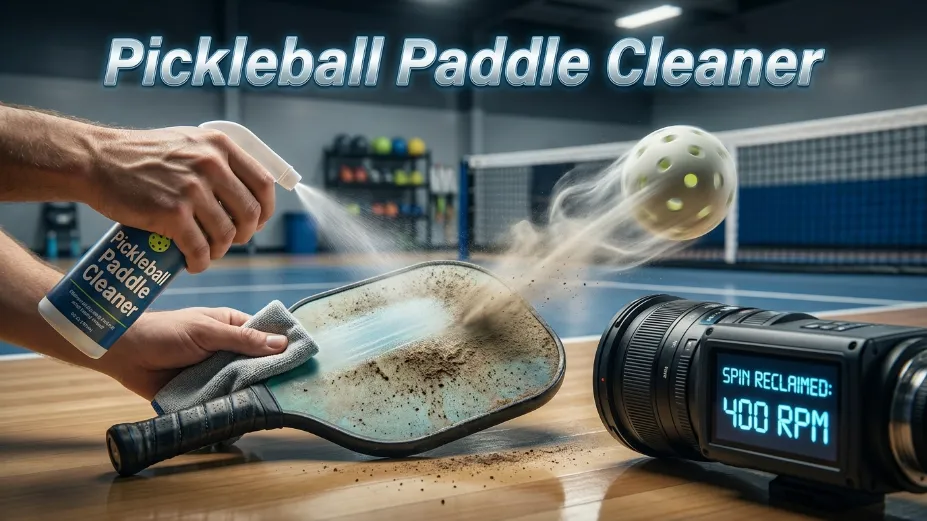
That crisp, game-winning spin you relied on last week didn’t vanish because you lost your touch—it is currently suffocating under a microscopic layer of melted plastic. Every single impact with the ball transfers outdoor polyethylene residue directly into your raw carbon fiber grids, silently transforming your high-tier paddle into a slick, uncontrollable surface. Splashing water or using household detergents will permanently delaminate the core, but utilizing a specialized pickleball paddle cleaner restores that gritty, tournament-legal friction in exactly ten seconds without altering the texture. Here is how professional players strip away the invisible grime and instantly reclaim their spin rate.
Paddle Cleaner Types Guide
Residue removal efficiency & core safety rating
The Correct Steps for Comprehensive pickleball paddle cleaning
To keep your paddle performing at its absolute limit without voiding its warranty or causing structural degradation, you must follow a disciplined, material-safe cleaning routine. Improper methods—such as using household abrasive sponges, pouring water directly onto the face, or applying harsh chemical solvents—will destroy the face texture and compromise the internal core. Follow this precise step-by-step workflow to clean your gear safely:
Step 1: Perform a Dry Surface Sweep
Before applying any mechanical friction or moisture, gently wipe down the paddle face with a clean, dry, lint-free microfiber cloth. This step is crucial because outdoor public courts are covered in fine, sharp quartz silica dust. If you immediately rub a rubber block or a damp cloth aggressively over a dusty paddle, those hard silica particles will act as an abrasive medium, scratching and micro-sanding the delicate epoxy grid. Sweeping the loose grit away first prevents this accidental wear.
Step 2: Apply the Dry Rubber Eraser (For Raw Carbon Surfaces)
Hold your paddle firmly near the throat with your non-dominant hand. Take your dry rubber eraser and apply light to moderate pressure, dragging it in straight, parallel, linear strokes from the throat to the tip of the paddle face. Avoid aggressive, circular scrubbing motions, which can generate localized frictional heat and soften the protective epoxy resin. As the rubber rolls up the embedded plastic fibers, brush away the resulting crumbs with a soft towel or your hand.
Step 3: Execute a Core-Safe Damp Wipe (For Fiberglass & Painted Composites)
If you are cleaning a painted composite, hybrid, or fiberglass pickleball paddles face, do not use a rubber block. Instead, mix lukewarm water with two drops of mild dish soap in a small spray bottle. Lightly mist a clean microfiber cloth until it is slightly damp—never spray the paddle face directly. Gently wipe the surface using light, circular motions. The microscopic, wedge-shaped fibers of the microfiber towel will reach into the tiny crevices of the face to lift dirt and sweat without stripping away the painted finish or texturized grit layers.
Step 4: Dry Thoroughly Before Storage
Once you have finished cleaning, wipe down the entire paddle face, edge guard, and handle with a dry portion of your microfiber towel. Allow the paddle to sit upright in a well-ventilated, shaded area for at least ten minutes to ensure all residual humidity has evaporated. Storing a damp paddle inside a sealed neoprene cover traps moisture, which leads to mold and weakens the structural adhesives.
Critical Warnings: The Hazards of Kevlar and Elite Grits
As paddle technology continues to evolve, new surface materials present unique cleaning challenges that players must navigate carefully:
- The Kevlar Fraying Hazard: Modern Kevlar-faced paddles (such as the premium Ruby pickleball paddle) are celebrated for their incredible strength and soft feel. However, because Kevlar is an organic aramid fiber, it is prone to structural fraying if its protective surface epoxy resin wears down. If you use a high-friction rubber eraser on a worn Kevlar paddle, the tacky rubber can catch on the exposed aramid strands and pull them out of the weave, causing irreversible “tufting” or fuzzy fraying. For Kevlar surfaces, stick exclusively to a damp microfiber cloth wipe to preserve the fibers.
- The “Eraser-Eating” Ultra-Grit Surface: Cutting-edge paddles featuring hyper-durable, highly texturized grit applications (like the Honolulu J2CR and Blue Grit) have surfaces so sharp they act like a cheese grater on standard rubber blocks. Attempting to use a rubber eraser on these faces will simply shred the block into sticky, tiny crumbs that clog the deep crevices, making the paddle surface even dirtier. If you use an ultra-grit model, clean it strictly with a soapy warm-water damp wipe and a soft-bristled toothbrush to clear deep-set dirt safely.
- Polypropylene Honeycomb Core Hydrolysis: Nearly all modern performance paddles are constructed with a lightweight polypropylene honeycomb core. While the carbon face itself is waterproof, the seams around the edge guard are not. If you submerge your paddle in water or use a heavily soaked towel, liquid can easily seep past the edge guard and become trapped inside the hexagonal cells. Because there is no airflow inside the core, this trapped water remains stagnant, causing localized hydrolysis that gradually dissolves the adhesive bonds holding the face to the core. This results in soft, unresponsive “dead spots” that completely ruin the paddle’s performance.
amoswiz pickleball cleaner paddles residue
How Amoswiz Eraser Handles Stubborn Polyethylene Residue
Intermediate and advanced players using models like the Amoswiz T800 Pro Carbon series often notice a rapid buildup of dense, white chalky marks near the sweet spot after only a few competitive sets. This is because the high-density T800 weave features incredibly sharp, deep micro-crevices designed to shred and grip the ball. However, this aggressive profile also acts like a mechanical grater, harvesting fine plastic fibers from outdoor balls and packing them tightly into the carbon weave. When these fibers melt under the friction of consecutive hard drives, they form a stubborn, glazed barrier that standard wipes cannot touch.
The specialized Amoswiz eraser handles this problem by leveraging cohesive mechanical adhesion. When you drag the dense, non-abrasive rubber block across the face, the rubber slightly deforms and flows into the microscopic valleys of the carbon grid. The rubber molecules have a higher chemical affinity for the embedded polyethylene plastic than the plastic has for the cured epoxy resin of the paddle face. As a result, the eraser grabs the compressed polymer sheets and lifts them out of the grid, rolling them into visible grey debris curls that can simply be brushed away. This dry cleaning method restores the original depth and sharpness of your paddle’s grit without leaving a sticky film or degrading the raw carbon structure.
The Molecular Mechanics of Spin Decay and Surface Friction
To understand why regular pickleball paddle cleaning is essential, we must examine the physics of ball-on-paddle contact. Modern high-tier paddles, particularly those crafted from raw carbon fiber, rely on a microscopic textural grid to bite into the plastic of the ball during impact. This mechanical locking generates the high rotational velocity known as spin. When a ball strikes a clean paddle, the coefficient of friction is maximized, allowing for precise control and aggressive arcs.
The equation representing this friction is:
$F_f = \mu F_n$
Where $F_f$ represents the frictional force, $\mu$ represents the coefficient of friction dictated by the surface texture, and $F_n$ represents the normal force applied during the swing. Every time you strike a pickleball, the intense local pressure and shear force transfer minute amounts of the ball’s outer polyethylene polymer directly into the microscopic pores and troughs of the paddle’s grid. Over several matches, this polymer transfer hardens and accumulates, clogging the channels and effectively smoothing out the surface of a premium carbon fiber pickleball paddle.
According to comprehensive spin-testing databases compiled by industry experts like John Kew, this residue buildup results in a devastating performance drop-off. A dirty paddle face can lose between 15% to 20% of its peak spin rate, dropping rotational speeds by 300 to 400 RPM:
$\omega_{\text{dirty}} \approx 0.80 \omega_{\text{initial}}$
Where $\omega_{\text{initial}}$ is the baseline spin rate of a pristine surface and $\omega_{\text{dirty}}$ is the decayed spin rate under heavy polymer contamination. In high-speed camera footage, this frictional loss manifests as ball slippage. While a clean paddle face grips the ball instantly, limiting slippage to under 1.0 inch of travel across the face, a dirty paddle surface allows the ball to slide 2.0 to 4.0 inches before releasing. This prolonged slide flattens your launch angle, turning sharp topspin drives into floating long balls that carry past the baseline.
The Great Industry Markup: Sander Belt Cleaners vs. Specialized Erasers
One of the most significant open secrets in the pickleball community is the massive commercial markup on branded paddle erasers. Many major sports brands package a small 2″ x 2″ x 1″ rubber block and market it as a proprietary pickleball paddle cleaner eraser or pickleball paddle cleaning block, retailing them for anywhere from $15 to $25. In reality, these products are materially and chemically identical to natural crepe rubber blocks used in woodworking shop environments.
Known in industrial sectors as “sanding belt cleaning sticks,” these blocks have been used for decades in woodworking to remove packed sawdust from high-grit sandpaper without wearing down the abrasive silicon carbide crystals. Because natural crepe rubber functions purely through physical cohesion rather than chemical abrasion, it is exceptionally gentle on delicate surfaces while aggressively pulling out packed debris. Savvy players can purchase an industrial-sized woodworking cleaning block for $5 to $8, slice it into four or five pocket-sized squares using a utility knife, and secure a multi-year supply of highly effective paddle cleaners at a fraction of the sporting goods markup.
The Head-to-Head Battle: Rubber Erasers vs. Liquid Spray Cleaners
When it comes to maintaining performance, players often find themselves choosing between dry rubber blocks and specialized liquid spray solutions. While both methods serve a purpose, they function through completely different chemical and physical pathways, making each suited to specific materials and scenarios.
- Targeted Debris Removal: Rubber erasers excel at extracting solid, packed polymer fibers from raw, uncoated surfaces. Liquid sprays, conversely, are designed to dissolve grease, sweat salts, sunscreen, and hand sebum that build up globally across the face and handle.
- Material Compatibility: Rubber blocks are highly effective on raw carbon fiber but should be used with extreme caution on painted, spray-on grit, or graphic-heavy faces. The high friction of a rubber block can strip off thin, aftermarket paint layers and spray-on coatings, destroying the finish. Liquid cleaners with low-foaming, pH-neutral surfactants are far gentler on delicate graphics, fiberglass, and composite materials.
- Core Safety & Convenience: A rubber block requires no water, meaning there is zero drying time and absolute core safety. You can swipe the block across your paddle during a two-minute side-out break on the court and immediately resume play. Liquid sprays require a microfiber cloth and a brief drying window to prevent wet balls from sliding off the face.
Many professional players employ a dual-maintenance protocol: they use a pocket-sized rubber block for on-court plastic removal between games, and execute a weekly deep clean using a mild, pH-neutral spray and a microfiber towel to lift hand oils and dirt from both the face and the edge guard.
Protecting Your Investment: Grip Maintenance and Storage Secrets
Maintaining high spin rates and consistent control requires looking beyond the face of your paddle. The grip and storage conditions play an equally vital role in your overall control on the court:
Advanced Grip Care: PU vs. Leather
During a fast-paced game, your hand transfers sweat, body oils, and dead skin directly into the handle material. If left untreated, this organic buildup turns your handle into a slick, slippery surface, forcing you to squeeze harder. This involuntary over-gripping is a primary contributor to tendonitis, commonly known as tennis or “pickleball elbow.”
For synthetic polyurethane (PU) grips, wipe down the handle weekly with a 70% isopropyl alcohol wipe to dissolve natural skin oils and restore tackiness. However, if your paddle is equipped with genuine leather, avoid alcohol completely, as it strip-dries the natural oils and causes immediate cracking. Instead, clean leather handles using a dry cloth and a minimal amount of saddle soap, followed by a light leather conditioner to keep the material supple and tacky. For players on hot outdoor courts, utilizing fresh, high-quality pickleball grips or thin overgrips remains the most cost-effective way to maintain a secure, non-slip hold.
Thermal Protection: The Threat of Delamination
The high-performance epoxy resins used to bond the carbon fiber face to the internal polymer core are highly sensitive to thermal fluctuations. A common mistake among US recreational players is storing their gear bags in the trunk of their car during the summer months. Internal trunk temperatures can easily exceed 140°F (60°C). This extreme heat softens the cured epoxy resins, allowing the face layers to slip, shift, and lift away from the core—a process known as delamination. To protect your investment, always store your paddles in a climate-controlled room (68°F to 72°F) and protect them with padded pickleball paddle covers during transport to shield them from sudden thermal shifts and physical impact dings.
Frequently Asked Questions (US Player Resource)
Q: Does using a rubber paddle eraser wear down the raw carbon fiber grit over time?
A: No. Natural crepe rubber is significantly softer than cured epoxy resin and carbon fiber. When used with moderate pressure, the rubber deforms to pull out embedded debris without scratching or degrading the structural grit layer. However, avoid aggressive, high-speed scrubbing, which can generate friction heat and soften the resin matrix.
Q: Can I use household glass cleaners like Windex on my raw carbon paddle?
A: While some players use glass cleaner for stubborn grime, it is generally not recommended as a primary method. Many commercial glass cleaners contain chemical solvents and ammonia that can degrade the graphics or react with the protective surface coatings. A mild soap-and-water mixture or a certified, pH-neutral paddle spray is a much safer alternative.
Q: Is it safe to use paper towels to dry off my texturized paddle face?
A: Absolutely not. The aggressive, raw texture of a carbon fiber face acts like sandpaper against wood-pulp paper towels, shredding them instantly. This leaves thousands of tiny white paper fibers deeply embedded within the microscopic crevices of your paddle grid, requiring a painstaking cleaning process to remove. Always use a lint-free microfiber cloth for wiping and drying.
Q: How can I tell when my paddle’s surface is permanently worn out rather than just dirty?
A: If you thoroughly clean your paddle using a rubber block and a damp microfiber cloth, but the surface still looks shiny, smooth to the touch, and struggles to generate ball rotation, the physical texture has worn down. All paddles eventually reach their structural limit due to friction wear from ball strikes. Most competitive players replace their primary paddles every 1 to 2 years to maintain optimal spin rates.