joola pickleball bag
There is a specific sound that defines a Saturday morning for many of us. It’s not the birds chirping; it’s that distinctive pop-pop-pop echoing from the local courts. If you are anything like me, your relationship with pickleball started casually. You grabbed a borrowed paddle, wore whatever running shoes you had in the trunk, and just played.
But then, the obsession set in. You upgraded your paddle. You bought specific court shoes. You started carrying extra balls, a towel, electrolytes, a change of shirt, and maybe a tripod to record your games. Suddenly, that flimsy drawstring sack wasn’t cutting it anymore. You needed a gear hauler.
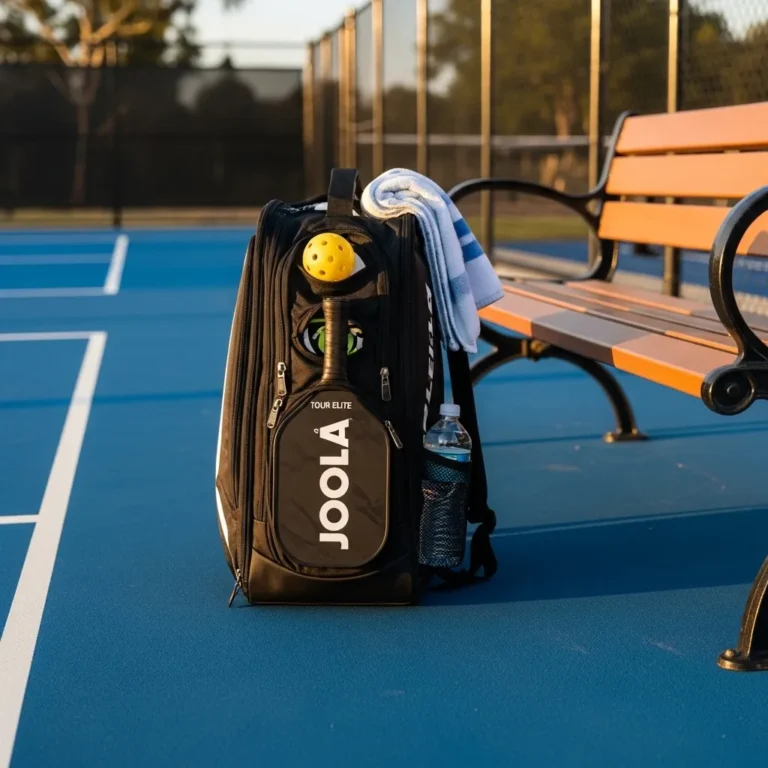
This is where the conversation usually turns to the joola pickleball bag. Whether you are eyeing the massive heavy-duty backpacks or the more streamlined totes, JOOLA has become a massive name on the sidelines of recreational and pro courts alike. But glossy product photos don’t tell you what it’s like to live with a bag day in and day out. They don’t tell you if your zippers will jam with clay dust or if your paddle will actually fit.
I’ve spent a lot of time looking at gear, talking to players, and seeing what actually survives the rigors of the court. We are going to dive deep into what makes these bags tick, specifically looking at models like the joola tour elite pro pickleball bag and its siblings. We’re going to strip away the marketing fluff and look at this gear through the eyes of someone who just wants to get to the court and play without the hassle.
Let’s unpack this, literally.
Article Section 1: Practical Usability & Design
When you are rushing to the courts to grab a spot before the crowd arrives, you don’t care about aerodynamics or fancy logos. You care about whether the bag works. Does it annoy you? does it slow you down? The design philosophy behind joola pickleball bags seems to lean heavily toward the “pro” demographic, but does that translate to convenience for the rest of us?
Does the JOOLA Tour Elite bag actually stand upright when fully loaded, or does it tip over?
This is, without a doubt, the number one frustration players have with “stand-up” bags. There is nothing more annoying than setting your bag down next to the bench, turning to grab your water, and hearing the sad thud of the bag falling face-first into the dirt.
Here is the honest truth about the joola tour elite pickleball bag: it has structure, but it requires you to be a smart packer. Unlike some of the softer, unstructured bags on the market (like the “Vision” series, which tends to be floppier and more prone to tipping), the Tour Elite series is built with a reinforced bottom and stiffer side walls.
However, gravity is still gravity. If you shove a pair of heavy size 13 shoes into the top compartment and leave the bottom empty, it’s going top-heavy and it’s going down. From what I’ve seen and experienced, if you pack the base correctly—keeping your shoes or heavier gear toward the bottom—it stands like a sentinel. It’s reliable, but it’s not magic. If you are on an uneven grass patch or a sloped hill, you might still need to lean it against the fence. But on a flat hardcourt surface? It holds its ground much better than most competitors.
How does the “fence hook” design on JOOLA bags compare to competitors like Selkirk?
The fence hook is one of those features you don’t think you need until you play at a court where the benches are wet, dirty, or non-existent. Then, it becomes the most important feature on the bag.
The pickleball bag joola designers definitely looked at the frustrations players had with cheap plastic hooks. The hook on the Tour Elite series is heavy-duty metal. It feels substantial in your hand, not like a paperclip that’s going to snap under the weight of three water bottles and two paddles.
One nice touch is that it hides away. There is a small, dedicated pocket that tucks the hook out of sight when you aren’t using it, so it doesn’t snag on your car upholstery or your clothes.
But the real question is about height. Does it hold the bag high enough? Generally, yes. If you are hanging it on a standard chain-link fence, the bag rides high enough that the bottom isn’t dragging in the dust. Compared to some other brands where the hook is attached too low (causing the bag to sag onto the ground), the JOOLA design keeps your gear elevated and clean. It’s a small detail, but when you are trying to keep a $150 bag looking nice, it matters.
Is the “dual-zip” flap on the main compartment annoying to use in practice?
If you browse enough forums, you will see this pop up. The main compartment of the joola tour elite pro pickleball bag is often covered by a protective flap that runs over the zipper line. The intention here is excellent: it protects the zipper teeth from rain, dirt, and direct abrasion.
However, in the real world, it can be a little fiddly. If you are the type of person who wants to rip your bag open in half a second to grab a towel between points, that flap can get in the way. It adds a split second of friction to the unzipping process.
Is it a dealbreaker? No. In fact, I’d argue it’s a necessary evil. Zippers are usually the first thing to fail on a sports bag because grit and sand get into the teeth. That flap acts as a shield. So, while you might find it slightly annoying to navigate when you’re in a hurry, you will likely appreciate it two years down the road when your zipper is still sliding smoothly because it hasn’t been eating court grit every weekend.
Can I access the shoe compartment while the bag is hanging on a fence?
This is a logistics question that many people forget to ask until they are actually at the court. The shoe compartment on the Tour Elite Pro is located at the bottom. This is great for weight distribution (helping that stand-up stability we talked about), but it creates a geometry problem when the bag is hanging up.
If you hang your bag on the fence and then realize you need to swap your slides for your court shoes, you are going to struggle. The bottom vent becomes difficult to reach, and gravity is working against you. You end up doing this awkward squat, trying to dig shoes out of the bottom of a hanging bag.
The verdict? Don’t try to use the shoe compartment while it’s hanging. It works best when the bag is lying flat on a bench or standing upright on the ground. Treat the hanging mode as “game time” mode, where you only need access to the main compartments and paddle pockets. Do your shoe swapping before you hook it up.
Article Section 2: Storage Capacity & Gear Protection
Okay, let’s move past the exterior and talk about the guts of the bag. We all suffer from “gear creep.” You start with one paddle, and suddenly you’re carrying a backup paddle, a demo paddle for a friend, a resistance band, sunblock, and enough snacks to feed a doubles bracket. You need space, and you need protection.
Will the thermal-lined pockets actually protect my paddles from warping in a hot car?
If you live in a hot climate—think Florida, Arizona, or Texas—you know the terror of leaving a carbon fiber paddle in a car. The heat can soften the adhesives, leading to core crushing, delamination, or warping.
JOOLA bags feature thermal-lined pockets, easily identifiable by that shiny, silver material inside. It looks like the inside of a cooler or a spacecraft. But let’s manage expectations here: this is a bag, not a refrigerator.
These thermal pockets are designed to reflect radiant heat. They are excellent at buffering your gear against rapid temperature changes. If you are walking from an air-conditioned car to a blazing hot court, that lining helps keep the paddle at a stable temperature for longer.
However, users and testing clarify a hard truth: no bag can fully protect a paddle left in a 100°F+ car for eight hours. The interior of a car can reach 140°F or more. Eventually, the heat soaks through. The thermal lining buys you time—maybe an hour or two of grace—but it is not a magic shield. Treat it as a temporary buffer, not a license to store your $250 paddle in the trunk during a heatwave.
Does the backpack version fit 16mm “elongated” paddles without the handle sticking out?
The sport has changed. A few years ago, most paddles were standard shapes. Now, with the popularity of elongated paddles (like the Ben Johns Perseus models), gear has gotten longer. A standard backpack often leaves the handle of these paddles exposed, sticking out like an antenna.
This is where the joola pickleball bag design team clearly did their homework. They know their audience is using their paddles. The dedicated paddle sleeves on the Tour Elite bags are deep. They are specifically designed to swallow a 16mm elongated paddle whole.
When you slide an elongated paddle in, the handle sits comfortably within the protected area, and on most models, the zippers can close fully around it (or right up to the neck depending on the specific model year). You don’t have to worry about your grip tape getting snagged on things or wet in the rain. If you are upgrading your paddle to a modern shape, your bag needs to match, and these bags fit the bill.
If I use the shoe compartment for size 12+ shoes, how much main compartment space do I lose?
This is the “hidden” trade-off of almost every sports backpack, and it’s something marketing photos rarely show. The shoe compartment is not a separate dimension; it is a tunnel that pushes into the main storage area.
If you have small feet, this isn’t a big deal. But if you wear size 12 or larger mens shoes, that tunnel is going to billow up significantly into the main compartment.
Here is the reality: If you pack giant shoes into the bottom of a joola tour elite pro pickleball bag, you are going to lose about 20% to 30% of your main storage space. The “floor” of the main compartment rises up.
Does this mean it’s unusable? No. But it means you have to change how you pack. You won’t be able to stack a neatly folded stack of four thick towels and a hoodie right on top of the shoes. You’ll have to pack softer items around the “hump” created by the shoes. It’s a compromise. You get to keep your dirty, smelly shoes separate from your clean clothes, but you sacrifice some of that open cavern feel in the main section.
Check out our guide to Babolat Pickleball Shoes Review: Jet Mach 3, SFX3, & More
Article Section 3: Durability & Maintenance
A bag is an investment. If you are spending premium prices for a joola pickleball bag, you want it to last longer than your next pair of court shoes. Durability is about more than just the fabric; it’s about maintenance and construction.
Are JOOLA pickleball bags machine washable?
We have all been there. You open your bag after a long tournament weekend, and the smell hits you. The temptation to just toss the whole thing in the washing machine on the “heavy duty” cycle is strong.
Please, don’t do it.
The official recommendation—and the voice of reason from the community—is strictly hand wash only. Why? It’s not just the fabric. It’s the thermal lining and the structure. Machine washing can crack that silver thermal material, rendering it useless. Furthermore, the stiffeners that allow the bag to stand upright can get warped or broken in the spin cycle.
The best way to clean a joola tour elite pickleball bag is the old-fashioned way: mild soap, warm water, and a rag. Wipe down the interiors. For the exterior, a soft brush can get the court dust out of the weave. And importantly, let it air dry completely. Open every zipper and let it breathe. If you machine wash it, you’re likely going to end up with a floppy, cracked bag that doesn’t protect anything.
How does the zipper quality hold up after 6+ months of daily use?
I mentioned earlier that zippers are the “bag killers.” In the world of outdoor gear, YKK zippers are the gold standard. The community consensus on JOOLA bags is that the zippers are decent, generally “B+” quality. They aren’t the industrial-grade zippers you might find on a $400 mountaineering pack, but they are sufficient for sports use.
However, longevity here is entirely dependent on you. The enemy is clay and court grit. If you play on outdoor courts, dust accumulates on the zipper tracks. If you force a zipper over that grit day after day, the slider will eventually wear down and separate.
To get these zippers to last past the 6-month mark of daily grinding, you need to keep them clean. Occasionally taking a toothbrush to the zipper tracks to clear out the dust makes a huge difference. If you treat the zippers with a little respect—don’t yank them when the bag is overstuffed—they hold up well. If you treat them roughly while covered in sand, they will fail, just like any other zipper.
What is the warranty coverage for rips or strap failures on JOOLA bags?
It is strange how we obsess over paddle warranties but often ignore bag warranties. JOOLA generally offers a limited warranty on their bags, typically covering defects in materials and workmanship. This usually falls in the 6-month range, though you should always check the specific policy at the time of purchase as they can update terms.
Here is the distinction you need to understand: “Defects” vs. “Wear and Tear.”
If a strap snaps the first week you use it because the stitching was bad? That’s a defect. They will cover that.
If you drag the bottom of the bag across the asphalt parking lot for six months and a hole wears through? That is wear and tear. That is not covered.
Because the warranty is somewhat limited compared to “lifetime” travel brands, the initial inspection is crucial. When you first get your pickleball bag joola, inspect the strap stitching and the zipper insertion points immediately. If something looks loose, exchange it right away. Don’t wait for it to fail three months later.
Article Section 4: Travel & Versatility
For the competitive player, pickleball isn’t just a local hobby; it’s a travel lifestyle. You are flying to qualifiers, driving to neighboring states, or hopping on trains. A bag needs to be a travel companion, not a burden.
Does the JOOLA Tour Elite fit in the overhead bin of a standard domestic flight?
This is a massive relief for tournament players: Yes, the joola tour elite pro pickleball bag fits in the overhead bin of standard domestic flights (think Boeing 737s or Airbus A320s). It packs away quite nicely.
However, a word of caution: It is not a “personal item.” You cannot stuff this thing under the seat in front of you. It is too rigid and too tall. If you are flying on a budget airline that charges for carry-ons, this counts as a carry-on.
Also, be mindful of regional jets (the small planes). The overhead bins on those are tiny. In those cases, you might be forced to gate-check the bag. This is where the durability we discussed earlier comes into play—you want to make sure your paddles are padded, just in case it ends up in the cargo hold.
Can the backpack straps be completely hidden if I want to check it as luggage?
There is nothing scarier than watching your backpack go down the conveyor belt with straps flailing around, waiting to get caught in the machinery.
One of the smartest design features of the Tour Elite series is the “tuck-away” functionality. You can unclip the backpack straps and tuck them into a dedicated sleeve or panel. This effectively converts the backpack into a streamlined duffel bag.
This is huge for travel. If you do have to check the bag, or if you just want to carry it by the top handle like a suitcase through a crowded hotel lobby, you can streamline it. It prevents the straps from getting snagged, torn, or covered in airport grease. It turns a piece of sports gear into a legitimate piece of luggage.
Final Thoughts: Is it Worth the Hype?
Choosing a pickleball bag feels like a small decision, but it impacts your game every single time you play. It’s the vessel for your tools. It’s the closet you bring to the court.
The joola pickleball bag lineup, particularly the Tour Elite series, sits in a premium spot. It’s not the cheapest option on the market. But what you are paying for is thoughtfulness. You are paying for a fence hook that actually works, pockets that fit modern paddles, and a structure that respects your gear.
It has its quirks—the shoe tunnel eats your space, and you have to keep the zippers clean—but for the serious player who wants to look professional and feel organized, it’s a solid contender. Just remember to pack the heavy stuff at the bottom, hand wash it when it gets funky, and enjoy the game.
See you on the court!