Gamma Pickleball Paddles
If you’ve been browsing the pickleball aisle or scrolling through endless gear forums, you’ve probably asked yourself, “What Distinguishes Gamma’s Engineering?” It’s a fair question. While many brands are just slapping their logos on generic factory molds, Gamma is one of the few that actually engineers its own tech. This section isn’t just marketing fluff; it’s about how these differences actually feel when the ball hits the face.
What differentiates Gamma’s “NeuCore” technology from standard polymer honeycomb cores?
You’ll hear “honeycomb core” thrown around constantly in pickleball, but Gamma’s NeuCore is genuinely different. Standard polymer cores use smaller, tighter cells—think of a dense beehive. NeuCore, on the other hand, increases the cell size and the core thickness by about 25%.
Why does this matter to you? A larger cell creates a softer, more “plush” feel. When you catch a ball perfectly in the sweet spot of a NeuCore paddle, it feels deeper and quieter, almost like the paddle is swallowing the ball for a split second before launching it. This is a stark contrast to standard thin cores, which often have a harsh, “pingy” vibration. If you hate that plastic-on-plastic vibration traveling up your arm, the thicker, large-cell NeuCore is a game-changer.
How does the Sensa Poly Core differ from the NeuCore in terms of feel and feedback?
Think of the Sensa Poly Core as the snappy, responsive younger sibling to the NeuCore. It is typically built into Gamma’s thinner profile paddles (around 13mm or typical 0.5″). Because the core is thinner and the cells are standard-sized, you get immediate feedback. You know exactly where the ball hit the face the moment contact is made.
In contrast, the NeuCore (often 16mm or 5/8″) feels more muted and dampening. If Sensa is a sports car suspension that lets you feel every bump in the road for maximum control, NeuCore is luxury suspension—smooth, forgiving, and quiet. Players who rely on “touch” and want to feel the ball pop off the face often prefer Sensa, while those looking to block hard drives without transferring heavy impact to the hand gravitate toward NeuCore.
Does the molded handle technology in Gamma paddles offer better stability than traditional pallet handles?
Absolutely. This is one of those hidden features that rarely gets talked about but makes a huge difference in durability. Many traditional paddles use “pallet handles,” where two pieces of material are glued onto the shaft to create the grip shape. Over time, these can loosen, creak, or shift, killing your confidence on big overhead smashes.
Gamma’s molded handle technology is a single-piece construction. The handle is integrated directly into the paddle’s body during the molding process. This means zero wiggling and a much more solid, “one-piece” feel. It translates to better stability because there’s no energy lost between your hand and the paddle face. It just feels… distinctively solid.
Recommended Reading
Top Pickleball Gifts 2025:From Stocking Stuffers to Pro Gear
Looking for unique pickleball gifts? We break down practical gear, funny apparel, and budget-friendly ideas to help you surprise the player in your life.
Model Comparison & Selection (Model Breakdown & Playstyle Analysis)
Choosing a paddle is tough because reviews often just say “good for beginners,” which helps nobody. Let’s get into the nitty-gritty comparisons that actually affect your court positioning and playstyle.
Gamma Obsidian vs. Hellbender: Which is better for a soft game (dinking) versus power driving?
This is a classic battle of “modern spin” vs. “classic touch.”
The Gamma Obsidian is optimized for a soft game that relies on heavy spin. Its raw carbon face grabs the ball, allowing you to hit aggressive topspin dinks that dive at your opponent’s feet. If your soft game involves “shaping” the ball, the Obsidian is your tool.
However, the Gamma Hellbender (specifically the Gamma Hellbender NeuCore) is surprisingly better for power driving and blocking, despite its weird shape. The teardrop design shifts the weight slightly away from your hand, giving you more leverage (plow-through) on drives. Plus, that thick NeuCore acts like a shield against opponent power. If you are a “banger” who likes to drive hard and then crash the net for a block, you will appreciate the Hellbender’s significant stability for its class.
How do the different shapes (Elongated vs. Wide Body) in the Gamma lineup specifically affect the sweet spot size?
Shape dictates forgiveness. In Gamma’s lineup, Elongated paddles (like the Compass or Obsidian) stretch the sweet spot vertically. It becomes a long, narrow oval. This is great for reach and high-point contact, but if you mishit near the edges (3 o’clock or 9 o’clock), the paddle will twist in your hand.
Wide Body shapes (like the Gamma Fusion Pro pickleball paddle or the Gamma Fusion React pickleball paddle) spread that sweet spot out horizontally. It’s a big, friendly circle. You can be late on a block, hit it off-center, and the ball will still likely go over the net. If you frame shots often, the Wide Body shape is your safety net.
Is the Gamma Compass specifically designed for singles or doubles play based on its reach?
While you can use it for doubles, the Gamma Compass is a singles player’s dream. At 16.625 inches long, it is one of the longest paddles on the market. In singles, that extra inch of reach is the difference between a passing shot and a winning volley.
In doubles, however, that length can be a liability during fast hands battles at the kitchen line. The longer the paddle, the higher the “swing weight,” meaning it takes more effort to flip the paddle from forehand to backhand quickly. Unless you have wrists of steel, the Compass might feel a split-second too slow for high-level doubles exchanges.
What are the key differences between the Gamma 2.0 series and the Airbender regarding aerodynamics?
The Gamma 2.0 series (like the Voltage 2.0) relies on traditional flat-face aerodynamics. It cuts through the air reasonably well because it’s thin, but it doesn’t have active airflow tech.
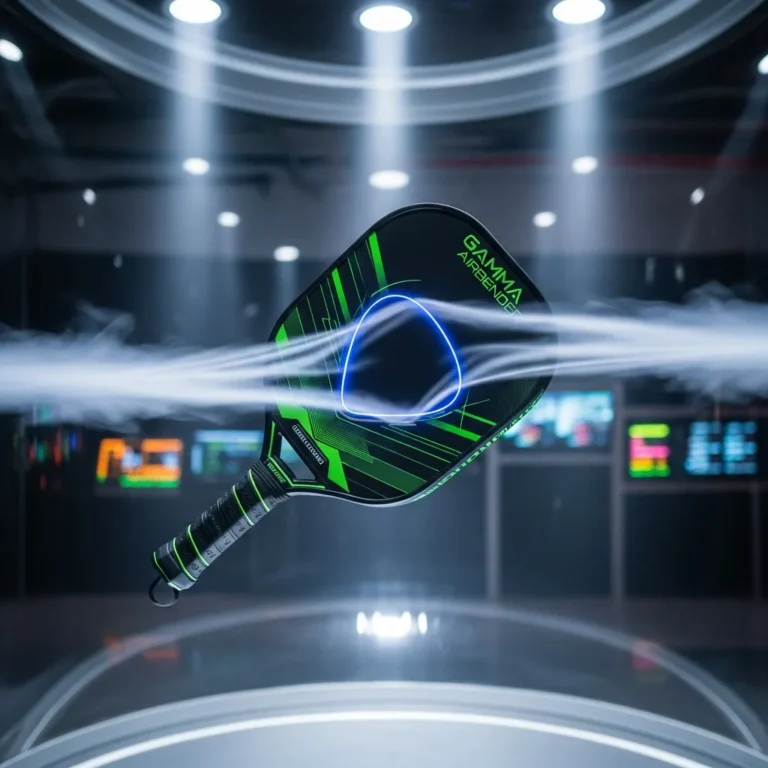
The Gamma Airbender, on the other hand, is a radical departure. It features an open throat (a literal hole near the handle) and variable weighting systems. That open throat reduces drag significantly, allowing you to swing faster without swinging harder. It’s noticeably quicker in the air than the 2.0 series, which feels more like a traditional “board” pushing against the wind.
Performance & Playability Specifics (Deep Dive)
Let’s tackle the specific questions that pop up in Reddit threads and serious player discussions.
Does the raw carbon face on the Gamma Obsidian wear down quickly compared to their textured fiberglass surfaces?
Actually, it’s the opposite. The “grit” you feel on a textured fiberglass paddle (like the Gamma Fusion React pickleball paddle) is often a spray-on texture. Over 6 months of heavy play, this can smooth out, leaving you with less spin potential.
The Gamma Obsidian uses Raw Carbon Fiber. The texture comes from the actual weave of the material, not a spray-on grit. While it will pick up ball dust (which looks like wear but usually wipes off with a rubber eraser), the actual friction capability lasts significantly longer. Raw Carbon materials are generally known to retain their surface friction properties longer than spray-on textures.
Are Gamma paddles generally considered head-heavy or handle-heavy compared to other major brands?
Historically, Gamma paddles (especially the NeuCore line like the Hellbender and Compass) lean towards being head-heavy. Because they use that thick, dense core and often feature elongated or teardrop shapes, the balance point is further away from your hand.
This gives them tremendous power and stability (plow-through), but they can feel heavier than their listed weight. If you are coming from a brand like Selkirk or Joola, which often strive for balanced or handle-heavy feels, a Gamma might feel like a hammer—great for driving nails (balls), but requiring more forearm strength.
How does the distinct octagonal grip shape of Gamma paddles impact players transitioning from tennis?
This is a huge selling point. Most pickleball paddles have a blocky, rectangular handle that feels foreign to tennis players. Gamma uses a distinct octagonal grip shape (similar to a tennis racquet handle).
If you are a tennis player, this is “gold.” It allows you to feel the bevels of the handle, making it intuitive to switch between a Continental grip for dinks/volleys and an Eastern grip for forehand drives. You don’t have to look at your hand; you just feel the ridges. For converts, this eliminates that “holding a frying pan” awkwardness.
Can Gamma paddles generate sufficient spin without a grit-painted surface?
Yes, but it depends on the model. The Gamma pickleball paddles gamma lineup is diverse. Models like the Obsidian generate massive spin through raw carbon friction.
However, older models or entry-level ones like the Gamma Fusion Pro rely on surface roughness that is less aggressive. They can generate sufficient spin for placement and casual play, but if you are trying to hit dipping topspin drives that drop violently inside the baseline, you will struggle without the raw carbon surface found on their premium tiers.
Customization & Ergonomics (Niche/Long-tail)
These are the details that matter once you’ve bought the paddle and are trying to dial it in.
Is the handle length on Gamma elongated paddles sufficient for a comfortable two-handed backhand?
This is a mixed bag. The Gamma Obsidian and Airbender have handle lengths (around 5.5″ to 5.75″) that are excellent for two-handed backhands. You can fit both hands comfortably without choking up on the paddle face.
However, be careful with older elongated models like the Compass or the Hellbender. Despite the long paddle face, some of these have surprisingly short handles (around 4.5″ to 4.75″). If you have large hands, your top hand will be resting on the rubber ring or the paddle face itself. Always check the specific “handle length” spec, not just the paddle length.
How effective are the shock dampening features in Gamma paddles for players sensitive to vibration?
Gamma is one of the best in the business here. The “NeuCore” technology was specifically marketed to address this. The thick core dissipates impact energy before it travels down the handle.
Furthermore, the Airbender features a “Shockbuster” insert—a literal gel dampener that sits in the throat of the paddle. It works exactly like those little worms or buttons you put on tennis strings. It dampens high-frequency vibrations that some players find uncomfortable. If you are sensitive to vibration, the Airbender with the Shockbuster installed is top-tier comfort.
Can lead tape be easily applied to the edgeless models of Gamma paddles without affecting balance too drastically?
Applying lead tape to edgeless paddles (like the Airbender) is tricky because there is no edge guard to hide the tape or protect it from scraping off on the ground. You have to use electrical tape over the lead to secure it.
Regarding balance: Because edgeless paddles are naturally more aerodynamic and have less weight at the perimeter, they are actually more receptive to lead tape. Adding weight to the 3 and 9 o’clock positions will drastically increase the sweet spot without making the paddle feel sluggish, because you are starting from a lower swing-weight baseline. It’s highly effective, but you have to be okay with the tape looking a bit DIY.
Durability & Maintenance (Post-Purchase Concerns)
What happens six months down the road?
What are the common durability issues reported with Gamma’s edge guards (or edgeless designs)?
On the standard models with edge guards (like the Gamma Fusion Pro), the durability is solid, though like all paddles, the plastic guard can scrape loose at the top if you are a “court scraper” who digs for low balls.
For the edgeless models (Airbender), the concern is chipping. Without a plastic bumper, hitting the ground on a low dink can chip the carbon fiber or foam edge. It’s purely cosmetic usually, but it hurts the soul to see your expensive paddle chipped. Using “edge tape” (protective tape) is basically mandatory if you want to keep it pristine.
How does the surface texture of Gamma paddles hold up after 6+ months of competitive play?
- Raw Carbon (Obsidian): The texture lasts a long time. You will see smooth spots develop where you hit the ball most, but spin retention remains high (over 80-90% of original spin) even after 6 months.
- Textured Fiberglass/Graphite (Fusion/Hellbender): These tend to smooth out faster. After 6 months of competitive play, you might notice the ball sliding more on the face rather than biting. They are durable structurally, but the “grit” performance degrades faster than carbon.
Does the internal core of thicker Gamma paddles (16mm+) soften significantly over time?
Yes, and this is actually often a good thing. As you break in a thick NeuCore paddle (like a 16mm Hellbender), the core cells loosen up slightly. This creates a “dead spot” phenomenon in a positive way—the paddle becomes even softer and more controlled.
However, eventually (usually 12-18 months of hard play), this can turn into a true “dead spot” where the ball just dies and doesn’t bounce. If you hear a “thud” instead of a “pop” and the ball lands in the net on a standard drive, the core has likely crushed and softened too much. But for the first year, that softening just makes your dinks feel buttery smooth.
You May Also Like