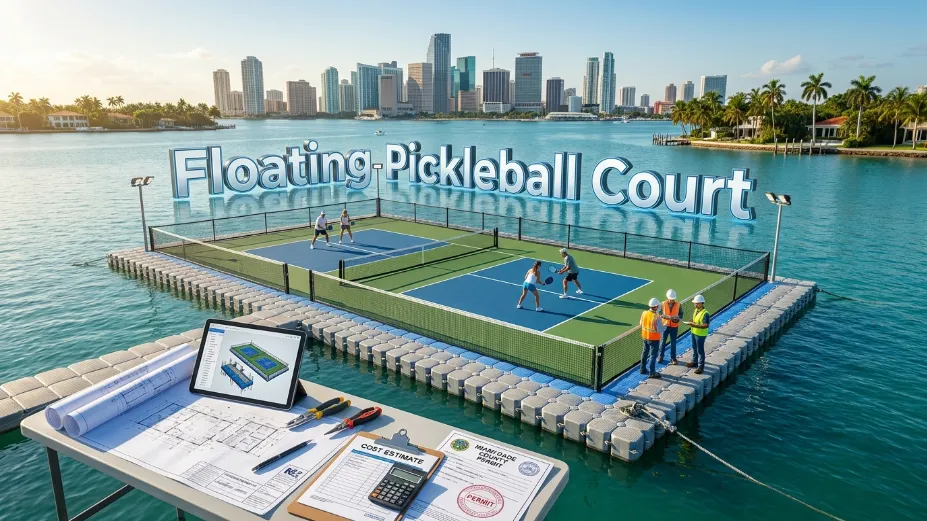
Land is no longer a requirement for a professional dink. While traditionalists are fighting for court time at crowded country clubs, a new breed of players is taking the game to the open water. A floating pickleball court is more than a luxury engineering feat; it is the ultimate solution for waterfront property owners who refuse to let geography limit their kitchen play. Whether it’s anchored in a private cove or attached to a mega-yacht, the physics of a high-performance floating pickleball court have evolved to deliver a true-bounce experience that rivals any asphalt surface in the country.
Comparison of 2026 floating pickleball systems: brand, pricing, use case, stability, installation type, and primary material
Quick Insights: A floating pickleball court is a specialized aquatic platform engineered with high-pressure drop-stitch technology (usually 12 inches thick) to provide a rigid, playable surface on water. While the ball bounce is approximately 3/4″ lower than a standard hardcourt, the experience is 100% functional for recreational play. In high-demand markets like Miami, these structures are increasingly used to bypass land scarcity, often requiring a Class I Coastal Construction Permit if permanently moored in tidal waters.
The Engineering Behind the Ultimate Floating Pickleball Court
The transition from asphalt to water isn’t as simple as throwing a mat on the waves. High-end floating pickleball courts rely on Drop-Stitch technology, the same engineering found in premium stand-up paddleboards. Thousands of polyester threads connect the top and bottom layers, allowing the court to be inflated to high pressures (up to 15 PSI) without bulging. This creates a surface that feels remarkably like a portable pickleball net setup on a gym floor.
Stability is the primary concern for any pickleball floating court. Manufacturers like AquaBanas design their units with a “ballast bag” system or heavy-duty D-rings for multi-point anchoring. This prevents the “wobble” during aggressive movements at the pickleball kitchen. Without a 12-inch base, the kinetic energy of a sprinting player would cause the opposite side of the court to dip, a common flaw in cheaper, sub-$5,000 models found on mass-market sites.
Market Analysis: Finding a Floating Pickleball Court for Sale
If you are searching for a floating pickleball court for sale, you must distinguish between “recreational toys” and “commercial assets.” The price gap is significant, often ranging from $8,000 to over $120,000. Commercial units, such as the Inflatable Island Pro, include anti-slip surfaces and reinforced seams designed to handle 50+ hours of weekly foot traffic.
- Entry-Level ($1,500 – $5,000): Best for small backyard ponds or swimming pools. These usually lack official pickleball court dimensions.
- Mid-Range ($8,000 – $25,000): Regulation-size inflatable courts with 12-inch thickness and perimeter netting. Ideal for luxury rental businesses.
- Elite Tier ($100,000+): Rigid, multi-deck structures like the Pickleball Bana, which feature spectator seating and integrated cabanas.
Floating Pickleball Court Miami: Navigating the Harbor Rules
Miami has become the global epicenter for luxury water sports innovation. However, installing a floating pickleball court miami harbor setup involves more than just a boat and an anchor. According to Section 24-48 of the Miami-Dade County Code, any structure “on or over” tidal waters requires a Class I Permit.
The city’s new Gold Key Permitting System has streamlined the process, aiming for a 90-day final decision on applications. However, biological assessments are mandatory. You must prove your floating pickleball courts won’t shade protected seagrass or interfere with manatee habitats. For private residential owners, Florida Statute 403.813 offers some exemptions for docks under 1,000 square feet, but since a regulation court is 880 square feet (20’x44′), adding safety margins often pushes owners into the full permitting category.
Head-to-Head: Floating Courts vs. Traditional Land Courts
To truly understand the value proposition, we must compare the mechanical performance of a pickleball floating court against the standard hardcourt experience.
- The Bounce Factor: A standard outdoor ball (like the pickleball balls used in tournaments) rebounds 30-34 inches on asphalt. On a high-pressure inflatable, expect a rebound of 28-30 inches. This requires players to bend their knees significantly more.
- Wind Dynamics: Floating courts are inherently exposed. While land courts use windscreens, water courts rely on the aerodynamics of 40-hole balls to maintain flight stability in 15 mph crosswinds.
- Surface Friction: Salt spray can create a slippery film. While asphalt stays gritty, inflatable PVC requires daily fresh-water rinsing to maintain traction for pickleball shoes.
Operational Challenges: The Saltwater and Wind Reality
One angle often ignored by major blogs is the “Spin Factor”. Saltwater humidity increases ball weight by a fraction of a gram, which, when combined with moisture on the paddle face, significantly reduces the effectiveness of topspin shots. Experienced players on a floating pickleball court often switch to a more “flat” hitting style to compensate for the erratic friction.
Furthermore, retrieval logistics are a hidden cost. At facilities like Wake Island in California, ball retrieval is handled via pool nets or jet skis. Interestingly, pickleballs float naturally, making them easier to “shag” in a cove than on a land court with deep bushes. However, losing a $200 carbon fiber paddle to the deep is a real risk; players are encouraged to use sealed-core paddles that offer some buoyancy.
Investment and ROI: The Business of Waterborne Sports
For resort owners, the ROI on floating pickleball courts is aggressive. In Florida lagoons, rentals can reach $600 for a 110-minute session. When bundled with full-day admission to waterpark attractions, the court effectively pays for its $20,000 purchase price in less than 40 high-occupancy days. This “Blue Ocean” strategy allows resorts to monetize water surface area that was previously just for “looking at.”
Safety and insurance remain the “red line.” Most homeowners’ policies in the US will not cover a floating sports platform. Owners must seek Inland Marine Insurance or specialized USAP-compliant liability coverage to protect against slip-and-fall injuries and potential “drifting” liability during storms.
Frequently Asked Questions About Floating Courts
Do pickleballs float if they hit the water?
Yes, regulation pickleballs are hollow plastic and float exceptionally well. Most facilities provide long-reach nets for easy retrieval without leaving the court.
What shoes should I wear on an inflatable court?
Standard sneakers are usually prohibited to prevent punctures. Most players use Aqua Socks or soft-soled water shoes. For maximum grip, check our guide on best shoes for pickleball.
Can I play in high winds?
Play is generally suspended when winds exceed 15-20 mph. The lightweight ball becomes unpredictable, and the platform may experience slight swaying, affecting your pickleball scoring accuracy.
How long does it take to inflate?
Commercial-grade courts take approximately 3.5 to 4 hours to reach full pressure using high-volume electric pumps. Deflation and storage take a similar amount of time.
Are there any “floating courts” for public use in Miami?
Most are currently private or part of luxury residential complexes like Laguna SoLé. However, public pop-up events in Miami Harbor are becoming common during the winter season.
The future of the game is fluid. As land prices in coastal cities continue to soar, the floating pickleball court transition from a “viral novelty” to a “structural necessity.” For those willing to invest in high-pressure engineering and navigate the coastal permits, the water offers a limitless frontier for the next great American dink.