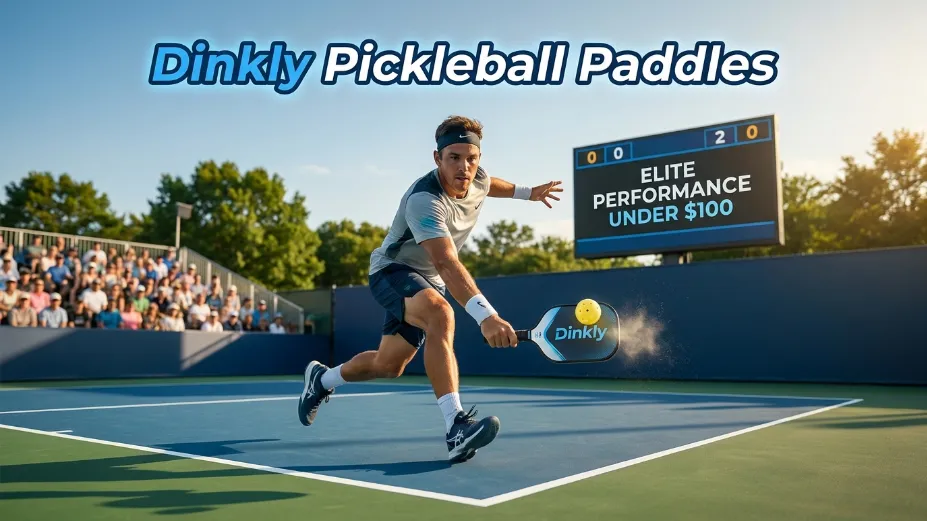
The court doesn’t care about marketing hype, but your elbow certainly does when a cheap honeycomb core dies mid-rally. While traditional brands scale up prices just to fund corporate pro sponsorships, a growing wave of competitive players in the US is quietly shifting to thermoformed control. Finding the right balance between raw spin and defensive stability leads straight to the latest engineering from dinkly pickleball paddles. If your current paddle feels hollow or lacks the grit needed to drop a baseline drive into the kitchen, it is time to look under the carbon fiber hood of a unibody build that refuses to compromise on aesthetics or court performance.
Dinkly Paddle Series
Core Tech · Design & Weight · Skill Level & Intent
Dinkly Radial Pro Carbon Fiber Pickleball Paddle: Viscoelastic Shock Absorption & Spin Dynamics
In the arena of competitive pickleball, vibration is the silent enemy of the wrist, elbow, and shoulder joints. The dinkly radial pro carbon fiber pickleball paddle has emerged as a premier engineering response to vibration-induced strain, offering players a highly technical solution to lateral epicondylitis, commonly known as tennis elbow. By integrating dual polyurethane inserts into its elongated handle, this paddle behaves as a tuned viscoelastic dampening system, filtering out high-frequency mechanical shock waves before they travel up the player’s arm.
This exceptional structural stability is anchored by its Toray T700 face, which is thermoformed into a unibody layout. When you impact a ball with the Radial Pro, the perimeter-injected foam walls collapse slightly under stress, expanding the sweet spot and preventing torsional twisting (paddle twist weight). Unlike traditional non-thermoformed models that suffer from structural instability during off-center hits, the dinkly radial pro carbon fiber pickleball paddle maintains an incredibly uniform energy transfer across its surface, giving players unparalleled confidence during fast-paced hand battles at the kitchen line.
To maximize rotational force on the ball, Dinkly applies its proprietary heat-press grit technology directly into the carbon layup. While cheaper brands rely on quick spray-on sand textures that deteriorate after a few weeks, this thermo-compressed texture remains structurally intact, allowing for aggressive topspin rolls and precision slices. The 16mm core option absorbs incoming pace with absolute ease, making it a masterpiece for the third-shot drop, whereas the 13mm variant offers a crisper, more offensive feedback profile for aggressive bangers.
Dinkly Pickleball Paddle Edge Protection: The Mechanical Science of Curved Tape Application
The lifetime of a premium paddle is directly bound to how well you guard its perimeter from court abrasions . This is where dinkly pickleball paddle edge protection tape steps in, shifting the paradigm from basic cosmetic protection to deliberate impact dampening . Standard flat tapes are highly prone to wrinkling when applied around the curved upper profile of a paddle . Because they cannot stretch in two dimensions simultaneously, they form tiny air pockets and creases that eventually fail, leading to adhesive peeling and exposed carbon layers .
Dinkly solves this geometric limitation using a specialized serrated (sawtooth) edge design . These precise notches allow the tape to compress and overlap smoothly along the paddle’s curves, providing a tight, professional wrap-around fit . This custom edge protection is engineered in three distinct widths to perfectly match varying paddle geometries :
- 20mm Width: Specifically designed to guard such as the Dinkly Atoms Pro without introducing drag or altering balance .
- 23mm Width: The industry standard for traditional 13mm to 14mm cores, aligning flawlessly with standard plastic bumper profiles .
- 26mm to 30mm Width: Optimized for thicker 16mm paddles (like the Fusion and Radial Pro series) to provide complete wrap-around protection over the thick bumper borders .
To apply this tape successfully, players should first wipe down the edge guard with a damp cloth to eliminate sweat salts and dirt . Stand the paddle vertically, aligning the midpoint indicator of the tape with the center apex of the paddle . Gently pull and stretch the tape as you smooth it down each side simultaneously, applying firm inward pressure towards the paddle face . Smooth out any micro-bubbles to activate the pressure-sensitive adhesive, ensuring a clean, lightweight shield that lasts for months of intensive play .
Clearing the Name Confusion: Dinkly vs. Dink Pickleball Paddles in the US Market
As the sport continues to swell across the United States, players frequently face brand confusion when searching for “Dink” and “Dinkly” gear. While the names sound incredibly similar, they represent completely different companies, design philosophies, and technological origins. Choosing the right tool requires analyzing these key distinctions so you do not accidentally purchase a paddle that contradicts your playing style.
First, dinkly pickleball paddles represent a laboratory-first brand operating on a Direct-to-Consumer (DTC) model. Instead of paying exorbitant sponsorship fees to marquee pro athletes, Dinkly invests heavily in material science, swing weight tuning, and core compression testing on the(). This engineering-focused model results in high-end thermoformed paddles priced significantly under the $100 threshold, representing outstanding value for intermediate and advanced players.
In contrast, the term dink pickleball paddles can refer to several distinct brands in the US ecosystem:
- diNGK Sports: Known for their high-end HYPR PRO X series, these paddles feature a raw carbon T700 face and a proprietary “Hyper Foam” wall injected around a polypropylene core to enhance durability and sweet spot stability.
- Dink Ninjas: Based in Austin, Texas, this brand offers the mid-weight Dink Ninja Carbon paddle ($139.00), utilizing a premium raw 18k carbon fiber face and a dual-layer polypropylene core for exceptional power and touch.
- The Dink Master by Spank Paddles: Designed specifically as a precision tool to dominate kitchen play, this paddle excels in cross-court touch, alongside Spank’s other releases like the Stealth and Sniper paddles. It shouldn’t be confused with the popular Dink Master 3.0 rebounder training board, which is an off-court training aid .
Understanding these branding boundaries ensures you target the exact paddle technology you need—whether it’s the raw 18k carbon face of a dink pickleball paddle or the full-foam EPP core of a Dinkly build.
Core Physics: EPP + EVA Full-Foam vs. Traditional Polypropylene Honeycomb Cores
To understand the leap in performance that modern offer, we must examine the physical behavior of core materials under stress. For years, the industry standard has been the polypropylene (PP) honeycomb core. While honeycomb cores are lightweight, they suffer from a mechanical failure known as “core crush”. Over months of repeating high-velocity impacts, the thin plastic walls of the honeycomb cells experience micro-fractures and structural buckling, leading to unpredictable dead zones on the face.
Dinkly’s Fusion series addresses this issue using a revolutionary EPP + EVA U-Core™ full-foam construction. EPP (Expanded Polypropylene) foam provides a highly elastic, solid core that eliminates dead zones entirely, offering up to three times the structural lifespan of traditional honeycomb. Surrounding this EPP core is an EVA (Ethylene-Vinyl Acetate) U-shaped perimeter ring. This hybrid combination functions as a dynamic spring, absorbing incoming energy and snapping back to deliver a massive power boost during fast counter-attacks.
This structural behavior is governed by the physics of strain-rate sensitivity in polymer foams, modeled by the flow stress equation:
σ=C⋅ε˙m
Where:
- σ represents the flow stress (the core’s instantaneous resistance to deformation).
- C is a specific material formulation constant of the EPP polymer.
- ε˙ is the strain rate (representing the speed and velocity of the ball’s impact).
- m is the strain-rate sensitivity exponent of the foam structure.
During soft, slow-paced exchanges, the strain rate (ε˙) is low. The EPP cells compress easily, taming the ball and providing an ultra-plush touch for a perfect . When a hard baseline drive hits the face, the high strain rate triggers a sharp spike in flow stress (σ), causing the core to instantly stiffen into a solid, high-rebound barrier that returns explosive power with zero break-in period.
The Core Thickness Debate: 14mm vs. 16mm Paddles
When selecting a paddle, choosing a core thickness is one of the most critical decisions a player can make. A 16mm core is widely considered the gold standard for defensive play and control, as the thicker profile absorbs more kinetic energy, increases ball dwell time, and expands the sweet spot. Conversely, a 14mm core is thinner, lighter, and stiffer, offering a much faster swing speed and immediate ball pop off the face, though at the cost of control and defensive forgiveness.
Head-to-Head Comparison: Dinkly Fusion vs. Six Zero Ruby
To establish how these engineering choices stack up on the court, let us pit the Dinkly Fusion directly against one of the most popular premium hybrid paddles in the United States: the Six Zero Ruby.
- Face Material Layup: The Six Zero Ruby features a 100% DuPont™ Kevlar® face, providing a crisp, highly responsive feel that delivers instant ball pop. The Dinkly Fusion utilizes a 4-ply Toray T700 raw carbon face with a 45° cross-weave layup, which prioritizes a slightly longer dwell time and cleaner, more predictable spin feedback.
- Core Architecture: While the Ruby relies on a traditional polypropylene honeycomb core that is highly vulnerable to gradual core crush over extended play, the Fusion uses the EPP + EVA full-foam core. This EPP center guarantees a consistent response across the entire face, completely eliminating dead spots and significantly extending the physical lifespan of the paddle.
- Pricing and Value: The Ruby commands a premium price tag of $200.00+, reflecting its extensive marketing campaigns and player sponsorships. In contrast, the Dinkly Fusion retails for just $89.00 on the official brand site, offering elite thermoformed performance at a fraction of the cost.
Edgeless Physics and Spin Generation: The Atoms Pro Analysis
For players who prioritize hand speed at the NVZ (Non-Volley Zone) line, the edgeless design of the Dinkly Atoms Pro is a true masterclass in aerodynamics. Removing the thick plastic bumper guard reduces drag by nearly 12%, allowing for lighting-fast reaction times during rapid hand battles. To prevent edge delamination—the primary failure point of most edgeless designs—Dinkly implements a high-pressure thermoforming process that seals the raw carbon face and foam-injected walls into a single unibody structure.
Spin generation on the Atoms Pro is fueled by SpinPro Micro Grit technology. While cheap paddles use an aesthetic sand-paint texture that wears flat after a month, SpinPro Micro Grit is heat-pressed directly into the carbon weave. This microscopic surface roughness dramatically increases friction with the plastic ball, allowing intermediate and advanced players to generate spin over 2,100 RPM, keeping aggressive rolls and drives diving safely within the baseline borders.