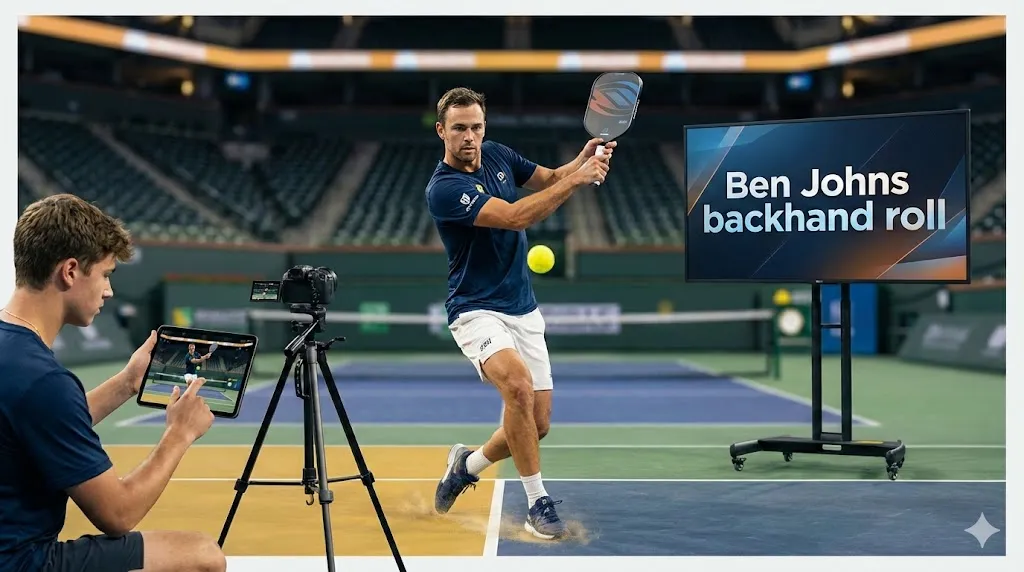
Picture this: You are at the kitchen line, locked in a dinking battle. Your opponent pushes a ball deep to your backhand side. For most players, this is a moment of panic—a defensive reset or a weak slice is the only option. But if you watch professional pickleball, you’ll see a different story. You’ll see the undisputed world number one utilize his signature weapon to turn defense into instant offense.
This weapon is the Ben Johns backhand roll. It is perhaps the most defining shot of modern pickleball, allowing players to attack balls that are technically below the net height, applying massive topspin to keep them in the court. If you are tired of being pinned in your backhand corner, unable to generate pressure, this guide is your roadmap out of that defensive mindset.
In this comprehensive guide, we will break down the mechanics of the two-handed backhand roll technique, analyze the slow-motion nuances that make Ben’s shot so deadly, and provide a step-by-step pickleball backhand roll tutorial to help you add this tool to your arsenal.
The Foundation: Grip, Stance, and the “Ben Johns” Setup
Before you can execute the shot, you must understand the foundation. Ben Johns didn’t invent the backhand, but he revolutionized how it’s used at the Non-Volley Zone (NVZ). The secret starts with how you hold the paddle.
The Two-Handed Grip Configuration
Unlike a one-handed slice where the dominant hand does all the work, the Ben Johns backhand roll relies heavily on the non-dominant hand. Here is the breakdown:
- Dominant Hand (Right Hand for Righties): You should be in a Continental Grip. Think of this hand as the pivot point or the hinge. It provides stability but does not generate the primary driving force.
- Non-Dominant Hand (Left Hand for Righties): This hand should be in an Eastern or Semi-Western Forehand grip (relative to the left hand). This is crucial. The non-dominant hand is the “driver.” It pushes the paddle through the ball and generates the topspin.
Stance and Readiness
To disguise the shot effectively, your body position is key. Ben Johns is a master of disguise. He sets up his feet slightly staggered, with the right foot (for a right-handed player) slightly forward. This allows him to load his hips.
More importantly, his paddle is always in the “ready position” — slightly out in front, tip up, and favoring the backhand side (roughly 10 or 11 o’clock). This readiness allows for a seamless transition into the roll without a massive, telegraphed backswing.
Pickleball Backhand Roll Tutorial: A Step-by-Step Guide
Many players understand the idea of the roll but fail in the execution. Let’s break down the pickleball backhand roll tutorial into distinct, actionable phases. This is how you build the shot from the ground up.
Phase 1: The Recognition and Drop
The moment you recognize a dink landing comfortably on your backhand side, the process begins. You must drop the paddle head below the ball. This is non-negotiable. To generate topspin (which brings the ball down into the court), your paddle must travel from low to high.
Pro Tip: Do not just drop your hands; drop your knees. Ben Johns gets low with his legs to ensure his eye level is closer to the contact point.
Phase 2: The Coiling (Loading)
As the ball bounces, rotate your shoulders slightly. You aren’t taking a massive tennis backswing. Instead, think of “coiling” your torso. Your paddle tip should be pointing down towards the ground, creating a vertical face that is ready to brush up the back of the ball.
Phase 3: The Contact (The “Brush”)
This is where the magic happens. You want to contact the ball out in front of your body—not beside you, and definitely not behind you.
- The Motion: Initiate the swing with your non-dominant shoulder and arm pushing forward and up.
- The Wrist: Use a snapping motion with your wrists, brushing up the back of the ball effectively. This creates the “roll.” You aren’t slapping the ball flat; you are rolling over it.
Phase 4: The Windshield Wiper Follow-Through
If you watch Ben Johns backhand roll slow motion clips, you will notice his follow-through resembles a windshield wiper on a car. After contact, the paddle doesn’t just go straight out; it wraps across his body towards his right ear. This “wiper” motion maximizes the topspin revolutions (RPMs), ensuring that even if you hit the ball hard, the physics of the spin will force it to dive back onto the court.
The Mechanics: Dissecting the Motion
To truly master the two-handed backhand roll technique, we need to look closer at the biomechanics. Why does Ben Johns generate so much more power and control than the average 4.0 player?
Wrist Snap vs. Arm Lift
A common mistake is lifting the entire arm from the shoulder socket without using the wrist. This results in a “push” rather than a “roll.” The power in Ben’s shot comes from a kinetic chain: legs push up, hips rotate, arm lifts, and finally—the most critical part—the wrists snap aggressively at the point of contact.
This wrist snap is what accelerates the paddle head speed instantly. Without the snap, the ball will likely float high and long (out of bounds). With the snap, the ball dips aggressively.
The Compact Swing Path
In pickleball, time is a luxury you don’t have. The backhand roll is a compact stroke. The distance the paddle travels before hitting the ball is short. The acceleration is explosive but contained. This compactness is what allows Ben to win rapid-fire hand battles. If your swing is too long, you will get jammed.
Ben Johns Backhand Flick vs Roll: Understanding the Difference
You will often hear commentators use the terms “flick” and “roll” interchangeably, but there are technical differences. Understanding the nuance of Ben Johns backhand flick vs roll can help you choose the right shot for the right moment.
The Backhand Flick
The flick is primarily a wrist-dominant shot used to surprise the opponent. It is faster, flatter, and has less topspin than a roll. Ben often uses the flick when he catches a ball out of the air (a volley) that is slightly high but hasn’t bounced yet. It is a quick “sting” meant to catch the opponent off guard.
The Backhand Roll
The roll is a stroke that utilizes more arm and shoulder mechanics along with the wrist. It generates heavy topspin (loopy trajectory). The roll is typically used on balls that have bounced (dinks). The goal of the roll isn’t just speed; it’s placement and pressure. The heavy spin makes the ball “heavy” on the opponent’s paddle, often forcing a pop-up.
Strategic Application: When to Pull the Trigger
Having the technique is useless if you don’t have the pickleball strategy to back it up. When does Ben Johns decide to unleash the roll?
Reading the Dink
Ben doesn’t roll every ball. He waits for a “dead dink”—a ball that lands shallow in the kitchen or bounces slightly higher than intended. If he sees an opponent leaning back or out of position, he identifies this as a green light. Patience is key; forcing a roll on a low, biting slice dink often leads to unforced errors.
Targeting Zones
Where you aim is just as important as how you hit. Ben Johns typically targets three specific zones with his backhand roll:
- The Right Hip/Shoulder (Chicken Wing): Aiming for the dominant hip or shoulder of a right-handed opponent jams them, making it nearly impossible to counter-attack effectively.
- The Feet: Rolling the ball steeply at the opponent’s feet forces them to hit a defensive pop-up, which sets up your partner for a smash.
- The Open Court: If the opponent pinches the middle too hard, Ben rolls the ball wide to the sideline, utilizing the sharp angle created by the topspin.
Using the roll effectively sets up the rest of your game, including the pickleball dink. If opponents fear your roll, they may try to keep their dinks too low, leading to errors into the net.
Troubleshooting & Common Mistakes
Even with the best paddle in hand, like the JOOLA Perseus, you will encounter execution errors. Here is how to fix the most common problems.
Why does my backhand roll go into the net?
This usually happens because the paddle face is closed too early. You might be rolling your wrists over the ball before making contact rather than through contact. Ensure your paddle face is vertical (open enough) at the moment of impact to lift the ball over the net before the topspin takes over.
How do I stop “popping up” the ball?
If your rolls are sailing high and long, you are likely lifting with your shoulder but forgetting the wrist snap. The “snap” imparts the spin that pulls the ball down. Without it, you are just hitting a lob. Focus on the “windshield wiper” finish to correct this.
How can I practice the Ben Johns roll alone?
You don’t need a partner to refine this mechanic. Wall drills are excellent. Stand 7 feet from a wall (kitchen distance) and practice hitting continuous backhand rolls against the wall. Focus on the low-to-high motion and the wrist snap. For more structured regimens, check out our guide on pickleball drills.
Frequently Asked Questions (FAQ)
1. Can I use a one-handed backhand roll like Ben Johns?
While Ben Johns predominantly uses a two-handed backhand roll for stability and power, he is capable of one-handed shots. However, for the specific “roll” technique at the kitchen line, the two-handed approach is superior because the non-dominant hand helps generate the necessary topspin and control in a short space.
2. What is the best paddle for a backhand roll?
Paddles with a carbon friction surface (Raw Carbon Fiber) are generally best for this shot because they grab the ball, allowing for maximum spin generation. The “dwell time” on the paddle face is crucial for executing a proper roll.
3. How do I stop hitting the net tape on my rolls?
Aim for a higher margin of error. The beauty of topspin is that you can aim 6-10 inches above the net, and the spin will bring the ball down. Don’t try to skim the net cord; trust the physics of the roll to keep the ball in.
4. Is the backhand roll an offensive or defensive shot?
It is a hybrid. It is primarily an offensive shot used to pressure opponents, but it also serves a defensive purpose by allowing you to take balls out of the air that would otherwise force you to retreat. It neutralizes the opponent’s aggressive dinks.
Conclusion
Mastering the Ben Johns backhand roll is not an overnight process. It requires a shift in mindset from passive defense to calculated offense. By adopting the two-handed grip, perfecting the low-to-high “windshield wiper” mechanics, and understanding the strategic difference between the flick and the roll, you can transform your backhand from a weakness into a weapon.
Remember, the goal isn’t to hit the ball as hard as possible; it’s to use the roll to disrupt your opponent’s rhythm and create easy put-away opportunities. So, grab your paddle, hit the wall, and start practicing the wrist snap today. Your next opponent at the kitchen line won’t know what hit them.