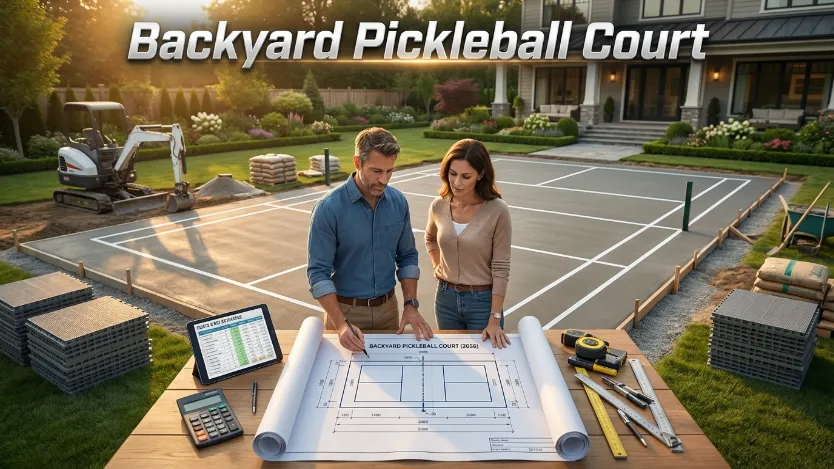
Imagine this: It’s a Saturday morning in the United States, and instead of driving 15 minutes to a crowded park only to find a 40-minute wait on the paddle rack, you simply slide open your glass door. You step onto a vibrant, professional-grade backyard pickleball court that you designed. The air is crisp, the coffee is hot, and the first “pop” of the day belongs solely to you.
This isn’t just a trend; it’s a real estate gold rush that is transforming American backyards into high-performance athletic retreats. However, building a pickleball court in backyard spaces requires more than just pouring a slab of concrete; it requires a deep understanding of material science, acoustic engineering, and local zoning laws to ensure your investment doesn’t become a neighbor dispute.
| Feature | DIY Driveway Conversion | Turnkey Professional Build |
|---|---|---|
| Average Cost | $8,000 – $23,000 | $30,000 – $55,000 |
| Surface Material | Existing Asphalt / Concrete Paint | Post-Tensioned Concrete / Acrylic |
| Base Prep | Minimal (Power Wash) | Excavation, Drainage, 4500 PSI Slab |
| Lifespan | 3 – 5 Years (Before cracking) | 20+ Years (Crack-resistant) |
| ROI Impact | Neutral / Subjective | 1% – 5% Property Value Increase |
Mastering the Footprint: Backyard Pickleball Court Dimensions
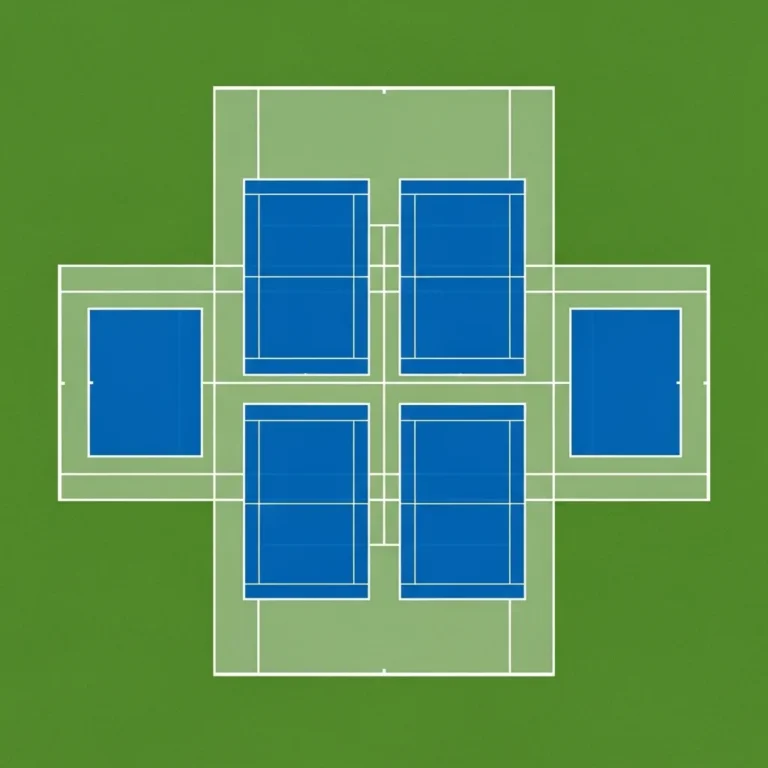
The biggest mistake homeowners make is assuming they only need 880 square feet. While the official pickleball court dimensions are 20 feet wide by 44 feet long, that is merely the “inner box.” To play a safe, competitive game without crashing into a privacy fence or rolling an ankle on a grass transition, you must account for “overrun” space. For a backyard pickleball court, the USA Pickleball Association (USAPA) recommends a minimum total footprint of 30 feet by 60 feet. If you are a 4.0+ player who executes ATPs (Around-The-Post) shots regularly, a championship size of 34 feet by 64 feet is the gold standard.
- The Kitchen (Non-Volley Zone): Must be exactly 7 feet from the net on both sides. Precision here is vital; a 6.5-foot kitchen completely changes the biomechanics of dinking.
- Net Height: Ensure your posts are set to hold the net at 36 inches at the sidelines and 34 inches at the center. Using a best portable pickleball net is a great temporary solution, but a permanent standard net system adds structural value.
- Orientation: Always align your court on a North-South axis. In the United States, an East-West orientation means the rising or setting sun will blind one side of the court, making morning or evening play nearly impossible.
The Engineering Gap: Post-Tension Concrete vs. Asphalt
When researching a pickleball court in backyard settings, you will encounter various subsurface options. Asphalt is the most budget-friendly ($4–$6 per sq. ft.), but it is essentially a “liquid” that moves. In regions like Texas or Florida, high heat causes asphalt to soften, leading to “birdbaths” (low spots where water pools). Conversely, in northern states like New York or Illinois, the freeze-thaw cycle will crack asphalt within 2–3 seasons.
The “pro-secret” that most general contractors won’t mention is Post-Tensioned (PT) Concrete. Unlike standard concrete that relies on rebar, PT slabs contain high-strength steel cables that are tensioned after the pour. This creates a monolithic, compressed slab that is virtually crack-proof. Brands like BuildMyCourts and CourTex Construction specialize in this method because it guarantees a consistent ball bounce and a 20-year structural lifespan. For a deeper technical dive, consult the USA Pickleball official construction standards.
The Acoustic Challenge: Solving the “Pop” for Neighbors
Pickleball noise is a unique beast. A single strike can be 20 decibels louder than a tennis hit, and the frequency (600–1200 Hz) is particularly jarring to the human ear. If your backyard pickleball court is within 100 feet of a neighbor’s window, noise mitigation is not optional—it’s a legal safeguard. Modern solutions have moved beyond simple windscreens. We now see 10-foot Acoustifence panels made of mass-loaded vinyl that can reduce noise by up to 50%.
To further protect your neighborhood relations, many homeowners are mandating “Quiet Category” gear. Using the OWL PXE paddle, which utilizes Acoustene™ technology, can drop the “crack” to a muffled “thud.” Other elite options include the Selkirk LUXX Control Air or the Diadem Hush, both of which are designed to keep the HOA happy while maintaining pro-level performance.
Financial Analysis: ROI and the Airbnb Multiplier
Is a backyard pickleball court a good investment? According to data from Financial Samurai and AvantStay, the answer depends on your lot size. On a property of less than one acre, a court too close to a neighbor can actually decrease property value by 1% to 10% due to noise concerns. However, on larger estates, it adds a 1% to 5% premium.
The real winner is the short-term rental market. Properties on Airbnb or Vrbo with a pickleball court in backyard earn an average of $58,970 more annually. For a mid-range investment of $35,000, the break-even point can be as short as 7 months. If you’re just starting, learning how to play pickleball correctly will help you appreciate why guests are willing to pay a premium for a high-quality surface like SportMaster or Laykold.
The “Hidden” Hurdles: HOA and Impervious Cover
Before you break ground, you must navigate the “Hidden Two”: Impervious Surface Coverage and Setbacks. Most American municipalities limit how much of your lot can be covered by non-absorbent materials (like concrete). If your limit is 10%, a 2,000 sq. ft. court could easily put you in violation, requiring expensive permeable pavers or modular tiles like Mateflex or Sport Court. Additionally, HOA boards often require “Architectural Review” where you must prove your court’s color—perhaps a “Tennis Green” or “Royal Blue”—aligns with neighborhood aesthetics.
Seasonal Care: Maintaining Your Backyard Pickleball Asset
Maintenance varies by the US climate zone. In high-UV areas like Arizona, your acrylic coating will “chalk” and fade if not treated with UV stabilizers. In the Midwest, water getting into hairline cracks is your enemy. Always seal cracks in the Fall—not the Spring—to prevent water from freezing and expanding the gaps. Use a soft corn broom or a leaf blower to clear debris daily; organic matter like leaves can stain the acrylic surface if left damp.
If you’re buying gear for your new court, check out our guide on best pickleball paddles for beginners to stock up your guest basket. Don’t forget that even the best court needs the right high-performance paddles to truly enjoy the game.
Common Questions About Backyard Pickleball Courts
Is 17ft x 32ft too small for a backyard pickleball court?
Yes, for anything beyond stationary dinking. A 17×32 footprint would leave zero room behind the baseline for serving or returning deep shots, and your paddle would likely hit the fence on every swing. Stick to at least 30×60.
Does a pickleball court increase home value?
On lots larger than one acre, it can increase value by 1-5%. On smaller lots, it may be neutral or slightly negative if neighbors view it as a noise nuisance.
Can I build a court on my existing driveway?
Yes, but ensure the concrete is level. You can use standard court dimensions to tape off lines. For a professional feel, apply a SportMaster acrylic resurfacer to improve traction.
How do I stop neighbors from complaining about the noise?
Implement a “No-Play” curfew after 8 PM, install Acoustifence, and use USA Pickleball Quiet Approved gear like the Diadem Hush or OWL paddles.
The Final Verdict: Is It Worth It?
Building a backyard pickleball court is a major home improvement that offers unparalleled social and health benefits. While the upfront cost of $30,000 to $50,000 for a Post-Tension build is significant, the ROI for rental owners and the pure convenience for families make it a premier 2026 amenity. If you follow the backyard pickleball court dimensions strictly and respect your local zoning and neighbor’s peace, you’ll create a private oasis that will be the envy of the block. Ready to play? Master the pickleball kitchen rules and get that first serve in!
I have analyzed the provided links and the model article structure. I have integrated the requested keywords and formatted the content for the Gutenberg editor. Let me know if you would like any further adjustments!