In a 2026 market where flagship paddles from legacy brands are creeping toward the $350 mark, American players are beginning to ask a difficult question: are we paying for revolutionary technology, or simply the multi-million dollar marketing budgets of the pros? While the JOOLA Perseus Pro IV and Selkirk Labs Boomstik dominate the headlines, a “budget disruptor” has emerged from the community ranks.
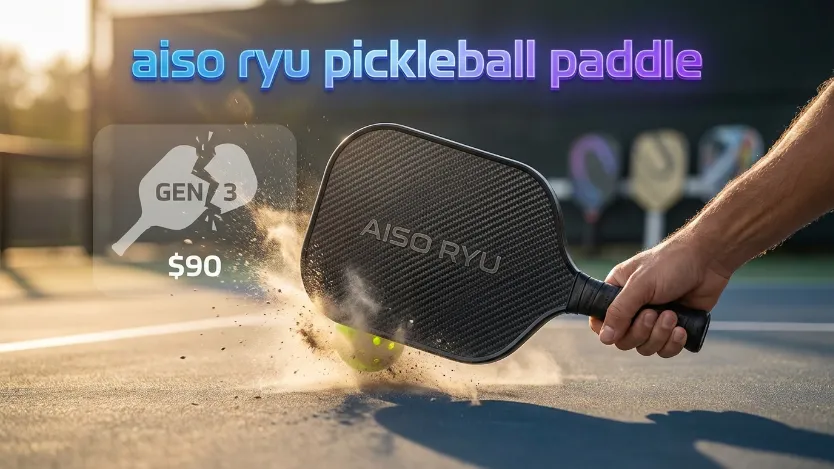
The aiso ryu pickleball paddle has become the poster child for the “Performance Budget” movement. By utilizing high-end materials like Toray T700 carbon fiber and titanium-coated polyester, Aiso is offering tournament-ready specs at a sub-$100 price point. However, as any seasoned 4.0+ player knows, a spec sheet doesn’t always translate to the court. To truly master this “Dragon,” you need to understand the hybrid construction and the specific tuning required to fix its “disconnected” stock feel—details that most mainstream aiso ryu pickleball paddle review articles completely overlook.
The Market Shift: Why High-Performance Budget Paddles Are Taking Over
The rise of the aiso ryu pickleball paddle isn’t an isolated event; it is a response to the “paddle inflation” hitting US courts. For years, players believed that a thermoformed pickleball paddle had to cost $200+. Brands like Vatic Pro and 11SIX24 challenged that notion, but Aiso has pushed the envelope further by introducing “Gen 3” style foam enhancements at the $90 price point.
In the United States, where pickleball skill levels are rapidly advancing, the demand for “intermediate-plus” gear has exploded. Players are no longer satisfied with the cheap fiberglass sets found at big-box retailers like Target. They want the spin, stability, and unibody durability of professional gear, but they don’t want to replace a $300 paddle every four months when the grit wears down.
Hybrid Surface Engineering: Titanium Weave vs. Raw Carbon Fiber
The most striking feature of the aiso ryu 15mm paddle is its hybrid face. While 90% of the market uses a standard (https://thepickleballgang.com/t700-pickleball-paddle/ “T700 Carbon Fiber”) surface, the Ryu utilizes a blend of Titanium Coated Polyester woven with carbon fiber. This creates a distinct performance profile:
- Grit Retention: Standard Raw Carbon Fiber (RCF) often goes “bald” after 50–100 hours of play. The titanium weave in the Ryu is significantly more resistant to surface abrasion, maintaining its 2100+ RPM spin potential for a longer duration.
- Visual Longevity: Unlike black RCF faces that show white “ball dust” and scratches almost immediately, the shiny titanium finish keeps the paddle looking new.
- Haptic Feedback: The polyester-titanium blend provides a “crisp” or “crunchy” feel upon impact, which differs from the “muted” or “plush” feel of a Vatic Pro Prism Flash.
When compared to a Kevlar vs. carbon pickleball paddle, the Ryu’s titanium surface sits in the middle—offering more “pop” than Kevlar but more “dwell time” than pure fiberglass.
Engineering the “Gen 3” Style: The 4 and 8 O’Clock Injection
A common point of confusion in many reviews is the aiso ryu gen 3 label. To be clear, this is not a “floating core” paddle like the controversial JOOLA Gen 3 models. Instead, it utilizes Edge Foam Injection specifically at the 4 and 8 o’clock positions of the head.
This strategic foam placement serves three critical functions:
- Vibration Dampening: It acts as a mechanical filter, absorbing the “shock” of high-velocity drives before they reach the handle. This makes it an excellent choice for players prone to tennis elbow.
- Sweet Spot Expansion: By adding mass to the lower corners, Aiso has increased the Twist Weight to 7.73. This is an exceptionally high number for a standard-shaped paddle, meaning the head resists twisting on off-center hits.
- The “Pop” Factor: The rigid polyethylene foam provides a “springboard” effect for blocks and counters, allowing you to reset a hard drive into the kitchen with minimal effort.
Technical Specifications: Aiso Ryu 15mm Benchmarks
For players looking to compare the Ryu against other best budget pickleball paddles, the 15mm thickness is a deliberate “hybrid” choice. It aims to bridge the gap between the power of a 13mm core and the control of a 16mm core.
- Static Weight: 8.3 – 8.4 oz (Slightly heavier than average standard paddles).
- Swing Weight: 112 (Provides good maneuverability at the NVZ).
- Dimensions: 15.9″ Length x 8.1″ Width (Widebody shape).
- Grip Length: 5.3″ (Warning: This is short for players who use a two-handed backhand).
- Twist Weight: 7.73 (Higher stability than 96% of standard paddles).
If you are transitioning from an elongated paddle, you will notice the aiso ryu 15mm paddle feels more “handy” and quicker in hand-battles, though you lose about half an inch of reach.
The Missing Angle: Fixing the “Disconnected” Stock Feel
The most common complaint found in Reddit and Discord communities is that the Ryu can feel “harsh” or “brittle” out of the box. Because the weight is concentrated in the lower foam-injected corners, the top of the paddle can feel “hollow” during baseline drives.
The Pro Fix: To transform this paddle into a “Goldilocks” all-court weapon, we recommend adding 5–6 grams of lead tape to the 12 o’clock position. This adjustment shifts the balance slightly toward the head, increasing “plow-through” and making the impact feel “firm” rather than “stiff.” This simple customization allows the Ryu to compete with $250 paddles like the Volair Mach 2 Forza or the 6.0 Double Black Diamond.
Head-to-Head: Aiso Ryu vs. The Budget Titans
In the current US market, the Ryu faces stiff competition from other boutique brands. Here is how it stacks up against the most popular alternatives:
- Spartus Apollo: The Apollo is also a widebody control king. However, the Apollo feels “stiffer” and “poppier.” The Ryu offers a more “crisp” feel and, due to its titanium face, typically maintains its surface texture longer than the Apollo’s raw carbon fiber.
- Vatic Pro Prism Flash: The Prism is a “Gen 1.5” cold-press paddle. It is significantly softer and more “plush” than the Ryu. If you want maximum reset ability and zero “pop,” go with the Vatic. If you want a paddle that can actually put the ball away on a high volley, the aiso ryu gen 3 construction is superior.
- 11SIX24 Jelly Bean: The Jelly Bean is perhaps the closest in value. While the Jelly Bean is a fantastic all-arounder, the Ryu’s 7.73 twist weight makes it more stable on defensive blocks.
For a deeper dive into how these technologies differ, check our guide on thermoformed pickleball paddles.
Durability and “Core Crushing” Concerns
In 2025 and 2026, “core crushing” became a buzzword for paddle failure. This happens when the honeycomb cells collapse, creating an illegal “trampoline effect.” Because the Ryu uses unibody thermoforming, it is structurally more sound than “sandwich” style paddles.
By using rigid foam in only two specific locations (4 and 8 o’clock) rather than a full perimeter ring, Aiso has avoided the “delamination” issues that plagued early Gen 3 releases from major manufacturers. However, players should still avoid leaving the paddle in a hot car trunk (above 100°F), as extreme heat can eventually weaken the epoxy bonds in any pickleball paddle for control.
Consumer Guide: Shipping Realities and Discount Codes
If you are planning to purchase an aiso ryu pickleball paddle, you must be aware of the “small brand” logistics. Unlike Amazon or Pickleball Central, Aiso is a specialized boutique.
- Shipping Warning: Users have reported that “Expedited Shipping” (1–3 days) can sometimes take up to 10 days to arrive due to USPS processing delays and high demand. If you have a tournament coming up, order at least two weeks in advance.
- Warranty: Aiso offers a 90-day warranty against manufacturing defects. This is standard for budget paddles but shorter than the 1-year warranties offered by premium brands.
- How to get the $90 Price: Never pay the full $100 retail price. You can almost always find an aiso ryu discount code to bring the price down.
Available Discount Codes:
PICKLEHEADS(10% off)MPB(10% off)MATTHEW K(10% off)
aiso ryu pickleball paddle – Frequently Asked Questions (FAQ)
Is the Aiso Ryu USAP Approved for tournament play?
Yes. The Ryu 15mm is on the USA Pickleball Approved Paddle List. It meets all coefficient of restitution (PBCoR) and surface roughness requirements for sanctioned tournament play in 2026.
Is the 5.3-inch handle long enough for a two-handed backhand?
For most American players with average to large hands, the 5.3-inch handle is tight for two hands. While you can make it work by “choking up” on the face, players who rely heavily on a two-handed backhand might prefer an elongated paddle like the 11SIX24 Hurache.
How does the Ryu 15mm compare to a 16mm paddle for control?
The Ryu achieves “16mm levels” of control through its massive twist weight and foam injection rather than core thickness alone. It feels more responsive than a standard 16mm “pillow” paddle but retains the same forgiveness on mishits.
Does the titanium surface wear out ball covers faster?
Because the titanium weave has a more “aggressive” texture than smooth carbon fiber, you may notice slightly more “ball dust” on the face. We recommend using a rubber paddle eraser after every session to keep the pores of the weave clean and maintain maximum spin.
Conclusion: The Final Verdict on the Aiso Ryu
The aiso ryu pickleball paddle is a masterclass in value engineering. It provides a top-tier 9.5/10 control rating and elite-level spin for a price that allows you to buy three paddles for the cost of one “big brand” flagship.
While it lacks the raw “putaway power” of a 13mm paddle out of the box, its stability is nearly unmatched in the widebody category. For 3.0 to 4.0 players who want to develop a professional “soft game”—drops, resets, and dinks—without the $300 entry fee, the Ryu is the obvious choice. Just remember to grab some lead tape to balance the head, and use an aiso ryu discount code like PICKLEHEADS to secure the best deal.
Whether you’re playing at a local park in Florida or a high-end club in Scottsdale, the Ryu proves that you don’t need a pro-sized bank account to play a pro-level game.