pickleball scoring
If you have ever walked past a pickleball court, you have probably heard the distinctive “pop” of the ball, the squeak of sneakers, and then… a string of random numbers shouted out loud. “4-2-1!” “0-0-2!” “Wait, was that a 5 or a 6?”
If you are standing on the sidelines scratching your head, you are not alone. In fact, you are in the majority.
Pickleball is undoubtedly one of the friendliest, most addictive sports sweeping the globe right now. It is easy to pick up a paddle, easy to hit the ball, and easy to make friends. But the scoring? That is usually the one barrier that stops new players in their tracks. It can feel like you need a degree in mathematics just to start a match.
But here is the secret: it is actually much simpler than it sounds. Once it clicks, it sticks.
Think of pickleball scoring as a rhythmic language. It tells you exactly where you are in the game, who is in control, and how much pressure is on the server. The score isn’t just a number; it’s a map of the match. Whether you are stepping onto the court for the very first time or you have played a few games and still panic when it is your turn to announce the score, this guide is for you.
We are going to strip away the technical jargon and look at this through the lens of a real game. Forget the dry rulebooks for a moment. Let’s imagine we are on the court together, the sun is shining, and we are about to play. By the time you finish reading this, you won’t just understand the numbers; you’ll be shouting them out with confidence.
Let’s dive in.
1. The Basics: Understanding the Score Call
This is where everyone gets tripped up initially, so don’t worry if it feels weird at first. In most sports, like tennis or soccer, you just have two numbers—us versus them. Pickleball throws a curveball (or perhaps a screwball) by adding a third number into the mix.
Why are there three numbers in a pickleball score?
Imagine you are playing doubles. You have a partner, and you are facing two opponents. In this scenario, the score call acts like a coordinates system.
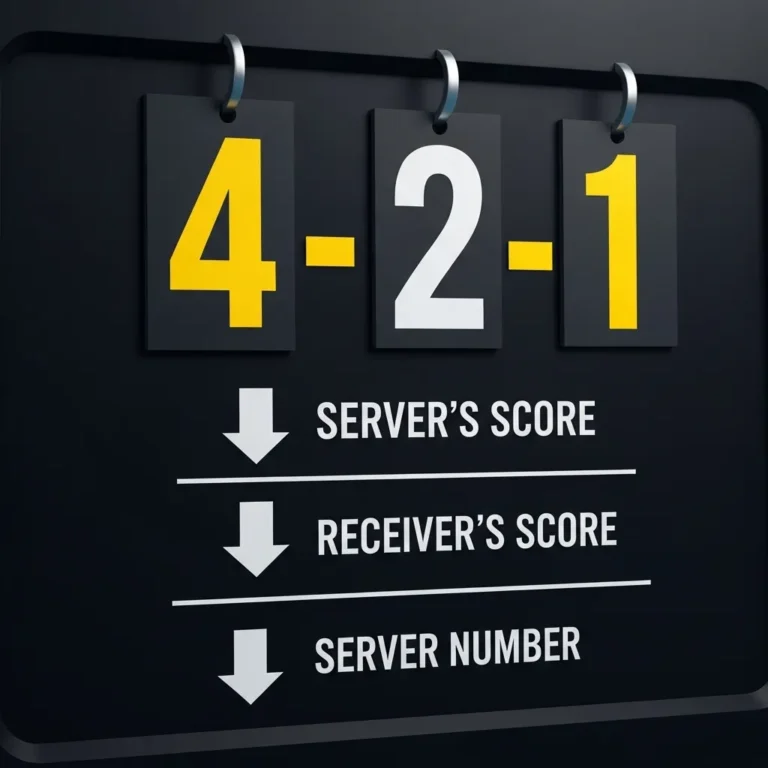
The sequence always follows the same flow: Serving Team’s Score – Receiving Team’s Score – Server Number.
For example, if you hear someone yell “4-2-1,” here is the story that number tells:
- The team currently serving has 4 points.
- The team trying to return the serve has 2 points.
- The “1” means the person serving is the first server for their team during this specific turn.
Think of that third number as a status update on your team’s “at-bat.” If the number is a “1,” your team still has a safety net—if you lose the point, your partner gets to serve. If the number is a “2,” you are on the edge; lose the rally, and the ball goes over to the other team. It adds a layer of drama to every serve.
What does “0-0-2” mean and why do we start with it?
This is the classic “Wait, what?” moment for every beginner. You walk onto the court, the game hasn’t even started, the score is zero to zero, but the server shouts “0-0-2!”
Why “2”? Did we skip a player?
This is actually a clever rule designed to keep the game fair. In pickleball, serving is a massive advantage because only the serving team can score points. If the very first team to serve got two chances (Server 1 and Server 2) right out of the gate, they could potentially rack up a huge lead before the other team ever touched the ball.
To prevent this “first-mover advantage” from getting out of hand, the rules dictate that the very first serving turn of the game is limited to one person.
So, when you start the game, you assume the identity of “Server 2” symbolically. It tells everyone, “Hey, if I lose this rally, my team’s turn is over immediately, and the ball goes to you.” It balances the scales right from the opening serve.
How many points do you play to?
If you are playing a standard recreational game at your local park or gym, the magic number is usually 11.
However, there is a catch that creates some of the most exciting moments in the sport: you must win by 2 points.
This means if the score is tied at 10-10, you can’t win by scoring just one more point to make it 11-10. You have to keep playing until one team is two points clear of the other—like 12-10, or 13-11. I’ve seen games that were supposed to end at 11 go all the way to 17-15 because neither team would give up that two-point gap. It turns the end of the match into a high-stakes tug-of-war.
In tournament settings, you might see games played to 15 or 21, but that “win by 2” rule is the golden standard that almost always applies.
Can the receiving team score points?
This is the rule that separates pickleball from table tennis or the modern “rally scoring” you might see in volleyball.
The short answer is No.
In standard pickleball (often called “side-out” scoring), point scoring is an exclusive privilege of the serving team. If you are receiving the serve and you smash a winner past your opponents, you don’t get a point on the scoreboard. Instead, you win the right to serve. This is called a “side-out.”
Think of it like baseball. You can’t score runs while you are in the field playing defense. You have to get the other team out so you can pick up the bat. In pickleball, the serve is the bat. You have to earn the serve to earn the points.
2. Positioning & Server Rotation
Now that we have the numbers down, let’s talk about the choreography. One of the biggest fears new players have is standing in the wrong spot. The court has a left side and a right side, and knowing where to stand is actually determined by your score. It’s like a built-in GPS.
How do I know which side to serve from?
You don’t need to memorize complex patterns; you just need to look at your team’s score.
- The Right Side (The “Even” Side): Whenever your team’s score is an even number (0, 2, 4, 6, 8…), the first server for that turn starts on the right side of the court.
- The Left Side (The “Odd” Side): Whenever your team’s score is an odd number (1, 3, 5, 7, 9…), the first server starts on the left side.
Here is a helpful way to remember it: The word “Right” has five letters, but think “Right is zero, two, four.” Okay, maybe that’s not catchy. Try this: You start the game at 0-0 on the Right. 0 is even. So, Right = Even.
Important Note: In doubles, this rule dictates where the team’s turn begins. As you score points, you will switch back and forth.
Do we switch sides when we win a point?
This brings us to the famous “pickleball dance.”
The Serving Team: Yes! Every time you score a point, you and your partner high-five (optional, but recommended) and switch box positions. If you just served from the right and won the point, you move to the left for the next serve. This forces you to serve to a different opponent each time.
The Receiving Team: No. This is crucial. If you are receiving, you are like a statue (well, an agile statue). You stay in your respective boxes. You do not switch sides when the serving team scores a point, and you do not switch sides when you win a rally to get the ball back.
This creates a scenario where the server keeps alternating targets. One point they serve to the person on the right, the next point to the person on the left. The receivers just hold their ground until they win the serve back.
What happens when the first server loses a rally?
So, you are “Server 1,” you serve the ball, and sadly, your team loses the rally. What now?
The ball doesn’t go to the opponents yet. In doubles, the serve passes to your partner, who becomes “Server 2.”
Here is the key regarding positioning: No sides are switched on a loss.
Your partner simply serves from whichever side they are currently standing on. If they are standing in the left box because of how the previous points played out, they serve from the left. If they are on the right, they serve from the right. The “Even/Odd” rule for starting positions only matters for the first server of the turn. The second server just picks up the fight from where they are standing.
Who serves first in the second game of a match?
If you are playing a “best of three” match in a tournament, fairness is key.
If Team A served first in Game 1, Team B gets the privilege of serving first in Game 2. It doesn’t matter who won or lost the previous game. It’s strictly an alternating turn to ensure both teams get a fair shake at that “first serve” advantage.
Also, don’t get too comfortable in your sun-glare or wind direction—teams switch ends of the court between games, too!
3. Singles Scoring Differences
Occasionally, you might find yourself on the court one-on-one. Singles pickleball is a cardio beast, and because you don’t have a partner to rely on, the scoring gets streamlined.
How is singles scoring different from doubles?
The biggest relief in singles? You can forget about the third number.
Since there is no “Server 2” to back you up, the score call reverts to two numbers: Server’s Score – Receiver’s Score.
So, a call in singles sounds like “4-2.” Short and sweet.
Where do I serve in singles?
In singles, the “Even/Right, Odd/Left” rule is your bible. It is strictly enforced for every single serve.
- If your score is Even, you must serve from the Right court.
- If your score is Odd, you must serve from the Left court.
This makes it very easy to correct yourself if you get confused. If you shout “5-3” but you are standing on the right side, you know immediately that something is wrong. You either forgot your score, or you are standing in the wrong spot.
If you lose a rally, it is an immediate side-out to your opponent.
In singles, there are no second chances. If you serve and lose the rally, the serve goes instantly to your opponent. You don’t pass it to a teammate; you hand the ball over. This makes momentum swings in singles incredibly fast and volatile.
4. Handling Mistakes & Confusion (FAQ)
Even the pros get confused sometimes. We are all human, and in the heat of a long rally under the hot sun, forgetting the score is practically a rite of passage. Here is how to handle those awkward “oops” moments gracefully.
What happens if the server calls the wrong score?
We have all been there. You are sure the score is 4-3-1, but the server shouts “5-3-1!”
Before the Serve: If the server calls the wrong score, shout “Wait!” or raise your hand/paddle immediately. Any player can stop play before the return of serve is hit to correct the score. The server then simply re-serves with the correct numbers. No harm, no foul.
Mid-Rally: This is tricky. If play has started and you suddenly realize the score was wrong, think twice before stopping. If you stop the rally to correct the score and you were right, the rally is replayed. BUT, if you stop play to argue the score and it turns out the server was actually correct, you have committed a fault and you lose the rally. The lesson? Unless you are 100% sure, play the point out and discuss it afterward.
What if I serve from the wrong side?
This is a “positional fault.”
- Before the point ends: If the referee or a player notices you served from the left when you should have been on the right, and the rally is stopped, it is a fault. You lose the rally.
- After the point ends: This is the “statute of limitations” rule. If you serve from the wrong spot, play the whole point, the rally ends, and the next serve happens before anyone notices… the point stands! The game moves on, and you escape without a penalty.
What if I forget who is Server 1 and Server 2?
It happens. You have been playing for 15 minutes, the ball has gone back and forth, and suddenly everyone is looking at each other asking, “Wait, whose turn is it?”
You can always ask the referee (in tournaments) or your opponents (in rec play). Everyone prefers to get the score right rather than guessing.
A helpful trick: Try to remember who served first for your team in that specific game.
- When that “first server” is on the Right side, your team’s score should be Even.
- When that “first server” is on the Left side, your team’s score should be Odd.
If those things don’t match up, you know you have likely swapped positions somewhere along the way by mistake.
5. Advanced Scoring Concepts
Once you have mastered the basics, you might hear about some other terms floating around the courts.
Does “stacking” change how we keep score?
You might see advanced teams doing something weird: they line up together on one side, or switch spots in a flurry of movement. This is called “stacking.” It’s a strategy used to keep a player with a strong forehand in the middle, or to mask a weakness.
The important thing to know is: No, stacking does not change the score rules.
Even if you are stacking, you must technically initiate the serve from the correct Even/Odd side based on your score. The server stands in the correct legal spot, hits the ball, and then slides over to their preferred spot. The scorekeeping remains exactly the same; the players just move around more after the ball is in play.
What is “Rally Scoring” vs. “Side-Out Scoring”?
Everything we have discussed so far is Side-Out Scoring (only the serving team scores). This is the heartbeat of recreational pickleball.
However, you might hear about pickleball rally scoring. In this format, a point is awarded to the winner of the rally regardless of who served. Every mistake results in a point for someone.
Rally scoring is much faster. It is used in specific leagues, like Major League Pickleball (MLP), to keep match times predictable for TV broadcasts. However, for 99% of the games you will play at the park or the Y, stick to Side-Out scoring. It allows for those epic comebacks where a team can get stuck on a score for ten minutes while they fight for a serve.
When do we switch ends in the third game?
If you are in a competitive match that goes to a tie-breaker third game, there is one final rule to remember. To ensure wind or sun glare doesn’t favor one team for the whole deciding game, you switch ends halfway through.
In a standard game to 11, teams switch ends of the court when the first team reaches 6 points. It’s like halftime. You tap paddles, switch sides, breathe for a second, and finish the match.
Conclusion
At the end of the day, scoring in pickleball is a lot like driving a manual transmission car. It feels clunky and overwhelming for the first few hours. You might grind the gears a few times, call a “4” when you meant “3,” or stand in the left court when you should be on the right.
That is completely okay.
The pickleball community is famous for its patience. If you get confused, just smile and ask, “What’s the score?” Your opponents will likely tell you, and you’ll be back to dinking and smashing in no time.
The most important number in pickleball isn’t the score—it’s the number of high-fives you give your partner. So get out there, embrace the “0-0-2,” and enjoy the game.
you may like it