who invented pickleball
If you’ve walked past a public park recently, you’ve probably heard it. That distinct pop-pop-pop sound echoing off the pavement. It’s the sound of the fastest-growing sport in America. But long before pickleball became a viral sensation attracting millions of players, it was just a quirky idea born out of necessity on a lazy summer afternoon.
It’s easy to look at the professional leagues and shiny gear we have today and forget that this whole thing started with a few dads trying to solve a very relatable problem: bored kids.
Let’s take a trip back to the mid-60s to unravel the fascinating, and slightly debated, history of who invented pickleball.
The Origins (Who, When, & Where)
To understand the soul of this game, we have to look at the trio of friends who threw the rulebook out the window to create something entirely new.
Who are the credited inventors of pickleball?
History is often shaped by groups of friends, and pickleball is no exception. The game wasn’t the brainchild of a massive sporting goods corporation or a professional athlete. It was the invention of three neighbors who were just looking for a way to pass the time.
The three men credited with this invention are Joel Pritchard, Bill Bell, and Barney McCallum.
Joel Pritchard was a Congressman from Washington State, a man known for his civic engagement and quick wit. But on the weekends, he was just a dad trying to relax. His friend, Bill Bell, was a successful businessman with a knack for improvisation. Later, they brought in Barney McCallum, a neighbor who proved to be the practical engine behind the game’s early development.
It’s the dynamic between these three that makes the story so charming. They weren’t trying to create a legacy; they were just trying to salvage a weekend. Pritchard provided the venue, Bell helped spark the initial idea, and McCallum helped refine the mechanics to make the game playable for adults, not just children.
When was pickleball officially invented?
If you want to mark your calendar for the sport’s birthday, circle the summer of 1965.
The world was changing rapidly in the mid-60s. The Beatles were dominating the charts, and the space race was in full swing. But on a quiet island in the Pacific Northwest, the only race happening was to find something to do.
It happened on a specific Saturday afternoon. The families had finished a game of golf and returned home, expecting to relax. Instead, they were greeted by a group of restless children complaining that there was “nothing to do.” That specific moment of parental desperation in the summer of ’65 is the spark that eventually lit the fire of a global phenomenon.
Where did the invention of pickleball take place?
The setting for this story is as picturesque as it gets. The invention took place on Bainbridge Island, Washington, specifically at the summer home of Joel Pritchard.
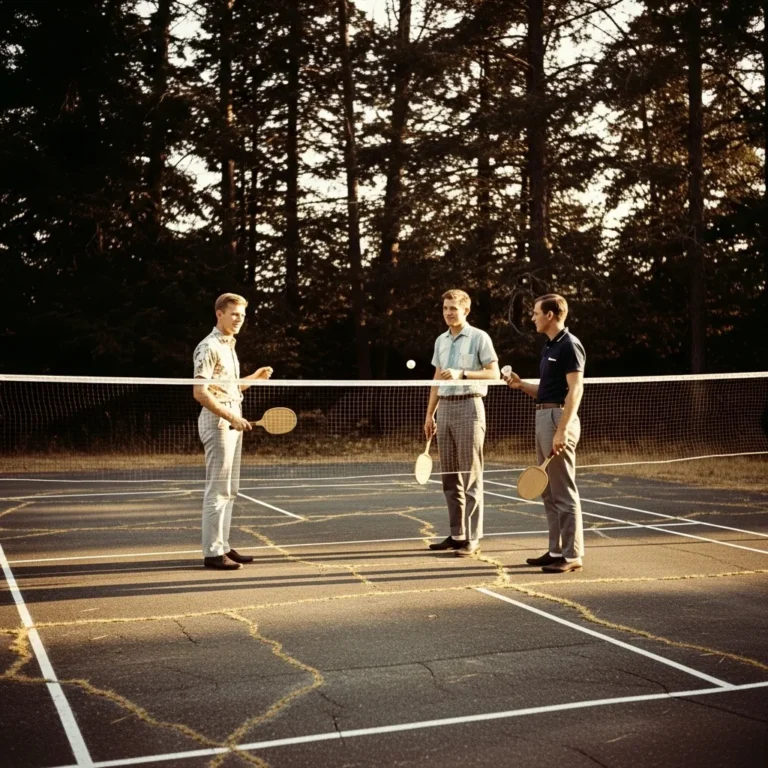
Bainbridge Island sits a short ferry ride away from Seattle, a lush, green escape known for its towering evergreens and rain-swept coastlines. The Pritchard property had an old badminton court that had seen better days. It was an asphalt patch that was overgrown and neglected, but it was the perfect laboratory for invention.
There’s something poetic about the fact that a sport now played in massive arenas started in a humble, mossy backyard in the Pacific Northwest. It wasn’t a pristine gym; it was a rough patch of asphalt surrounded by rhododendrons and fir trees.
Why was pickleball created in the first place?
As mentioned earlier, necessity is the mother of invention. The “why” is simple: To entertain their bored children who couldn’t find the shuttlecock for badminton.
The plan was originally to play badminton. It was a classic backyard staple. Pritchard and Bell went to the storage shed to grab the gear, but they hit a snag—they could find the badminton rackets, but the shuttlecock (the “birdie”) was missing.
Most people would have just given up and gone inside to watch TV. But Pritchard and Bell improvised. They grabbed a perforated plastic ball (a Wiffle ball) that was lying around. Then, realizing the badminton rackets were too delicate and small for the heavier plastic ball, they looked for alternatives. They found some plywood paddles used for table tennis.
They lowered the net, handed the equipment to the kids, and hoped it would keep them occupied for an hour. Little did they know, the adults would end up playing more than the children.
The Name Controversy
If you ask a casual observer about the sport, the first thing they usually ask is, “What’s up with the name?” It’s a valid question. The name “pickleball” sounds silly, and for decades, there have been two competing stories about where it came from.
How did pickleball actually get its name?
The most historically supported theory comes from Joel Pritchard’s wife, Joan Pritchard. She was a competitive rower and a fan of crew racing.
According to Joan, the name was a reference to the “pickle boat” in rowing. In crew races, the “pickle boat” is the final boat to race, and it is usually manned by a crew thrown together from the leftover oarsmen who didn’t make the main boats.
Joan felt the name fit perfectly because the game itself was a hodgepodge of other sports—a “throw-together” of tennis, badminton, and ping-pong. It was a mix of leftovers, just like the crew of a pickle boat. This explanation has been backed up by the Pritchard family for years and is generally accepted as the true origin.
Was pickleball really named after a dog named Pickles?
This is the story everyone wants to believe because it’s adorable. The legend goes that the Pritchards had a family dog—a Cockapoo named Pickles—who would chase the ball and run off with it. Hence, “Pickles’ ball.”
However, we have to be the bearer of bad news: this is a myth.
While the family did have a dog named Pickles, factual timelines debunk this story. The game was invented and named in the summer of 1965. The dog, Pickles, wasn’t born until 1968—three years later.
It seems the dog was named after the game, not the other way around. Over time, the story of the dog was likely circulated because it was a funnier, more media-friendly soundbite than the rowing terminology. Even the inventors occasionally played along with the dog story because it made people smile, but the “pickle boat” theory is the one rooted in fact.
Early Equipment & Development
The game didn’t start with the graphite, carbon-fiber, noise-dampening paddles we see today. The early days were a masterclass in DIY engineering.
What equipment was used in the very first game of pickleball?
That first Saturday afternoon was a scramble. The equipment consisted of ping-pong paddles, a perforated plastic ball (a Wiffle ball), and a badminton net.
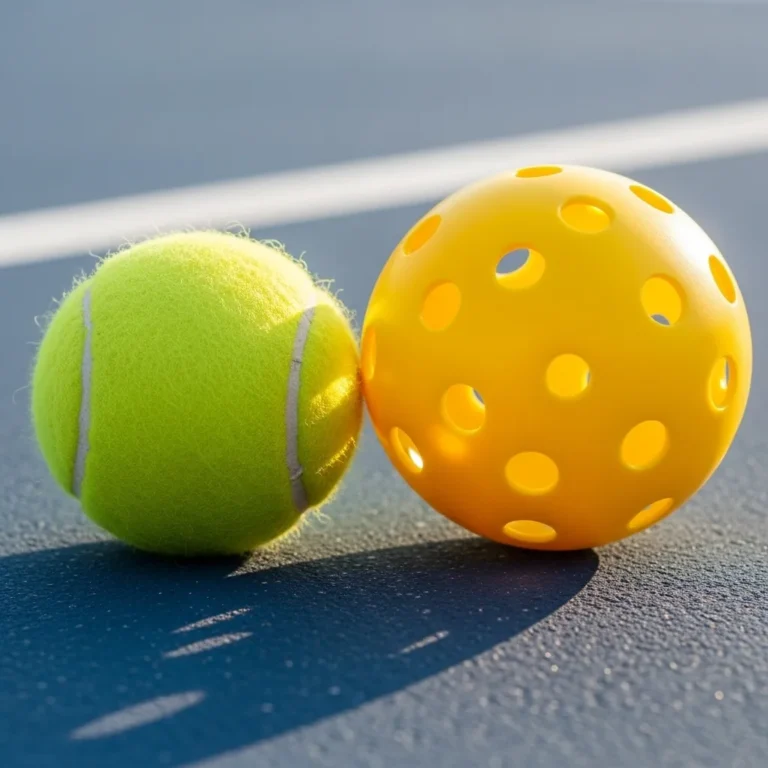
The Wiffle ball was key. A tennis ball would have bounced too high and fast on the asphalt; a badminton birdie was missing. The plastic ball moved slower, allowing for longer rallies and making the game accessible to all ages. The ping-pong paddles were serviceable, but they were heavy and small, which eventually led to sore wrists and a desire for something better.
How did the original pickleball court dimensions compare to badminton?
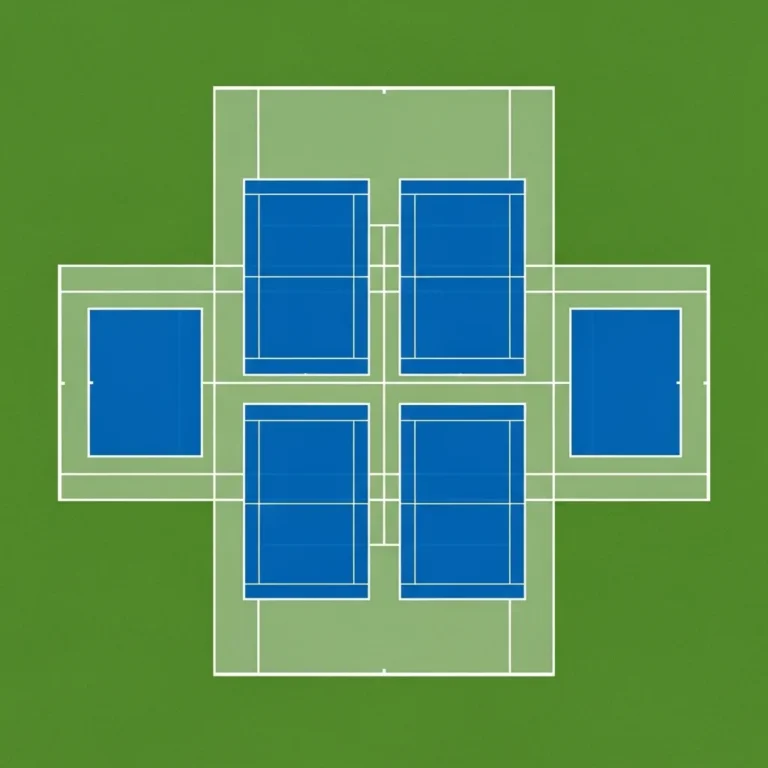
Because they were using an existing court, they stuck with what they had. They used the existing asphalt badminton court dimensions (20 x 44 feet).
However, there was one major change regarding the net. In badminton, the net is high—over five feet. Initially, they played with the net at that height. But as the game progressed over the weekend, the dads realized the heavy plastic ball didn’t bounce well off the racket like a shuttlecock. It worked better if they let it bounce on the ground like tennis.
So, they lowered the net. At first, they dropped it all the way to the ground, but eventually, they raised it to about 36 inches—roughly the height of a tennis net hip-high. This hybrid dimension (badminton court size, tennis net height) is exactly what gives pickleball its unique strategic flavor today.
Who manufactured the first pickleball paddles?
This is where Barney McCallum truly shines. After a few weekends of playing with fragile ping-pong paddles that kept breaking, McCallum went into his basement on Bainbridge Island.
He was a bit of a craftsman. He traced the shape of the ping-pong paddle onto plywood but enlarged it to give them more surface area and reach. Using his basement band saw, he cut out the first custom pickleball paddles.
These weren’t fancy. They were solid wood, heavy, and loud. But they were durable. McCallum continued to tweak the design, experimenting with different woods and handle shapes. Those basement-made paddles were the prototypes for an industry that is now worth millions of dollars.
Milestones & Expansion
How did a backyard game for bored kids become a national obsession? It didn’t happen overnight. It was a slow burn that started in the Pacific Northwest and spread through word of mouth.
When was the first permanent pickleball court constructed?
For the first two years, the game was played on the Pritchard’s driveway or temporary setups. But by 1967, the game had hooked enough neighbors that it needed a dedicated space.
The first permanent pickleball court was constructed in the backyard of a neighbor and friend, Bob O’Brian. This was a significant moment because it signaled that the game wasn’t just a passing fad for the Pritchard family; it was something the community was investing in. They poured concrete specifically for pickleball—a commitment to the future of the sport.
When was the first official pickleball corporation formed?
By the early 70s, the founders realized they had to protect their invention and help it grow properly. They couldn’t keep making paddles in a basement forever.
In 1972, Pickle-Ball, Inc. was officially incorporated. This was the business entity formed to sell paddles, balls, and rulebooks. This step was crucial because it standardized the equipment. Before this, people were playing with whatever they could make. The corporation helped unify the sport, ensuring that a game played in Washington looked the same as a game played in Florida.
When and where was the first known pickleball tournament held?
Competition is human nature. It took about a decade for the sport to move from “friendly backyard activity” to “organized competitive sport.”
The first known pickleball tournament was held in 1976 at the South Center Athletic Club in Tukwila, Washington.
This tournament was a wild affair. Because the sport was so new, there were no ranked players. The participants were a mix of college tennis players who had heard about the game and total novices. They played with solid wood paddles and whacked the large plastic balls around with surprising ferocity.
An interesting footnote about this tournament is that the participants didn’t just play with “pickleballs.” They experimented with softball-sized wiffle balls and different paddle materials. It was the “Wild West” era of the sport, where the rules were solidifying, and the competitive spirit was born.
The Legacy of a Summer Afternoon
Looking back at the history of pickleball, it’s refreshing to see how organic it was. There were no focus groups, no marketing strategies, and no venture capital funding. It was just Joel, Bill, and Barney, standing on a wet patch of asphalt, trying to get their kids to stop complaining.
They succeeded in entertaining the kids, but they accidentally created a sport that bridges generations. Today, when you pick up a paddle, you are holding a piece of history that traces directly back to Barney McCallum’s band saw and Joan Pritchard’s rowing stories.
So, the next time someone asks you who invented pickleball, you can tell them the truth: It wasn’t a lab experiment. It was three dads, a missing shuttlecock, and a dog that (contrary to popular belief) showed up three years late to the party.
Finally, I hope I have succeeded in answering the question:
who invented pickleball and why?
you may like it