The unmistakable thwack of the wiffle ball echoing across the court is the heartbeat of every great match. Players are locked in a relentless dink battle at the kitchen line, reflexes firing on all cylinders, until suddenly—the action halts. A hand goes up, a frustrated sigh breaks the tension, and the point shifts. The game pauses, but for many players caught in the heat of the moment, the exact cause isn’t always crystal clear.
Knowing exactly when does a rally end in pickleball is the definitive line between giving away cheap points and dominating the court. Whether it’s a subtle foot fault, an out-of-bounds call by a fraction of an inch, or a violation of the two-bounce rule, mastering these critical stopping points will instantly sharpen your competitive edge and keep you on the winning side of the scoreboard.
The Short Answer
In pickleball, a rally concludes the moment the ball becomes “dead.” This occurs when a player commits a fault, such as hitting the net or a kitchen violation, or when the ball lands out of bounds. Additionally, a rally ends if the ball bounces twice on one side before being returned.
When Does a Rally End in Pickleball?
Technically, a rally is the continuous play that occurs after the serve and before a fault. The rally ends the instant a “dead ball” is created. In the fast-paced environment of a typical U.S. court, determining the exact millisecond of a dead ball is vital because of “First-Fault Precedence.” If the ball hits the net and your opponent simultaneously touches the net, the rally ended the moment the ball hit the net, making your opponent’s action irrelevant.
To master the game, you must understand the distinction between a physical end (the ball stopping) and a technical end (a rule violation). For instance, a rally can end even while the ball is still in the air if a player shouts an out call prematurely or if a stray ball from another court enters the playing area, creating a “hinder.” Understanding the Pickleball rules regarding these stops is the first step toward becoming a high-level player.
What Counts as a Fault in Pickleball
A fault is any action that stops play because of a rule violation. Understanding what counts as a fault in pickleball is essential because it determines who wins the point or who gains the serve. Common faults include:
- Net Violations: Hitting the ball into the net on a serve or return. The rally ends when the ball touches the ground or the net system.
- Service Errors: Failing to land the serve in the diagonal service box or committing a foot fault during the serve.
- Double Hits: While an unintentional double hit during a single continuous stroke is legal, an intentional double hit or a “carry” results in an immediate fault.
- Body Contact: The ball touching any part of the player’s body or clothing (except the paddle hand below the wrist) is a fault.
- Touching the Net: A player, their clothing, or their paddle touching the net or net posts while the ball is in play ends the rally.
One angle often missed by beginners is the “Permanent Object” rule. If your shot hits a ceiling, a light fixture, or a referee before bouncing on the opponent’s court, you lose the rally. However, if it hits a permanent object after bouncing in the correct court, you win the point, and the ball is dead.
Double Bounce Rule Explained
There is often confusion between the “Two-Bounce Rule” and a “Double Bounce” fault. Let’s clarify the double bounce rule explained for those looking to avoid unforced errors. A “Double Bounce” fault occurs at any time during a rally if the ball bounces twice on your side of the court before you strike it. This immediately ends the play.
The Two-Bounce Rule vs. Double Bounce
The “Two-Bounce Rule” (often mislabeled as the double-bounce rule by beginners) is a specific regulation for the start of the game. It requires the ball to bounce once on the receiver’s side and once on the server’s side before anyone can volley. If you hit a pickleball dink out of the air before these two mandatory bounces occur, the rally ends in a fault.
- Shot 1: The serve must bounce.
- Shot 2: The return of serve must bounce.
- Shot 3: The ball can now be volleyed or played off the bounce.
Non-Volley Zone (Kitchen) Faults: The Momentum Trap
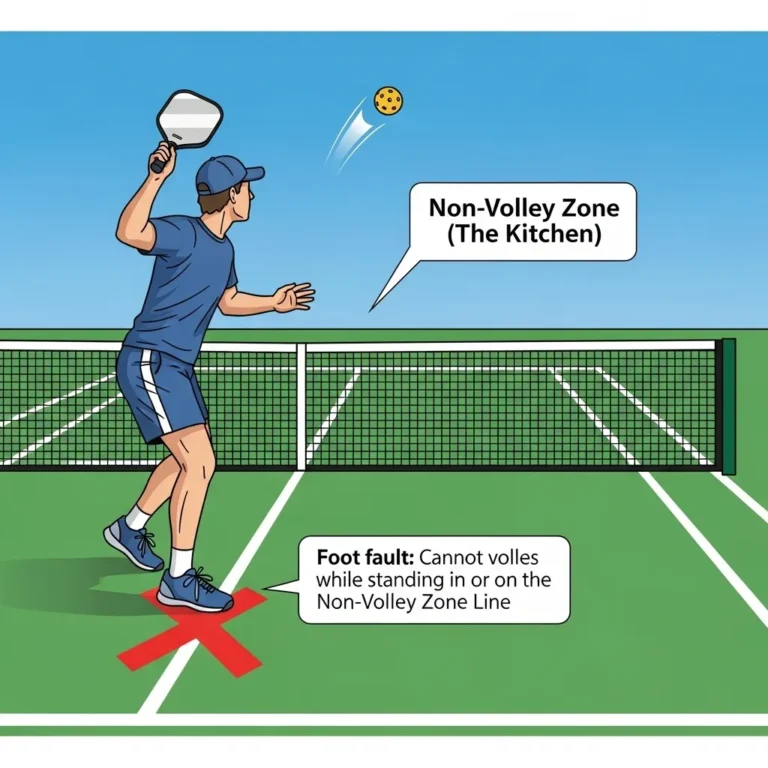
The Kitchen is the most litigated area on the court. Most non-volley zone (kitchen) faults happen not because of where a player stands, but because of their momentum. You can stand in the kitchen as long as you want, provided you aren’t hitting a volley. The rally ends the moment you volley the ball while touching the kitchen line or if your momentum carries you into the zone after the hit.
The “Eternity” Momentum Rule
A “missing angle” often overlooked is that momentum has no time limit. If you hit a winning overhead smash and the ball is long dead, but you then stumble into the kitchen because of the power of that shot, you lose the rally. This is known among pros as the “Time Traveler” fault. You must regain full balance and control outside the zone before your next action to avoid ending the rally in a loss. This is why mastering pickleball kitchen rules is a top priority for competitive players.
Pickleball Out of Bounds Rules
In the United States, the “Daylight” rule is the gold standard for pickleball out of bounds rules. A ball is considered “in” if it touches any part of the line. The rally only ends when a ball lands completely outside the court boundaries. If there is no “daylight” (visible court space) between the ball and the line, the ball must be played as in.
- Line Calls: In recreational play, the team receiving the ball makes the call. If partners disagree (one says in, one says out), the ball is IN.
- The Kitchen Line Exception: On a serve, the kitchen line is considered “out.” If the serve clips the kitchen line, the rally ends immediately as a service fault.
- Promptness: All out calls must be made promptly. If you continue playing the ball and then call it out, the rally continues as if the ball was in.
Pickleball Scoring Rules for Beginners
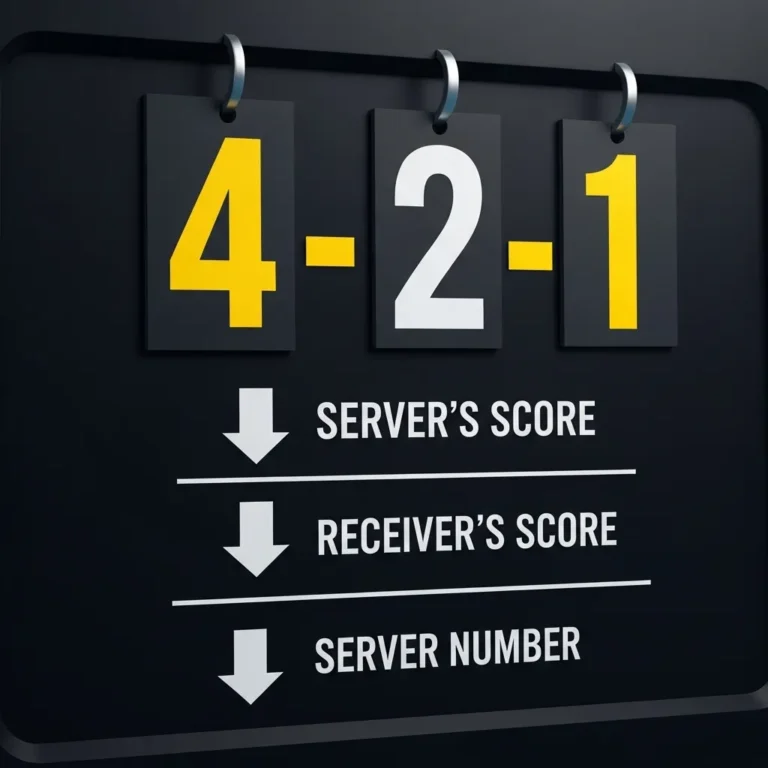
How a rally ends also depends on the scoring format being used. For those learning pickleball scoring rules for beginners, the traditional “Side-Out” system is the most common. In this format, only the serving team can score a point. If the serving team loses a rally, they commit a fault, and the serve either moves to the second server or results in a “side-out.”
Side-Out vs. Rally Scoring
While traditional scoring is standard, “Rally Scoring” is becoming popular in the U.S. (especially in Major League Pickleball). In rally scoring, a point is awarded to the winner of every rally, regardless of who served. Understanding pickleball scoring nuances like the “Freeze” rule—where teams must win on their serve once they reach game point—is vital for tournament play. Whether you are aiming for a winning by 2 points scenario or just playing for fun, the scoring system dictates the pressure of the rally’s end.
Nuanced Disputes: What the Pros Won’t Tell You
Beyond the basics, several technicalities often lead to heated debates on Reddit and Quora. For instance, did you know that if your paddle flies out of your hand and lands in the kitchen during a volley, it’s a fault even if your body stays out? Or that if a ball hits a “Nasty Nelson” (the server hitting the opponent standing at the net), the receiving team loses the rally immediately?
For official clarifications on these bizarre scenarios, always consult the USA Pickleball Official Rulebook. Knowing these edge cases prevents you from being “cheated” out of points during high-stakes matches.
Frequently Asked Questions
Can I stand in the kitchen before the ball bounces?
Yes. You can stand in the kitchen at any time. The only restriction is that you cannot volley (hit the ball in the air) while standing there. If you hit the ball after it bounces, being in the kitchen is perfectly legal.
Does a ball hitting the net post end the rally?
Yes. The net posts are considered out of bounds. If the ball strikes the post directly, the hitter commits a fault and loses the rally. However, if the ball hits the net cord/tape and lands in the court, play continues.
What happens if the ball hits me while I’m standing out of bounds?
If the ball hits you before it bounces, it is a fault on you—even if you are standing 10 feet out of bounds. Never catch or touch a ball that is clearly going out; let it bounce first to ensure the rally ends in your favor.
Can the rally end if my partner calls the ball “out” while I’m hitting it?
In pickleball, saying “out” before the ball bounces is considered “partner communication.” It does not end the rally. Only an “out” call made after the ball bounces officially stops the play.
What is an unintentional double hit?
If the ball hits your paddle twice in one continuous forward motion, it is legal and the rally continues. If you deliberately “carry” the ball or hit it with two distinct motions, it is a fault.
Mastering the end of a rally is just as important as the serve itself. By identifying illegal pickleball serves and staying mindful of your momentum near the kitchen, you reduce unforced errors and force your opponents to win points the hard way. Stay balanced, watch the lines, and always give your opponent the benefit of the doubt on close calls to keep the spirit of the game alive.